World’s water footprint linked to free trade

Posted on behalf of Katherine Rowland.

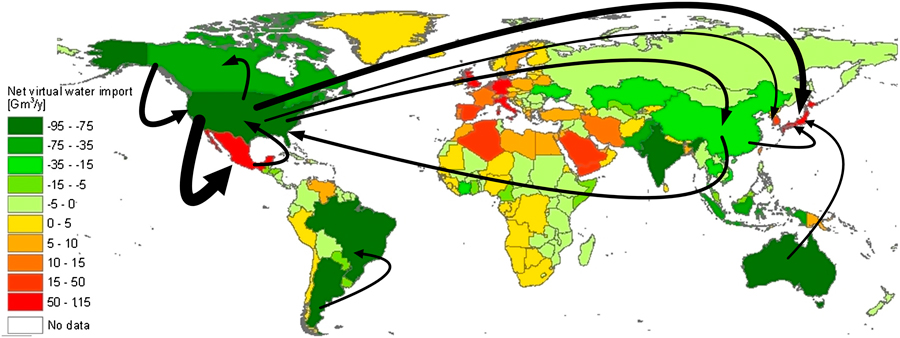
More than one-fifth of the world’s water supplies go towards crops and commodities produced for export, a new study reports. As developed nations import water-intensive goods from overseas, they place pressure on finite resources in areas where water governance and conservation policies are often lacking.

Researchers from the Netherlands have quantified and mapped the global water footprint, highlighting how patterns in international commerce create disparities in water use. The new study, published today in the Proceedings of the National Academy of Sciences, presents a spatial analysis of water consumption and pollution based on worldwide trade indicators, demographic data and water-usage statistics.

Arjen Hoekstra, a water management analyst at the University of Twente in Enschede, Netherlands, and lead author of the study, says that water supplies follow the flow of goods around the world. Water consumption and pollution, he says, “are directly tied to the global economy”. Continue reading

Complete Denisovan genome offers glimpse of ancient variation

Posted on behalf of Katherine Rowland.

From the fragment of a finger bone found in a Siberian cave, researchers have created the most accurate genetic map yet of an extinct human relative that, before 2010, was not known to exist.

Thanks to innovations in gene-sequencing technology, molecular geneticist Svante Pääbo and his colleagues at the Max Planck Institute of Evolutionary Anthropology in Leipzig, Germany, and his colleagues have improved their genetic picture of the Denisovans, mapping every position of the genome 30 times over, with an unprecedented level of resolution. “Now we can look at variation,” says Pääbo. “We have a complete catalogue of what makes a fully modern human.”

Yesterday, the researchers released the complete DNA sequence online, with the hopes that the scientific community will start to answer some of the many questions raised by the discovery of this mysterious hominid.

Named after the cave in which the fragment was found (pictured), the Denisovans — pronounced dun-EE-suh-vinz — inhabited Asia at least 30,000 years ago, leaving behind no more than a tiny piece of finger and a wisdom tooth.

But from those scant remains, researchers have been able to map the entire genome. In 2010, the Leipzig team presented their first-draft genome, suggesting that the Denisovans are distinct from the Neanderthals and early modern humans in Eurasia (see ‘Fossil genome reveals ancestral link‘).

But where the preliminary sequence raised a host of questions, the newly released data may begin to provide some answers about who the Denisovans were. The improved resolution allows researchers to spot the differences between gene copies inherited from the mother and from the father.

Richard Edward Green, a biomolecular engineer at the University of California, Santa Cruz, who led the original gene sequencing, says that the new information provides a window into the population genetics of this species. “It’s pretty powerful,” he says of the technologies that transform a fingertip into an evolutionary record. “Every spot on the genome has a unique evolutionary history, and we can now draw comparisons and identify where there were common ancestors.”

Image © MPI for Evolutionary Anthropology

The sweet song of a Jurassic cricket

Posted on behalf of Dan Jones.

The fossilized remains of long-extinct animals provide clear evidence of their size, stature and gait, but can we ever know what they sounded like? A reconstruction of the song sung by a fossilized katydid that lived 165 million years ago shows how it can be done. The results are published in the Proceedings of the National Academy of Sciences (PNAS).

Like other crickets, male katydids (also known as bush crickets) sing to females through a technique called stridulation, in which noise is generated by rubbing a thick, ridged vein (called a file) on one wing against a ‘scraper’ on another. The length of the file, and the speed with which it is dragged over the scraper, determines the frequency of the noise it generates. The fossil katydid in the new study, dubbed Archaboilus musicus and described in the PNAS paper for first time, is exceptionally well preserved for such an old specimen, allowing for detailed measurements of the sound-making file.

The shape and structure of the file determines whether a katydid creates a pure (musical) tone of a single frequency, or ‘elaborate noise’ that ranges over a broad bandwidth of frequencies. The A. musicus fossil suggests it produced a pure, musical tone.

To predict the frequency of the tone A. musicus emitted, the team first plotted the lengths of files from nearly 60 living species of katydid against the frequency of sound they produce, showing that shorter files tend to create a lower-frequency sound. Next, this model was validated by showing that it could accurately predict the songs known to be sung by two living katydid species most closely related to A. musicus. Then it was simply a matter of seeing where A. musicus fell on this graph, and estimating the frequency of its song.

This analysis suggests that A. musicus produced a relatively low and pure tone of around 6.4 kHz (you can hear a reconstruction of the song in the video above). The team says this low tone would have been well-suited to communicating over long distances and close to the ground in the sparse vegetation of Jurassic forests. In particular, females could have picked out this pure tone above the rabble created by other creatures in the area, says Fernando Montealegre Zapata of Bristol University, UK, who is a co-author on the paper. The next challenge, he says, is to work out why the low, pure tones of early katydids evolved into the variety of higher-frequency songs and non-pure tones that are heard among katydid species living today.

A year in jail without trial for Iranian student accused of spying

Posted on behalf of Michele Catanzaro.

Omid Kokabee, a physics student accused of spying by Iran, has spent one year in Evin jail in Tehran without being judged. In a hearing on 31 January the trial was postponed for at least another four months, according to sources in Tehran. The trial has already been postponed twice before, in July and October.

Kokabee complains in an open letter published by the opposition magazine Khaleme that authorities are trying to obtain his “collaboration” through threats to him and his family. According to this document, Iranian authorities are seeking scientific cooperation: “My only mistake has been to study and seek expertise in a field that has turned out to be needed,” the document states.

Kokabee, a 29-year-old Iranian graduate student in laser physics at the University of Texas, Austin, was arrested by Iranian intelligence at Tehran’s airport in February 2011, and accused of “collaboration with a hostile government” and “illegal earnings”. In an earlier open letter, published by Kaleme in July, he proclaimed his innocence, and the American Physical Society, along with four international optics organizations, asked for a fair trial for him.

The Committee of Concerned Scientists, which started a petition demanding a fair trial, will discuss Kokabee’s case at its Annual Board Meeting on 19 February “with two distinguished guests from Iran”, says Eugene Chudnovsky, the organization’s co-chairman. “At that time decisions will be made on how to address Omid’s case in the most effective way.”

Canada lags on protecting marine biodiversity

Posted on behalf of Hannah Hoag.

Canada’s marine biodiversity is under threat and there’s no strategy for fixing it, states a report released today by the Royal Society of Canada. According to the independent panel behind the assessment, the heart of the problem lies in the conflicting responsibilities of Fisheries and Oceans Canada (DFO), a federal department with the joint role of promoting industrial and economic activity and conserving marine life and ocean health.

The international ten-person panel found that climate change, aquaculture and over-fishing were having negative effects on Canada’s marine ecosystems and species. The oceans are becoming warmer and less salty, food webs are being disrupted and disease is being transferred from farmed to wild species. The panel also gauged whether Canada was fulfilling its obligations to sustain marine biodiversity. The answer: no.

“We’ve made many commitments, but we have not met those commitments and we don’t have a plan,” says Jeff Hutchings, an expert on marine biodiversity and conservation at Dalhousie University in Halifax and the panel’s chairman.

Several national and international agreements, such as the UN Fish Stocks Agreement, commit Canada to protecting its marine biodiversity. Even so, “Canada has fallen well short of the progress made by most developed nations,” the authors write. Canada should have set targets for exploited fish stocks, including target population size and limits that aren’t to be exceeded.

“The United States, Australia, New Zealand, and increasingly parts of Europe have these plans, but we don’t have them for Canadian Atlantic cod, or for most of marine species,” says Hutchings.

Canada is also committed to establishing a national system of marine protected areas, and during a 2010 Conference of the Parties of the UN Convention on Biological Diversity, it agreed to set aside 10% of coastal and marine areas by 2020. To date, only 0.8% is protected.

The panel made seven recommendations to establish Canada as a leader in ocean stewardship and marine conservation. Among them, it urged the federal government to resolve the conflicts of interest surrounding DFO and to limit the discretionary power of the Minister of Fisheries and Oceans.

Other countries have managed to overcome such conflicts. In the United States, the Magnuson-Stevens Act requires recovery plans for over-fished stocks and provides impact assessments for fisheries. It also mandates the following of scientific advice, says Dave VanderZwaag, the Canada Research Chair in Ocean Law & Governance at Dalhousie University, and one of the panel members.

Hutchings is among those who would like to see the DFO’s fishing industry activities transferred to Industry Canada.

“If they were separated, and they probably should be, the outcome would depend on the weight the political leaders give to science and conservation. At present, the government gives little emphasis to science and even less to conservation,” says Daniel Pauly, a marine biologist at the University of British Columbia in Vancouver, who was not part of the panel.

A spokesperson for DFO would not comment on the report until it has been reviewed by the department.

Japan’s second asteroid probe gets the green light

Posted on behalf of Ichiko Fuyuno.

Nearly six years after it was proposed, Japan’s Space Activities Commission has finally approved the development of Hayabusa 2, successor to the Hayabusa asteroid probe, which returned samples to Earth in 2010 (see ‘Asteroid visit finds familiar dust’).

Hayabusa 2 will aim for 1999JU3, a small asteroid about 900 metres in diameter. The asteroid is slightly bigger than the first mission’s destination, Itokawa, but it is supposedly more primitive and contains more organic or hydrated materials, which may provide clues about the origins of the Solar System. The Japan Aerospace Exploration Agency (JAXA) plans to launch Hayabusa 2 in 2014 or 2015, land on the asteroid in 2018 and return to the Earth in 2020.

Hayabusa 2 will be closely based on its predecessor, but will incorporate many “lessons learned” from the problems encountered by the first mission. In the original Hayabusa, the ion-thrust engines died before the end of the mission, so the team will work to extend their operating life. The probe crashed down on the surface when it attempted its first landing, because of a malfunction of an obstacle-detection sensor. The sensor will be scrapped and navigation systems improved to enable a smooth touch-down.

Moreover, the original Hayabusa had expected to fire two bullets on the Itokawa surface to blast up debris that could be sampled, but it didn’t happen because of problems with the autonomous navigation systems. Instead of using bullets, the new team will develop an impactor to drop on the asteroid surface.

But aside from the technical challenges, funding could be a problem. For 2012, Hayabusa 2 has been allotted 3 billion yen (US$39 million), less than half the amount requested by JAXA and only a slice of the expected total cost of 26 billion yen ($342 million).

Image from JAXA.

Wiretap revelation could aid Italian seismologists’ defence

Posted on behalf of Nicola Nosengo.

A wiretap has brought a new twist to the trial in L’Aquila, Italy, of six Italian scientists and one government official accused of manslaughter for having reassured the population before the deadly earthquake of 6 April, 2009 (see ‘Scientists face trial over earthquake deaths’ and ‘Scientists on trial: At fault?’).

All those indicted took part in a meeting held in L’Aquila on 30 March, 2009, during which they were asked to assess the risk of a major earthquake in view of many shocks that had hit the city in the previous months. Most of the trial revolves around a statement made to the press by the deputy head of the Italian Civil Protection Bernardo De Bernardinis, who is among the indicted: “The scientific community tells me there is no danger because there is an ongoing discharge of energy.”

According to the Public Prosecutor of L’Aquila, that statement made some citizens who were about to flee their homes decide to stay instead, and thus indirectly caused their death. But those words have been judged scientifically incorrect by most seismology experts, including some of the accused scientists, who deny having said anything like that at the meeting. So a key question in the investigation was where those words came from.

On 20 January the Italian newspaper La Repubblica revealed a taped telephone conversation between Guido Bertolaso, then head of the Civil Protection, and Daniela Stati, an officer of the L’Aquila Provincial Administration, recorded the day before the meeting. Bertolaso can be heard saying, of the seismologists now on trial: “I will send them there mostly as a media move. They are the best experts in Italy, and they will say that it is better to have a hundred shocks at 4 Richter than silence, because a hundred shocks release energy, so that there will never be the big one.”

Continue reading

Expanding the Panama Canal may shrink shipping industry emissions

Posted on behalf of Virginia Gewin.

The Panama Canal is growing. By 2014 — 100 years after the canal was first completed — ships with a beam of up to 49 metres will be able to travel through the 82-kilometre channel (pictured), up from the current 32.2-metre limit.

Upping the beam constraint, known among seafarers as ‘Panamax’, will have ripple effects throughout the shipping industry. Larger ships will enable the transport of more goods in fewer trips, and larger beams will facilitate the design of more efficient hulls, according to a study in the International Journal of Maritime Engineering.

Overall, the potential savings — in both fuel and reduced emissions — may be as great as 16% per tonne-mile. The potential for such reduced environmental impact stemming from the canal expansion is, largely, an unexpected windfall for the shipping industry as a whole, says study author Paul Stott, a marine engineering lecturer at Newcastle University, UK.

A 16% improvement in efficiency is significant given that the International Maritime Organisation estimates that, without major steps to reduce emissions, shipping will be responsible for 12–18% of global emissions of carbon dioxide by 2050.

Continue reading

Darwin’s long-forgetten fossils unearthed

Posted on behalf of Katherine Rowland.

A chance discovery has yielded a “treasure trove” of fossils, including specimens collected by Charles Darwin. The collection, marked “unregistered fossil plants”, has been gathering dust in a gloomy corner of the British Geological Survey for more than 150 years.

When Howard Falcon-Lang of Royal Holloway University of London happened upon the collection by accident last April, he experienced a moment of disbelief when he examined the specimens. “Almost the first one I pulled out was inscribed with a diamond cut signature of C. Darwin, Esq,” he says.

Of the 314 re-discovered specimens, 17 have been verified as Darwin’s, samples collected during his voyages on the HMS Beagle from 1831 to 1836.

Two of the slide specimens bearing Darwin’s name were gathered on the island of Chiloe in the Chilean archipelago. In his account of his travels, Darwin described the island as a “miserable hole.” However, he found fossils of 40-million-year-old trees, which he shipped back to the British Museum where they were cut and segmented using newly developed techniques.

Continue reading

Fracking’s future in the US comes down to upcoming New York State decisions

Cross posted from Scientific American’s Observations blog on behalf of Mark Fischetti.

New York State is the key battleground that will determine the future of fracking in the U.S., and January 11, 2012, was a turning point. The date ended the public comment period on proposed state regulations that will govern the process: drilling into deep Marcellus shales, fracturing the rock with water and chemicals to release natural gas, and disposing of the resulting wastewater that flows back up the well with the gas. When the comment period opened back in September, few industry or government leaders anticipated the massive antifracking movement that would arise, which has galvanized resistance in states nationwide.

The New York Department of Environmental Conservation (DEC), which regulates drilling, has received 21,000 comments to its proposed rules. Officials there say they cannot remember receiving more than 1,000 comments on any prior environmental issue. Opposition to fracking has become a central plank in the Occupy movement, and the attention in New York has prompted other state leaders such as New Jersey Governor Chris Christie to stop or slow the process of allowing drilling until deeper scientific investigation is done. The primary concern is that the practice could contaminate drinking water supplies.

One New York congressman is using the DEC deadline to reenergize support for tougher national regulations. Maurice Hinchey has been trying to pass a bill known as the FRAC Act that would close a loophole in the 2005 Safe Drinking Water Act that prevents the U.S. Environmental Protection Agency from regulating fracking. He sent his objections to the DEC’s proposed state rules in a public letter to New York Governor Andrew Cuomo. The letter urges the governor to not just amend the proposed regulations, known as the revised draft Supplemental Generic Environmental Impact Statement, but to withdraw them altogether.

Continue reading