Chinese astronauts board home-built space station

Posted on behalf of Jane Qiu.

It’s another milestone day for China’s space programme. At 2:07pm Beijing time, China’s manned Shenzhou 9 spacecraft (‘Divine Vessel’) successfully docked with Tiangong 1 space module (‘Heavenly Palace’) at an altitude of 340 kilometres.

Three hours later, after a series of safety checks, Jing Haipeng, commander of the spacecraft, entered Tiangong-1, followed shortly by the other two astronauts onboard Shenzhou 9, Liu Wang and Liu Yang. The entire process was broadcast live on CCTV, China’s state television.

Shenzhou 9 was launched last Friday from the Jiuquan spaceport in Gansu province. It’s the fourth time China sent astronauts to space but its first manned mission in a series of efforts to build a space station by 2020.

“This is a magnificent achievement,” Zhang Qiang, a chief engineer at the Beijing-based China Aerospace Science and Technology Corporation, told CCTV. “We are moving one step closer towards building the space station.”

Today’s docking followed last November’s success when the unmanned Shenzhou 8 spacecraft docked with Tiangong 1 (see China forges ahead in space). Similar to the earlier attempt, it took place via an automatic control system. On Saturday the astronauts are scheduled to go back to the spacecraft and detach the vessel from the lab module and try to dock with Tiangong 1 through manual control.

In the next few days, Liu Yang, China’s first female astronaut, will lead a range of scientific experiments in Tiangong 1. These include the effects of weightlessness on brain and heart functions and bone metabolism, as well as analysing the air quality and trace-gas levels in the space module.

Europe keeps hopes of Mars missions alive

Posted on behalf of Edwin Cartlidge.

{credit}ESA, Ted Stryk{/credit}

Member states of the European Space Agency (ESA) meeting in Paris yesterday decided to continue funding the development of the ExoMars missions until a final decision is taken on the project around the end of the year.

ExoMars envisages launching two missions to the Red Planet. The first, scheduled for 2016, would feature an orbiter making measurements of trace gases in the Martian atmosphere, while the second, which it is hoped will take off in 2018, would see a rover landed on the surface of the planet to search for signs of life.

ExoMars was to have been a joint undertaking between ESA and NASA but the US agency pulled out last year following budgetary problems. The Europeans are now working on a new partnership with the Russian space agency Roscosmos, who are expected to provide Proton rockets to launch both missions. ESA, however, will nevertheless have to stump up more money for the project, up from its original contribution that was capped at €1 billion (US$1.25 billion) to around €1.2 billion. With member states having so far promised €850 million, the missions face a shortfall of around €350 million.

A spokesman for ESA’s director general Jean-Jacques Dordain says that the agency is currently working on securing several lines of funding to fill the gap. One of these is to ask member states to up their existing commitments as well as using the joining fees from two new members, Poland and Romania. ESA is also hoping that Russia can provide a Proton rocket for its recently approved JUICE mission to Jupiter, scheduled to take off in 2022 , so freeing up additional funds for ExoMars. In addition, says the spokesman, ESA may transfer €50 million from its science programme (ExoMars being part of the exploration programme), although he stresses that this would not lead to any other missions being cancelled. Continue reading

First vein grown from human stem cells successfully transplanted into a young girl

Cross-posted from Nature Medicine’s Spoonful of Medicine blog on behalf of Kathleen Raven.

{credit}Lightspring via Shutterstock{/credit}

First came bladders. Then pulmonary arteries. Followed by urethras, arteriovenous shunts and tracheas. Now, in another first for the world of tissue-engineered body parts, Swedish surgeons have successfully transplanted a bioengineered vein into a 10-year-old girl suffering from portal-vein obstruction.

“This is a very good start for demonstrating what impact regenerative medicine can have on patients by using a biological matrix and seeding it with a patient’s own cells,” says Juliana Blum, co-founder and senior director of business operations at Humacyte, a North Carolina–based company developing bioengineered blood vessels for dialysis patients.

A team led by Suchitra Sumitran-Holgersson at the University of Gothenburg took a 9 centimetre-long snippet of vein from the groin of a deceased donor, stripped it of all cells and then reseeded the resulting hollow tube with stem cells taken from the recipient’s own bone marrow. Two weeks later, the surgeons transplanted the engineered conduit into the young girl. She remained healthy for close to a year, although a second procedure was then needed to lengthen the first graft after the vein started to constrict. Ever since the second transplant, in February of this year, the girl’s energy levels have improved and the blood flow to her kidneys are back to normal.

“The girl is somersaulting now,” says Sumitran-Holgersson, who reported the findings in The Lancet. “Her parents told me, ‘We have a completely different child.’” Continue reading

US universities should be leaner research machines, say National Academies

Posted on behalf of Zoë Corbyn.

America’s research universities need to give more bang for their buck. So says a report released today by the US National Academies that suggests universities take steps to become more efficient and productive, such as streamlining their laboratories.

The long-awaited 228-page report, Research Universities and the Future of America: Ten Breakthrough Actions Vital to Our Nation’s Prosperity and Security, the gist of which Nature has previously reported, recommends ten fixes needed if institutions are to maintain their quality. It was requested by Congress in 2009 to examine the health of the nation’s research universities.

Magnified by the financial crisis, institutions are facing critical challenges that threaten to erode the quality of research and education, the report says. Federal funding has flattened or declined, and state funding has dropped by 25% on average and by up to 50% in some cases.

The list of remedies includes adequate and stable research funding from the federal government and more autonomy from the states so that institutions can better navigate the tumult for themselves. Investments should be restored when state budgets recover, says the report. Continue reading

A sign of cancer immortality in mitochondria?

Posted on behalf of Melissa Lee Phillips.

Cancer researchers got a surprise when they went looking for signs of disease in tumour mitochondria — a surprise that may help to explain the characteristic immortality of cancer cells.

Nuclear DNA in cancer cells is rife with mutations, and there was no reason to think that mitochondrial DNA, which contains genes important for the cell’s metabolism, would be any different. But Jason Bielas and his colleagues at the Fred Hutchinson Cancer Research Center in Seattle, Washington, report in PLoS Genetics this week that far fewer mitochondrial mutations arise in cancer cells than in normal, healthy cells.

Several years ago, Bielas and his co-workers quantified the “mutator phenotype” in the nuclear DNA of human cancers: they found 100 times as many de novo mutations in cancer cells as in healthy cells. Expecting to find something similar in mitochondrial DNA, they measured the frequency of new mutations in the mitochondria genomes of colorectal cancer cells. Instead, they found that the tumour cells contained an average of three times fewer new mutations than normal colon tissue.

The mutations found in healthy cells that seemed to be “missing” from cancer cells were mainly C-G to T-A transitions — a type of mutation that results from oxidative damage. This makes sense, the authors say, because cancer cells are known to shift from an energy metabolism based on oxidative phosphorylation to one based more on anaerobic glycolysis.

In fact, they speculate that tumour cells’ shift to glycolysis may be beneficial to the cancer for just this reason: with an anaerobic metabolism, oxidative damage to mitochondrial DNA decreases; the tumour mitochondria then function better than normal mitochondria, allowing the diseased cells to live indefinitely. This “may be a key factor in cancer-cell immortality”, Bielas says.

The researchers also see potential for new therapeutic approaches in these results. “Cancer therapeutics focused on directly increasing mitochondrial DNA damage might suppress malignant growth,” says Bielas.

International trade puts species in peril

Posted on behalf of Alice Lighton.

Your coffee is killing me.{credit}wwarby via Flickr{/credit}

If you want to save the endangered Mexican spider monkey, put down your double-chocolate brownie and hazelnut skinny latte. The developed world’s insatiable appetite for commodities such as tea, coffee and palm oil causes a third of threats to biodiversity.

It is no secret that habitats are destroyed to grow goods for export, but a new study quantifies the effect of international trade on animals. Published today in Nature, the study links threats to species recorded on the International Union for Conservation of Nature and Natural Resources (IUCN) Red List with data on trade in 15,000 commodities. Up to 30% of species threats are due to international trade, and developed countries buy most of the harmful products. Other threats include domestic food production, hunting and pollution.

In an analogy to a carbon footprint, the authors calculate which countries are the largest net importers of threats to species. For instance, the plywood Japan imports for construction comes from Papua New Guinea, destroying the habitat of the critically endangered black-spotted Cuscus (Spilocuscus rufoniger).

Unsurprisingly, the consumption habits of the United States pose the most threats, followed by Japan, Germany and France. Developing countries often have rich biodiversity and economies based on raw materials, so they tend to be net exporters of threats to species.

According to Edgar Hertwich, professor of energy and process engineering at the Norwegian University of Science and Technology in Trondheim, the situation is unlikely to improve any time soon. In China and India, home to one-third of the world’s population, people are being lifted out of poverty into the middle class, and consumption is shooting up. “We see what one billion rich people do. What happens when there’s five billion?” he asks. Continue reading

Chemists image the Olympic rings on a molecular scale

Posted on behalf of Philip Ball.

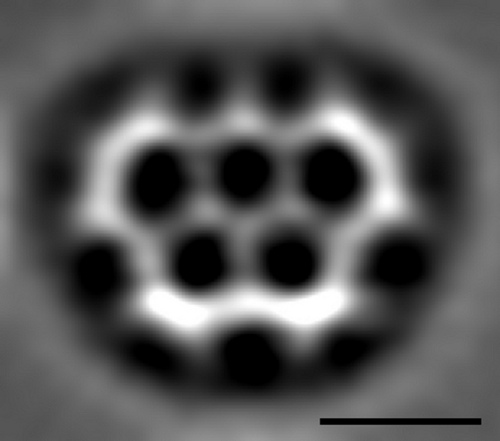
Olympicene - the black scale bar is 0.5 nm.{credit}IBM Research - Zurich, University of Warwick, Royal Society of Chemistry{/credit}

Everyone in the United Kingdom wants a slice of Olympic pie, and you can hardly blame chemists for getting in on the act. At the University of Warwick, a team led by Anish Mistry and David Fox has forged a synthetic route to the five-ring polyaromatic hydrocarbon dubbed olympicene, which can be regarded as a little fragment of graphene. They have teamed up with researchers at IBM’s research laboratory in Zurich to take a snapshot of this molecule with atomic resolution — a direct confirmation that its name is warranted. Seeing this degree of detail in a molecular structure has only recently become possible thanks to advances in atomic-force microscopy: conventional imaging with a scanning tunnelling microscope would provide only a blurry view of the molecule’s trapezoidal shape, without the visible ring structure.

Is it good for anything, besides illustrating that chemists can have fun? The Warwick researchers say that olympicene’s electronic and optical properties might confer applications in solar cells and light-emitting diodes. Purists might feel that the Olympic symbol is better represented by the five interlocking rings of the so-called catenane named olympiadane, synthesized a full 18 years ago by a team up the road from Warwick at the University of Birmingham. But despite its more accurate topology, the three-dimensional crystal structure of that complex beast doesn’t match the Olympic symbol quite as well.


It’s not sugar that makes heirloom tomatoes taste sweeter

Posted on behalf of Alice Lighton.

{credit}Photo by Mark Taylor{/credit}

Researchers have answered a question that has bothered gastronomists for years – which is the tastiest tomato? At the same time, they discovered a heady mixture of volatile organic compounds that gives tomatoes a sweeter flavour than their sugar content would suggest.

In addition to the uninspiring perfect red spheres on supermarket shelves, there are hundreds of heirloom varieties, such as the Mexican Midget and Mr Stripey, that come in all shapes, sizes and colours. Aficionados swear by the wonky fruits, which were bred before mass farming methods arrived.

“People don’t generally like tomatoes that come from supermarkets,” says Denise Tieman, from the University of Florida. The researchers selected about 50 heritage species which they liked the taste of and grew well in the Florida sunshine.

To find out what makes heirlooms so good, Tieman and her colleagues analysed the volatile organic compounds in heirloom and supermarket tomatoes, and asked volunteers to rate varieties based on their deliciousness and intensity of flavour.

According to their study, published in Current Biology, certain volatiles enhance the inherent sweetness in the fruits. Tomatoes with high content of a particular apocarotenoid tasted sweeter. Previous studies have shown that consumers don’t like fruits with low quantities of apocarotenoids. Continue reading

R&D Scoreboard is gone for good

Posted on behalf of Alice Lighton.

The UK government is not going to reinstate its R&D Scoreboard, which analysed the research-and-development (R&D) investment by the country’s top 1,000 research-active businesses and investment by the top 1,000 global companies in the UK. The last edition was produced in November 2010, but earlier this year the government considered reviving the annual report. According to the Campaign for Science and Engineering (CaSE), this has now been ruled out.

The decision has been met with disappointment. Imran Khan , director of CaSE, wrote on his blog: “When we’re trying to increase private-sector investment it’s important that we can see whether the Government’s strategy is working or not … we’re both surprised and disappointed that they have confirmed they won’t be reversing a hastily-taken and short-sighted decision.”

The scoreboard provided information on innovation across a wide range of sectors and allowed for comparisons between the United Kingdom and other countries. It provided a definitive and accurate measure of the state of R&D; its figures were almost never revised.

CaSE claims that budgetary concerns are the reason the Scoreboard has been binned. Announcing the end in 2010, science minister David Willets blamed “unprecedented financial pressures“. The report cost around £410,000 (US$648,000) to produce each year.

The United Kingdom has several other methods of measuring what businesses spend on R&D, but none are as rigorous as the Scoreboard. The biannual UK Innovation Survey is based on voluntary responses from businesses with ten or more employees. The Business Enterprise Research and Development and the Gross Domestic Expenditure on Research and Development surveys (BERD and GERD) are based on the responses of 4,600 businesses, and are submitted to the European Union and the Organisation for Economic Co-operation and Development for comparisons with other countries.

Disappearing hand trick wins best illusion of 2012

Posted on behalf of Julian De Freitas.

Watch where you put your hands, because Roger Newport of the University of Nottingham knows how to fool a brain into thinking they have vanished. This sleight of mind is so compelling that it has officially been crowned the best illusion in the world.

“The illusions this year were particularly spectacular”, says Stephen Macknik, judge moderator for the 8thAnnual Best Illusion of the Year contest, which took place at the annual meeting of the Vision Sciences Society in Florida yesterday. The 10 best illusions from 59 entries were unveiled in a concert hall packed with vision scientists from across the globe, who voted for the final winners.

You are currently viewing a placeholder content from YouTube. To access the actual content, click the button below. Please note that doing so will share data with third-party providers.

More Information

Newport’s was the only tactile illusion. As shown in the video, a participant places both hands into a closed box, and then tries to keep them still while being shown a video of them. The video is manipulated so that the hands appear to drift slowly toward each other; in an attempt to counteract this drift, the participant moves her hands further away from each other. Eventually, she has moved them a fair distance apart without even noticing having done so, since the video continues to display an image of her hands close to each other. Continue reading