
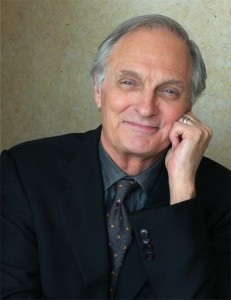
This week’s guest blogger on Soapbox Science is Alan Alda: actor, director, writer, and founding member of the Center for Communicating Science at Stony Brook University. He talks about his lifelong interest in communicating science and opening up these channels to encourage children:
We launched The Flame Challenge through the Center for Communicating Science, which I had helped found at Stony Brook University, and it immediately caught the imagination of people from all over the world. Hundreds of entries came in from scientists in 31 countries and were judged by 6,000 kids from across the globe. This year, the Flame Challenge is sponsored by both the AAAS and the American Chemical Society.
But, as popular as the challenge became, I don’t think we realized what a tough task it would be to explain a flame in a few words. (I didn’t know, for instance, that Michael Faraday had taken several lectures to do it. And that was without getting into modern physics.) In spite of the difficulty, though, we got some wonderful answers. The winning entry was a spectacular animated video.
You can watch the video in Alan’s post. This post was also featured in a blogging series building up to February’s SpotOn NYC (#SoNYC) event, hosted in association with the American Museum of Natural History as part of Social Media Week. The panel’s focus was on Telling Stories with Scientists, examining the various ways of communicating scientific research. You can read all of the blog posts featured in the series here and follow the conversation using #smwScience and #SoNYC hashtags.
Injectable gel repairs damage after heart attack in pigs
Kevin Jiang explains in the Spoonful of Mediciene blog, there are currently no treatments that can repair the damage associated with ‘myocardial infarctions’ (MI), but a potential solution is now showing promise in a large-animal model:

Processed hydrogel floats in a beaker{credit}UC SAN DIEGO JACOBS SCHOOL OF ENGINEERING{/credit}
Reporting today in Science Translational Medicine, a team of bioengineers at the University of California–San Diego (UCSD) has developed a protein-rich gel that appears to help repair cardiac muscle in a pig model of MI.
The researchers delivered the hydrogel via a catheter directly into the damaged regions of the porcine heart, and showed that the product promoted cellular regeneration and improved cardiac function after a heart attack. Compared to placebo-treated animals, the pigs that received a hydrogel injection displayed a 30% increase in heart volume, a 20% improvement in heart wall movement and a 10% reduction in the amount of scar tissue scar three months out from their heart attacks. “We hope this will be a game-changing technology that can actually prevent heart failure after heart attack,” says UCSD’s Karen Christman, who led the study.
Learn more about this research in Kevin’s post.
More details of Russian meteor emerge
Geoffrey Brumfiel reveals in the News Blog that over the weekend, scientists learned more about the meteor that struck the Chelyabinsk region of Russia on 15 February:

{credit}BUTSENKO ANTON/ITAR-TASS PHOTO/CORBIS{/credit}
Ria Novosti is reporting that scientists from Urals State University in Ekaterinburg have made an expedition to Lake Chebarkul, where meteor fragments reportedly fell.
On the basis of 53 samples between 0.5–1 centimetre in diameter, the researchers determined that the meteor was an ordinary chondrite containing olivine, sulfite and about 10% iron. The material is consistent with a stony meteoroid from the asteroid belt.
While Russian researchers get their hands on the tiny meteorites that remain, other researchers have been sifting through the data picked up by a network of infrasound stations that are designed to listen for atomic weapons tests. As many as 17 stations, including one as far way as Antarctica, have picked up the reverberation of the meteor in the atmosphere. The Comprehensive Nuclear-test-ban Treaty Organization, which runs the network, is now calling the explosion the largest ever seen by their system.
Continue to the post to find out how scientists plan to deal with future meteorites.
Dark-matter search from the space station continues to tease
Nobel prize winner, Samuel Ting, likes to keep people guessing and this was apparent at his press conference this week at the American Association for the Advancement of Science (AAAS) meeting in Boston, Massachusetts. Eugenie Samuel Reich elaborates in the News Blog:
Samuel Ting
The AAAS had suggested that Ting would be ready to present the first dark matter results from his brainchild, the US$1.5 billion Alpha Magnetic Spectrometer (AMS), basically a giant magnet and antimatter detector fixed to the outside of the International Space Station. Ting was prefaced by a line-up of physicist colleagues who described themselves as “very excited”. But Ting ended up only disappointing them and around 100 reporters who had gathered for the press conference. Ting said that he wasn’t ready to make an announcement yet. “In two to three weeks, we should be ready,” he said.

Ting did say that he is on the verge of releasing a paper showing how the ratio of positrons (the antimatter counterpart of electrons) to electrons passing through the space station’s near-Earth orbit varies with energy. That ratio is a key parameter in the search for dark matter, which is thought to make up 85% of the matter in the Universe. Some theories predict that dark-matter particles will annihilate in space, producing an excess of positrons that particle detectors can capture.
Hear what attendees, and those who tuned in online to follow the press conference had to say about Ting’s talk here.
New SciLogs.com Bloggers
This week, three science bloggers joined the ever-growing SciLogs.com science blogging network. Marc Kuchner, Alex Brown and Malcolm Campbell have now started blogging on their new SciLogs.com home, adding to the more than 35 science bloggers currently on the network. Khalil A. Cassimally, Community Manager of SciLogs.com elaborates:
Marc Kuchner (@marckuchner), an astrophysicist who works at NASA and a songwriter, will blog about about marketing strategies from the business world that scientists can adopt to help them win jobs and grants, improve the culture of science and shape the public debate. Marc’s blog, aptly called Marketing for Scientists, is an extension of his book of the same title.
Enthusiastic blogger Alex Brown (@alex_brovvn) also joins SciLogs.com with new blog Do you speak science?. Alex will focus on science communication and the use of languages in the scientific world. With witty, humorous and thought-provoking blog posts, Alex will investigate how the very words you know may affect the way you perceive the world.
Malcolm Campbell (@m_m_campbell), a professor and vice-principal of Research at the University of Toronto Scarborough, joins SciLogs.com where he will continue his tremendous curation of the best science content online. (Check out the #SixIncredibleThingsBeforeBreakfast hashtag on Twitter where everyday Malcolm highlights some of the “wow-est” science he’s read the day before.) Malcolm is co-blogger on The Aggregatorblog and will post weekly linkfests starting later this week.
Make sure you update your bookmarks and RSS feeds and follow them on Twitter at @scilogscom.
Four Questions for Anyone Engaged in Outreach
For Those Engaged in Outreach
- If you are part of a science outreach project, what are the goals of the project? Please be as specific as possible.
- What sort of questions are you asking (or could you ask) to help determine whether you are meeting those goals?
- What, if anything, are you doing to assess progress toward those goals?
For Everyone
- Which research disciplines have the requisite skillsets/interests to answer these questions?
If you can answer any, or all, of these questions, Matt would be very grateful. Add your answers into the comments section of his post.
Doodling Science
Scitable’s Conference Cast blog managed by Jonathan Lawson, hosts a guest post from science scribe and communicator, Perrin Ireland. Find out how Perrin communicates science through her art work in her post.

This post also ties in with this month’s SoNYC event on Telling Stories.