
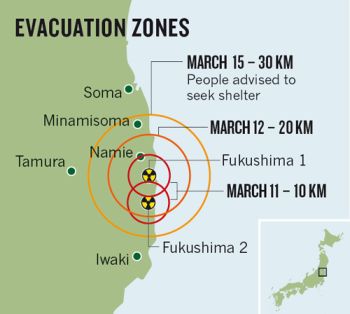
 As more radiation monitoring equipment arrives in Fukushima prefecture, we’re starting to get a sense of just how far the radioactive material from the stricken Fukushima Daiichi nuclear plant is travelling. Surprisingly high doses have been seen outside the evacuation zone set up by the government.
Today NHK, the Japanese broadcaster reported .17 millisieverts per hour (mSv/hr) 30 kilometres northwest of the reactor and 10 km outside the government’s evacuation zone around the plant (see map). There are also reports of .012 mSv/hr in Fukushima City, 60 km away from the plant. The United States is recommending that citizens stay at least 80 km from the plant, as is the British Foreign and Commonwealth Office. The conflicting messages have generated confusion. So what is safe?
Calculating the effects of these doses is difficult even for health physicists, but in terms of long-term health effects, it’s generally acceptable to make a worst-case estimate by multiplying the dose by hours in the day and days in the year. Doing so yields a rate of roughly 1500 mSv/yr at the station 30 km away and 100 mSv/yr 60 km away in Fukushima City. An exposure rate of 100 mSv/yr is considered the threshold at which cancer rates begin to increase, and 1500 mSv/yr is certainly dangerous.
It surprised one physicist I spoke to today to hear these dose rates. Radiation should decrease as the inverse square of distance (1/[4 π r2]). Thus, being 1 kilometre from the plant will decrease your radiation exposure by roughly a factor of ten and being 10 km from the plant will decrease it by a factor of a thousand. Based on the numbers being reported at the plant boundary, the numbers reported on NHK are way too high.
 That’s the theory, but in practice radioactive materials often travel in a concentrated plume blown by the wind. In this way, high doses of radiation can pass over cities many kilometres from the site. The good news is that the doses won’t stick around for long, so the back-of-the-envelope calculations of 1500 mSv/yr or 100 mSv/yr aren’t particularly meaningful.
Because these plumes are only temporary, and can travel far without dispersing, the government might feel that the benefit of expanding the evacuation zone may be minimal. Moreover, stretching the zone even another 10 km would likely involve moving tens, and possibly hundreds, of thousands of people on top of the roughly 200,000 people that have already been asked to leave. At the moment Fukushima prefecture is beset by fuel shortages and fear, so even if the government wanted to move people out, they probably wouldn’t be able to.
There is one thing the government could do is release more data about the radiation blowing out across the prefecture, says Malcolm Sperrin, a medical physicist at Royal Berkshire Hospital in Reading, UK. Knowing the radiation type, how long it’s sticking around, and whether it is travelling as dust or an aerosol would allow experts to better advise people on protective measures. “We need to know what’s in that radiation,” he says.
UPDATE 18 March 09:30 UTC: The Japanese science ministry, MEXT, has stepped up its reporting of radiation levels throughout the region (It has also provided the location of monitoring stations, right). See Hideaki Shiraishi’s comment below for more information. A quick review of some of the graphs seems to support the view above that plumes of debris are responsible for temproary spikes in radiation.
More on radiation exposure:
Radiation exposure, beyond the numbers
Confusing radiation numbers swirl around Fukushima
For full coverage of the Fukushima disaster, go to Nature’s news special.
Credit: F. Bale/Nature/MEXT