
{credit}CERN{/credit}
Get Guinness. Physicists at CERN’s Large Hadron Collider near Geneva, Switzerland, have achieved the hottest manmade temperatures ever, by colliding lead ions to momentarily create a quark–gluon plasma, a subatomic soup and unique state of matter that is thought to have existed just moments after the Big Bang.
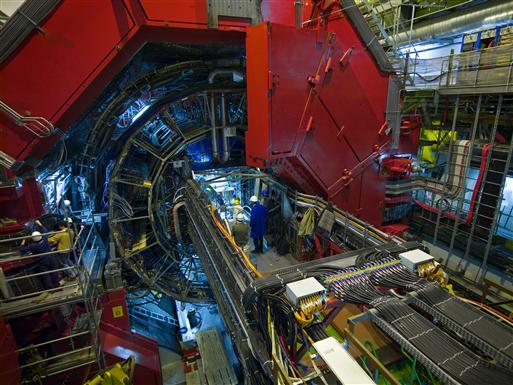
The results come from the ALICE heavy-ion experiment (at right) — a lesser-known sibling to ATLAS and the Compact Muon Solenoid, which produced the data that led to the announcement in July that the Higgs boson had been discovered. ALICE physicists, presenting on Monday at Quark Matter 2012 in Washington DC, say that they have achieved a quark–gluon plasma 38% hotter than a record 4-trillion-degree plasma achieved in 2010 by a similar experiment at Brookhaven National Laboratory in New York, which had been anointed the Guinness record holder.
ALICE spokesman Paolo Giubellino says that the team’s measurement is relatively uncertain and, moreover, they haven’t yet converted an energy measurement into degrees. But he says there’s no reason to suspect that the conversion won’t produce a number like 5.5 trillion degrees. “It’s a very delicate measurement,” he says. “Give us a few weeks and it will be out.”
Meanwhile, physicists at Brookhaven’s Relativistic Heavy Ion Collider (RHIC), who in 2005 discovered that quark–gluon plasmas behave like perfect, frictionless liquids, say that they are still learning more and more about the stuff. Two RHIC experiments announced on Monday that, working with collisions of gold ions, they were beginning to map out the way in which a quark–gluon plasma morphs into a normal gas made of hadrons. Just as water exists in different phases depending on the temperature and pressure, so too do these physicists want to trace out the boundaries that separate quark–gluon plasmas from ordinary matter. Steven Vignor, head of the RHIC research programme at Brookhaven, says that there are “strong hints” that the experiments have been able to cross this boundary. “But we don’t feel the evidence is compelling enough to make a clear statement.”
Although the RHIC will not be able to compete with the LHC in reaching the highest temperatures and densities, physicists for the machine say that they are in a sweet spot for mapping out this phase transition. Moreover, this year they began working with uranium–uranium ion collisions as well as gold–copper collisions, which Vignor says will allow the teams to explore different collision geometries.