
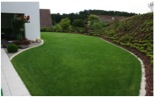
Sometimes we don’t give our neighbors enough credit. There’s a common trope in eco-nerd circles, the story of the exuberant, wild, ecologically vibrant garden attacked by neighbors for failing to conform conventional aesthetic standards. These unenlightened lawn worshipers complain to the city, dismiss the native plants as weeds and fret about vermin.
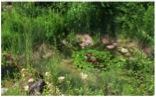
But the research doesn’t necessarily support this familiar story. Today, at the Ecological Society of America meeting in Austin, Texas, conference-goers heard another story. Petra Lindemann-Matthies of the University of Education Karlsruhe, in Karlsruhe, Germany presented 250 people with photographs of a subset of 36 Swiss gardens, some diverse, some dull and dominated by lawns, and asked them to rate them on their beauty. Her colleague Thomas Marty of the University of Zürich had counted native Swiss species in each garden, giving himself 75 minutes per garden. The least diverse had only 20 species, the most, 105. It turns out that the Swiss public thinks the most diverse gardens are the most beautiful (r = 0.47). So maintaining a perfect lawn to impress the neighbors may be a losing strategy. Far better, this research suggests, to put in a meadow of native grasses and flowers and then just let it go crazy.
Interestingly, when given adjectives to describe the gardens, the 250 subjects tended to pick words like “natural” and “diverse” to gardens they thought beautiful. But some ecologically managed gardens were also described as “wild” and “chaotic,” and these were ranked as ugly, hinting that there are complex connotations to these eco-gardens.
When added to the work of landscape ecologists like Joan Iverson Nassauer, who has surveyed people in the US Midwest with photoshopped gardens in various states of tidiness and ecological diversity, the work is more evidence that the “critical neighbor” is, in Lindemann-Matthies’ words, “a figment of the imagination.”
If you are interested in going crazy in the garden, there are a number of resources to help you get started. The consensus seems to be that it takes a bit of work initially (ripping out a lawn is tough, for starters) but then takes little or no ongoing maintenece. Here are some resources:
-The National Wildlife Federation program to certify wildlife habitat gardens
The Wildlife Trust and Royal Horticultrual Society’s Wild About Gardens page.
There are also many local resources tailored to particular ecosystems, like Adelaide’s Backyards for Wildlife.
Pictures courtesy Lindemann-Matthies