
 The whistle-blower group Public Employees for Environmental Responsibility (PEER) has filed a scientific integrity complaint against the US Bureau of Land Management (BLM) because, it says, the agency is excluding grazing data from an ambitious ecological study for political reasons (see their press release).
The Bureau, which manages 1,068,000 square kilometers of the American west, launched the study across the region last year with economic stimulus funding. The study consists of several Rapid Ecoregional Assessments (REAs), including maps of “areas of high conservation value,” and subsequent analyses of how these areas will be affected by four “change agents”, which are: climate change, wildfires, invasive species, and development (both energy development and urban growth).
PEER has posted minutes from an August 2010 workshop for scientists involved with the Colorado Plateau REA in which several people in the room asked that grazing also be included in the list of change agents, pointing out that it was a huge factor in the local ecology and saying that omitting it would be “intellectually dishonest.” But the minutes-taker summarized the comments of Karl Ford, manager of the overall REA project, this way: “Grazing is considered a resource within the agency and with a group of stakeholders and there are litigation worries. BLM fears litigation may put a stop to future REAs, but he wants to get through the mine field and do something meaningful.”
The discussions that followed seemed to center around how grazing data might be included in the assessment without annoying the “stakeholders,” which PEER guesses to be the ranching community — though PEER director Jeff Ruch says they aren’t sure if the ranchers leaned on BLM or if the agency was self-censoring for fear of backlash. The solution arrived at during the meeting amounts to lumping data on grazing by cattle and other livestock in with other kinds of grazing — from game animals to wild horses — presumably thus limiting the negative implication that livestock grazing is hurting the west.
BLM staff say that while grazing is not among the four overarching change agents to be examined at all sites, some sites will look at grazing. “The primary reason that some of the Assessment teams decided not to look at grazing as a change agent is that they concluded that it would be difficult to model the effects of grazing at a regional scale given the available data,” wrote BLM spokesperson Tom Gorey in an email.
Ruch’s response to Gorey’s explanation was a hearty laugh, followed by this: “Grazing is something they have more data on than any other subject. Regional scale data [from the BLM] has just been published by the US Geological Survey. The notion that they don’t have enough information is both laughable and untrue.”




 The Howard Hughes Medical Institute (
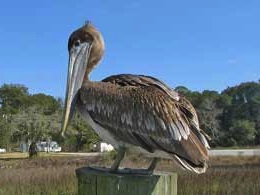 Recently, someone brought to my attention a wave of “mysterious pelican injuries and deaths” in North Carolina. Dozens of brown pelicans have washed up on the shore with broken wings and other injuries,