
 Posted on behalf of Lee Sweetlove
Either the Moon is significantly younger than thought, or scientists need to completely rethink how it formed. That’s the conclusion of new isotope dating of the lunar crust published in Nature today.
The Moon was created when a Mars-sized body hurtled into the newly-formed Earth. Debris from the collision ended up in orbit around the Earth, and eventually accreted to become the Moon. It is thought that the satellite was initially a molten ball of rock – a global magma ocean – that gradually cooled at its surface to form a solid crust.
A study by geochemist Lars Borg at the Lawrence Livermore National Laboratory in California and his colleagues now suggests that this process took tens of millions of years longer than thought. Using improved isotope dating techniques, they have revised the age of a class of lunar crustal rocks known as ferroan anorthosite (FAN). According to their measurements of a sample of FAN collected during the Apollo 16 mission in 1972, the Moon’s crust solidified 4,360 million years ago, around 200 million years after the formation of the Solar System.
Previous estimates of the age of FANs are highly variable, covering a 200-million-year range, but Borg’s result is 60 million years younger than the previous reliable youngest estimate.
Borg describes this as an “extraordinarily young age” and says that on face value it means that the Moon formed surprisingly recently. Alternatively, scientists would need to rethink the process of lunar formation, to explain how the FAN rock could have solidified later on.
Borg’s discovery comes hot on the heels of a proposal that the Earth once had two moons, both created in the same giant impact, that later merged in a slow-motion collision (see “Early earth may have had two moons“).
If so, then one would expect two temporally distinct FANs on the moon: an older class derived from the smaller companion moon, and a younger class from the main body of the moon, which would have cooled more slowly. This could explain the varying ages that have been reported for lunar FAN samples, but Borg is cautious: “The ages of most FANs are not determined with enough confidence or with enough temporal resolution to rigorously assess this possibility.”
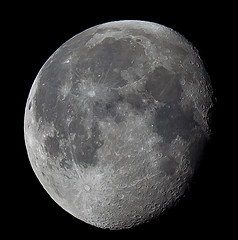
Image courtesy of RONg, via Flickr under Creative Commons.