
If carbon dioxide is trump, then methane is the joker in the greenhouse game. The flammable gas (CH4) is produced in wetlands, landfills and in the guts of cattle and sheep, and it is stored in vast amounts in so-called clathrates, or gas hydrates, in the ocean floor.
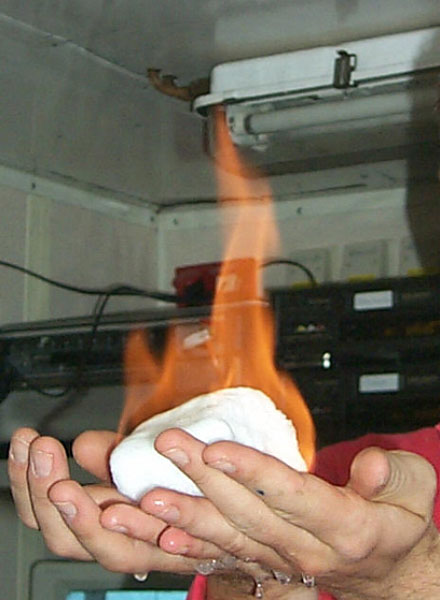
The latter stuff has always kindled imagination. In the 1930s, dumbfounded Russian sailors who had lit dynamite for navigational purposes in the Siberian Arctic reported that the air around them started to burn. Had they set on fire methane released from clathrate reservoirs? Perhaps.
Less likely is that methane bubbling up from the ocean floor can makes the water so foamy that ships floating above sink like a rock. File this under Bermuda triangle myths.
But catastrophic methane bursts do seem to be linked with anomalous warming episodes in the Earth’s past, such as the one that occurred at the Palaeocene-Eocene Thermal Maximum around 55 million years ago. Dissociating clathrates may well have been the culprit then.
What had uncorked the bottle is unclear. But in any case, reports this week of methane emissions from sub-sea permafrost beneath the Siberian shelf, and from the seabed off Svalbard, sound alarming.
Geologists assume there are large methane hydrate reservoirs in both regions. Are they beginning to destabilize? Have we lit a time bomb? Is global warning getting out of control?
Media reports this week imply all this, some more and some less cautiously. It’s a wonderful story of course: Weird things happening in the Arctic, strange tales from the bottom of the ocean, Apocalypse Soon! It’s new, it’s exciting, it’s scary – no wonder journalists love it.
But wait a minute. The methane system discovered off Svalbard has probably been active for thousands of years, it’s only that no-one has ever looked for it.
The methane emissions detected in the Laptev Sea are also not a new phenomenon. Russian scientists have observed methane plumes there since the mid-1990s when they began to regularly visit the remote and inaccessible region. It does seem that there are many more, and possibly more vigorous, emission hotspots than was previously thought. But observations are still few; it’s not too much of a surprise that the harder they look the more they will find. I have tried to put the recent discoveries in context in my news story here.
That’s not to say that rising methane emissions, and thawing permafrost, are no concerns. They are, and their sources and causes need to be studied carefully. Long-overlooked methane emissions from living plants, as were just recently confirmed, are proof enough for how poorly methane cycles are actually understood.
But not only in matters climate change there’s a danger of confusing people by media coverage that alternates between alarmism and appeasement. Andrew Revkin of the New York Times has appositely termed the effect a journalistic whiplash for the public.
Science, although intrinsically a never-ending process, will every so often generate journalistic scoops – and sometimes journalistic kitsch. The methane story is exciting, but inflationary use of ‘dramatic’, ‘alarming’ etc in science stories produces only cheap thrills.
Quirin Schiermeier