
Posted on behalf of Gozde Zorlu
The recent claim that early hominins were butchering meat 3.4 million years ago has been questioned, after a reanalysis of marks found on animal bones from the era.
The team who discovered the bones at Dikika in the Lower Awash Valley, Ethiopia, and presented their analysis in Nature in August (see ‘Butchering dinner 3.4 million years ago’), argued that the cut marks (see picture) were evidence that large animal carcasses had been carved up by one of our ancestors, probably Australopithecus afarensis.
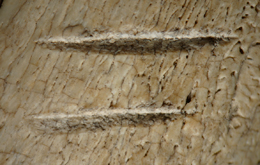
Previously, the earliest evidence of stone tool use had been found on butchered bones from the Gona and Bouri regions of Ethiopia and dated to between 2.6 and 2.5 million years ago. The older finds probably do not indicate hunting, but they would show that early hominins were at least able to recognize large animal carcasses as a source of food, and chop them into morsels – something never seen before in Australopithecus afarensis.
This “evidence for exceptionally early tool use and butchery would have immense implications for our current models of human evolution,” says Alan Outram, an archaeologist at the University of Exeter, UK, who was not involved with the research.
But Manuel Dominguez-Rodrigo, an archaeologist at the Complutense University, Madrid, Spain, and colleagues have now poured cold water on the theory in a study published this week in the Proceedings of the National Academy of Sciences. They suggest, based on photographs of the bones, that the marks were caused by natural processes, such as grinding against sediment when the bones were trampled under the feet of other animals.
They add that the marks are not V-shaped – as would be expected if they were made by a hominin wielding a cutting stone – but instead have a flattened base, typical of marks made by trampling.
Shannon McPherron, a Paleolithic archaeologist at the Max Planck Institute for Evolutionary Anthropology in Leipzig, Germany, and part of the team behind the butchery claim, refutes the new analysis. He points out that the team have not examined the original specimens – if they had, he says, they would have seen that only a few of the cut marks his team identified actually resembled trampling marks.
McPherron adds that the most likely implement used to make the marks was unflaked stone – rather than the sharper flaked stone tools used by later hominins. “Recent experiments reported in a paper now under review show that the Dikika marks are a tight fit to marks produced by unflaked stone,” he says.
“The controversy over these few marks on two bones has highlighted the pressing need to understand the experimentation process that early hominins went through, prior to the advent of fully-fledged stone tool manufacture,” comments Michael Haslam, a paleolithic archaeologist at the University of Oxford, UK, who was not involved in either study.