
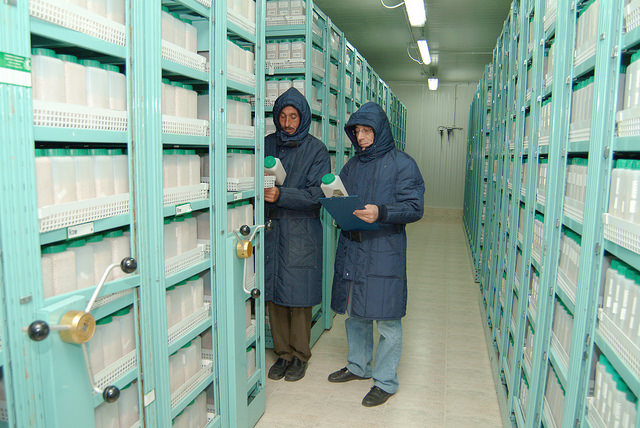
The gene bank in Tel Hadya, Syria{credit}ICARDA{/credit}
The war in Syria has left nothing untouched, including researchers unaffiliated to any of the fighting parties. In September 2012, the International Center for Agricultural Research in the Dry Areas (ICARDA) based in Aleppo, Syria, had to move all its international staff out of Syria as the fighting intensified. After looting and attacks on the premises, the research institute had to move a lot of sensitive equipment to hide them in rented houses, before they eventually had to evacuate and move all the operation to neighbouring Lebanon in the same year.
Before leaving the country, and to safe keep over 110,000 genetic samples for crops that were stored in ICARDA’s gene bank in Aleppo, the researchers started to send copies of all the gene accessions stored to the Svalbard gene bank in Norway, a secure ‘Doomsday’ gene bank near the North Pole designed to protect genetic material in case of a nuclear attack or devastating natural disaster. In March 2015, the organization received the Gregor Mendel Innovation Prize for managing this monumental task.
So far, genetic material has only ever gone into the vault. Last week marked the first time genetic material came out, when ICARDA requested copies of some of the samples they it had sent there for safekeeping, to fulfill requests from farmers and agricultural organizations that it works with.
“Until recently we were using and dispatching bulk seeds of these genetic materials to meet requests from Aleppo in spite of the tough security situation.” said Mahmoud Solh, ICARDA’s director general. “ICARDA requested some of its stored material in Svalbard in order to reconstitute the active collection in both Morocco and Lebanon in large bulks to meet requests for germplasm from the collections we have to meet the challenges facing dry areas globally.”
Since its formation, ICARDA has been working with developing countries, especially those in desert and arid areas, to help national programmes and individual farmers increase their yield by providing them with drought and pest resistant variants of staple crops like wheat, barley, lentil, chickpea, faba bean and peas.
Once we multiply these varieties, ICARDA will return part of it to Svalbard as another duplicated set,” adds Solh.
More bad news were reported for ICARDA yesterday, when news started to spread that Russian airstrikes near Aleppo may have destroyed the gene bank that the organization left behind in the war-torn country. However, the few ICARDA staff still in Syria confirmed that the bank was safe and unaffected.