
The latest Soapbox Science mini-series focuses on the role of mentors in science. Tying in with this year’s Lindau Nobel Laureate meeting, where almost 600 young scientists have the opportunity to meet each other and 25 Nobel laureates, we’ll be looking at the importance of supportive relationships and role models. We’ll hear from a mix of mentors, mentees and projects set up to support scientists and we aim to explore not just the positive examples of good mentoring but what can happen when these key relationships are absent or break down. For more discussions around this year’s Lindau meeting, check out the Lindau Nobel Community site.
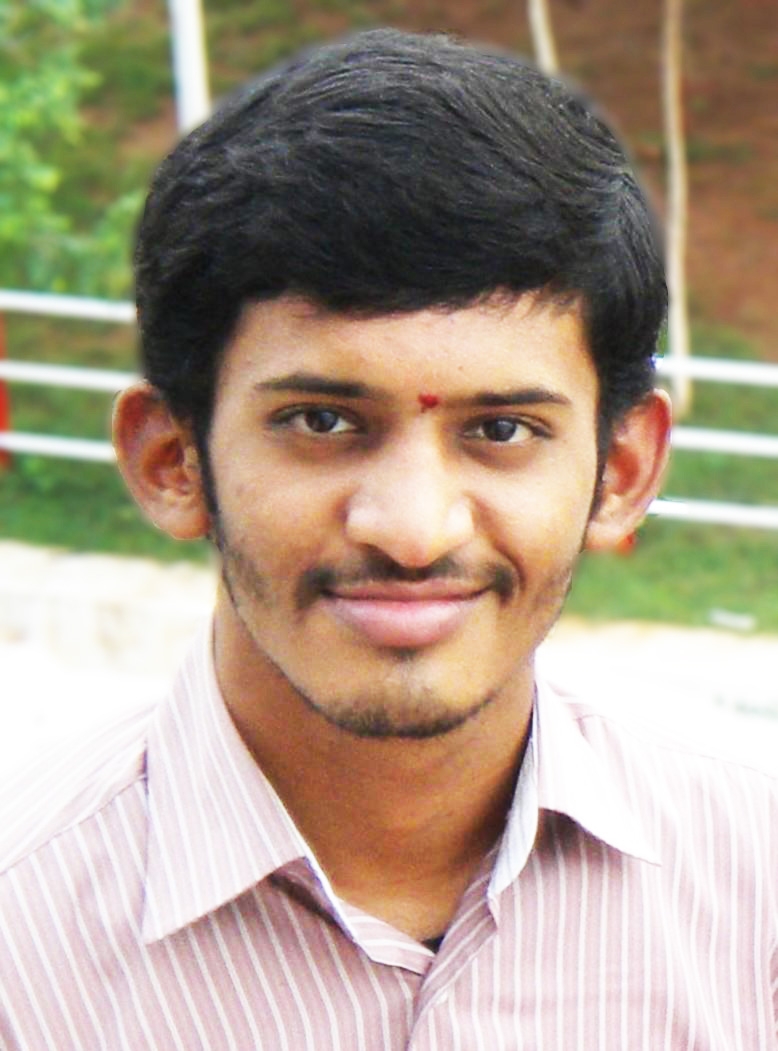 Harshavardhan Reddy Pinninty, representing India in this year’s Lindau Nobel Laureates Meeting, is a fourth year Integrated MSc Physics student at University of Hyderabad. He is also a convener of Junior Science Club, a student organization which aims to promote and develop scientific interest among the students of the university community by organizing various activities related to science. He is working on a project related to light matter interaction at different time scales (nano, pcio and femto second regimes), under the guidance of Prof. D. Narayana Rao along with his regular academics. Harshavardhan’s interests include Yoga and Meditation.
What is your scientific background?
I am from a remote village in India where I was able to live very close to nature. Since childhood, I have tried to understand natural surroundings in my own way. In fact, nature has been the main motivation for me taking up research as a career.
As a child I once discovered a piece of CD on the road-side while coming home from school. I picked it up and noticed rainbow colours. With the curiosity of a child, I wondered how the rainbow came to appear there. I dipped it in water and found that it began to shine more, then dipped it in oil and found something different happening. Next, I dipped it in water and added oil, which produced a very different phenomenon. So, I concluded that the colours of the rainbow were caused by a reflection of sunlight falling on the CD and this was verified by my science teacher when I shared my experience with her in school. I still remember how she told the class about my research aptitude. This incident encouraged me a lot and my interest in interaction of light with matter grew. When I entered university and did some experiments in the laser lab, I enjoyed recalling my childhood experience and the enthusiasm it brought for experimentation.
I strongly believe that for every research problem, nature holds a solution, but often we ignore it. This is why I feel it is worth studying the fundamentals of natural sciences in greater depth.
What is your current role?
I am a fourth year Integrated MSc Physics student at University of Hyderabad; I am also a convener of Junior Science Club, a student organization which aims to promote and develop scientific interest among the students of the university community by organizing various activities related to science. I am working on a project related to light matter interaction at different time scales (nano, pcio and femto second regimes), under the guidance of Prof. D. Narayana Rao along with my regular academics.
Who was your mentor?
Nature was my first mentor in making me think for myself, while my parents taught me the fundamentals of life. In school, my education progressed with the help of many mentors, but it was learning the fundamentals of science after entering university which really formed the basis for my scientific career. Prof. K.P.N. Murthy, who taught us during third semester and whose inspiring lectures provided my first step towards scientific research, encouraged me to think outside of the box. Prof. D. Narayana Rao identified my experimental skills and gave me an opportunity to work in his laser lab at very early age and guided me towards experimental physics. H. Sekhar, a PhD student and one of my best friends, taught me the basics of instrumentation and experimentation, which enhanced my interest and skills.
Why did you need a mentor?
A mentor is like a catalyst, helping to bring out the hidden scientific ability in the character. In an ideal case, nature should be sufficient as a mentor but, when I began my university life, I soon realized the importance of a human mentor in helping to bridge the gap between village and city, both in terms of my education and working culture. I couldn’t have developed without the help of my mentors at each and every stage of my university life. Mentoring has been particularly important for a villager like me, in helping me to cope with city life and the modern world.
Why was your mentor so great?
Prof. K.P.N. Murthy, who taught the Heat and Thermodynamics course during my 3rd semester is an inspiring speaker. His teaching manner encourages all the students and he tries to explain difficult concepts by telling stories from the history of physical sciences, explaining exactly how a particular scientist thought while carrying out experiments. His teaching made me seek out information beyond the classroom, which developed my scientific knowledge and made me think outside of the box. His inspiring lectures helped me in my first steps towards scientific research.
Prof. D. Narayana Rao, an eminent scientist in Non-linear Laser Spectroscopy, identified my experimental skills very early and gave me a chance to work in his Laser Lab. This provided my main motivation for taking up a career in experimental laser physics. He guided me step by step by directing me from basic research papers to advanced ones, always making great efforts to help me clarify my thoughts.
A friend can also be a mentor. H. Sekhar, a final year PhD student of Prof. D. Narayana Rao, guided me and taught me the basics of experimental skills by coming to my level; for me, this resulted in enhancement of my skills and interest in experimental physics.
The contribution of each of above mentors in different stages of my university life is priceless and helped provide the motivation for my application to the Lindau meeting where there are great benefits to be had from further mentoring from Nobel laureates which will undoubtedly accelerate my development.
What do you think the key challenges are for a mentor?
A good mentor is one who listens to the student, understands him/her and clears up any doubts the student may have. A mentor should also provoke the student into thinking about new issues, considering new problems and finding solutions. Patience, clarity and the depth of knowledge should be the hallmark of a good mentor.
Where do you see your career in the future and how do you think your mentoring experience shaped this?
I see my career in laser research. The experience I gained in Prof. D. Narayana Rao’s Research Laboratory gave me such confidence that I feel I can work on any research problem and ultimately find solutions.
How do you think the Lindau conference will shape your future?
I believe that good discussions always leave us with interesting thoughts and ideas. Interacting directly with Nobel laureates and discussing my ideas with them will definitely sharpen my thoughts.
I believe interacting with like-minded young researchers from all over the world with entirely different backgrounds and establishing contact with them is going to provide a great platform for interdisciplinary and collaborative research in the future. I believe that this opportunity will help me to appreciate and understand the importance of physics as an interdisciplinary tool in other fields which also fascinate me. I also expect it will help me achieve my goal to become a good scientist and serve India, taking science to remote villages and developing people’s awareness of what can be achieved through science.