The genetic syntax of febrile seizures

The genetics of seizure disorders, including epilepsy, has recently come into the spotlight (see the Nature Outlook on epilepsy). Epilepsy is a complex disease with many different subtypes, both sporadic and familial. While epilepsy is one of the most common neurological disorders, and it has been studied for a very long time, the underlying mechanisms of seizure disorders remain largely elusive. Identifying the genetic causes of different subtypes of the disorder can help to illuminate the gene networks involved and lead to a deeper understanding overall. Importantly, the genetic tools now exist to identify causal mutations for the many different subtypes of seizure disorders.

Febrile seizures, which are induced by fever, affect approximately 2-4% of children worldwide. This type of epileptic seizure is often triggered by infectious disease, but there is strong evidence that it has a genetic basis. A paper recently published in Nature Genetics by Bjarke Feenstra identified two genes associated with vaccine-induced febrile seizures (vaccines, such as MMR, are an extremely rare cause of febrile seizure).
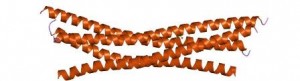
Protein model for STX1B

Protein model for STX1B{credit}Wikipedia{/credit}

Now, a study by Holger Lerche, Camila Esguerra and colleagues identifies variants in the gene STX1B as causing a familial form of febrile seizure disorder. STX1B encodes a protein called syntaxin-1B. Syntaxin-1 is a key component of a protein complex necessary for the release of neurotransmitters from the presynaptic membrane.

The authors first identified two families in Germany with a history of febrile seizures. They used a combination of whole-exome and whole-genome sequencing to identify the gene most likely to harbor pathogenic mutations causing the disorder. Targeted sequencing in an extended cohort identified further variants in STX1B in patients who had experienced febrile seizures.

To validate these findings, the authors tested the function of stx1b in zebrafish, and showed that a reduction in syntaxin-1B led to behavioral defects in the fish, such as lack of touch response, fin fluttering and jerking movements. Recordings of brain activity confirmed that the fish were experiencing epilepsy-like symptoms. You can read a more in-depth summary of the paper in a blog post at Beyond the Ion Channel by one of the study’s co-authors. 

We asked one of the study’s senior authors, Holger Lerche, to tell us a little more about the background of this study:

How did you initially become interested in studying seizure disorders?

I was working during my thesis with mutated ion channels in rare muscle diseases. When I started with my Neurology training, epilepsy emerged as a highly interesting topic in that field as well, and also clinically I became very interested in epilepsy.

How did the two families in this study first come to your attention?

The index case of the first family was referred to me during a cooperation with the Children’s Hospital (at that time at the University of Ulm), when I was looking for familial cases with epilepsy for genetic studies. When I called his grandmother, it turned out to be a large pedigree further increasing when contacting and visiting the different branches of the families. The second family was referred to my colleague Yvonne Weber for similar reasons from another Children’s Hospital in Germany.

STX1B mutations have been associated with other forms of epilepsy. How does the association with febrile seizures further the understanding of this gene’s function?

The function of this gene has been explored very well already by Nobel Laureate Thomas Südhof and his group. The mutations we detected may teach us more about the functional role of different protein domains and their interaction with other proteins in the vesicle release machinery. It is not surprising that mutations in STX1B cause epilepsy, but how febrile seizures develop is still an enigma. Follow-up studies of our discovery may shed light on the unknown temperature-sensitive mechanisms leading to febrile seizures.

Do you think there is the potential for developing drugs targeting STX1B in these patients?

The question is how the loss of function of one allele of STX1B could be compensated. If targeting STX1B to enhance its production or activity is possible, and if this may help these patients, is difficult to predict. However, the zebrafish model can also help us to find therapies which work in a completely different way to compensate for STX1B failure (see answer to next question).

Can you say a little about why you chose zebrafish as a model, and what you learned from this model organism that you wouldn’t have been able to learn otherwise?

We started only recently to collaborate with Camila Esguerra and Alex Crawford who have the zebrafish facilities and expertise. It is a vertebrate, easy to study and very quick to manipulate (much quicker and easier than mice).
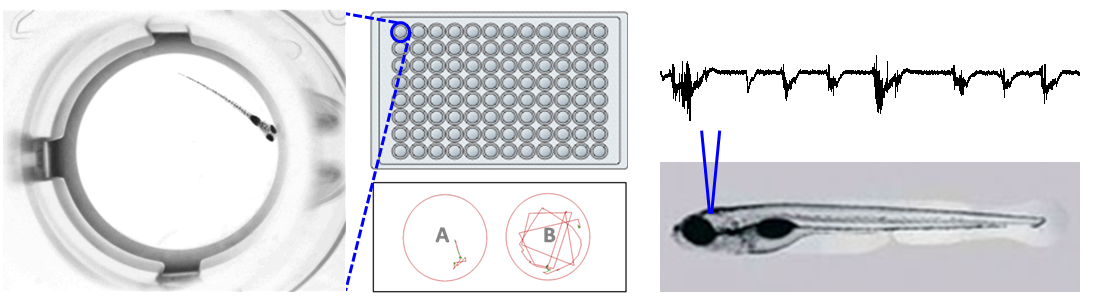
Behavioral assays (left) and electrographic recordings of zebrafish brain (right)

Behavioral assays (left) and electrographic recordings of zebrafish brain (right){credit}Courtesy of Alex Crawford and Camila Esguerra{/credit}

To establish a cellular model for functional proof of these mutations would have been more difficult in our case. And the zebrafish is an in vivo model, so we can study behavior and EEG, which is not possible in a cellular assay. Also the temperature effect could be studied very nicely with an effect on EEG in an in vivo system.Last but not least, and most important when thinking of the impact of our work: zebrafish models can be used to find new drugs in medium to high throughput screens using seizure-like behaviour or EEG as read-outs. This allows us to find different kinds of drugs that are able to antagonize the consequences of the STX1B defect on a system-wide level.

Read the full study by Lerche and colleagues here. You can also read more about this work here [press release]. 

A re-SMARCable finding

Paper cranes are the symbol for the Small Cell Ovarian Cancer center

Paper cranes are the symbol for the Small Cell Ovarian Cancer Foundation {credit}Brooke LaFlamme{/credit}

On March 23, Nature Genetics published 3 related papers reporting the finding that SMARCA4 is frequently mutated in a rare ovarian cancer type, small cell carcinoma of the ovary, hypercalcemic type (SCCOHT) [Jelinic et al 2014, Ramos et al 2014, Witkowski et al 2014]

The fact that 3 independent research efforts made virtually the same discovery is, in a sense, remarkable, but it is also a reflection of just how critical this mutation is to the development of SCCOHT.

SCCOHT is a bit of a misnomer. Despite the fact that it is called a “carcinoma,” the World Health Organization classifies it as a “miscellaneous tumor.” As Dr. William Foulkes, senior author of one of the papers [Witkowski et al 2014], says:

“Like the Holy Roman Empire (not Holy, not Roman and not an Empire) not all cases of SCCOHT contained small cells, the term carcinoma was somewhat arbitrary and a third of patients never developed hypercalcaemia.”

SCCOHT is an extremely rare, very aggressive ovarian tumor that is most common in young women and girls. Regardless of the fact that most patients present at an early disease stage, the majority die within 2 years of diagnosis. You can find more about this tumor type at the Small Cell Ovarian Cancer Foundation’s website. Because SCCOHT is so rare, each of the three studies relied on archival samples (formalin-fixed paraffin-embedded tissue) and used different strategies to identify the genetic landscape of the tumor.

Douglas Levine’s group at Memorial Sloan-Kettering Cancer Center in New York used a candidate gene approach, sequencing the coding regions of 279 cancer-related genes in 12 pairs of tumor/normal tissue. They found biallelic inactivating mutations in SMARCA4 in each of the 12 tumor samples. Even more interesting, there were virtually no other recurrent mutations in any cancer-related gene in the tumors. Where suitable tissue was available, they were also able to show that the protein product of SMARCA4 was absent in the tumors. To test the functional consequences of SMARCA4 loss, the group introduced the protein into a lung cancer cell line that lacks it. By reintroducing SMARCA4, they were able to suppress cell growth. Depleting SMARCA4 transcript from another cell line had the opposite effect. (Read more about this study here and here)

William Foulkes’ group at McGill University started with familial cases of SCCOHT and used whole-exome sequencing to identify mutations. Although they suspected SMARCA4 already from previous work, they used the whole-exome approach to, paradoxically, obtain higher quality tumor sequence data for SMARCA4 than they were able to by traditional Sanger sequencing. This had the effect of not only identifying mutations in SMARCA4 in all 4 affected families, but also allowed the researchers to conclude, as with Dr. Levine’s group, that there were no other strong candidate genes that could be drivers of SCCOHT. Luckily, whole-exome sequencing turned out to be possible with these archival samples. They extended their sequencing efforts to additional non-familial samples and looked for protein loss as well. In all, 38/40 tumors showed loss of SMARCA4 protein. Similar to the other studies, they found mutations throughout the entire length of the gene and found that nearly all samples carried SMARCA4 mutations. 

An interesting aspect of the paper by Witkowski et al. is that the authors propose a re-classification of SCCOHT to extra-cranial rhabdoid tumors instead of carcinomas based on both histology and the finding that SMARCA4 is the driving mutation. Dr. Foulkes characterized the findings as both a “game changer” for SCCOHT and a “name changer.” (read more about this study here and here)

Finally, a collaborative group led by David Huntsman and Jeffry Trent at TGen in Phoenix, AZ also identified germline and somatic mutations (as in Witkowski) in 75% (9/12) of their tumor samples and loss of SMARCA4 protein in 14/17 samples. The group used whole-genome sequencing of both tumor and blood to identify mutations causing SCCOHT. Even with extensive genome sequence data, they found that SMARCA4 is the only significantly mutated gene in this tumor type. They also demonstrate that SMARCA4 mutation is very specific to SCCOHT–only 0.4% of other tumor types carry this mutation (a similar discovery was also reported by Witkowski et al). (Read more about this study here)

The significance of these studies is two-fold. First, they pinpoint the driving mutation behind this extremely aggressive tumor type and give clinicians a new tool to diagnose them. Second, they open the door for development of specific therapies targeted to SCCOHT, of which there currently are none.

In the end, these types of studies have a single goal in mind: to give people with terminal illnesses a chance at survival. To close, I’d like to share this story from Dr. Foulkes related to the SCCOHT study:

“One of the most satisfying parts of the project was working directly with women and their families from all around the world. When we found the familial mutation in family 3, the aunt of the proband decided to have a preventive oophorectomy, as her identical twin sisters both died of SCCOHT. While this might not be sensible for all women at risk, you can appreciate her concern. Now we have to try to find better treatments. If you talk to Maren Petersen, from the small cell ovarian carcinoma foundation, she will tell you how far things have moved on since her daughter was diagnosed. Unfortunately, she did not survive. We have to hope this work will in the future help other women to escape her fate.”

Author: Brooke LaFlamme, assistant editor Nature Genetics

Follow me on Twitter: @Brooke_LaFlamme