McPherson et al., Nature Genetics 2016
The trajectory of tumor cells during metastasis can be influenced by many factors, including the physical environment and the genetic makeup of metastatic clones. In high-grade serous ovarian cancer, there are limited barriers in the intraperitoneal space, allowing for extensive spreading and mixing of tumor cells. A recent article published in Nature Genetics explores these different patterns of clonal evolution in metastatic ovarian cancer using a combination of bulk and single cell sequencing.
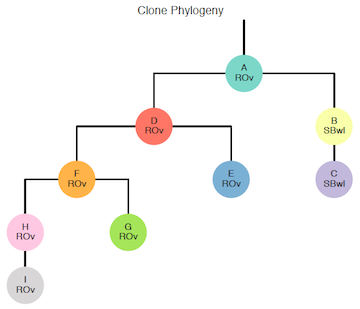
The authors characterized the mutation landscapes of different metastatic tumors and find both monophyletic and polyphyletic clones. While in most patients there was unidirectional seeding from the original ovarian tumor, two patients exhibited polyclonal spread and reseeding. Therefore, high-grade serous ovarian cancer cells can migrate through and establish metastasis within the intraperitoneal space via different evolutionary routes.
McPherson et al., Nature Genetics 2016
We spoke to lead author, Sohrab Shah, to get some background on this research.
What features of this particular cancer made you want to study its metastasis? Were you surprised by your findings?
High grade serous ovarian cancers are often widespread through the peritoneal cavity at diagnosis. We wanted to ask what are the characteristics of cells that spread and what is the distribution of these cells throughout the abdominal lesions. The focus was to study the disease state prior to any treatment to characterize the diversity and take in inventory of the ‘substrate’ of clones upon which treatment selective pressures may be acting. Many patients experience relapse after initial response to treatment. Mapping which clones lead to relapse remains a key question in the field. This was borne out in one patient in our study where specific clones that led to relapses were already present at diagnosis but only represented a minority of branches in the clonal phylogeny.
It is important to note that the mode of spread in this disease differs from most solid cancers, where spread is achieved through the bloodstream or lymphatics. Ovarian cancer represents a unique opportunity to study disease spread through a relatively physically unencumbered anatomic space. One might expect that in such an environment the potential for clonal intermixing is high. This might lead to many clones co-existing at many sites. But the majority of intraperitoneal samples were clonally pure, suggesting unidirectional spreading from ovary sites with diverse clonal repertoires, and a lack of clonal intermixing.
You provide evidence that the microenvironment influences the metastatic success of tumors. What does this say about in vitro cancer models that don’t account for tissue context?
One of the intriguing findings suggested that specific clones were present in specific sites. This may indicate that particular microenvironments are differently suited to particular clones. Another surprising finding was that every patient harbored at least one lesion that was very diverse in its clonal make-up (typically within primary ovary sites). This leads to the natural question of whether properties of specific microenvironments in some way promote or ‘tolerate’ clonal diversity. If this were the case, then both in vitro and in vivo model systems such as cell lines, organoids and mouse xenografts may not adequately represent the natural disease state we find in patients prior to treatment.
How did you choose your sampling strategy?
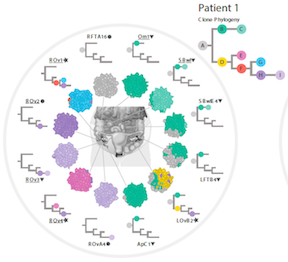
The study results are naturally biased by the sampling strategy. The study design was subject to what material could be obtained during the provision of care. In our setup, we consented patients for collection and study of all material removed at primary debulking surgery. Wherever possible tissue was cryopreserved, but inevitably many deposits were preserved in formalin. Our strategy led to acquisition of a median n=10 samples per patient. The nature of the samples and their locations are presented in Figure 4 and are also available in interactive web-form at:
https://compbio.bccrc.ca/research/tumour-evolution/
Users can click on the links for each patient and explore the clonal maps.
You utilize both bulk and single cell sequencing as complementary approaches to elucidating tumor evolution. Can you comment on the trade offs between cost and throughput and how you chose your sample sizes?
The field is entering an interesting time. There are several limitations to both bulk and single cell sequencing strategies to define the clonal constituents of a tumor sample. Most single cell techniques suffer from vast under-sampling of the clonal repertoire since they are limited in throughput and may only practically yield data from 100s of cells. Furthermore, single cell techniques are prone to two key experimental sources of noise: missing data and allele-dropout. We used targeted, multiplexed single cell sequencing as a form of validation from inferences made from the bulk sampling including validating co-occurrence of point mutations and structural variations in the same cells. Hypotheses were generated from multi-site bulk analysis and were then tested using orthogonal single cell approaches. Accordingly, the sample sizes in single cell were chosen to identify clones that were detected in bulk samples – in the range of 5% prevalence. Notably, the noise properties of targeted multiplexed single cell data required some careful statistical treatment, the results of which were published as a standalone contribution in Nature Methods simultaneously with this publication. As the field moves forward, it may become practical to sequence the whole genomes of 1000s of cells per sample. I look forward to the day when a single experimental design would be sufficient to dissect the important clones present in a cancer. This would enable studying evolutionary properties at scale, leveraging richly defined principles and statistical models from the field of population genetics.
You find that there are differences in the potential for migration and metastasis across the tumors from your patients. What clinical implications might this have?
Our study is underpowered to provide a clear answer on this. Our results hint anecdotally that cases with strong patterns of unidirectional spread fared poorly in their treatment trajectories. Whether cancers harboring clones with strong potential to invade new micro-environments and dominate their local landscapes indicates potential to evade chemotherapy remains an important question to consider. As we take this study forward in model systems derived from spatially distinct sites, reproducible treatment selection experiments can be carried out to robustly address this question.