
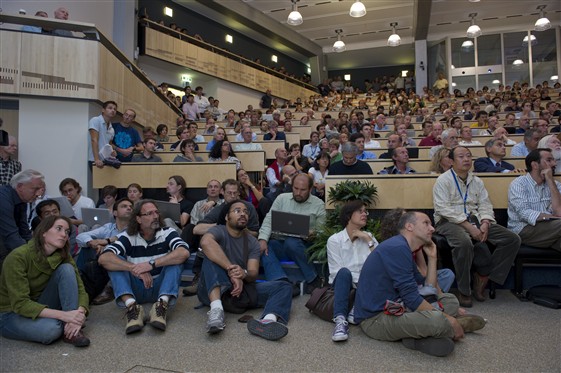
 A month after revealing errors in their high-profile claim that subatomic neutrinos had been clocked traveling faster than the speed of light, two leaders of the Italian OPERA collaboration have resigned. Both spokesman Antonio Ereditato of the University of Bern in Switzerland and physics coordinator Dario Autiero of Lyon’s Institute of Nuclear Physics in France, who presented the stunning result in September 2011 to a packed auditorium at CERN (pictured), sent out resignations today.
Autiero says that both men have been concerned about the existence of a large split within OPERA’s 170-strong collaboration, and want to make way for an alternative leadership that can provide more unity. Ereditato, reached by phone, says firmly, “my comment is no comment.”
OPERA had clocked neutrinos traveling 730 kilometres from CERN near Geneva, Switzerland, to Gran Sasso National Laboratory near L’Aquila, Italy, finding that they arrived 60 nanoseconds faster than a light beam would do. This seemed to conflict with Einstein’s Special Theory of Relativity, which bans faster-than-light travel. But a subsequent investigation of the experiment’s systematics revealed a troublesome cable and timing device that cast doubt on the certainty of the result. OPERA still plans to repeat its measurement in May with the goal of quantifying the effect of its errors.
Autiero denied that he was stepping down because of mistakes in the measurement, saying that the discovery of an unknown systematic error is an inevitable hazard for any scientist doing a precision measurement. “In science you cannot pretend to be the owner of any absolute truth,” he says. Instead, he says that he and Ereditato felt that tensions that had always existed within OPERA were becoming impossible to bridge. He acknowledges that these were exacerbated by the publication of the provocative result, with some complaining from the beginning that the findings were likely to be wrong. He also agrees that the spectacular degree of media attention has brought pressure to bear. Despite the fact that OPERA itself never claimed to overturn Einstein’s theory, keeping its claims narrowly to the report of an anomalous measurement, many newspapers depicted it that way. ‘They played with the sensationalism of the story,” he says.
Yves Declais, also of Lyon’s Institute of Nuclear Physics in France, who was spokesman of OPERA from 2002 to 2008, says that OPERA has always been difficult to lead. There are cultural splits between the Italians and Northern Europeans, and a lot of personality conflicts that make it hard to have a quiet scientific discussion, he says. He believes that part of the problem is that the leaders are elected by a collaboration board of 20–30 people, consisting of one person from each participating institution, and not by the whole collaboration, so many do not feel it is truly representative.
Ereditato’s resignation was first reported by Reuters. His and Autiero’s resignations were unexpected, and Autiero suggests that it may take some weeks for OPERA to elect successors.
Update: Physics World reports that the resignations followed a vote of ‘no confidence’, which, although it did not carry with enough votes to require a change of leadership, made clear that the majority of researchers in the collaboration were no longer supportive.
Update 31 March: Antonio Ereditato has issued a lengthy public statement, echoing Autiero’s account of the resignation, and again taking a swipe at the media for, he says, sensationalizing the result and putting pressure on the collaboration. He says he did everything he could to dissipate tensions in the project, but when these turned into open criticism, “I felt that the time had come for me to tender my resignation in order to foster a new, more widely-shared consensus.”
Image: Dario Autiero’s September 2011 Seminar/CERN