
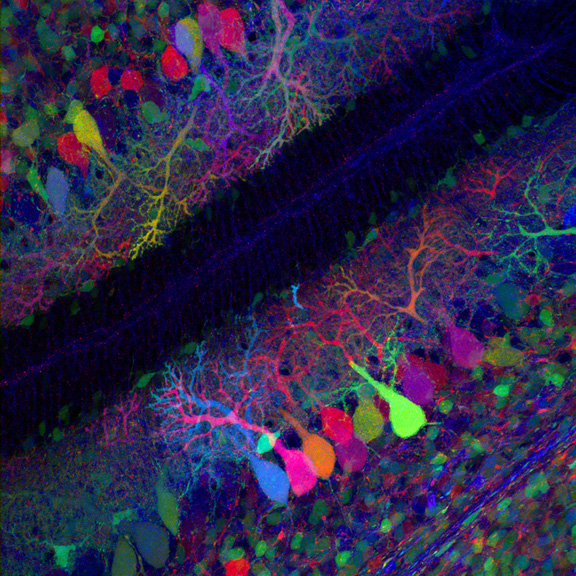
Image: Tamily Weissman
This week’s paper is by Abigail Person and Indira Raman and is about information transmission between two cell populations in the cerebellum – purkinje cells in the cortex and their targets in the deep nuclei. Purkinje cells are justifiably famous for their spectacular anatomy which enables integration of thousands of inputs. This paper, however, is about their output and how these exclusively GABAergic cells control the activity of downstream neurons. Conventional wisdom holds that there should be a straightforward inverse relationship between the firing rate of the two populations, but this has not always been observed. Person and Raman present a new solution based on spike timing – when purkinje cells spike asynchronously, their targets are inhibited (as expected), but when they spike synchronously, nuclear neurons can spike during the gaps in inhibition and end up time locking their activity to their inputs.
This is an intriguing proposal for how information is transmitted in the cerebellum that could have implications for how this brain structure controls movement, but it’s just the first step. The proposal is built from in vitro experiments, deduction, and some supporting in vivo data, but several crucial unknowns have to be resolved before we’ll know whether it’s relevant to actual behavior. There was plenty of spirited discussion during the review process about the strength of some of the authors’ assumptions. There were deeply divided views on whether the authors had made sufficiently strong a case for how the cerebellum IS operating, as opposed to just proposing how it COULD be. We had to decide whether to publish a paper that everyone agreed was interesting, but one that contained some pieces of indirect evidence and some good (but by no means universally agreed-upon) assumptions.
Obviously, in the end we did decide to publish. Fundamentally it came down to this: the “killer experiment” that would verify the hypothesis – recording of nuclear neurons in vivo while manipulating the synchrony of its input purkinje cells – is technically not something that can be done routinely now (as far as we know) and would not have been reasonable to ask of the authors. It was universally agreed that, if true, the conclusions were potentially important and the current data were deemed technically sound by the reviewers. So rather than be totally risk averse and wait for technology to come along that would enable the authors to test their hypothesis directly, we decided to put it out there and see if it stands the test of time.
But to acknowledge the diversity of positions that can be taken, and to expand upon the nuances and limitations of the conclusions, we are accompanying it with a News and View Forum by Javier Medina and Kamran Khodakhah discussing points both in support of and questioning the authors’ hypothesis. (NB to answer a question I’m often asked: News and Views authors are often, but not always, reviewers of papers). We are eager to hear your feedback and welcome any discussion here on this blog or in the comments section of online version of the paper.
With thanks to Tamily Weissman for the image of purkinje cells in the Brainbow mouse.