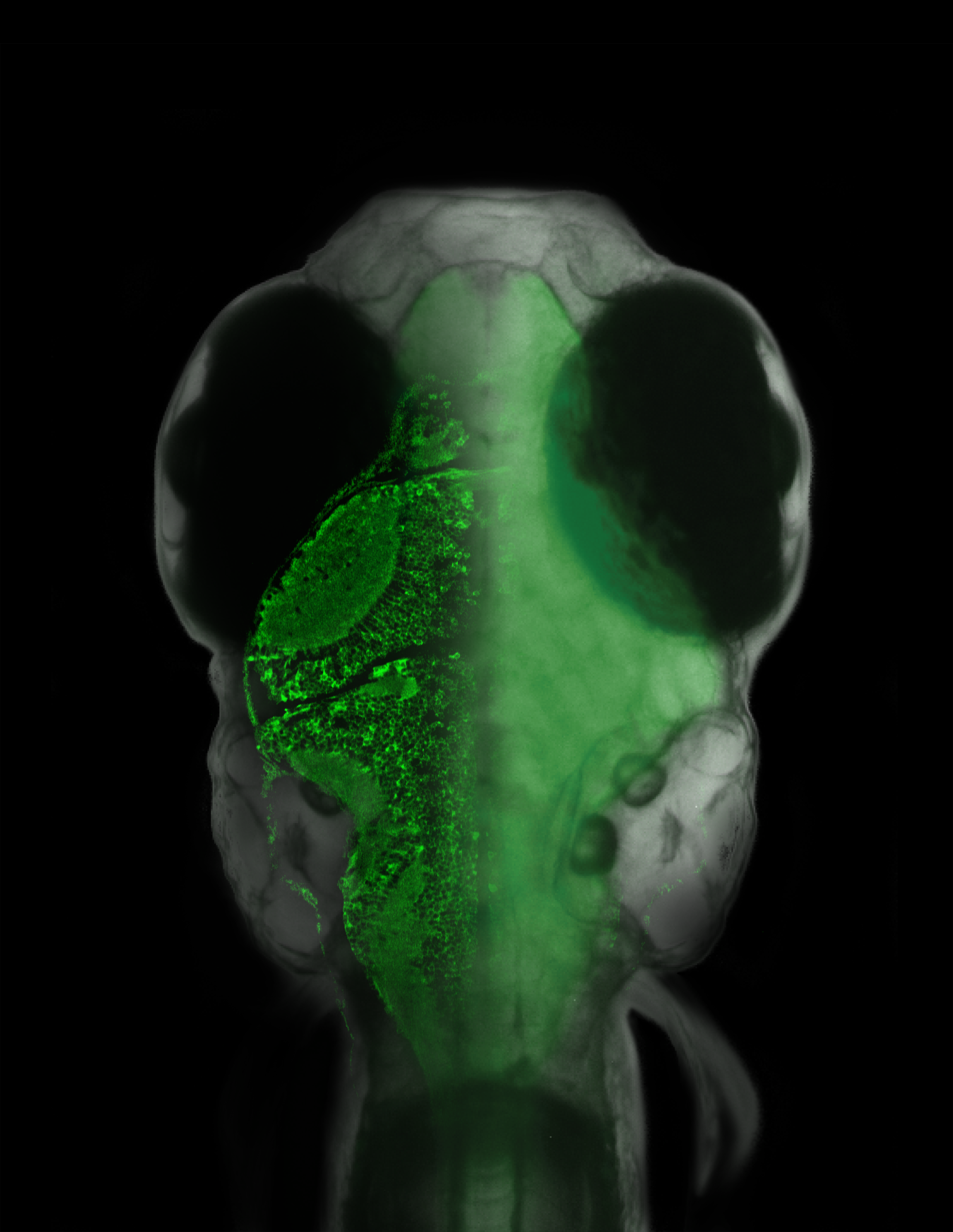
“There is no spoon…”: Paralyzed fish navigates virtual environment while we watch its brain

Overlaid on the micrograph of the fish is a slice of its brain measured with a laser scanning microscope, in which single neurons are visible.{credit}(courtesy of Ahrens et al.){/credit}

Sometimes an experiment will just reach off the page and slap you in the face, demanding attention. This happens to me every so often and I must admit, our latest paper from the lab of Florien Engert induced such an experience. There have been several cool, technical tours-de-force (is that proper grammar??) over the last few years involving different creatures navigating in a virtual environment while neuronal activity was monitored. These include a mouse running on a spherical treadmill, as well as a fly marching along a similar treadmill-style ball. But in these examples, having the subject head-fixed (for the stability of recordings in the brain, either with electrodes or through imaging) was moderately non-intrusive since walking motions were independent of the head. The same can’t be said for the subject in this latest example of a virtual reality navigator: a wriggling, swimming fish. Therefore, a more creative solution had to be sought and in a paper published online yesterday, Ahrens, Engert and colleagues decided that paralysis was the way to go in order to follow the neural activity of this navigating fish. Continue reading
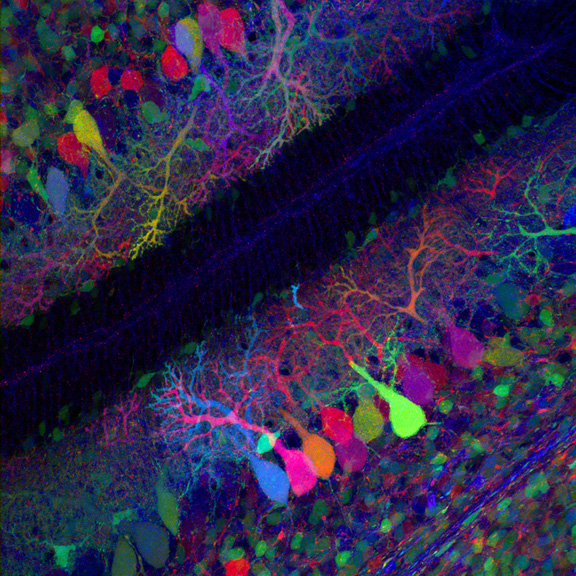
Timely inhibition

Image: Tamily Weissman

This week’s paper is by Abigail Person and Indira Raman and is about information transmission between two cell populations in the cerebellum – purkinje cells in the cortex and their targets in the deep nuclei. Purkinje cells are justifiably famous for their spectacular anatomy  which enables integration of thousands of inputs. This paper, however, is about their output and how these exclusively GABAergic cells control the activity of downstream neurons. Conventional wisdom holds that there should be a straightforward inverse relationship between the firing rate of the two populations, but this has not always been observed. Person and Raman present a new solution based on spike timing – when purkinje cells spike asynchronously, their targets are inhibited (as expected), but when they spike synchronously, nuclear neurons can spike during the gaps in inhibition and end up time locking their activity to their inputs.

This is an intriguing proposal for how information is transmitted in the cerebellum that could have implications for how this brain structure controls movement, but it’s just the first step. The proposal is built from in vitro experiments, deduction, and some supporting in vivo data, but several crucial unknowns have to be resolved before we’ll know whether it’s relevant to actual behavior. There was plenty of spirited discussion during the review process about the strength of some of the authors’ assumptions. There were deeply divided views on whether the authors had made sufficiently strong a case for how the cerebellum IS operating, as opposed to just proposing how it COULD be. We had to decide whether to publish a paper that everyone agreed was interesting, but one that contained some pieces of indirect evidence and some good (but by no means universally agreed-upon) assumptions.

Continue reading