
By Carolyn Beans, contributor
Professor C. Bodin, LEGO’s newest scientist minifigure, has a lot going for her. She built a fascinating career around finding “new and interesting ways to combine things together.” Her hard work was rewarded with a Nobrick Prize. She looks smart and professional in her crisp white lab coat and glasses. And last month, her very existence was met with a deluge of Tweets and blog posts as male and female science enthusiasts alike welcomed a long-over-due female scientist to the LEGO minifigure collection. Here is a LEGO character that will inspire girls to follow her away from pink-and-purple-sparkle-covered pass-times and into the lab.
The only trouble is that if girls actually read Professor C. Bodin’s bio, they’ll likely wonder whether they will ever get to leave that lab. According to Professor C. Bodin’s LEGO page, “She’ll spend all night in her lab analyzing how to connect bricks of different sizes and shapes…”
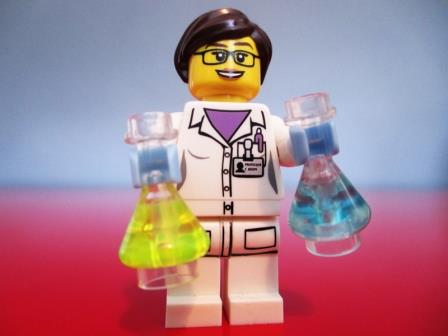
Prof Bodin{credit}Maia Weinstock {/credit}
I appreciate that LEGO wants to describe their new scientist as a hardworking professional. But I worry that we may lose budding scientists if we continue to depict STEM researchers as people who have no lives outside of their careers. Why can’t Professor C. Bodin do groundbreaking work during the day and still make it to her hip hop class or book club at night?
Stereotypes surrounding scientists abound—we dress in lab coats, we live in our labs, we have crazy hair, we are male. When we focus our energy on overturning just one of these misconceptions, we may unwittingly support another, or even support the very stereotype we are trying to address. LEGO did so much right when creating Professor C. Bodin. But presenting the profession of science to children can be tricky business. In my own interactions with young would-be scientists, I’ve faced similar challenges.
Along with other graduate students in our Women in Math and Science Club, I make regular visits to kindergarten and first grade classrooms. Our goal is to excite kids about science by encouraging them to observe the natural world, make and test hypotheses, and learn from unexpected results. While we’re at it, we aim to destroy any stereotypes about science that the kids may absorb from television or movies. We’ve been surprised, at times, by just how complicated stereotype busting can be.
The ‘scientists-are-chemists’ stereotype
We started wearing lab coats during our elementary school visits primarily to counter the misconception that only old white men with crazy hair wear them. Also, sometimes our experiments can get messy so wearing a lab coat makes sense. But by wearing them to all of our visits, I’ve recently begun to wonder whether we are fending off the scientists-are-male stereotype only to replace it with the scientists-are-chemists stereotype. I do most of my research outside or in a greenhouse so I rarely need a lab coat. I have to borrow one for these visits and I always feel like I’m playing dress up when I put it on.
Children may be more interested in science if they know there are many different STEM fields to explore. By perpetuating the idea that all scientists wear lab coats, we may under-represent the broad scope of scientific career possibilities. After all, who’s ever seen scientists wearing lab coats while deep sea diving, collecting seeds, or programming new video games?
The ‘scientists-are-male’ stereotype
In our visits we’ve explored everything from what makes an object sink or float, to how liquid turns to gas, to where to find beetle larvae in a shelf fungus. We are rewarded with exclamations of “I love science!” “Let’s do another experiment!” “I’m going to be a scientist someday!”
Occasionally, however, we hear an excited shout that makes us cringe. As we walk into a classroom, we sometimes hear a student scream, “It’s the lady scientists!”
When I hear these shouts, I fear we may have inadvertently introduced the idea that we women need our own science club because we are somehow different from other scientists–the idea that there are scientists, and then there are lady scientists. We certainly do need our own club and will continue to need it until the gender gap in science closes. I wonder, though, whether by cluing young children into this fact, we have created a gender divide that otherwise wouldn’t exist for them yet. If we just introduced ourselves as scientists, and didn’t mention our club, would it have occurred to students that not one of us is male?
The ‘scientists-are-geniuses’ stereotype
As we watch children work, there is always one student in every group who comes up with the correct hypothesis, blows through the experiment, and then, while waiting for others to finish, figures out how to use his or her experimental supplies to make some crazy musical instrument or toy. These students are clearly bright. On multiple occasions I’ve caught myself saying, “Nice work! You’re quick!” Or, “Wow! You’re a smart cookie.”
But praising a student’s intelligence can be dangerous. Sure, it takes some degree of smarts to be a successful scientist. But scientists must also have an insatiable curiosity and dogged determination. If we make scientists out to be geniuses, then students may come to think that if they don’t figure a problem out on their first try, then they must not be scientist material. Surely better to praise children for their determination, and to be honest with them about all of the many times we too have been stumped or flat out wrong.
Scientists may, on occasion, work all night like Professor C. Bodin. But we also may play sports, spend time with our families, go to the beach every summer, and bake the best carrot cake. Scientists may work with chemicals, but we also may work with magnets, beetles, and glowing axolotls. Whether in the toy aisle or in the classroom, presenting the profession of science to children is challenging. There are just so many stereotypes to navigate around. I am starting to realize the best way to bust those stereotypes is to take off the lab coats and simply be ourselves.
Carolyn Beans is a fourth year Biology PhD student at the University of Virginia and is one of the winners of this year’s Nature careers columnist competition. Watch out for more posts from Carolyn here on the blog and in the magazine.
Image courtesy of Maia Weinstock.