
Amidst the sorry stories we hear about dwindling (and mostly non-existent) tiger populations across tiger reserves in India, there was something to cheer during the long Independence Day weekend as Indian scientists demonstrated the invaluable genetic diversity of the subcontinent’s big cats.
Samrat Mondol and Uma Ramakrishnan of the National Centre for Biological Sciences, Bangalore, along with K. Ullas Karanth of the Wildlife Conservation Society, New York and Centre for Wildlife Studies, Bangalore urged through their study that conservation efforts “must prioritise regions that harbor more tigers, as well try to capture most of the remaining genetic variation and habitat diversity.” Nature India research highlight.
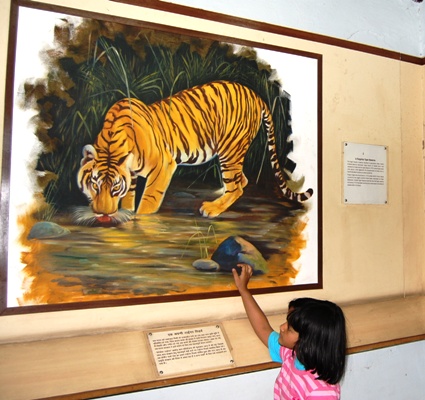
Will they grow up to admire these stripes in paintings alone?
Only such prioritisation based on demographic, genetic, and ecological considerations can ensure species recovery and retention of evolutionary flexibility in the face of ongoing global changes, they say.
As widely reported now in the media, thanks to the ever growing concern for the tiger, the trio sampled 73 individual tigers from 28 reserves spread across the Indian subcontinent to find that Indian tigers retain more than half of the extant genetic diversity in the species. Their results suggest that only 1.7% (with an upper limit of 13% and a lower limit of 0.2%) of tigers from historical times remain now.
In an analysis of the study, Oliver A. Ryder of San Diego Zoo’s Institute for Conservation Research in California, USA, says the team’s proposal merits serious consideration, but the realities of providing sufficient habitat for expanding tiger populations should also be calculated into global efforts for tiger conservation.
I spotted a blog post by Anne-Marie Hodge, an undergraduate in biological sciences at Auburn University, Alabama, USA, who raised some rather interesting points on what to make of the genetic diversity issue. I am tempted to quote her from her Nature Network blog here:
“I am increasingly concerned that the public will get the impression that we can claim conservation success merely by preserving genetic diversity. Much has been made of ‘minimum viable populations,’ ‘maximum sustainable yield,’ and the like, with too little regard for the integrity and function of food-webs, and the resulting impacts on not only predators and prey but the ecosystem as a whole. Humans had been doing their best to eradicate large carnivores long before our historical and scientific records began. We would not know how large Indian tiger populations were several centuries ago if analyses like the ones in the current PLoS paper did not allow us to create estimates from molecular evidence. This makes it extremely hard to set appropriate goals for conservation and management plans.
Even if we had a complete tiger genome on hand, it would not do much good if the animals are relegated to zoo cages or small ecotourism resorts. Even if a token number of animals are allowed to roam in the wild, the species would simply be lingering as a present and yet enfeebled shade of its former self, with its role in community interactions and regulation essentially paralysed.
Genetic diversity is still a crucial factor, and the results of this paper are both important and fascinating. This information gives us further clues as to the size and distribution of historic tiger populations, which can lead to further analyses of predator-prey relationships and ecosystem interactions. The news about the remaining genetic diversity is encouraging; inbreeding depression can potentially prevent species from ever recovering from extremely low population numbers, even if their habitat is restored.”
I wonder what Indian conservation experts have to say on the way forward from this important scientific finding. Also, whether this will affect any policy changes in the existing conservation roadmap of the country’s big cats.