Genetic sequencing tools key to pandemic fight

Indian-born British chemist Shankar Balasubramanian recently won the Millennium Technology Prize, instituted by the Technology Academy Finland, for development of revolutionary DNA sequencing techniques. Vanita Srivastava caught up with him to understand the award winning genetic sequencing work that has widely impacted the fields of genomics, medicine and biology.

[Shankar Balasubramanian is a Herchel Smith Professor of Medicinal Chemistry in the Department of Chemistry at the University of Cambridge, a Senior Group Leader at the Cancer Research UK Cambridge Institute and a Fellow of Trinity College, Cambridge. He won the one million euro prize jointly with David Klenerman.]

Shankar Balasubramanian{credit}University of Cambridge{/credit}

Q. Tell us about your genome sequencing technology and how it has impacted the course of the COVID-19 pandemic.

A. Prof David Klenerman and I are co-inventors of Solexa-Illumina Next Generation DNA Sequencing (NGS). The technology was fully developed at Solexa into an integrated, commercial system, then further improved by the team in Illumina. This technology has enabled fast, accurate, low-cost and large-scale genome sequencing, which is the process of determining the complete DNA sequence of an organism’s make-up.

During the pandemic, NGS has been providing an effective way to study SARS-CoV-2’s genetic make-up and help us track the viral mutations, which continues to be a great global concern. This work has also helped the creation of multiple vaccines now being administered worldwide and is critical to the creation of new vaccines against new dangerous viral strains.

Q. India is now a hotspot of coronavirus mutants. How can this technology help address problems relating to this?

A. By studying and understanding the genetic make-up of the new mutant using our technology, we can identify its potential as a new threat by knowing how it differs from the other variants. Further, I hope that our technology can be useful in sequencing the genomes of people who have had COVID and trying to get an understanding of why some people are severely affected by the disease and others are asymptomatic. This approach could identify risk factors in specific people that may also be applicable to other viruses in years to come.

Q. What other potential use does this technology have?

A. The technology has a huge transformative impact in the fields of genomics, medicine and biology. It is being applied widely in the basic research of living systems, as DNA and RNA are fundamental to cells and organisms. Aspects of living systems include genetics, the expression of genes, the structure of DNA in the nucleus and differences between cells, to name but a few.

The technology is beginning to be applied in medicine, particularly in the areas of cancer and rare diseases. The applications in medicine will grow as we sequence more human genomes allowing the idea of personalised medicine where diseases are more optimally treated by understanding the individual and the drugs that are used are designed to correct the molecular pathway that has gone in a specific person. It will also be used in agriculture to breed species with desired properties.

Over the past few years, there have been tremendous advances in cancer, both with therapy and also detection and diagnosis. Over the coming decades, the goal is to use this technology to help make some cancers become manageable diseases because they are detected sufficiently early and it’s clear what has to be done. This could also hopefully be extended to other complex diseases such as heart disease and Alzheimer’s disease.

Q. What are the challenges to personalised genomic medicine?

A. Developing an effective and efficient infrastructure for sequencing patients on a large scale and using their genetic profile to help make the decisions in regard to the prevention, diagnosis, and treatment of their disease is currently the biggest challenge.
Publishing metrics and agricultural science

Having achieved an H-index of 100, Rajeev Varshney* explains what the metric means in scientific publishing and why it is a milestone, especially in an agricultural scientist’s life.

H-index is an author-level metric that measures both productivity and citation impact of an author’s publications across the global scientific community. It is calculated by counting the number of publications in which an author has been cited by other authors. H-index 100 means each of the latest 100 of the author’s papers have been cited at least 100 times.

Opinions vary on these metrics and the number of citations is not the only way to measure scientific impact. But it certainly is one of the many metrics that recognise scientists’ publishing lives, and in turn, their science. Research publications are a great way to share the latest advancements in science with the global community. They also help reduce redundancy or duplication in research while directly or indirectly saving the valuable time and effort of the scientific community as also taxpayers’ money.

Generally speaking, medical science generates more research innovations that are used by different biological disciplines, including agricultural sciences. As a result, citations in medical science research are higher than agricultural science publications. When agricultural science publications have high citations, it does indicate that the research is making an impact in advancing science. The milestone of 100 h-index is a recognition of the high-quality science at ICRISAT with colleagues and partners from across the globe.

The metric that matters even more

The real battle that agricultural science should wage is against hunger, food insecurity and malnutrition. Scientists in the same discipline anywhere can learn from the latest research and take it forward to address issues of smallholder farmers while advancing the cause of scientific research for global good.

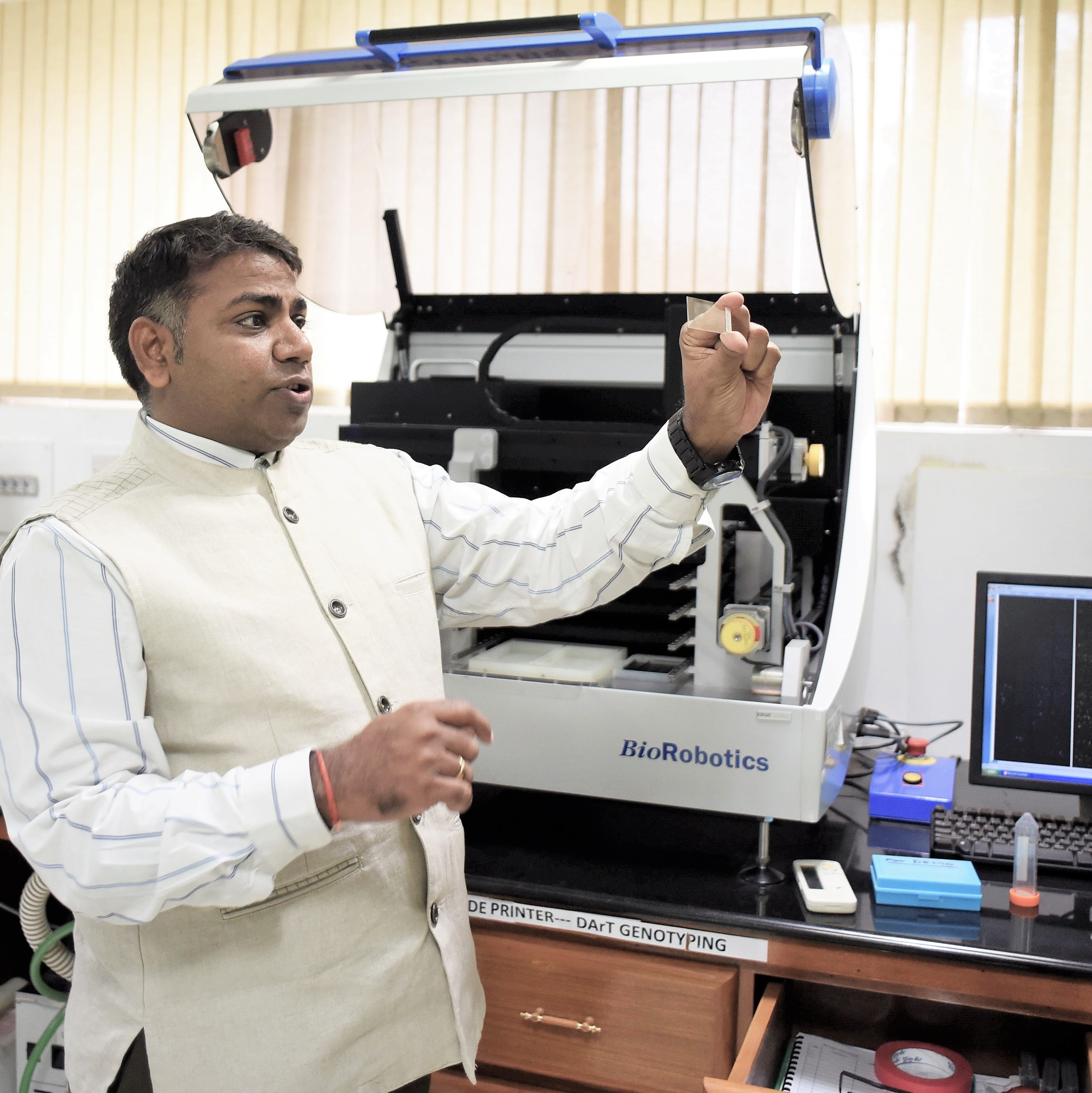
As scientists, we believe in every study we conduct irrespective of the results we get. Some of the research we conducted with a large number of global partners has an edge over the others because of massive learnings from the multidisciplinary scientists involved. For example, our genome sequencing work of 429 chickpea lines was a collaboration of 39 scientists from 21 research institutes across 45 countries. It tapped next-generation sequencing (NGS) technology to better understand the genetic architecture, centre of origin, migration route as well as genetic loci for agronomic traits in chickpea. This study1 with several brilliant minds from across the world offered much learning for me.

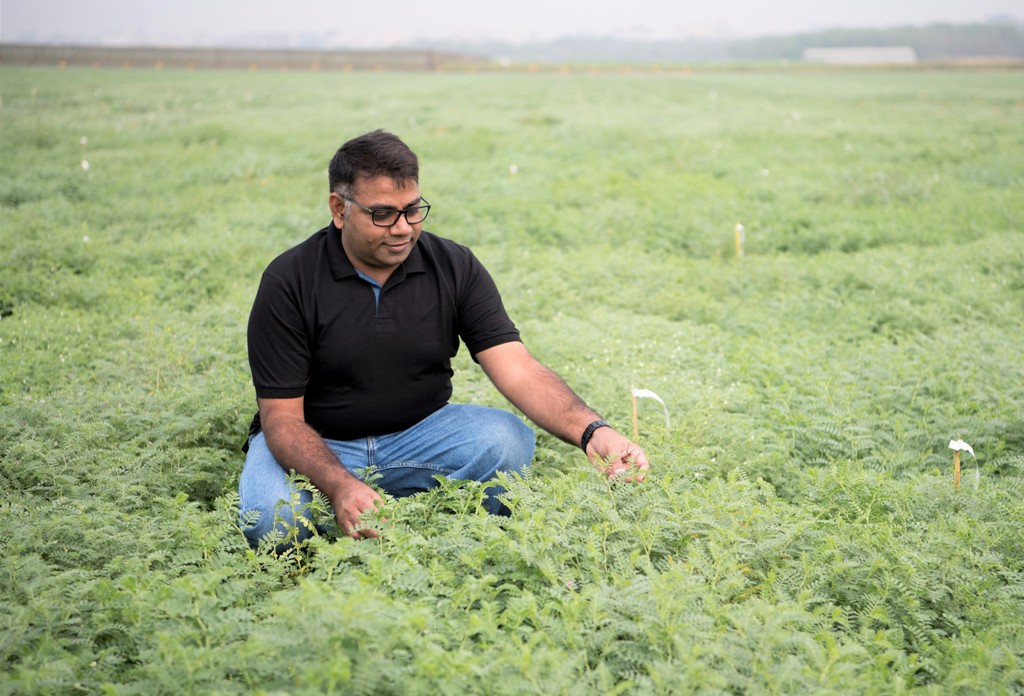
Chickpea crop improvement has been a key area of Varshney’s research.

There is a great sense of satisfaction when the upstream research we conduct delivers results in farmers’ fields in addition to advancing the cause of science for global good. As a genomics scientist, I provide research outputs for breeding programmes that develop improved crops.

ICRISAT’s collaborative work on genomics-assisted breeding helped develop and release the first set of products in 2019. There were three high yielding, wilt resistant varieties of chickpea2, 3 and two high-oleic varieties of groundnut4. The Ethiopian Institute of Agricultural Research also released a high-yielding chickpea variety5. The groundnut varieties were among the 17 biofortified crops dedicated to India on World Food Day 2020.

My efforts in genomics-assisted breeding will continue with an aim to accelerate the replacement of older crop varieties to help smallholding farmers improve their income and ensure better nutrition and health for the society.

(*Rajeev Varshney is Research Program Director, Genetic Gains and Director, Center of Excellence in Genomics & Systems Biology at the International Crops Research Institute for the Semi-Arid Tropics (ICRISAT), Hyderabad, India.)

Away from home: Doubling research fun with twin subjects

Our ‘Away from home’ interactive map features 49 bright Indian postdocs from around the world. Write to us at npgindia@nature.com to suggest names of postdocs from countries and disciplines we haven’t covered yet.

Varun Warrier, a postdoctoral researcher at the Autism Research Centre in University of Cambridge, UK, talks about the beautiful marriage of genetics and neurosciences . And how he has come to combine these two complementary subjects to carve out a meaningful research career. An alumnus of the Jawaharlal Nehru Centre for Advanced Scientific Research (JNCASR), Bangalore, Varun works on the genetics of autism and related traits.

Varun Warrier

It helps to know what you don’t want to do

When I finished high school, I had no idea what I wanted to do. I knew what I didn’t want to do, and in retrospect, that was very helpful. I didn’t want to study engineering or medicine. I didn’t have the inclination for the former, and was too squeamish for the latter. I ended up pursuing a degree in zoology, something I was reasonably good at.

At the end of the three-year undergraduate programme, I was faced with exactly the opposite problem. I knew what I wanted to do, but had to make a choice. I was lucky enough to get a three-summer undergraduate fellowship at the Jawaharlal Nehru Centre for Advanced Scientific Research (JNCASR), Bangalore. There, I worked with Anuranjan Anand on the genetics of stuttering. We searched for genetic regions linked to stuttering using an old genetic mapping technique called genetic linkage mapping. Many of the interesting genes were involved in brain development or neural signalling. I soon realized that I was as excited by neuroscience as genetics, and I had to decide between the two for my graduate programme. Since I already had some research experience in human genetics, I chose neuroscience for master’s at University College London (UCL).

People ask me if it was a big jump from zoology to neuroscience. I don’t think it was. The zoology degree was panoramic and, in effect, a life sciences degree. So, while some concepts like cognitive neurosciences were new, I was never completely at sea.

At UCL, I was required to conduct a 9-month research project. I was very much looking forward to this. Perhaps I wasn’t adventurous enough and ended up choosing a genetics project again! I worked on an extremely rare and debilitating childhood neurogenerative disease called Neuronal Ceroid Lipofuscinoses and thoroughly enjoyed it.

Coupling favourites

Towards the end of the project, when I had to make another choice, it came easy. I was enjoying the beautiful coming together of the two disciplines – neuroscience and genetics. I wanted to investigate research questions in neuroscience, using genetic methods. These silos are all a bit arbitrary though and don’t really matter too much. Once you start working on something, you’re likely to ‘borrow’ ideas from multiple fields.

It was this happy marriage of genetics and neuroscience that got me working with Simon Baron-Cohen at the University of Cambridge in the United Kingdom for an MPhil and a PhD. Getting into Simon’s lab was a matter of being at the right place at the right time. I had read some of Simon’s work, and wrote to him. I didn’t expect to get in. But as luck would have it, Simon had genetic data that needed to be analysed.

At Cambridge, I gradually pivoted towards human genomics, which required a lot of programming and statistics. I worked (and still do) on the genetics of traits related to autism, such as empathy, emotion recognition, and an interest in systems. People are surprised when I tell them of my work on the genetics of these traits – many don’t think something like empathy is genetic. But all human attributes are partly genetic despite what my sociologist friends will tell you.

Autism is complex, and no two autistic persons are alike. There are subgroups within the autism spectrum. Large scale genetic studies have had some success in subgrouping this spectrum by identifying variants in specific genes linked to specific syndromes. My most exciting research so far suggests that the two core domains of autism – social interaction difficulties (the social domain), and the unusually repetitive and restricted interests and behaviour (the non-social domain) – are genetically dissociable. I am not the first to suggest this as there have been a few studies to come to similar conclusions, but ours was the first to provide molecular genetic evidence in support of this hypothesis.

Choose your lab, supervisor well

So much of this journey has been made less arduous by very supportive and inspiring mentors and supervisors. When you don’t get along with your supervisor, your project can be extremely stressful. It’s always important to think carefully about doing a PhD, and finding the right supervisor. A PhD is always challenging, and it’s meant to be.  To paraphrase the author Jhumpa Lahiri, writing a novel is like jumping off a cliff and not knowing where you’re going to land. I think this is true of a PhD as well. Ideally, you’re doing something new and you’re never sure if you’re going to get it right. That for me was the most exciting aspect of the PhD.

When I embarked on doctoral research, I knew three years would be enough for me to decide whether to stay in academia or not. I found the PhD experience so enjoyable that I’ve decided to stay on at the University of Cambridge, and have transitioned into postdoctoral research.

The first few months as a postdoc were daunting. I guess the lack of a structured medium or long-term goal is difficult to get used to. I’m now used to the rhythm of a postdoc, and continue researching the genetics of autism and related traits.

Something that people don’t necessarily tell you but becomes quickly apparent is the number of rejections you get as an academic. Experiments fail, manuscripts are rejected, applications are unsuccessful. Perhaps this is true of all human endeavour, but I have nothing else to compare this to. I am still learning to develop a thick skin and take failures and rejection in my stride. But it’s not always a rejection – the intermittent successes are enormously exciting and make everything worthwhile.

Dance your Science: Where did Indians come from?

Nature India‘s most recent and most creative foray into science communication is through a format called dance-narration. At the beautiful confluence of science and arts, these dance-narration productions are a unique new way of science story telling using the rich medium of traditional Indian performing arts.

We recently did a couple of experiments with the format and found that it won hands-down in terms of audience engagement and in conveying complex science ideas through a simple science-led script, dance expressions and music.

Here’s a piece we executed at the 10th Anniversary celebrations of Nature India on 16 April 16 2018. This dance narration tries to trace the origin of human life in India through a review of recent population genetics studies in the country. The troupe consisted of a trained classical Odishi dancer, a trained keyboard player and a science journalist.

The medium of dance and music allow the science story to become more personal and thus immediately understandable. Not surprisingly, this dance narration video is one of the most viewed, shared and liked content on our social media channels.

The script for the narration is culled from scientific studies, just like any journalistic science story. Some popular elements of science writing – drawing analogies, describing the human side of science, or contextualizing data and numbers – are used to enliven the script. Voice modulation and music variations are used to highlight the important points of the story and to add drama and excitement to the narrative.

We look forward to your feedback on this new experiment. Nature India hopes to bring to you many more dance narrations from various scientific disciplines in the near future.

India’s DNA fingerprinting hero through the eyes of a life-long mentee

It has been over a week that Lalji Singh, widely regarded as the father of DNA fingerprinting in India, and a former director of Hyderabad-based Centre for Cellular and Molecular Biology (CCMB) passed away (on 10 December 2017).

Tributes have been pouring in from around the world for the affable geneticist who could ‘light up a room with his smile’.

Today, one of his mentees and long time associates Kumarasamy Thangaraj pays a personal tribute to the man who was also known for his ‘English weather-like anger’ and was always true to his word, except once….

Dr_Lalji_Singh

Lalji Singh (1947-2017)

It’s very difficult to accept that Dr. Lalji Singh, who was always full of life and infected so many people around him with his exuberance, is not among us today.

I met Dr. Singh for the first time in Chennai in 1991 when he visited the Department of Genetics of the University of Madras to conduct the Ph. D viva of one of my seniors. I was a Ph. D student at that time and my supervisor Prof. P. M. Gopinath deputed me at the airport to receive Dr. Lalji Singh. I never imagined that this meeting would be the beginning of an immersive, life-long mentoring that was to shape my entire scientific career.

A couple years later I joined the Centre for Cellular and Molecular Biology (CCMB) in October 1993 as a junior scientist. CCMB Director Prof. D. Balasubramanian allowed me a generous interaction with group leaders to identify the lab I wanted to join. I met Dr. Lalji Singh, he offered me coffee, gave me an overview of CCMB, and discussed the project I would be expected to carry out in his lab. I liked the project as it was in human genetics, very similar to my Ph.D work. I readily agreed to begin my scientific journey with Dr. Singh, an association that continued till a few hours before his demise.

Dr. Singh made sure everything in CCMB ran smoothly, not just the science but also the supporting facility and administration. One morning in 1995, when most of us were working in the lab, he noticed a sink blocked with some gel causing problems for all of us. He walked up to the sink, put his hand in and removed the gel without waiting for anyone to come and clean. Everyone in the lab was stunned. We had learnt a great lesson in self-drive.

Many people thought he got angry very quickly. But not many knew that his anger was very short-lived and he never nursed grudges. In 1994, he organised an international conference on DNA fingerprinting and wanted to invite Prof. Ed Southern  of the University of Oxford. Prof. Southern’s secretary picked up his call but was somehow unable to connect the two — the invitation could not go through. Dr. Singh was infuriated. One year later, we established a collaborative research programme with Prof. Southern’s lab.  Dr. Singh sent me to Oxford to initiate the human diversity programme with Prof. Southern’s colleague Dr. Chris Tyler-Smith. When I met Prof. Southern’s secretary there, she recollected how angry Dr. Singh had got during that phone conversation. I told her she should forget this incidence as Dr. Singh’s anger was like the English weather — it never stayed for long. Back in Hyderabad, when I shared this incident with Dr.Singh, he had a hearty laugh.

If he couldn’t give something 100%, he wouldn’t do it. In March 2009, we jointly established the Society for Mitochondrial Research and Medicine (SMRM) along with Prof. Keshav Singh of the University of Alabama at Birmingham, USA. The idea was to promote mitochondrial research and bridge the gap between basic research and the clinics. Dr. Singh was the founder president and presided over two annual meetings. When he became the Vice-Chancellor of the Banaras Hindu University (BHU), I send him a mail regarding SMRM’s next annual meeting. He called me to convey it would be difficult for him to devote much time to SMRM and suggested we elect a new President instead.

He initiated several innovative programmes at CCMB. One such symbiotic programme invites students from universities and colleges with scant research facilities to make dissertations in human diversity at CCMB. The students get an opportunity to conduct research on human population samples which they bring from remote places, and CCMB gets to build a robust DNA bank, a great resource for population and medical genetic research. Dr. Singh’s mentorship and easy prodding has helped many, incuding me, to excel in the field of human genetics and has influenced several generations of scientists.

My journey with Dr. Singh was not restricted to the lab — it took me to the remote islands of Andaman and Nicobar and the dense forests of Chhattisgarh, where we collected the most precious samples, helping us reach very big scientific conclusions.

Though Dr. Singh always stood by his words, the one occasion he could not do so was on the afternoon of 10 December 2017. He told me on phone, “I am coming to Hyderabad”, but end came before he could leave Varanasi. This last conversation, which I was so fortunate to have with him, will continue to ring in my ears for a long, long time.


Related links:

India’s DNA fingerprinting pioneer Lalji Singh passes away

Nature India Photo Story: Cubanacan the Litigon

In our visual storytelling blog series titled the ‘Nature India Photo Story’, we feature photo stories that explore the realms of science, wildlife, environment, health or anything else that smells of science.

The third in this series is a photo story and commentary by Karl Shuker and Shubhobroto Ghosh, about the rediscovery of a litigon’s image amid the hybridisation debate, which Nature India has previously covered in-depth here.

On 22 May 2017, Karl Shuker, author and cryptozoologist in England, discovered this long lost photograph of an extraordinary hybrid cat. Cubanacan, the progeny of a lion and a tigon [tiger x lioness] was born at the Alipore Zoo in Kolkata, India, on 7 March 1979, and was the only surviving cub of his litter of three.

Cubanacan as portrayed in the 1985 Guinness Book of Records.

Cubanacan as portrayed in the 1985 Guinness Book of Records.{credit}Alipore Zoo, Kolkata{/credit}


Alipore Zoo had embarked on a fifteen-year endeavour to hybridise lions and tigers, an effort that created Cubanacan’s tigon mother, Rudrani, and her sister, Rangini, several years earlier. A pioneering scientific success for India, and even the rest of the world, Cubanacan was widely regarded as the first litigon born in the world.

A depiction of Cubanacan’s tigon mother, Rudrani, approaching his lion father, Devabrata. From 100 Years of Calcutta Zoo (1875-1975).

A depiction of Cubanacan’s tigon mother, Rudrani, approaching his lion father, Devabrata. From 100 Years of Calcutta Zoo (1875-1975).{credit} The Centenary Celebration Committee, Zoological Garden, Alipore, Calcutta (1975){/credit}


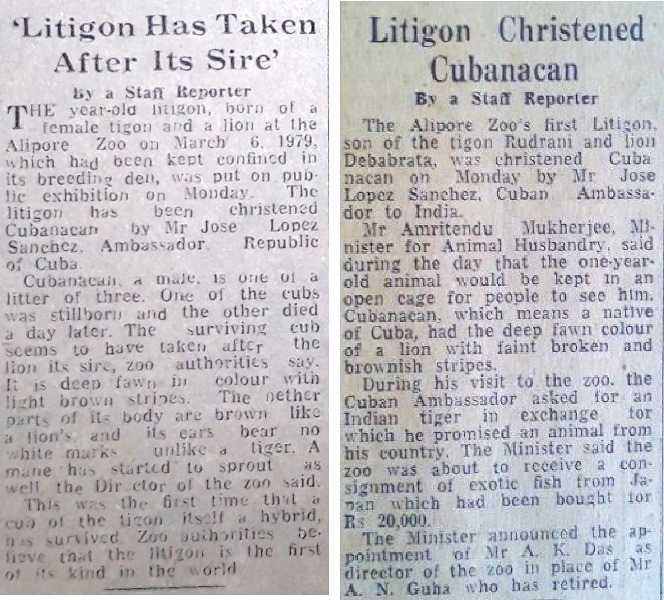
A captioned photograph of the litigon Cubanacan, published in The Statesman, Calcutta (now Kolkata) on 12 March 1980.

A captioned photograph of the litigon Cubanacan, published in The Statesman, Calcutta (now Kolkata) on 12 March 1980.

However, a record from 1943 indicates a successful mating between a fifteen-year-old lion-tiger and a lion at the Munich Hellabrunn Zoo to produce a female cub. Even so, Cubanacan’s remarkable genetic makeup sparked interest and enthusiasm in India and around the globe. The fascination with hybrid cats continued as Rudrani produced four more litigons in subsequent years.

There is now evidence that these experiments were led by a scientific quest to determine if hybrids could be fertile, a question that struck at the heart of the notion of biological species. At the time, the very definition of species hinged on reproductive isolation.  Though probing at a research question, concerns surfaced about artificially creating animals not found in the wild as freaks for public curiosity. There were also claims of animal cruelty during the process, an allegation that has come to the forefront in the current effort to ban cross breeding of big cats in the United States.

In the weeks following his birth, The Statesman ran articles about Cubanacan.

In the weeks following his birth, The Statesman ran articles about Cubanacan.

In the midst of this controversy, hybrids still command ample public attention. The 2017 Guinness World Records (formerly the Guinness Book of Records) ranked, Hercules, a liger [lion x tigress] at the Myrtle Beach Safari in South Carolina, the world’s largest big cat.

Cubanacan was also once the world’s largest big cat, who, according to Guinness in 1985, weighed 363 kg (800 pounds), stood 1.32 m (4.4 inches) at the shoulder and measured 3.5 m (11.6 inches) in length. Given the aversion to hybridisation and the subsequent 1985 ban on cross breeding big cats in India, it appears that Cubanacan’s memory was purposely forgotten.

Unspecified photographs of a tigon and a litigon, published in the Guidebook to Calcutta Zoo, A Dunlop Presentation, with legends whitened. Presumably, this was an effort to prevent proper identification of the taxa in the years after cross breeding became illegal. Exact publisher & publication date unknown, but circumstantially the photographs date to between 1992 and 1995.

Unspecified photographs of a tigon and a litigon, published in the Guidebook to Calcutta Zoo, A Dunlop Presentation, with legends whitened. Presumably, this was an effort to prevent proper identification of the taxa in the years after cross breeding became illegal. Exact publisher & publication date unknown, but circumstantially the photographs date to between 1992 and 1995.

The hybridisation debate in biology is important. So is the current proposal on banning big cat hybridisation in the US, and it is in the light of this controversy that Cubanacan’s photograph is being preserved for posterity as a valuable item in wildlife history, best viewed without value judgement.

Karl Shuker is a British zoologist, cryptozoologist and author. He currently lives in the Midlands, England, where he works as a zoological consultant and writer. He is a Scientific Fellow of the Zoological Society of London and a Fellow of the Royal Entomological Society. His books include Mystery Cats of the World (1989), The Lost Ark: New and Rediscovered Animals of the 20th Century (1993; expanded in 2002 as The New Zoo), and In Search of Prehistoric Survivors (1995), as well as two worldwide bestsellers – Dragons: A Natural History (1995; reissued in 2006), and The Unexplained (1996; reissued in 2002).

Shubhobroto Ghosh is Wildlife Project Manager of World Animal Protection in India and the author of the “Indian Zoo Inquiry,” a white paper review of conditions in Indian Zoos, and the book Dreaming in Calcutta and Channel Islands (2015).

[The authors are grateful to Dr Ashish Kumar Samanta and Ms Piyali Chattopadhyay Sinha, Director and Deputy Director of Alipore Zoo, for allowing the use of the Cubanacan photograph published in the Guinness Book of Records in 1985, in this photo story.]

You can follow this blog series online with the hashtag #NatureIndphotostory. If you have a photo story to tell, email your high resolution entries with a short narration and a couple of lines about yourself to npgindia@nature.com with the subject line “Nature India Photo Story”. If it appeals to our editorial team, your photo story might get featured on this blog.


Suggested posts

Nature India Photo Story: A midnight date

Nature India Photo Story: The kingfisher feeds

Nature India Photo Contest

GM debate

The long-drawn debate over genetically modified (GM) crops in India saw another shocker this week when one of the country’s Parliamentary committees said it was ‘highly disconcerted’ over the pressure being created by the GM industry over the body responsible for approval of GM crops in India (press release). The parliamentary committee smells a ‘collusion of a worst kind’ happening between the approving committee and the industry and has recommended a thorough independent probe into the introduction and subsequent moratorium on Bt. brinjal in India.

In 2008, the Indian Council for Agricultural Research (ICAR) had noted in a report that when lambs were fed with Bt. cotton seeds, the weights of their liver and testicles increased and the WBC in their blood decreased.  The parliamentary committee took note of this and has recommended a professional evaluation of these developments to decide biosafety and health safety aspects of Bt. cotton.

Another interesting observation that the committee makes is that considering India’s rich biodiversity and the irretrievability of transgenic crops released in the environment, any further research and development on transgenics in agricultural crops should only be done in strict containment. Field trials ‘under any garb’ should be a strict no-no. Serious concerns have been raised over the poor policies governing GM crops, absence of a powerful implementing authority, the likely impact of transgenics on agricultural and medicinal crops and labeling of GM products.

The report has met support from independent think tanks and is being seen as a clear indication that the government is waking up to the need for a more broad based debate over introduction of GM crops in India. Sunita Narain, who heads New Delhi-based Centre for Science and Environment says GM technologies need a robust and credible regulatory framework to work in the interest of people and environment. She deposed in front of the Parliamentary committee earlier and believes that this new report paves the way for a more matured debate on GM crops in India.

Hopefully we will have more indigenous R&D and healthier debates to support or trash each move of the government and the industry towards introduction of GM crops in this country.

Pashmina clone

After the controversy surrounding the claim over world’s first buffalo clone three years back, Indian scientists today claimed to have cloned world’s first pashmina goat. This, they say, was done using an indigenously-developed technique — the cost-effective “hand guided technique” earlier used to produce India’s first cloned buffalo.

The cloned female pashmina kid was born on March 9, 2012, according to reports. The scientists used somatic cells from the ear of a goat to produce the clone. The healthy baby is reportedly under medical observation. The World Bank-funded project was a collaboration between Srinagar-based Sher-e-Kashmir University of Agricultural Sciences and Technology (SKUSAT) and National Dairy Research Institute, Karnal (NDRI).

Pashmina goats are considered valuable for the economy of Jammu and Kashmir for their wool that produces the exquisite pashmina shawls and other products. There has been a decline in their population in the last few years and so the news of cloning comes as a blessing for all the pashmina workers in the region, who have seen bad days owing to the short supply of pashmina wool. The cloning technique, if perfected and commercially exploited, could bring back the glory days for these craftsmen in the Jammu and Kashmir valley and help boost its ailing economy.

Brinjalgate?

There could be a ‘Brinjalgate’ brewing in the wings as evidence trickles in that crucial data on the safety of Bt Brinjal was supressed or misinterpreted by Indian hybrid seeds company Mahyco in its report submitted to the country’s Genetic Engineering Approval Committee.

In animal studies, rats fed on Bt Brinjal exhibited decreased immunity, liver damage and reproductive disorders. These facts were not mentioned in Mahyco’s report, based on which India had approved the commercial release of Bt Brinjal. It is another story that the release had to be shelved last year in the face of massive opposition from environmental groups. Mahyco is the first private enterprise in India to produce and market hybrids of cotton, sorghum, pearl millet, sunflower and wheat. It was also the first Indian company to commercially grow and market transgenic Bollgard cotton — India’s first transgenic crop in 2002.

According to a media report, New Zealander epidemiologist Lou Gallagher analysed the data to report the mismatch between the Mahyco report and its interpretation. The report states ‘no alterations in the organ weights of rats treated at 1,000 mg/kg’ whereas significant changes were seen in ovarian and spleen weights.

The revelation reminds one of last year’s ‘Climategate’ triggered from leaked mails of the Climate Research Unit of the University of East Anglia. Data being tweaked and supressed to suit scientific hypotheses is not new.

This one will ensure that the Brinjal debate does not die down in a hurry.

Big fat studies

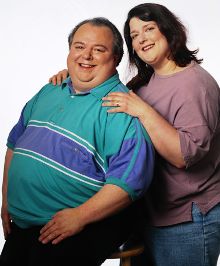
As Body Volume Index (BVI) takes the place of dear old Body Mass Index (BMI) to become the new accepted measure of general adiposity and obesity, textbooks will hopefully be re-written and fitness experts sensitised to the ‘gold standard’.

It appears more scientific to be able to determine the difference between muscle and fat in the body to assess how obese or not a person is. This is what BVI does as opposed to BMI, which is a measure of body weight based on a person’s weight and height. BVI also takes into account body shape determining exactly where weight is distributed across the body.

fat.jpg

© Getty Images

Parallely, two interesting studies in Nature Genetics this week look at new genomic regions associated with and sex-specific differences occuring in obesity. The first — a meta-analysis of 46 genome-wide association studies for BMI — identified 18 genomic regions newly associated with BMI, and confirmed 14 previously associated regions. This study highlights the role for neuronal regulators of energy balance in weight regulation.

The second — a meta-analysis of 32 genome-wide association studies for waist-hip ratio (WHR) — a measure of body fat distribution — identified 13 genomic regions newly associated with WHR. Seven of these associations show a stronger effect in women, highlighting sex specific differences.

A whole set of new genes associated with body fat distribution and obesity have been identified in these studies and that includes the largest study yet of DNA variation across our genomes involving almost ¼ million people.

Variations in DNA sequence in these genetic regions can actually be linked to whether we are apple-shaped or pear-shaped, the researchers say. A good lot of these variations have a markedly stronger effect in women than in men.

Another noteworthy aspect of these findings is that many genetic regions for WHR have been found to be independent of BMI. Genetics seems to be pointing us to biological distinctions between two components of the regulation of weight – how much we eat, and how and where calories are stored as fat.

Such fat news for a week that will see a lot of happy eating and bingeing in India, what with the festival season right ahead! Not everything can be dictated by your genes, shall we say?