SciArt scribbles: Playing science out

Many scientists embrace the artistic medium to infuse new ideas into their scientific works. With science-art collaborations, both artists and scientists challenge their ways of thinking as well as the process of artistic and scientific inquiry. Can art hold a mirror to science? Can it help frame and answer uncomfortable questions about science: its practice and its impact on society? Do artistic practices inform science? In short, does art aid evidence?

Nature India’s blog series ‘SciArt Scribbles’ will try to answer some of these questions through the works of some brilliant Indian scientists and artists working at this novel intersection that offers limitless possibilities. You can follow this online conversation with #SciArtscribbles .

In the opening blog of the series, we feature neuroscientist-dramatist-playwright Prabahan Chakraborty, a PhD student at the National Centre for Biological Sciences, Bengaluru, who fondly refers to his twin love for science and theatre as ‘the two vices of my life’. In dividing his time between the two, Prabahan says he finds a symbiotic give and take that enriches each of his passions in more ways than one.
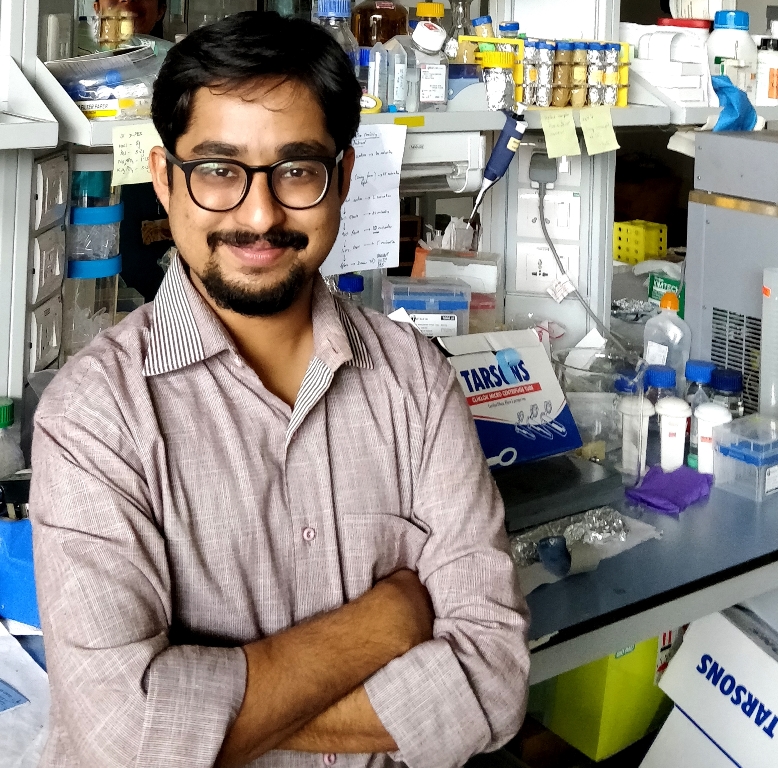
Prabahan Chakraborty

Everyone loves a good story. It could be about how brain cells store memories or a comedy about travelling musicians. Told well, stories have the wondrous ability to captivate an audience like nothing else can.

This is the invaluable lesson looking me in the face as I stand at the crossroads of two decades of theatre training and many years of graduate school. Right now, I am getting ready to submit my doctoral thesis and have just published an anthology of short plays – the story-teller in me embracing the scientist in a loving sort of way.

Nurturing the twain

Though I had been acting in plays since I was two and a half, my love for theatre blossomed with my first ‘big’ play at school when I was ten. Around the same time, I was presenting a field-based research project on medicinal properties of indigenous plants – first at a National Children’s Science Congress in 2000, at Indian Institute of Engineering Science and Technology, Shibpur, West Bengal and the very next year at the Indian Science Congress in New Delhi.

In the decade that followed, my summer vacations were filled with science camps, my weekends with theatre classes under the stalwart of modern Bengali theatre Ramaprasad Banik, and the last few pages of my notebooks with poems, stories and doodles.

My parents made sure I never missed a single tuition class (which I wanted to miss sometimes) or a single theatre rehearsal (which I never wanted to miss). Growing up, therefore, theatre and science coexisted peacefully in my life. Twenty years down the line, I feel incredibly lucky that none elbowed the other out.

The symbiosis

Connecting the dots on hindsight, my scientific curiosity around animal behaviour probably has its roots in how I saw characters behave in a play. A sudden crisis-inducing dialogue on stage seemed fascinating. A burst of song and dance that left a smile felt wonderful. Later, I learnt about the amygdala, and how it processes such emotional stimuli – how principles of Hebbian plasticity lead to long term changes that leave a lasting memory of fear. I learnt how amygdala was to be blamed for the anxiety I felt before every stage show and how the friendly hippocampus helped me remember precise cues for dialogues and choreography during a performance.

During the day, I study how stress affects neurobiological processes such as learning, memory and fear. By night, I am de-stressing and recharging myself with theatre. My scientific training, on the other hand, helps me structure each play with logic and reason. The canvas of a stage mirrors in its emptiness an unwritten Power Point slide. A stage looks ‘balanced’ with sets and actors, a slide with graphs and text.

As the twain merged, science instilled in me the belief that nothing is impossible. That helped me step out of my creative comfort zone and challenge myself. This spirit reflected amply in the plays I wrote about ‘nothing’, or a ludicrous black comedy about a man who suddenly finds a newspaper growing out of his nose, or telling one woman’s incredible life story using only two chairs, or even devising a musical on how we are rarely punctual. My scientific training was egging me to dare, to probe into the seemingly improbable ‘what if’.

Feeding back into science

I should accept, however, that I am not beyond the quirks of a usual scientist who tends to start paragraphs with ‘in conclusion’ and thinks of decisions in terms of ‘statistical significance’. Practicing theatre has given me an added feather in the cap – that of communicating science better to an uninitiated audience. Most recently, I attempted it in a play called ‘Triangles and Squares’, a short musical about habitat loss, man-animal conflict and animal cruelty through song and dance. When the audience saw a drunkard killing a puppy with a stone, they shivered. When they saw the animated movements of a lowly peddler caging a common sparrow, they laughed their guts out. But they got affected. When the show got over, they came to discuss all the above ‘ecological’ terms we never stated even once in the play.

Prabahan (in front) in one of his plays ‘Triangles and Squares’, a musical on habitat loss and man-animal conflicts.

At this time, if you ask me whether I can survive without either of my two vices, my answer would be no. Theatre is my therapy for scientific roadblocks, science my caffeine for the ‘little grey cells’.

If you ask me if it is really possible to manage both simultaneously, a question that I get asked very often, my answer would be yes, absolutely. Sure, three hours of intense rehearsal at the end of a whole day of experiments is tiring, but it gives you a creative high and a sense of exhilaration which is irreplaceable. The happiness in designing a novel experiment is as much as writing a new script. The joy of having my research published is as much as a standing ovation at the end of a show.

For me, it all boils down to telling captivating stories that I want everyone to remember. When the curtain falls, that is all that matters.

(Prabahan Chakraborty can be contacted at prabahan.ncbs@gmail.com )


Suggested reading:

SciArt scribbles: Coupling creation and analysis with collages

SciArt scribbles: Technology to aid dance

SciArt scribbles: Music to tackle PhD blues

Artists on science: scientists on art

Being rocket woman

Physicist Moumita Dutta from the Indian Space Research Organisation’s Space Applications Centre in Ahmedabad, Gujarat, was part of the team that put a probe into Mars orbit in 2014.  In an interview with Elizabeth Gibney, a senior reporter for Nature based in London, she talks about the lure of optics, the challenge of crafting super-light sensors, and the rise in Indian women entering space science.

Moumita Dutta and colleagues in her lab.

Tell me about your work with the Indian Space Research Organisation (ISRO).

The Polar Satellite Launch Vehicle of the Indian Space Research Organisation, which carried the Mars Orbiter Mission satellite Mangalyaan. The payload included instruments developed by Dutta and her team.{credit}ISRO{/credit}

In my childhood I dreamed about space, aliens, the Universe, the stars – particularly the aliens! But I didn’t think I would be involved in space science. I became interested in physics when I saw the magnificent colours coming out of a prism in an experiment at school.

I ended up doing a master’s in applied physics, specialising in optics. Then one morning in 2004 I read in the local newspaper that India was preparing for its first lunar mission, and I thought ‘What a phenomenal thing’. From that moment on I wanted to join the ISRO. A year and a half later, I did, ending up working on two sensors that would fly on the Chandrayaan-1 project [India’s first lunar mission, which launched in 2008 and found evidence of water before losing contact with Earth.]

My base is the Space Applications Centre in Ahmedabad, mainly working on optical sensors for studying Earth and for planetary missions. For India’s 2018 lunar mission, Chandrayaan-2, we will use advanced versions of the sensors flown in the last mission, carrying out a very detailed study of the lunar surface and mineralogical mapping. There will be an orbiter, a lander and a rover, with mounted instruments to carry out experiments on the surface.

Methane sensor for Mangalyaan.{credit}SPACE APPLICATION CENTRE, ISRO{/credit}

Mangalyaan launched just 18 months from its conception, costing a relatively low US$75 million.  What challenges did you face in building its sensors? 

All the sensors were designed in India: a colour camera, an infrared spectrometer generating a thermal map of the Martian surface and a methane sensor. We had 15 months or so to develop them. The main challenge was to make them very compact, lightweight and low-power, because the mission was to be launched with minimum fuel. We fought for every gram. The sensors were all first of a kind, and to develop them quickly we had to use off-the-shelf — rather than space-qualified — components, then test each under extreme conditions. The team of almost 500 engineers working  across the centres on the mission worked day and night.

I feel like people worked from their heart and no one cared about the clock. The mindset was that they were working for our country, and the mission had to be successful. When we received the first signal after the spacecraft was captured into Mars orbit, a wave of joy spread across the country. The project team members became the superstars of India, with people even holding their pictures on placards, like film stars. Eagerness about Indian space research has rocketed. Three years on, the orbiter still transmits data from all the sensors, which we are analysing today.

Colour camera for Mangalyaan. {credit}SPACE APPLICATION CENTRE, ISRO{/credit}

Is space science in India welcoming women?

In the past few years we have seen a significant increase in the number of women joining Indian space science: right now, they constitute 20% or 25% of ISRO. The organisation is always ready to welcome women. As a government body, we get a minimum of six months’ maternity leave, for example, and women are given equal responsibilities. I feel like it’s not about whether someone is a man or woman, it is all about how they can handle the challenges.

Now, whenever I give a talk and a small girl comes up to me and says, “I want to work for ISRO, I want to be an astronaut,” I feel wonderful. Women scientists of ISRO have also featured in the media, including Vogue India; and when our work is recognised, we represent the contributions of all the women involved.  That is the best part of it.

[This interview was edited for brevity and clarity. It first appeared in ‘A View from the Bridge‘, Nature’s books and arts blog.]

Speak up if you experience intolerance, racism in your lab

Senior academics must step up and take the lead in discussing intolerance, says Devang Mehta, a postdoctoral fellow in the Laboratory of Plant Genomics at the Department of Biological Sciences, University of Alberta in Edmonton, Canada.

Mehta, who moved to Europe from India as a graduate student, regrets not having talked about such concerns with supervisors during his PhD.

{credit}Pixabay{/credit}

Last month, anti-Asian graffiti was painted in residences on the campus of my PhD alma mater, the Swiss Federal Institute of Technology (ETH) Zurich, and Asian students’ work was vandalized with racist slogans. That same week brought allegations that a leading astrophysicist at the Max Planck Institute for Astrophysics in Garching, Germany, had used racist language towards trainees, among other bullying. (The astrophysicist has defended her behaviour, and says her comments were distorted and taken out of context; see news story.)

When blatantly racist incidents occur in our universities, we academics usually prefer not to address them. We leave their handling to university administrators, who tend to deal only with the most serious cases, frequently long after they have happened. In my experience, scientists often do a poor job of recognizing and dealing with racism in our workplaces. In fact, several colleagues I spoke to while writing this article expressed scepticism that racial bias even exists in the often highly international scientific work environment. This blindness to the issue keeps us from addressing racism within the close-knit structures of academic labs.

{credit}devang mehta{/credit}

My own experiences pale in comparison to others’, but are still worth recounting. I came to Europe as a graduate student from India in 2012, just as terrorism and the refugee crisis were sparking a sharp increase in anti-immigrant rhetoric. However, working in incredibly diverse labs, I felt largely insulated.

This changed when a colleague asked me to tell a Muslim colleague off for having an untidy workbench because ‘they’ respond better to male authority. All I could do was stare, dumbstruck. In another instance, when asked about supporting diversity in a meeting with students, a European professor laughingly admitted to not hiring Asian researchers because he found ‘them’ difficult to work with. And I’ve heard many scientists casually dismiss all published papers from labs in certain countries as bad science, in the presence of students from those very countries.

I deeply regret that during my PhD I did not talk about these experiences with my supervisors. By not doing so, I denied them the opportunity to learn from and address my concerns in the manner in which I’m now confident they would have done. Why didn’t I work up the courage to report my concerns? I didn’t want to rock the boat. Like many scientists from ethnic-minority groups, I was an immigrant lacking the social and economic safety nets that citizens enjoy. It was so much easier to put my head down and race towards that PhD.

Although official policies such as institutional codes of conduct and instruments of redress for serious offences are essential, individual principal investigators (PIs) also need to model the sort of communication that is lacking today. If the reluctance of junior researchers like me to talk about racism is regrettable, the silence, and hence complicity, of senior faculty members is unconscionable. Scientists, as a community, must practise having tolerant conversations about intolerance, unconscious bias, unfair power structures and a friendlier workplace for everyone. And that just isn’t happening: both the targets of and witnesses to microaggressions worry that they are reading too much into certain actions. Relevant incidents rarely reach the attention of PIs.

The lead must come from the top — from PIs, deans, provosts. The first step could be something as simple as showing a willingness to hear about racism and intolerance from students and employees. I have asked around, and I have not heard of a single instance in which a lab head, of any race or ethnicity, male or female, held a lab meeting or sent a welcome e-mail explicitly recognizing that these are real problems they are willing to discuss. I write publicly about these topics, but I find it hard to even imagine raising racism or inequality with supervisors in face-to-face meetings unless they first signalled an openness to talk about them.

It’s not easy to call out colleagues over racist comments or intolerant behaviour, but we must. For inspiration, I sometimes consider the universal ethical code for scientists devised in 2007 by David King, then the UK government’s chief scientific adviser, which requires high standards of integrity for evidence and society (go.nature.com/2u7ydtd). And guidelines exist for essential conversations, for example those from the Massive Science Consortium, a group of more than 300 young scientists of which I’m a member. One tenet is “assume good intentions and forgive”. Talking about race can lead to people feeling persecuted, fairly or unfairly, and forgiveness is needed to move on from a confrontational or racist incident. (Assuming, of course, that the incident was minor, and apologies were offered.)

Another guideline is “step back and step up”. This asks privileged individuals to make sure they don’t dominate a discussion, and to listen to contributions from minorities and less powerful groups.

Perhaps the most important guideline is “speak and listen from personal experience”. In other words, do not instinctively question the validity of someone else’s experience; this happens so often with women and minorities. It is especially apparent when institutions reflexively defend the accused. It is up to tenured professors to protest and demand more introspection from their employers and employees.

Fundamentally, tackling racism and intolerance in science requires an acknowledgement from us all that it exists. I call on senior scientists to speak up and to invite others to do so.

[This piece was first published as a ‘World View’ article in Nature.] 

Breaking the curse on science

Open data can help us avoid inherent biases in our work, says winner of the Naturejobs ‘Better Science through Better Data’ writing competition Ayushi Sood.

Ayushi is an undergraduate microbiology student at Amity University, Noida, Uttar Pradesh. Her interest in what makes life tick made her fall in love with bacteria and astrobiology, and her passion for making scientific research more efficient and accessible led her to explore bioinformatics. She has been a part of research projects investigating nanoparticle-plant interactions, transgenic algae, and bacteria-algae associations.

Recently, an economist friend told me that “scientific inquiry is inherently cursed.” At first I was offended. But I had to agree after he elaborated further – science today suffers from something economists enigmatically call the “winner’s curse”.

The first scientific journals were print editions — something akin to a printed memo — circulated among researchers to update them of the findings of others in the field. To submit a paper for publication, only the observations required to prove results needed to be included in a manuscript, and rightly so: if every paper included every shred of data, journals would run into thousands of pages. This means, though, that what was communicated to the scientific community was only a fraction of what could have been communicated: only the observations that were ‘winners’ – the ones which best supported a result – would be presented, and the others would be effectively relegated to obscurity. Although we’re not limited by paper and page counts today, the same pattern of data use continues. This leads us to the problem of the winner’s curse: by the process of selection, the ‘winning’ observation oversells itself.

In economics, the winner’s curse refers to situations in auctions where the winner tends to overpay, because the actual value of the product is the average of the bids, not the highest bid. In scientific research, the curse takes hold in scientists who aim for publication in the most selective journals, with the most impressive results being favored. This ignores all the other results — the ones which weren’t so impressive — while giving disproportionate importance to the ‘winning result’.

The problem with this phenomenon isn’t immediately evident — isn’t the result what actually matters? The data is, after all, just a tool, necessary only to prove what’s important — the conclusion. In looking for conclusions in data, however, researchers can forget to ask: “does the conclusion effectively justify my repeated sampling of the real world?” In other words, is reality accurately reflected by the dataset presented? All the observations we take, whether they are inconclusive, negative, or ‘winners’, represent an analysis of the natural world. By only reporting the ones that work, the other sampling efforts cannot be used by anyone else. This process confers on a small, selected number of observations the authority to predict an unpredictable future! Back in the auction house, this would mean the value of the product is set only by the winning bid. When we report only the best set of data, we are relegating the less impressive observations to obscurity, even though these also represent an analysis of the real world, with real potential to inform.

So what does this mean for us? How should scientists avoid falling into the trap of the winner’s curse? One way would be to save, store and share all data — not just positive results. We are only human. By making our data openly accessible, we can avoid internal inconsistencies. The smallest of mistakes would be corrected by fresh eyes poring over the very same data.

Ayushi Sood

More importantly, open data could prove to be a shot in the arm for scientific inquiry as a whole. What data I find important may be perfect for my study, yet a small cluster of ignored numbers in my dataset could lead to a breakthrough for someone else, possibly in a way that I could never have imagined! Gene expression data in cancer cells could provide insights into cell signaling pathways in neurodegenerative disorders. Algal bloom observations in polluted lakes could help in effective biomass production for algal biofuel. The analysis and application of open data could usher in a new age of scientific connectivity, with the available knowledge transcending traditional discipline boundaries in way never seen before.

Well, if it’s so good, why hasn’t open data been the norm since science began? We come back to the thousand-page journal here — the question wasn’t of why not, but of how. Transmitting every single byte of data through papers and talks was impossible before the advent of computers and the emergence of the internet in the 1990s. In 2017, however, we have the tools at our disposal to store, parse, organize and retrieve every single digit. The burgeoning field of data science and analysis is ours to exploit, just waiting to script the next scientific success story.

So, I have to hand it to the economists on this one — the winner’s curse is alive and kicking in science. But, like any good scientist, I’m thinking of solutions, and every clue suggests that open data, accessibility and collaboration could be just the spell that breaks this curse.

[This blog piece was first posted in NaturejobsYou can follow Ayushi Sood’s work on Bitesize Bio and connect with her on LinkedIn or Facebook.]

Suggested posts

The era of big data is coming: Scientists need to step out of their comfort zone

Defending science by opening up: Lessons from Understanding Animal Research

Sharing data: Why it should be done