Of a swear word & a most cited Indian-American

Confessions first. The inspiration for this quirky-titled blog comes from an equally unusual and brilliant blog by Nature Chemistry resident wordsmith and chief editor Stuart Cantrill. The journal is rolling out its 50th issue in May 2013 and Cantrill lists, in his trademark style, all the seriously funny things these guys do at Nature Chemistry. What all [1, 2, 3, 4, 5, 6] goes on at the Nature Publishing Group in the name of science, I tell you!

The mention of the ‘swear word’ in the title of this blog is just to get your attention. Erm, yes you read that right the first time. Why? Amusingly, among the 50 wonderful things (coinciding with the 50th edition) Cantrill lists, one is how the f-word made its debut in Nature Chemistry through one of their blogrolls in July last year. Also the explanation for it. I’m not sure if the word or similar such have a longer association with NPG. I shall investigate that for our curious readers. Coincidentally, the blog also mentions why the journal uses ‘f’ for sulfur and does not spell it ‘sulphur’. Some coincidences just fit in so well, don’t they? In fact, the first draft of this blog’s headline read ‘Of the f-word &…’ but I rephrased it for reasons that might need a separate blog to elaborate.

Gets us back to the oft-debated question of why serious academic journals continue to remain stiff and refrain from embracing a little bit of pop punch in their writing. Also, why eyebrows are raised when editors try to experiment with not-so-serious headlines or off-beat formats for something that fall within the realms of so called “serious science”? All this even while they have tried hard to do so without “dumbing down the science”.  Takes me to two fine topical reads: one by Kaj Sand-Jensen of the University of Copenhagen, Denmark titled How to write consistently boring scientific literature and the other by Adam Ruben — The unwritten rules of journalism. There is a huge lot of interesting literature to be read in this regard, please feel free to point us and our readers to them in the comment section.

Science bloggers, of course, are a league apart and have made science reading online a lot more bearable. More strength to their ever-growing breed!

I see Nature Chemistry do a whole lot of such refreshing things. At Nature India, we have tried playing around with fun headlines for a while now — some have been brilliant, some a bit far-fetched, some turned out dumb and some were plain eyeball-grabbing exercises (the present blog being an excellent case study in the latest category). Sample these and you’ll know which one belongs where (or nowhere): Long live chapattis, Care for some gum?, Don’t kill the mice, Smell my tea, Guava for gold, The nano love triangle, Magnetic charm in the genes and Honey, I shrunk the antioxidants

Some more apparently thought-provoking ones meant to draw you into reading (there, we are giving out our secrets!): Go for whole blood, Do scientists believe in God, ghosts, Women are from Venus, are magnetic bacteria from Mars?, Wanted: traffic policemen for space, Michael Jackson and science, You haven’t got mail, Rat race for chocolate and Old habits don’t die

Ajayan

Ajayan{credit}Rice University{/credit}

And to fully justify the headline of this particular blog (as also my salary and job), I must turn my attention back to Cantrill’s blog. Here’s the newsy bit for Nature India’s readers — Nature Chemistry‘s most cited article with 390 citations till date is by an Indian-American Pulickel Ajayan and his co-workers. The paper ‘New insights into the structure and reduction of graphite oxide‘ is by Ajayan and his group at Rice University in Texas, USA.

Interestingly, apart from 370 journal papers with more than 32,000 citations and an h-index of 89, Ajayan is a double Guinness Book record holder — one for the creation of the smallest brush and the other for creating the darkest material. Ajayan’s early education was in Kerala, India and he moved out of the country with a metallurgical engineering degree from the Indian Institute of Technology, Banaras Hindu University,Varanasi. He is a keen poet and has been quoted in the past as saying that if he didn’t stumble into the world of carbon nanotubes he might as well have been a movie director.

Now how much more punch can one pack into a single hydra-headed blog struggling to stay focused!

Away from home: April round-up

Our ‘Away from home’ blogging series features one Indian postdoc working in a foreign lab every Wednesday. The posts recount the experience of these postdocs — the triumphs and challenges of lab life, the cultural differences, what they miss about India — and, most importantly, offer some useful tips for postdocs headed abroad.

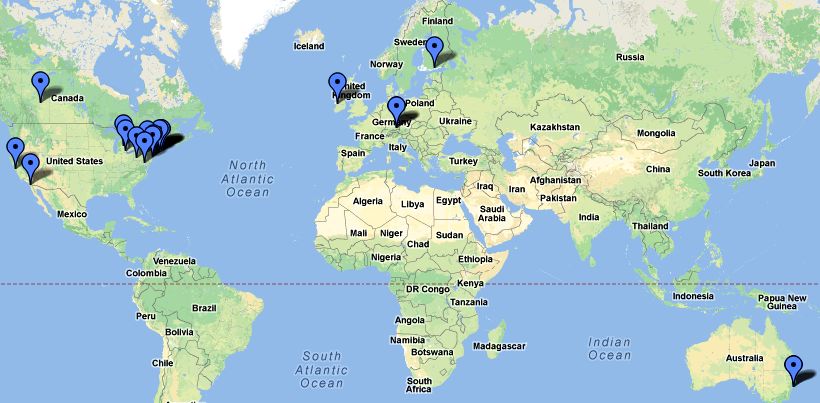
The series has had an excellent response from the scientific and research community worldwide. For our regular readers, and those who are just joining us now, we provide a summary of the month’s entries, including an interactive  map pinpointing the labs these postdocs are based. All these interesting entries and summaries can be found under the Away from home’ category of the Indigenus blog.

We will continue to update the map each Wednesday and hope that you will join in the online conversation using the #postdochat hashtag. 

In April 2013, we heard three great stories from diverse parts of the world — Australia, Finland and USA. Here’s a summary of the month’s wonderful entries.

Living with epigenetics & ‘strine’

For Amita Limaye, who worked at the National Centre for Cell Science in Pune, India before moving in as a postdoc to the Garvan Institute of Medical Research, Darlinghurst, the multiculutral city of Sydney is a welcome change. Getting used to the famous Aussie twang, however, remains a challenge for her! Her dream is to bridge the gap between epigenetics and translational research.

Coping with Northern lights & darkness

Bhupendra Verma is a PhD from the Indian Institute of Science in Bangalore, India and is working as a  postdoctoral researcher at the University of Helsinki, Finland right now. Bhupendra gives postdoc aspirants some brilliant tips to chose their lab as he slowly comes to terms with the harsh weather, the beautiful Northern lights and the long periods of darkness in Helsinki.

‘Indian academics must welcome global desis’

Suvasini Ramaswamy shares her alma mater with Bhupendra. She is also a PhD from the Indian Insititute of Science, Bangalore and  works as a post-doctoral fellow at the Salk Institute for Biological Studies, San Diego, California, United States. She tells us about her work in stem cells and regenerative medicine, the enviable weather in La jolla that keeps her going and that inherently Indian phenomenon of ‘jugaad’ (roughly translating to ‘a creative quick-fix’) — something she says makes Indians rustle up innovations in their backyard. Suvasini’s flair for science communication also saw her author this piece for Nature India some time back.

We love the way our Away from home interactive map, pictured below and updated every Wednesday, is dotting up with some enriching Indian postdoc experiences — we have 20 flags on that map now! Stay tuned as we add more from around the world. Please feel free to suggest names of postdocs from unusual countries and disciplines we haven’t covered yet.

AFH-Apr

Away from home: ‘Indian academics must welcome global desis’

Every Wednesday, our ‘Away from home’ blog series features one Indian postdoc working in a foreign lab recounting his/her experience of working there, the triumphs and challenges, the cultural differences, what they miss about India, as well as some top tips for postdocs headed abroad. You can join in the online conversation using the #postdochat hashtag.

Let’s hear from Suvasini Ramaswamy this week. Suvasini is a PhD from the Indian Insititute of Science, Bangalore and  works as a post-doctoral fellow at the Salk Institute for Biological Studies, San Diego, California, United States. She tells us about her work in stem cells and regenerative medicine, the enviable weather in La jolla that keeps her going and that inherently Indian phenomenon of ‘jugaad’ (roughly translating to ‘a creative quick-fix’) — something she says makes Indians rustle up innovations in their backyard. Suvasini’s flair for science communication also saw her author this piece for Nature India some time back.

Suvasini Ramaswamy

Suvasini Ramaswamy

Marie Curie, my trigger for science

My interest in science goes all the way back to my childhood. I have wanted to be a scientist for as long as I can remember. And although a good memory is not one of my strong suits, I think my fascination with science and experimentation began with a chapter on Marie Curie in one of my NCERT (Bal Bharti) textbooks.

Studying brain cancer, stem cells

My PhD from the Indian Institute of Science was a life altering experience. My graduate work was in molecular oncology and our studies were focused on gliomablastomas — a malignant form of brain cancer.  As a PhD student, I had visited Dr. Inder Verma’s lab at the Salk Institute for Biological Studies to learn their mouse model of glioblastoma. It was during this 45 day stay, where I learnt about intracranial injections and lentiviral technology, that I was offered to consider his lab for a post-doc in the future. Upon completion of my PhD, I decided to take up the offer and join Inder’s lab for the sheer diversity of projects and the scientfiic freedom – both of which I truly treasure.

Our’s is a big lab and that fosters diversity in research projects, people and cultures. My present work is in the field of stem cells and regenerative medicine where we aim to develop novel cell-therapy based approaches for the treatment of hepatic diseases. In addition, the freedom provided by the lab and the encouragement from my lab mates has also enabled me to pursue some interesting questions in neuroscience.

Weather, my best ally

Being based in La jolla, California, I would have to say that the weather is my best ally. Unlike the rest of the US where storms, rains and snowfalls abound, California lets us enjoy warm temperatures through out the year. A long coast line, an abundance of fellow Indians, warm climes, Indian movies and decent Indian food are all some of the many perks of living in California.

Ours being a big lab, there is a diversity in cultures, ideas and temperaments and that is the best part. It is always nice to have people from India, China, Japan, Austria, Britain, spain and the likes under one roof — makes for interesting conversation at all times. Also, thanks to Inder, people are also extremely aware and tolerant of the Indian idiosyncrasies like the famous head shake or the talking-fast syndrome.

My American experience

It has been filled with loads of learning coupled with fun times, travel, photography and a good many firsts such as sky diving, paragliding, skiing and Bollywood dancing. It has made me more Indian in some ways and a more global person in some others.

The Salk Institute is a great place for research with its wall-less, breathtaking architecture that aims to break all boundaries and the lab is a wonderful training ground in science and culture.

Like all things, my American experience has been a mixed bag of the good and the bad. While punctuality, courtesy, communication skills, adherence to rules and regulations are some of the wonderful things that one can learn from the American culture; there are also a lot of good things that I miss from back home. The Indian ability to reach out and make people a part of their family is something I often miss in the professional settings here. Our mentality of repairing, saving resources and “jugaad” are other strengths we should hold onto. In a resource intensive society like America, it is often easy to lose value for what you have — that value comes to Indians easily since we grow up conserving and re-using our limited resources.

Steep learning curve

Settling into any culture or country is always a difficult experience, especially if the gulfs are big. For me, it has been a long transition with a steep learning curve but not particularly distressing. While the practical challenges of running a household, managing bills, driving, repairing, cooking and cleaning in addition to work at the lab are additional responsibilities, they almost instantly transform you into an adult from a carefree student. At the same time, the opportunities for learning about societies, cultures, people, food, and life are almost never-ending.

One of the first things that I noticed early on here was the difference in the scale of things. Back home, things tend to grow vertically, here everything grew horizontally because of the abundance of space. In the distances that would normally take you across neighbourhoods in India, here you would probably reach the nearest super market. Also, unlike India where all great things came in small packaging, here everything from vegetables to medicine to milk, would come in bulk packages. The phrase “size does matter” suddenly made sense to me from the American perspective.

Tips for postdoc aspirants

There is a shadow looming over American science and academics on account of the prevailing economic crisis and this has made life difficult for investigators and laboratories. Under such conditions, it would be great if applicants could get their own funding from India or from international organisations. Checking the track record of the Principal Investigator (PI) and his grants would also be helpful for Indian students coming all the way.

I have also seen that it is a lot easier to find a position when people can meet you in person and evaluate your skills as opposed to reading about you and Universities 8000 miles away. It is critical for Indian students to come for international symposia, workshops and conferences. Also, a network of people is critical to break into any field.

I firmly believe that Indian students possess many strengths vis a vis their western counterparts. However, what we often lack is the breadth of knowledge, the necessary confidence, modesty, clarity and communication skills and all of these can be worked upon.

Could pack my bags any day

India is where home is and I miss everything about it -– from my people to the colours, sights, sounds and smells. In fact, even after two years of coming here, there are days and moments when I could just as easily pack up my bags and leave.

I would love to come back to India in the near future. I strongly believe that people who have had an opportunity to experience different cultures and societies should come back home and create a world that incorporates the best of all cultures and should use it to develop newer skills and resources.

I also believe that the Indian academic setting needs to be transformed to welcome young blood. I believe, we as a culture need to embrace the idea that although experience that comes with age is vital and enriching, youth is not to be brushed aside for, it brings with it fearlessness and openness to new experiences.

Broaden your horizon

My experience with two different societies and cultures makes me believe that our society and culture play a big part in making us who we are. I strongly believe that we as people must be confident of our origins and yet open to imbibe the better aspects of other cultures.

Also, while the old saying condemned the Jack of all trades, I believe a broader skill set and an expanding perspective are critical for a successful and fulfilling life. And although this might make me sound a generation older, I would strongly encourage all students back home to constantly broaden their horizons and to never stop learning.

Suvasini Ramaswamy joins Vijay Singh, featured in this blog earlier, to populate the western coast of the US in our interactive Away from home map. Find her and 19 other Indian postdocs from around the world in the map updated every Wednesday (a snapshot showing our postdocs from US and Canada below). Please feel free to suggest names of postdocs from countries and disciplines we haven’t covered yet.

AFH map update15

Heat warning system for India’s harsh summer

I found it quite interesting that an Indian city should have a proper ‘action plan’ to tackle the effects of changing climate patterns that have resulted in some severe summer temperatures in the last decade. Living in India, the action plans by city or state administrations we have mostly seen are: close schools and colleges,  close offices and at best issue a “do not venture out between 11 a.m. to 4 p.m” notice. There have been sporadic public interest advertisements in newspapers on how to beat the heat.

So, this week when the U.S. based environmental action group NRDC said it would be releasing South Asia’s first ‘heat action plan’ for the city of Ahmedabad in Gujarat, India, it struck as a novel, much-needed concept.

viewimage

Some key people behind the action plan: (clockwise) Kim Knowlton, Dileep Mavalankar, Gulrez Azhar and Anjali Jaiswal (inset).

The plan has been finalised in collaboration with the Indian Institute of Public Health (IIPH), Gandhinagar; Mount Sinai School of Medicine, Rollins School of Public Health at Emory University, Georgia, USA; and Ahmedabad Municipal Corporation (AMC). NRDC said in a release that with this plan to protect residents from extreme heat events, Ahmedabad will be able to ‘comprehensively address the threat of extreme heat caused by climate change.’ (NRDC’s Anjali Jaiswal and Kim Knowlton have elaborated on the action plan in their blogs earlier. Dileep Mavalankar and Gulrez Shah Azhar from IIPH, Gandhinagar were partners in the project. )

The action plan includes initiatives to educate communities on the health risks of extreme heat, implement an early warning system, and train medical officials to treat heat-related illnesses. The plan is being officially released on Arpil 16, 2013.  It includes plans on how to equip government agencies, healthcare providers and other stakeholders to respond to extreme heat events as India’s heat season progresses.

NRDC says the action plan is based on scientific studies conducted in the city over two years. The plan also suggests policy measures to address projected future health risks related to extreme heat. A key area of the plan that would be useful for the local administration are suggestions on creating emergency response and management; and involving health agencies as well as meteorological services in the bigger scheme of things.

The idea is to have an innovative set of strategies, including an early heat-health warning system, to protect the city’s seven million residents (especially the vulnerable ones) from extreme heat.

If the Ahmedabad project turns out to be successful, Gujarat apparently plans to implement it across the state.

Sounds like a good plan!

Indigenous shrimp brood stock to boost exports

An RGCA brood stock centre. Inset: L. Vannamei

An RGCA brood stock centre. Inset: L. Vannamei{credit}RGCA{/credit}

India released a specific pathogen free variety of shrimp for commercial aquaculture today. This promises to help marginal shrimp farmers and boost seafood exports from India.

The brood stock of  the shrimp in question — Litopenaeus vannamei —  have been developed for the first time in India by the Rajiv Gandhi Centre for Aquaculture (RGCA) in Tamil Nadu. These can now be supplied to hatchery operators at competitive prices, according to a government release. These selectively bred mother shrimps can produce high quality shrimp seed that grow fast and survive well in commercial shrimp farms in India.

Till now Indian shrimp hatcheries imported such brood stock from centres in  USA, Thailand and Singapore incurring high shipping costs and massive transit losses. The average cost of brood stock was estimated at Rs. 5000. This also prompted some hatcheries to source brood stock from shrimp ponds which ultimately resulted in the production of poor quality seeds and subsequent crop loss to farmers.

About 80% of India’s shrimp farmers are estimated to be marginal and small scale and the success of their crop largely depends on the quality of seeds.

India’s export of marine products crossed US$ 3.5 billion for the first time in 2011-12 recording a growth of 6.02%. over the previous year. Frozen shrimps are the major export value item accounting for about half of the total US dollar earnings. One of the major reasons for the increase in production and higher export turnover was due to the introduction of L. vannamei shrimp for aquaculture production. However, one of the major obstacles to higher production was the non-availability of quality brood stock in India in the required quantity.

Government sources said this project will help Indian farmers produce 1.35 lakh metric tonnes of additional shrimp for export worth around Rs. 4000 crore per annum by utilizing about 10,000 hectare water spread area for two crops per every year. It will also deliver quality brood stock to shrimp hatcheries.

RGCA, in collaboration with the Oceanic Institute, Hawaii, USA has produced these selectively bred brood stocks that show good maturation/hatchery performance. Though L.vannamei is native to the Pacific coast of central and south America, it is popular among shrimp farmers worldwide due to the availability of selectively bred fast growing improved quality specific pathogen free (SPF) and specific pathogen resistant (SPR) seeds.

Away from home: Coping with Northern lights & darkness

Every Wednesday, our ‘Away from home’ blog series features one Indian postdoc working in a foreign lab recounting his/her experience of working there, the triumphs and challenges, the cultural differences, what they miss about India, as well as some top tips for postdocs headed abroad. You can join in the online conversation using the #postdochat hashtag.

This week we have Bhupendra Verma, a PhD from the Indian Institute of Science in Bangalore, India currently working as a  postdoctoral researcher at the University of Helsinki, Finland. Bhupendra gives postdoc aspirants some brilliant tips to chose their lab as he slowly comes to terms with the harsh weather, the beautiful Northern lights and the long periods of darkness in Helsinki.

Bhupendra Verma

Bhupendra Verma

Biology-struck

I was fascinated with biology as a subject in school. That led me into science and this field of research.

The real motivation for research came during my PhD studies. My PhD supervisor had always encouraged me to do best.I did my PhD in the laboratory of Dr. Saumitra Das in the Department of Microbiolgy and Cell Biology at the Indian Institute of Science, Bangalore. Then I worked at the New Jersey medical school in the US as a visiting researcher.

During PhD, I worked on internal ribosome entry site mediated translation of Picorna viruses. I worked on host-viral RNA interaction using advance molecular biology techniques.

Understanding complex cellular machinery

Since I worked on viral RNA during PhD, I decided to increase my understanding further in RNA biology but with a different system. Now I work on one of most complex cellular machinery involving hundreds of proteins, pre-mRNA splicing. That is how I landed in my current lab at the University of Helsinki, Finland. I work as postdoctoral researcher in the laboratory of Dr. Mikko Frilander at the university’s Institute of Biotechnology.

My work focuses on pre-mRNA regulation centered on splicing of U12 type introns. In humans there are approximately 600 U12-type introns which are linked to important cellular functions as transcription, translation, DNA replication/repair, and signaling pathways.  Abrupt splicing of these introns is implicated in human diseases.

Great work environment

The work environment in my lab is great. We get enough time and space to think about our project. New ideas are always welcome. Everyone has a positive pressure which drives them to deliver their best. The other thing I like about this lab are the collaborations. I am part of many collaborative projects inside the institute and in different institutes across Europe.

The best thing about Finland is the country’s integration plan for foreigners. I was really worried for my family, especially for my wife, as to what she would do there. But things here are very systematic for foreigners. They integrate foreigners into the system according to their qualifications.

Another cool thing is that you don’t need a car as Finland has one of best public transport.

The cold shock

I came to Finland in January, which was one of coldest months here. It was -27 oC when I landed in Helsinki so it was a 40 oC difference from Delhi. Weather is very adverse in this part of the world but life never stops here in Finland. One can’t but appreciate the Finnish society for being well prepared for adversities all the while. That’s why they are at the top as far as living standards are concerned.

The weather is really harsh. During the dark phase of November and December, everyone tries to go India for a vacation. I don’t like the long winter which restricts all movements. Another amusing part is we need to draw our curtains during June/July after evening to make rooms darker so that we can sleep. Sunshine even at 11 p.m can make you crazy! The longest day — June 21 — has almost 19 hours of sunlight.

Initially, it was a little tough for my daughter, especially in day care where people are not fluent in English. But they are very helpful and try their best. Now, life is better and my family is enjoying their stay here.

My tips for greenhorns

Before finalizing any lab for postdoc across the globe, you must

1. Look at publications: they are the currency of science. The publication profile of the lab reflects its funding status.

2. Plan carefully: whether you want to be part of big group or a small one. Both have its pros and cons. Small groups are better as you get more attention.

3. Switch your field: It is always worth changing your research field partially at the postdoc level. That helps broaden expertise scientifically and practically. It will help you in the long-term when you become a group leader.

4. Look out for independent funding: If you are planning to come Europe, always keep an eye out on funding opportunities. Special mention here: EMBO fellowship, Marie-curies, Human frontier science program, Academy of Finland.

5. Get a PhD publication: Try to get your PhD work published in a good journal before you leave. For all these fellowships, the publications during PhD, leadership quality (part of collaborations during PhD) and integration to postdoc lab are important points. Also try to attend some national and international conferences in the form of poster presentation or as speaker.

I think everyone should take a postdoc stint abroad. It is really necessary to be part of another scientific culture and to evaluate yourself. Take the risk and join labs according to their merits and your own interest, not according to the reputation of institute.

Chai-pakodi, I miss you

I miss India a lot in Finland. The things which I miss daily are the roadside chai/pakodi stalls, because I am a tea-addict. Also the festival seasons of India. Being a Rajasthani with a Gujarati wife, I miss Navratra (Dandiya) and Diwali a lot. And being an IIScian, I miss the Holi celebration at IISc.

I will definitely come back to India and will continue my research projects once my current commitments are over.

Bhupendra Verma is our first postdoc from Scandinavia in this series. Find him and 18 other Indian postdocs from around the world in our interactive Away from home map. We love updating our happening map every Wednesday (a snapshot showing our first flag post in Scandinavia below). Please feel free to suggest names of postdocs from countries and disciplines we haven’t covered yet.

AFH map update14

India in the Nature Asia-Pacific publishing index 2012

NPI-AP2012The Nature Publishing Group has just published its 2012 publishing index for the Asia-Pacific region. The index is a picture of high-quality research output from the region and ranks institutions and countries based on their publications in Nature journals.

[The index is based on an article’s corrected count (CC) — a calculation that takes into account the number of affiliated institutions per author and the percentage of authors per institution. All authors are factored to have contributed equally to each article. The maximum CC for any article is 1.0. The overall CC for a country/territory reflects the sum of the corrected counts of all institutions in that region.]

During 2012, Japan, traditionally the leader in the region and still on top, saw close competition from China in terms of research output. Japan was at number one (398 articles, CC: 233.87), closely followed by China (303 articles, CC: 150.02) and then Australia (223 articles, CC: 68.26).

More here on how each country in the region is doing as seen through the lens of Nature journals.

My area of interest in the index was India and where the country stands in the region. India comes in at number seven, exactly where it was the previous year (2011), sandwiched between Taiwan (number 6) and New Zealand (number 8). However, the number of papers published from India in Nature journals has gone down from 30 to 25 in this period.

According to the index, India is particularly strong in the life sciences. Three of the country’s best institutions were ranked within the top 100 in the Asia-Pacific region on the basis of publications in this field. They are the Institute of Genomics and Integrative Biology in Delhi at rank no. 56, the Tata Institute of Fundamental Research in Mumbai (rank 78) and the Jawaharlal Nehru University in New Delhi (rank 82).

On where the science and research scene in the country stands, here’s quoting from a summary in the index:

“The country’s (India’s) science effort has blown hot and cold over the past five  years, in some way reflecting the relationship at home between its ambitious scientific plans and its struggle with poverty.

The country’s Corrected Count (CC) is prone to fluctuation: in 2009, India had a CC of  6.84, well over double that of Taiwan. The next year this had plummeted  to 1.22 — below that of Bangladesh — only to reach a new high in 2011 of 8.53. In 2012, however, the CC fell again, to 8.24.

This uneven research output reflects an inconsistency in government priority for science. The budget of March 2012 was disappointing, particularly as Prime Minister Manmohan Singh had previously raised expectations by suggesting that India should double the proportion of  GDP spent on R&D. In the end, however, the budget only provided for a 5% increase, about half the rate of inflation, leaving research outlays at around 1% of GDP.

There were bright spots for India’s science community, such as the announcement of a plan to launch a satellite to orbit Mars in late 2013. The government also outlined a five-year plan earmarking US$24 billion for R&D in six key scientific departments. This is more than 2.5 times what the country had spent on science over the previous five-year period.

India’s economic boom is slowing — growing by 5.5% last year, the lowest rate since 2004. Science and technology, expressed through improved agriculture, increased energy efficiency, better infrastructure and higher levels of innovation, are expected to provide a boost. But the value of innovation is sometimes questioned. A former chair of the Indian Space Research Organisation, G. Madhavan Nair, described the Mars venture as “a half-baked mission being attempted in undue haste with misplaced objectives”. Others consider it an unnecessary expense in a country where many children are malnourished and homes lack sanitation.

Last July, India suffered the world’s biggest electricity blackout and, according to the OECD, a quarter of the population still has no access to power. Yet many oppose, on environmental grounds, the 300 proposed Himalayan dams, which would provide much-needed power. In agricultural science too there are mixed messages. In October, the science minister, S. Jaipal Reddy, cast doubt on the future of genetic engineering. “The science is not clear,” he said, in response to the proposal set out by a panel of scientists which was appointed by India’s Supreme Court. The panel recommended a 10-year moratorium on trials of GM crops after opposition to the method. The court is hearing a case to stop GM trials in which the government itself is a defendant.”

Here’s hoping 2013 will be a better year for India in terms of scientific output and research papers in Nature journals.

Away from home: Living with epigenetics & ‘strine’

Every Wednesday, our ‘Away from home’ blog series features one Indian postdoc working in a foreign lab recounting his/her experience of working there, the triumphs and challenges, the cultural differences, what they miss about India, as well as some top tips for postdocs headed abroad. You can join in the online conversation using the #postdochat hashtag.

Today’s blogger is from New South Wales, our second in this series from Australia. Here’s featuring Amita Limaye, who worked at the National Centre for Cell Science in Pune, India before moving in as a postdoc to the Garvan Institute of Medical Research, Darlinghurst. Amita loves the multiculutral city she lives in, though getting used to the famous Aussie twang remains a challenge for her! Her dream is to bridge the gap between epigenetics and translational research.

Amita Limaye

Amita Limaye

Spirit of inquiry

I always loved science. I was amazed at the fact that although the basic composition of human beings remains the same, each one of us is different. I think this spirit of inquiry was the driving force for me to choose science as a career.

Epigenentics, my calling

My interest in epigenetics and immunology blossomed at the National Centre for Cell Science in Pune where I worked with Dr. Sanjeev Galande. I moved to the Victor Chang Cardiac Research Institute in New South Wales, Asutralia to understand the role of epigenetics in heart development and diseases. My interest led me to Prof. Susan Clark’s group at the Garvan Institute of Medical Research, Darlinghurst, NSW, Australia.

Right now, I focus my interest in unraveling the multiple layers of epigenetics and the effect they have in cancer progression. I work as a post –doctoral  researcher with Prof. Clark, primarily on teasing  out the different layers  of epigenetic regulation that govern prostate  cancer  etiology.

In the long term, I want to make my research beneficial to the medical sector. There is a big rift between epigenetics research and translational research. I would like to be able to bridge this gap so that epigenetic information aids in understanding prognosis and hence diagnosis of disease and its state.

Coping with the Aussie twang

Although it is sometimes difficult to follow their accent (called strine), Australians are pretty helpful people. Australia is a very good place to live  in. My lab mates are very  helpful and jovial. For me, the move from India to this country was  smoother than expected.

I find the cultural mix of this place quite interesting — there’s no single dominant culture, it’s a mix of all cultures that imparts a unique flavour.

Competitive funding

Postdocs are treated as employees in my lab. Garvan cares for its postdocs and we get treated well.

A word for postdocs looking at this country: Australia has a relatively small pool of funding as compared to  the US. The funding here is similar to some European countries. Therefore, getting funds here is pretty competitive.

Miss Pune traffic

Apart from friends and family, I miss the city of Pune and its chaotic traffic! I would definitely love  to come back to India soon.

Amita Limaye joins Mugdha Joglekar, featured earlier in this blog, to become the second postdoc from Australia in this series. Find her and 17 other Indian postdocs from around the world in our interactive Away from home map. We gleefully update our map every Wednesday (a snapshot showing the duo from Australia below). Please feel free to suggest names of postdocs from countries and disciplines we haven’t covered yet.
AFH map update13