Away from home: June round-up

Our ‘Away from home’ blogging series features one Indian postdoc working in a foreign lab every Wednesday. The posts recount the experience of these postdocs — the triumphs and challenges of lab life, the cultural differences, what they miss about India — and, most importantly, offer some useful tips for postdocs headed abroad.

We started the blog series in November 2012 and have just completed eight months, having featured 27 postdocs till now. The series has had excellent response from the scientific and research community worldwide.

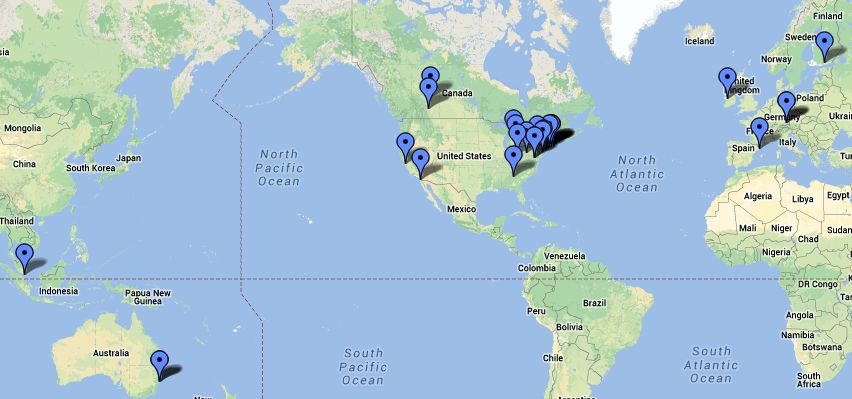
For our regular readers, and those who are just joining us now, we provide a summary of the month’s entries, including an interactive  map pinpointing the labs these postdocs are based. All these interesting entries and summaries can be found under the Away from home’ category of the Indigenus blog.

We will continue to update the map each Wednesday and hope that you will join in the online conversation using the #postdochat hashtag. 

June 2013 saw some excellent entries pouring in from various parts of the world — from the sunny beaches of  Barcelona to hi-tech university campuses in the US . The month also saw a milestone in the life of the blogging series — its 25th entry.

But close to my dream

Sushil Kumar Tomar is a PhD from the Indian Institute of Technology, Kanpur (IITK) and currently a postdoc researcher at The RNA Center, Ohio State University (OSU), Columbus, USA. Sushil has a fascinating formula to find success in life: he calls it ‘absolute success’. Read on to find what it is.

Engineering stem cells and vaccines

Ankur Singh, an IIT-Bombay alumnus and a postdoc in Mechanical Engineering and the Parker H. Petit Institute for Bioengineering and Bioscience (IBB) at Georgia Tech, USA. Ankur is preparing for an exciting stint in academia as an assistant professor in the Sibley School of Mechanical and Aerospace Engineering at Cornell University. His advice to aspiring trainees: work hard, publish well, and do your homework before you accept a postdoc position.

Science on the beach

For the 25th edition,we chose to feature Arun Kumar, a PhD from the Institute of Genomics and Integrative Biology (IGIB), Delhi and currently a postdoc scientist at the Centre for Genomic Regulation, Barcelona, Spain. Arun’s incredible journey is a story of hope, grit and ambition – from small town India where he couldn’t take up mathematics for want of a maths teacher to researching molecular mechanisms of cancer cells at a premier lab in an exotic location.  It is stories like these that  inspire the next generation of scientists.

Have you seen our Away from home interactive map yet? Here it is pictured below and updated every Wednesday with new postdoc experiences. Stay tuned as we add more from around the world. Please feel free to suggest names of postdocs from unusual countries and disciplines we haven’t covered yet.

AFH map update22

Indo-US collaborative awards

This one’s a great initiative that facilitates research collaborations between Indian and American institutes.

In the second round of the Obama-Singh  21st Century Knowledge Initiative awards, eight Indian institutes will partner with American counterparts to further research in various areas. The awards are instituted bilaterally by India and the United States to strengthen collaboration and build partnerships between American and Indian institutions of higher education.

Each project gets an award of approximately $250,000 that can be utilized over a three year period. Besides the obvious objectives, one of the aims of the award is to help develop junior faculty at the collaborating institutions. That is something that Indian institutes would truly benefit from.

For India-led partnerships, the list in this round of awards reads like this :

1. Annamalai University partnering with Tennessee Technological University on a project that maps uncertainties and risks in Tamil Nadu’s energy futures.

2. Assam Agricultural University to collaborate with Washington State University on a project that will engineering ADP – Glucose Pyrophosphorylase (AGPase) enzymes for heat tolerance in rice.

3. Avinashilingam Institute for Home Science and Higher Education for Women to partner with University of Minnesota, Minneapolis on project titled “A sustainable ‘response to intervention’ model for successful inclusion of children with disabilities”.

4. National Institute of Technology, Trichy to partner with University of Nevada, Las Vegas to create a cognition-based curriculum development tool for emerging areas of computer engineering and management studies to improve the teaching-learning process.

Among partnerships that U.S.-based institutions will lead are:

1. Harvard School of Public Health collaborating with St. Johns Research Institute, Bangalore on a nutrition initiative.

2. Ohio State University coming together with Aligarh Muslim University to train the next generation of STEM faculty at higher education institutions in India.

3. University of Massachusetts, Amherst joining hands with University of Pune on a project to titledInclusive Universities: Linking Diversity, Equity and Excellence for the 21st Century”.

4. University of North Carolina, Chapel Hill collaborating with Indian Institute of Management, Bangalore to research advancing sustainability research and education in India.

The awards were announced first in 2009  with each government pledging an equal sum of $5 million. The next request for proposals for fresh grants will be announced in July 2013.

Away from home: But close to my dream

Every Wednesday, our ‘Away from home’ blog series features one Indian postdoc working in a foreign lab recounting his/her experience of working there, the triumphs and challenges, the cultural differences, what they miss about India, as well as some top tips for postdocs headed abroad. You can join in the online conversation using the #postdochat hashtag.

This week we feature Sushil Kumar Tomar, a PhD from the Indian Institute of Technology, Kanpur (IITK) and currently a postdoc researcher at The RNA Center, Ohio State University (OSU), Columbus, USA. Sushil has a fascinating formula to find success in life: he calls it ‘absolute success’. Read on to find what it is.

Sushil Kumar Tomar

Sushil Kumar Tomar

My superheroes: Shapeless Amoeba and immortal Hydra

My father was my first biology teacher. He used to inspire me with stories of shapeless Amoeba and rejuvenating Hydra. Electric outages were too common those days (actually even now) and there were no invertors back then.  So sleeping on the terrace was a common practice. My father and I talked about several exciting things – monstrous mosquito eating plants or giant dinosaurs or plant pigments filling the world with colors. Later, partly due to inept mathematics teachers and partly due to my biology fantasies, I opted for biology in senior school. I was extremely fortunate to choose St. John’s Pharmacy College, Bangalore, where I found several fantastic teachers in my undergraduate years. Among them Dr. Elisha Injeti deserves special mention as he was the first teacher who inspired me towards research and higher studies.

Basic Science is the key

Destiny also played a huge role in my career. Upon completion of my B. Pharmacy, I was inclined to take Medicinal Chemistry for my future studies. But, due to some unconnected mysterious events I reached at the multidisciplinary department of Biological Sciences & Bioengineering at Indian Institute of Technology, Kanpur (IITK). It had a totally different flavor for basic science in contrast to my interests. After the first few months of disappointment, I began to realize the strength of basic science. I found that it is basic science which gives birth to applied science. I realised it was important to understand normal (health) first before exploring the abnormal (disease). I started looking for postdoctoral opportunities. For my PhD, I worked with Dr. Balaji Prakash, an X-ray crystallographer by training but he encouraged me to explore the power of molecular biology and biochemistry. During this period, I attempted to elucidate the role of bacterial GTPases in a complex and essential process of ribosome biogenesis. I generated immense interest for RNA world. After profound search I selected the laboratory of Dr. Irina Artsimovitch at The RNA Center, Ohio State University (OSU) Columbus, USA for my future work.

Transcription, a potential hub for large macromolecular interactions

Here at OSU, I am working on the transcription factor RfaH. It is a unique protein that is capable of undergoing tremendous structural change. I am exploring the folding/refolding properties of RfaH. Transcription is coupled to various other cellular processes such as recombination, repair and translation. In future I am looking to explore these communications in detail. My current group is relatively small but efficient. Irina is an excellent mentor and very supportive. Sometimes I feel that it was better if the group had few more people. That could have generated larger interactions but this lacuna is fulfilled by other research groups on the floor. Weekly joint meetings provide plenty of opportunities for such communications.

Inscrutable Americans and cryptic Indians

Before coming to America, I had been to Germany three times for conferences and collaborative work during PhD. Honestly, I did not have a very pleasant experience there. This was also partly because of a language barrier and my introvert nature. But in comparison to that America seems very open and I easily mixed in. Though I still find it difficult to understand their expressions and jokes at times, it is also equally true for my fellow American friends. Overall it has been a nice experience so far.

Look for absolute success

My tip for potential postdoctoral candidates is that one should look for absolute success. Do not compare your selection with that of others. During this time most candidates have families. It means apart from science, their time is also important for the family. In a few places, work culture could be very competing and demanding. Also you need to make careful decisions based on your choices between academics/industries or planning to stay in USA or returning to India. You need to check the history of a laboratory to see how many past members have successfully achieved specific goals. So do not get overwhelmed by the numbers of publications you see from a lab on PubMed. If you do not accomplish your final goal, then even an additional good publication could leave you with an empty feeling.

Home is always better than paradise

At least for me, a postdoctoral stay is like a long work holiday in a five start hotel. Whatever facility and comfort it offers, I still miss my country every day. America seems like paradise when it comes to living standards and progress-driven culture, but home is always home. A bird could fly to distant places for fun but in the evening it needs to return to its nest. The feeling of being with parents and friends is absolutely gratifying. For now it seems couple more years before I seriously start looking for positions back in India.

Anticipations and obligations

If I had an equal opportunity in India, I could have stayed back. Right now, there are few grant agencies which offer good salary and independent research funds. This improves the economic state of the candidate but unfortunately in all institutes (even the big ones) the social status of the postdoctoral fellows remains unchanged. They are treated as graduate students when it comes to residential or any other facility on campus. For a married family it is impossible to stay in a hostel kind of environment. The overall socioeconomic status needs to be improved. Postdoctoral fellows should be treated equal to “faculty at contract basis” at least in institutes of national importance. If I become part of system some day, I would like to contribute towards these changes. After all, postdoctorate is one of the most important times in one’s scientific career.

Sushil Kumar Tomar joins a large group of Indian postdocs from USA featured so far in this blog. Find him and 26 others in our interactive Away from home map pictured below and updated every Wednesday. Please feel free to suggest names of postdocs from countries and disciplines we haven’t covered yet.

AFH map updte22

Away from home: Engineering stem cells and vaccines

Every Wednesday, our ‘Away from home’ blog series features one Indian postdoc working in a foreign lab recounting his/her experience of working there, the triumphs and challenges, the cultural differences, what they miss about India, as well as some top tips for postdocs headed abroad. You can join in the online conversation using the #postdochat hashtag.

Our postdoc blogger today is Ankur Singh, an IIT-Bombay alumnus and a postdoc in Mechanical Engineering and the Parker H. Petit Institute for Bioengineering and Bioscience (IBB) at Georgia Tech, USA. Ankur is preparing for an exciting stint in academia as an assistant professor in the Sibley School of Mechanical and Aerospace Engineering at Cornell University.

Ankur Singh loads a biomaterial vaccine into a syringe.

Ankur Singh loads a biomaterial vaccine into a syringe.{credit}Beverly Barrett{/credit}

Merging disciplines: engineering and medicine

I was born and brought up in India where the education system is still traditional. The society in general and family in particular expects you to choose between engineering and medicine. Mine was no different. Combining the best of both worlds in the literal sense, I chose engineering and went on to apply it to medicine.

My undergraduate training in Biochemical Engineering and Biotechnology originally motivated me to make the next generation wine and beers using engineered microbes and agriculture produce in India. But someone close to me suggested in jest: why ruin lives, try saving some! This changed everything for me. I qualified in the Graduate Aptitude Test in Engineering with an national rank of 13 and chose IIT-Bombay for its outstanding biomedical engineering programme, with eminent scientists working at the interface of engineering and cancer biology, neuroscience, and cardiac electrophysiology.

IIT-Bombay and working with Prof. Rinti Banerjee towards my M.Tech have been the monumental milestones of my life in carving out the scientist inside me. The working hours at IIT-B were intense and the institute provided a hi-tech research environment which gave me an opportunity to realise how materials-based drug delivery platforms work to cure diseases like cancers. Many of my friends and family urged me to for pursue biomedicine given that the field was under-represented in India at that time, but I followed my heart.

Personalised medicine

I moved to the US in 2006 to gain experience in two prime emerging areas of research — stem cells and engineered vaccines. In my postdoc at Georgia Tech, I worked with a special type of stem cell called the human induced pluripotent stem (iPS) cells,which can be derived in the lab by reverting the human adult skin, blood, or even urine but behave like embryonic stem cells to form any mature cell in the body. Derivation of these cells is a non-trivial process and requires state-of-the-art culture facilities like the multi-million dollars funded Stem Cell Engineering Center (SCEC) and the Parker H. Petit Institute for Bioengineering and Bioscience (IBB) at Georgia Tech, where I did a significant part of my research work (published recently in Nature Methods).

Working in IBB, where my postdoc advisor Andrés García’s lab is housed, has been a unique experience. Faculty of most disciplines (biology, engineering, medicine, physics, chemistry) are housed under the same roof in this hi-tech building along with some of the finest biomedical research equipment. These resources have helped me establish connections with my peers and foster transdisciplinary collaborations, which I found was difficult to do in India where I had to travel for two hours in Mumbai local trains and buses to reach the collaborative institute outside Mumbai. One of the great things I have enjoyed living and working here is the mixed culture and the global talent pool that the US is able to draw.

A postdoc is a temporary position and several institutes in the US (like Georgia Tech) offer competitive salaries and benefits along with subsidized health care, retirement planning, and childcare. However, a major downside is the high level of competitiveness among the postdocs and you literally have to be on your toes to publish, protect ideas and grow. I have also struggled in finding fellowship opportunities similar to those accessible to US citizens. This is sometimes disheartening and could be of potential concern if your advisor runs out of money.

I worked with Prof. Krishnendu Roy (’93 IIT-Kharagpur) for my Ph.D. in biomedical engineering at the University of Texas at Austin to develop biomaterials based vaccine platforms that could be used to engineer immunity. Among the peers, there was a big respect for IIT students — I was praised for my mathematical abilities as an engineer, and yet questioned for my knowledge of biology, something attributed to the misconception about the education system in India. When I started my work in Texas I realised that while we had a sustainable research environment at IIT-Bombay, there was more government funding to support research in the US. I did not have to wait for several weeks for research material to arrive from vendors. There were well-established state-of-the-art core facilities with some of the best imaging, testing and analytical tools to support biomedical research. These helped me significantly to achieve my goals.

On the move

I have been fortunate to live in some of the best cities in the nation — Austin and Atlanta — and now moving to upstate New York, known for its incredibly beautiful landscapes and notoriously cold weather. My wife Shalu (’05 IIT-Bombay and a biomedical scientist) and I often miss India — our parents, siblings, cousins — and celebrating festivals with them. Although technology cannot really replace the human touch, the warmth and blessings, it still forms the best alternate when you want to pursue your dreams.

Into academics

My strong research interest and interaction with peers in the field motivated me to become a professor in the biomedical field. I am starting as an assistant professor in the Sibley School of Mechanical and Aerospace Engineering at Cornell University, an Ivy League research university in upstate New York. I am extremely excited about this transition to the faculty position and am currently in the process of setting up my research lab — Immunotherapy and Cell Engineering Lab (ICEL). Moving forward, I realize the initial years of a tenure track faculty position are going to be highly demanding as I set up my research lab, hire students and postdocs, travel, and balance my life to concentrate on my family —  my wife, daughter, and parents in India. The current recession puts most of the researchers on the edge of economic precipice, but we are in the same boat enjoying the unique funding situation around the globe.

For aspiring postdocs

Finding a postdoc position is easy. Finding a great postdoc position is rather tricky and very tough. My recommendation to aspiring trainees is to work hard, publish well, and do your homework before you accept a postdoc position. Look for publications, mentoring style, funding, and where the past trainees have transitioned to. You need to be clear on what you want out of that postdoc training. This phase of your life is extremely crucial, fundamental to your long term future. I also suggest actively looking for funding opportunities and attending conferences to establish connections.

Find Ankur Singh and 25 Indian postdocs featured so far in this blog in our interactive Away from home map pictured below and updated every Wednesday. Please feel free to suggest names of postdocs from countries and disciplines we haven’t covered yet.

AFH map update21

Away from home: Science on the beach

We are delighted to bring to you the 25th entry in our  ‘Away from Home’ blog series. Every Wednesday, the series features one Indian postdoc working in a foreign lab recounting his/her experience of working there, the triumphs and challenges, the cultural differences, what they miss about India, as well as some top tips for postdocs headed abroad.

We hope you have had as much fun reading these wonderful success stories as we have bringing them to you. You can join in the online conversation using the #postdochat hashtag.

For the 25th edition, we chose to feature Arun Kumar, a PhD from the Institute of Genomics and Integrative Biology (IGIB), Delhi and currently a postdoc scientist at the Centre for Genomic Regulation, Barcelona, Spain. Arun’s incredible journey is a story of hope, grit and ambition — from small town India where he couldn’t take up mathematics for want of a maths teacher to researching molecular mechanisms of cancer cells at a premier lab in an exotic location.  It is stories like these that  inspire the next generation of scientists.

We hope you enjoy this narration.

AK

Arun Kumar

The tough path to science

I come from a very small town called Jhajjar in Haryana, where people aspire for a government job with retirement plans or want to join the army or police. If these options don’t work out, they settle for farming. If you are exceptionally intelligent, people expect you to become a doctor or an engineer. These were the ‘options’ I grew up with. So my becoming a scientist was a completely new thing in the entire neighborhood. Here was someone who had dared to do a PhD in science and walk on new grounds.

My pull for science began with the TV show “Turning Point”  presented by Prof. Yash Pal on Doordarshan. And thanks to the public library in my town, I got to read science books and magazines. I was curious about how things work around us to the extent that I dismantled all electronic gadgets and toys to see how they worked. I generally ended up destroying them for good as I could never  put them back together!

I wanted to be a topper in school. But that never happened despite working hard for the exams, except in the science subjects. I was very good in mathematics. So another turning point came when I chose  biology over mathematics in senior school. The reason: there was no senior school teacher for mathematics at the government high school I studied in.

Later, I completed graduate and postgraduate studies in life sciences from Maharshi Dayanand University, Rohtak, Haryana. During masters, I got a CSIR research fellowship which meant good money (equivalent to a government lecturer’s job!) and motivation to go for higher studies (PhD). I enrolled for PhD at the Institute of Genomics and Integrative Biology (IGIB), Delhi. From childhood to adulthood, my reasons for doing science had changed. Now, I wanted to do something novel to escape the monotony of regular jobs and make a career that would also get me international exposure and an opportunity to experience new cultures.

The breakthrough

I was excited to get a break after PhD to work in one of the topmost biology labs in the world, the European Molecular Biology Laboratory at Heidelberg, Germany. I worked as an interdisciplinary postdoc. Despite the wonderful opportunity to work with the best biologists of the world, soon I realised that I was not at the right place given my research interests. Some time later, I got an opportunity at the Centre for Genomic Regulation, Barcelona and instantly grabbed it since it was closer to my research aspirations.

I love working at CRG not just because of the good working environment but also because of its location — its on the beach! What more can you ask from life if your workplace is on a sea beach. Whenever I feel tired, stressed or clueless about an experiment, I come out to see the waves and people playing on the beach.  I feel almost instantly energised and come back to attack my work problems with renewed vigour. If you are looking for nice sunny weather and a wonderful place for research that offers the best work-life balance, CRG is the best.

Research interests

I work with the group of Manuel Mendoza in the Cell & Developmental biology unit of CRG. Our group is focused on studying coordination of chromosome segregation and cytokinesis.  A failure of this coordination can lead to improper chromosome conditions like aneuploidy or polyploidy which lead to cancer cells.

I have been pursuing a new research question in the lab about studying asymmetric nuclear cell division in yeast. It is interesting to note that yeast cells give rise to new daughter cells upon mitotic division, which are different from mother cells in many aspects. For example, certain extra chromosomal DNA do not get transferred to daughter cells during cell division and remain in the mother cells. This sets the age of mother cells (life span) as they die after 30-32 divisions while the age of daughter cells that do not receive this DNA is set to zero. My research is now aimed at exploring different molecular mechanisms on how yeast achieves asymmetric nuclear cell division. As mammalian cell gives rise to different cell types using these asymmetric principles, my work could shed light on these molecular mechanisms in future.

Workplace a breeding ground for new ideas

I like the work environment in my lab as our principal investigator Manuel has enough time for day-to-day discussions on research. New ideas are always welcome in the lab and he provides a lot of freedom at work.

I like the Spanish culture with its plethora of festivals sprinkled through the year and cuisine that’s close to India’s. Spanish people are very warm, enthusiastic and helpful. You will find people laughing, enjoying and talking loudly on streets, which is not common in many European countries. I feel infected with their enthusiasm for small day-to-day activities.

Communication, weather could be issues

Sometimes, it is not easy to communicate with locals in hospitals, administrative offices or police stations if you do not know the native language. If you are sick or need medical emergency, it is not very easy to use the medical facilities in town.

Earlier, I faced harsh winters in Germany with no sunshine for many weeks. If you are used to sunrises every morning like in North India, it could be depressing to live in the such dull weather. It also affects work efficiency a lot. However I enjoyed the snowfall in Germany.

If you are a vegetarian, you could have a hard time in many European cities. For example, if you ask for a vegetarian sandwich in a shop, you might end up getting a fish sandwich. It was shocking for me to see people consider fish as a vegetarian dish here. For them only red meat is non-vegetarian. Quite funny!

For fellow postdocs

Following is my advice from experience:

1. Don’t overwork yourself, think well and enjoy: Indian PhD students are trained to work very hard and stay longer in the lab including on weekends or holidays. I would advise you not to overwork yourself. Try to minimize effort in experiments by thinking hard through it first. Increase productivity, which might not mean more number of hours in the lab. If possible, don’t force yourself to work on the weekends. This will allow you to find time for yourself to become more creative and productive in life.

2. Choose the best mentor: When you are looking for a lab for postdoc, do not just consider publication record or the institute’s name. Pay enough attention to see the group leader’s abilities as a mentor. For example, look at how many ex-lab members are established in their scientific careers. What kind of relation did they share with the group leader? You will be more productive and enthusiastic if your PI gives enough time and encouragement to your scientific accomplishments and acts as postdoc mentor rather than a scientist or boss.

3. Choose questions wisely:  I would say your success as a postdoc is not by chance but by the choices you make. If possible, try to find a good project with important questions to study. You should avoid the rat race of publishing many papers or worrying all the time about academics jobs. After all, postdoc is the best productive time of your scientific life and you should enjoy doing good science as much as possible.

Spicy food, chaos, movies: miss them

I miss the roadside chaat shops in Delhi. Also hanging out with friends to generous helpings of my favourite snacks pani puri, samosa, aloo tikki and the pointless gossip. Reading newspapers in the morning and watching movies in the theater are not possible here. They are not in English most times. The chaos and bustle of people all around in India is missing in some European cities. This could make lonesome at times.

Giving back to the society

It would be great to go back to India and put to use the knowledge I have gained over these years. I know that getting a good job in academics or industry is not always easy. I would love to associate with or visit local high schools and colleges in my area to provide free education about modern science and to create awareness about new scientific career options. If I continue to work abroad for a long time, I would like to associate with local people who do not have access to such information. It would give me immense satisfaction if I can give back something to my own people.

So here’s the 25th flag going up on our interactive Away from home map!  Pictured below and updated every Wednesday, the map now features 25 postdocs from eight countries. Please feel free to suggest names of postdocs from countries and disciplines we haven’t covered yet.

AFH map update20