Aerosols contributing to climate change in India, China

Our freelance writer Biplab Das dug out an interesting research paper from Geophysical Research Letters this week. Though the authors are from Argonne National Laboratory, Illinois; NASA Goddard Institute for Space Studies and Columbia Earth Institute, Columbia University, New York; they have been working on the contribution of aerosols  to climate change in India and China.

It is worth pointing out here that there has been very little study of the contribution of aerosol emissions from India and China to radiative forcing. Radiative forcing is the process through which about 30 per cent of sunlight reaching the Earth’s surface is reflected back into space as invisible infrared light.  Aerosols generated by human activities reflect infrared light generated by reflected sunlight, thereby trapping it in the atmosphere. This alters radiative forcing, resulting in climate change. Recent studies have identified aerosol emission, particularly black carbon emission from industrializing countries like India and China, as emission control targets for mitigating climate change.
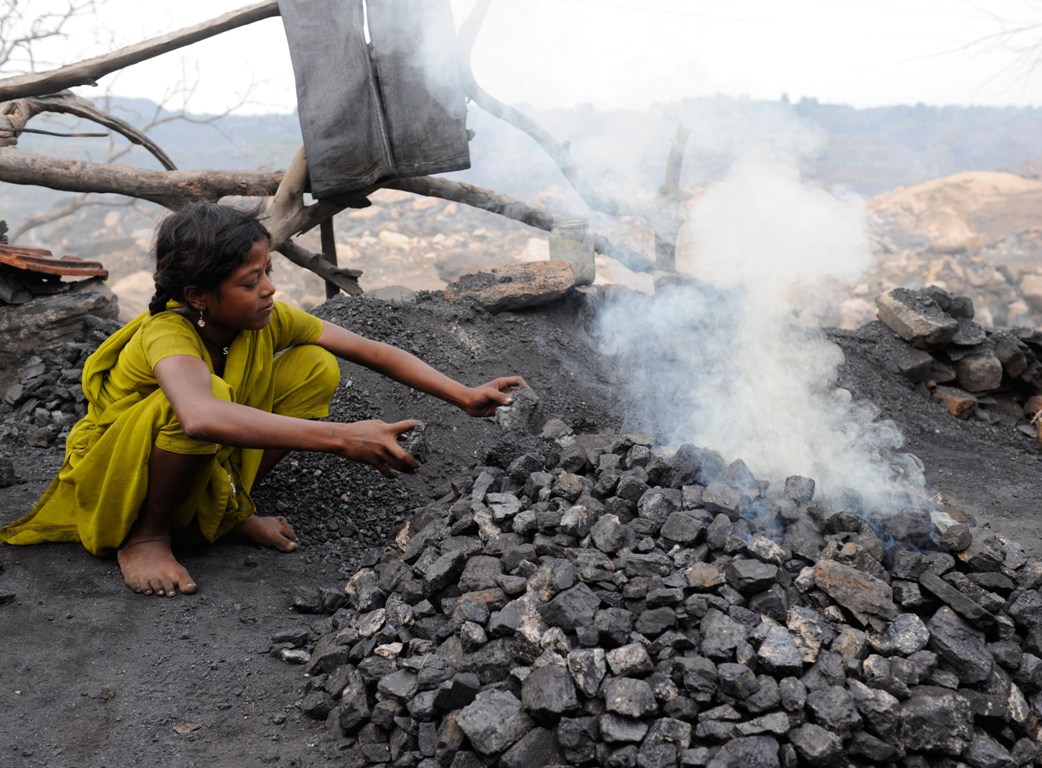
Coal burning is one of the key contributors to aerosol emissions.

Coal burning is one of the key contributors to aerosol emissions.{credit}Joerg Boethling / Alamy{/credit}

So the researchers have found that these small airborne particles called aerosols (for example, black carbon particles in diesel exhaust and sulfate particles produced by coal burning) in India and China may indirectly contribute to climate change. Higher black carbon levels in the atmosphere lead to warming, whereas increased sulfate levels cause cooling.

To find out the situation in India and China, the researchers examined emissions from the most important aerosol sources in the two neighbouring countries and estimated the net radiative forcing from each source, both locally and globally. In this analysis, they used models developed by the NASA Goddard Institute for Space Studies.

Major emission sources of black carbon are diesel truck and bus exhaust and residential biofuel and fossil-fuel combustion. For organic carbon, residential biofuel and fossil-fuel combustion are important sources. The study found that fossil-fuel combustion in the power sector accounts for 52.3 per cent of sulphur dioxide emission in India.

The researchers reveal that residential biofuel combustion in both India and China gave rise to significant positive direct radiative forcing through black carbon emission. They say that aerosol emission from diesel trucks and buses also makes a positive contribution to radiative forcing in India.

References

1. Streets, D. G. et al. Radiative forcing due to major aerosol emitting sectors in China and India. Geophys. Res. Lett. (2013) doi: 10.1002/grl.50805
What can India learn from Bose, Raman & Saha?

When I was referred to a documentary film on India’s scientific greats by its maker Raja Choudhury this week, I was wondering if there’d be anything beyond what I already know about  them in the hour-long film. To find this out, it also meant dedicating an hour to watch the film on YouTube with its infamous buffering time. But I was ready to endure that, partly because the title of the film was inviting — The Quantum Indians — and partly because I had not been able to take up Raja’s earlier offer to feature in this film as an ‘expert’ on India’s science. After watching the film today, I am happy I declined that offer — it would have been audacious for me to talk about Indian science’s legendary trio — Satyendra Nath Bose, Chandrashekar Venkat Raman and Meghnad Saha — whose life and times Raja has so aesthetically weaved on celluloid.

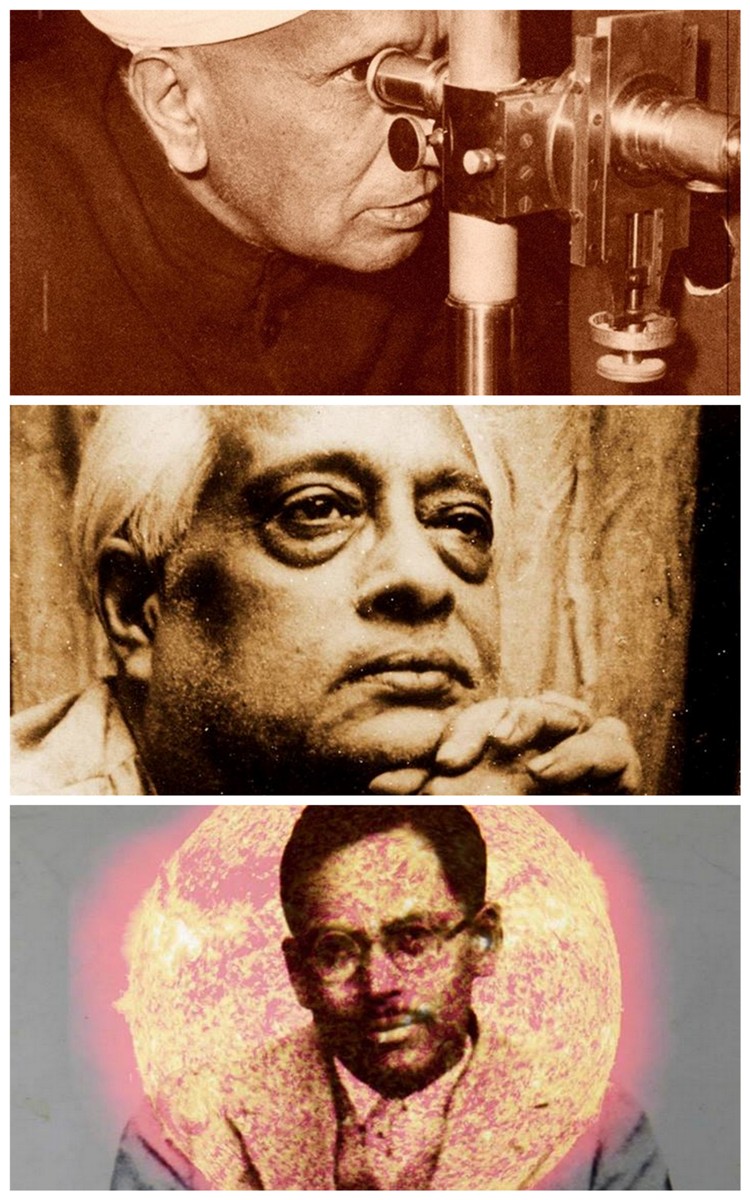
The 'Quantum Indians': Raman, Bose, Saha.

The ‘Quantum Indians’: Raman, Bose, Saha.

First up, things that you might or might not have heard about these greats — Raman was a supreme egotist, Saha loved mathematics as much as he dug history, Bose tore off a scientific paper of significance and threw it in the bin when he heard of  Einstein’s death. And similar anecdotes, which lend the film a human touch.

‘The Quantum Indians’ traces the scientific legacy of India through the lives of these scientists, all of whom “fought colonialism, British rule, racism, inadequate funding and limited resources to place India at the cutting edge of world science more than 20 years before Independence.” And it does so by going back in time to see what life was like for Bose, Raman and Saha — all starting their careers at the Calcutta University in 1917 and going on to become Fellows of the Royal Society. Raman also won India her sole science Nobel till date.

Contemporary scientists and India’s science establishment who, quite often, face the embarrassing question “Why hasn’t India got a Nobel in science after Raman?” have lessons to learn from him. Not just from his immense dedication and scientific genius. But also from the way Raman ‘pushed’ what he thought was a Nobel winning discovery and made sure he had the attention of people who mattered in the Western world. In short, creating a buzz about his work. The film talks at some length about Raman’s concerted quest for the Nobel — how he wrote to industrialist G D Birla asking him to fund a spectrograph in return for a promise to win a Nobel for India, how he sent a paper to Nature via telegram to beat anyone else with a similar idea, how he sought out Nobel Laureates such as Ernest Rutherford and Neils Bohr asking them to nominate him for the Nobel. And how he called a press conference to claim that he had made a significant discovery — a candidate for a Nobel — eventually getting the attention of acclaimed physicists such as Albert Einstein and Arnold Sommerfeld, who backed him.

Raman is the only one of whom we see some significant live footage, presumably from his post-Nobel television interviews to the Western press. He is introduced as a man of many contradictions —  “a great teacher but an intolerant perfectionist, a simple man at heart but a supreme egotist, a recluse who loved children and teaching. But without doubt a genius.”

Through interviews with leading contemporary scientists — Partha Ghose (also Bose’s last PhD student), Milan Sanyal, G. Srinivasan, Kankan Bhattacharya, N. Kumar and Sandip Chakrabarti —  Raja has tried to bring out the scientific and social sides of the trio. Also featuring in the documentary is Bose’s grandson Falguni Sarkar taking viewers around Bose’s ancestral home in Calcutta. The city — epicentre of the Bengal Renaissance —  has an interesting scientific legacy but has seen some reversals in recent times. The film could serve as a tool to inspire young scientists to get their act together.

Bose, who lends ‘bosons’ his name, (and there has been significant debate in India about why he shouldn’t be nominated for a Nobel too) is called a ‘forgotten hero’ in a BBC footage in the film. I like the way Partha Ghose describes the last paper written by Bose — the one he tore off on hearing of Einstein’s death. Ghose calls it the ‘unfinished symphony’, much in line with Bose’s other passions — the Esraj and the flute.

Of the three, Saha seems to be the one most comfortable with administration and science policy making. He is credited with bolstering India’s scientific infrastructure, forming the backbone of its atomic energy policies and even joining politics with the ambition of strengthening India’s scientific prowess. It is befitting then that the scientist who loved history as much as mathematics died of a heart attack on the stairs of the Planning Commission. Just like the Rajput warriors who happily die on battleground, the narrative notes.

Barring the western pronunciation of Indian names, which sticks out like a sore thumb in most Western productions, I relished the film, primarily for its intense research and scientific clarity. It was previewed at The Indian Association for the Cultivation of Science to celebrate their Foundation Day on July 29, 2013. You can watch it free on YouTube here.

Biology’s ‘gentle genius’ through the eyes of a protege

It’s been a week that Obaid Siddiqi, India’s molecular biology genius, passed away in a freak accident on July 26, 2013. Tributes have been pouring in from far and wide and we are overwhelmed by responses from our readers, fellow scientists and colleagues wanting to express their love, admiration and respect for the man variously called ‘Renaissance Man’ and the ‘Catalyst of a culture of creativity‘.  We compiled some of this outpouring in the Nature India feature “India mourns loss of ‘aristrocratic’ & gutsy molecular biology guru“.

We also heard from science film maker Matiur Rahman, who has been tracking Siddiqi’s life sine 1983. He sent us some rare pictures of Siddiqi which we featured in a guest blog piece “An ace biologist through the eyes of a lenseman“.

In this series of tributes, today we got to hear about Obaid Siddiqi from another unique perspective — from someone who hero-worshiped him as a child and who’s family ties with Siddiqi go back ages. Our guest blogger today is an ace scientist himself, inspired hugely by Siddiqi. He is Shahid Jameel, group leader of Virology at the International Centre for Genetic Engineering and Biotechnology (ICGEB), New Delhi. He recently took over as CEO of the Wellcome Trust-DBT India Alliance.

Shahid told me he wasn’t going to give an account of the scientist — everyone is aware of Siddiqi’s scientific genius. So here’s Shahid’s touching tribute to the extraordinary human that Obaid Siddiqi was:

The Gentle Genius: my childhood hero

One sign of getting old(er) is to see the heroes of your youth leave this mortal world. I lost three in 2011 – my father in August, cricketing legend ‘Tiger” Pataudi in September and the evergreen actor Dev Anand in December. Last week I lost another – Professor Obaid Siddiqi, or simply Obaid.

OS

© Matiur Rahman

Obaid was popular with three generations of my family. Being related to my maternal grandfather through his mother, Obaid shared with him the common bonds of leftist ideology and progressive Urdu literature. He and my father had the same last name and were contemporaries at the Aligarh Muslim University, having done MSc in the same year in Botany and Chemistry respectively. Both returned to India in 1962 to establish a career in teaching and research.

While growing up in Aligarh, I do not recall meeting Obaid; he made short visits to see his parents. But there was always talk of his genius and even as kids we knew that he was an important scientist. I was friendly with his father, who we called Qadeer Nana. He came frequently to the AMU Lawn Tennis Courts where Obaid’s nephews – Salman and Chotu, and I played. There were many tips on the game, admonition for bad shots and endless stories in his inimitable style.

My first interaction with Obaid was in1978 when I was selected as a National Science Talent Summer Fellow in his lab at TIFR. This was my first taste of laboratory research and it was so much fun. We rarely left the lab and many nights were spent sleeping on the seminar library table. I worked directly with Krishnan (who is as kind now as he was then), and Obaid appeared occasionally to enquire if all was well. He was quiet but there was an aura around him that made people respect him and be comfortable at the same time.

Much through the 80s, I was in US and lost touch but reconnected again when I returned to India. Obaid was starting NCBS and proudly gave me a personal tour of the interim laboratories on the Indian Institute of Science campus. For the past 25 years, we were in constant touch and developed a bond that cannot be described, only felt.

Over the past few years, our link has been Abu, who Obaid took on as a PhD student on my recommendation. Abu graduated from rearing flies to taking care of Obaid, while trying to understand the biochemical and genetic basis of olfactory memory. Obaid sent him to my lab to use biochemical methods for identifying proteins associated with olfactory learning in Drosophila. Having been in a completely different field of research, this was my chance to fulfill a life-long dream to publish a paper with Obaid. But fate had other plans. The paper will be written up, but there will be no Obaid to celebrate it.

Though I never worked with Obaid after that summer in 1978, I have benefited both professionally and personally from his visionary thinking for Indian science. Around the turn of the century, he played a big role in the Wellcome Trust’s decision to start a special International Senior Research Fellowship competition for Indian scientists. In the few years that it ran, the ISRF selected 30 odd Fellows; many are now in leadership positions in the country. I was lucky to be one of the Fellows. He also catalyzed the Wellcome Trust-DBT India Alliance, a visionary partnership between the British charity and Government of India that was set up in 2008. I recently started looking after the India Alliance and hope it will produce the next generation of biomedical research leaders for the country. That will be my tribute to Obaid. In his silent and unassuming ways he has done more for Indian science than many of his vociferous peers.

Dhoondhogey hamein mulkon-mulkon / Milney key naheen, naayaab hain hum! (You may look for me around the world but in vain. For, I am rare).

I admired Obaid for many things but one of them stands out — his confidence in the next generation. Many people in leadership positions claim to do this, but become large trees under which very little can grow. Obaid, however, was different. He conceived and set up NCBS, but then let his younger colleagues manage it. And they have done full justice to the confidence he reposed in them to make NCBS a world-class institution. This is a legacy we must celebrate and nurture as our best tribute to this visionary.

A few months back Obaid had fallen down at home and had hurt himself. I went to see him in June, 2013 and was pleasantly surprised to see how well he had bounced back. He made me a cup of tea and insisted that I also ate the biscuits. We chatted for over an hour. Little did I know this was to be our last meeting.

I want to remember this gentle genius for the special bond we had. To his family and to his numerous friends and admirers at NCBS, TIFR, in Aligarh and elsewhere, I can only say –

Ujaale apni yadon ke humare saath rehne do / Na jaane kis gali mein zindagi ki shaam ho jaye (Let the light of your memories remain with us. Who can tell when the twilight of life comes by?)

Till we meet again!

(Shahid Jameel can be reached at shahid@icgeb.res.in or shahid.jameel@wellcomedbt.org)