Nature India partners with JNU

Pages from JNU Abstracts Book Final_03_02_2015Nature India is proud to be associated with Jawaharlal Nehru University (JNU), New Delhi as media partner of the just concluded International Symposium on Current Advances in Radiobiology, Stem Cells and Cancer Research (February 19-21, 2015).

According to conference organising secretary Rana P. Singh, “The symposium focused on radiation therapy of cancer, mechanisms of radiation resistance in cancer, radiosensitizing agents and their mode of action, radiation carcinogenesis and targeting stem cells for cancer prevention.”

“It also discussed emerging trends in cancer stem cells, therapeutic targeting of cancer stem cells, novel mechanisms in cancer chemoprevention, development of phytopharmaceuticals for cancer chemoprevention and therapy, genetic and epigenetic mechanisms in the pathobiology of cancer, and advances in basic and translational cancer research.”

The symposium looked at developments in these areas and turned out to be a breeding ground for atypical and modernistic ideas among the participants, to combat the growing menace of cancer. The meeting was designed with an emphasis on advances in the translational aspects of cancer control.

Here’s an editorial titled Cancer Biology: Pre-clinical to Translational Research I wrote for the abstracts book of the conference:

In November 2014, Nature featured a body of work (1, 2, 3, 4, 5) extending the list of cancers that might respond to antitumour immunity restoration therapies by blocking the PD-1 pathway. There were results1, 2 from a phase I clinical trial of a monoclonal antibody (MPDL3280A) in patients with non-small-cell lung cancer, melanoma, renal-cell carcinoma and other solid tumours.

Experiments also showed how expression of PD-L1 on immune cells infiltrating tumours could be a key predictor of clinical activity2,3. A couple of findings4,5 suggested that ‘passenger’ mutations — cancer-cell mutations that do not directly contribute to cancer initiation and progression — play a key part in tumour immunity.

While the significance of cancer research and the mounting global burden of cancer can never be emphasised enough, the International Conference on Current Advances in Radiobiology, Stem Cells and Cancer Research is promising to give us some significant take homes. To begin with, a review of trends in these three key areas is expected to showcase results of new experiments from the world over.

For instance, in radiation therapy, the problem of radio-resistance and the probable mechanism that makes cancer cells more radio sensitive will be a novel area to explore. Also of interest will be the stem cell experiments, a relatively new area in cancer biology. The conference will present results from laboratories working on compounds that can target tumour like stem cells. Results from screening and evaluation of new natural compounds or phytopharmaceuticals and their anticancer mechanism are expected to add another interesting dimension to the well-rounded conference.

Nature India, a showcase of India’s science, is proud to be associated with the International Conference on Current Advances in Radiobiology, Stem Cells and Cancer Research. We hope that the conference will take a keen look at pre-clinical cancer biology in pinpointing a combination of best drugs and mechanisms for cancer treatment protocols. We also hope the conference, with a star-studded speaker list from around the world, will be a significant step towards identifying the most relevant translational research for times to come.

  1. Powles, T. et alNature 515, 558–562 (2014)
  2. Herbst, R. S. et alNature 515, 563–567 (2014)
  3. Tumeh, P. C. et alNature 515, 568–571 (2014)
  4. Yadav, M. et alNature 515, 572–576 (2014)
  5. Gubin, M. M. et alNature 515, 577–581 (2014)

Nature India partners with ICRISAT

ICRISAT_Abstracts_Book_Cover_10_02_2015Nature India is proud to have been associated with the International Crops Research Institute for the Semi-Arid Tropics (ICRISAT) as media partner of the just concluded 5th International Conference on Next Generation Genomics and Integrated Breeding for Crop Improvement (February 18-20, 2015).

ICRISAT Director General David Bergvinson says, “Next-generation sequencing (NGS) is projected to be the seventh most important disruptive technology towards increased economic impact by 2025 (McKinsey Global Institute, 2014). In the last decade, NGS not only accelerated the genomics and genetics research-based solutions in humans, but has also dramatically impacted agriculture research.”

“Through partnerships, ICRISAT has contributed to the genomics revolution through the sequencing of two of its mandate crops – chickpea and pigeonpea. We are now applying this information to accelerate the development of climate change-resilient varieties for sorghum, millets, chickpea, pigeonpea and groundnut. ICRISAT has always valued its partnership with national and international research programs and private sector partners towards modernizing breeding programs to develop farmer-preferred varieties better, faster and cheaper,” he said in a message.

According to the conference chair Rajeev Varshney,  this edition of the conference has become the largest meeting in the series with over 300 delegates from more than 30 countries. The conference had 10 sessions covering 40 presentations by eminent speakers. In addition, there was a dedicated session for poster presentations for young researchers to get an opportunity to present their work and interact with eminent scientists.

Here’s an editorial titled From the Genomes to the Fields I wrote for the abstracts book of the conference:

The developing country perspective of food security is anything but lavish. It has always been about reaching subsistence nutrition to the teeming millions – for instance, the thought behind most of India’s food policies is “let’s ensure that the poorest of the poor get basic carbohydrates and proteins to survive”.

Scientists in developing countries, therefore, are faced with a bigger challenge of not just making newer crops to counter changing climate or shrinking resources, but also to make crops that can produce huge volumes. Given the odds, it seems pertinent that Next Generation Sequencing (NGS) is being heralded as the new uncrowned king of technologies that could do the trick for developing countries.

This brings us to the question of resources available to scientists in developing countries to participate in this global shift towards genomics and integrated breeding. Or, for that matter, their access to global databases that can then be used to meet local needs. In January 2015, Nature Genetics endorsed the need to support an international initiative that makes plant genome data across the world’s seed banks accessible to plant breeders and researchers1. The journal will work with authors to ensure that researchers get access to phenotype data that is linked to published genetic data.

Maintaining the 11 international gene bank collections alone costs about 18 million US dollars every year. Scientists have increasingly advocated mining this biodiversity for food security and creating an internationally accessible informatics infrastructure to catalogue the diversity of the world’s seed collections2. After mining the superior alleles, it is imperative to use them in the breeding programs and the approach has been referred as integrated breeding approach.

In the light of new genomic interventions in several crops such as rice, maize, barley, wheat, legumes, sorghum, millets, chickpea, pigeon pea and groundnut – crops that the developing world immensely benefits from – ICRISAT’s 5th International Conference on Next Generation Genomics and Integrated Breeding for Crop Improvement will be an interesting meet to watch.

Nature India, a showcase of India’s science, is proud to be associated with the conference as its media partner. We hope that the conference, with a star-studded international speakers’ list, will identify novel native varieties that can make their way from genebanks to the fields, discuss trends in high-throughput SNP genotyping, as also take a significant first step in giving to the world some new climate smart varieties.

  1. Growing access to phenotype data. Nat. Genet. 47, 99 (2015)
  2. Agriculture: Feeding the future. Nature 499, 23-24 (2013)


Indian research scholars renew pay hike protests

protest

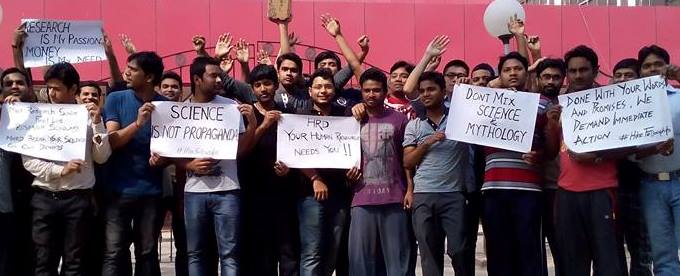
The long-drawn agitation by Indian research scholars demanding a hike in their scholarship stipends made a comeback this week, as research institutions across the country witnessed various forms of protests. At the heart of the protests is the venerable hub of Indian research —  Indian Institution of Science (IISc) in Bangalore — where the scholars are resorting to novel ways of making their point. Sample this street play that shows their disappointment with India’s ministry of human resource development, which has been promising to implement a revised fellowship regime since October last year but hasn’t.

Candlelight vigils, protest marches, human chains, a postcard and cheque campaign (where each research scholar will send a one rupee cheque to the ministries concerned)  and an ‘Open Day’ mark the protests planned across the country this week. The researchers say their patience is being tested by the union government and that these protests are aimed at getting them to issue a new and final notification on when the promised hikes will be implemented. 

IISER research scholar Sivaranjan Uppala withdrawing his hunger strike after promises by the Indian government

IISER research scholar Sivaranjan Uppala withdrawing his hunger strike after promises by the Indian government

Fresh protests erupted last week with Sivaranjan Uppala, a research scholar from Indian Institute of Science Education and Research, Mohali, sitting on a hunger strike in New Delhi. The strike was supported by researchers from Indian Institutes of Technology, All India Institute of Medical Sciences, Jawaharlal Nehru University and the Defence Research and Development Organisation. Uppala’s hunger strike was called off after promises from the ministry to look into the matter by the end of this week.

In October last year, yielding to long standing demands of research scholars,  the Indian government had announced a hike in the fellowships for young scientists working in government laboratories across the country. The union human resource ministry also issued a fresh notice last week saying the same thing again.

The October protests were under the banner of ‘Research Scholars of India’ with scholars from many institutes in Delhi — All India Institute of Medical Sciences, National Institute of Immunology, International Center for Genetic Engineering and Biotechnology (ICGEB), Indian Institute of Technology Delhi, Jawaharlal Nehru University, Jamia Hamdard University, Jamia Milia Islamia, Delhi University and National Institute of Plant Genome Research. Their immediate demands were a hike in fellowship to compensate for the current inflation rate, annual increments linked to inflation, revision of fellowships from April 1, 2014 and streamlining of monthly fellowships.

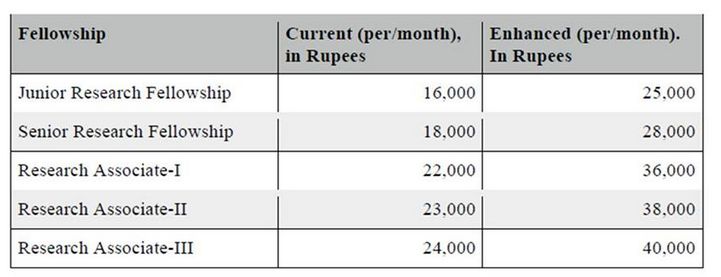
The Indian government agreed to their demands announcing just a couple of days before the festival of lights Diwali that the ‘much awaited hike’ across the board will be at least 50% more than the existing levels and effective 1 October 2014. The hike was affected after India’s finance ministry, after examining the recommendations of an inter-ministerial meeting for its budgetary implications, gave its nod. Here’s how the hike is expected to look like:

fellowship hike

[More details in this official memorandum of India’s Department of Science and Technology.]

The protests do not look like dying down until the Indian government goes beyond promises and follows them up with some action.