The celestial smiley!

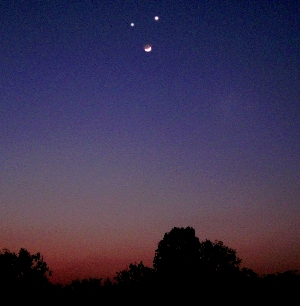
Here’s a lovely picture sent by Arvind Paranjpye of the Inter-University Centre for Astronomy and Astrophysics in Pune. Arvind has done a little computer graphic to show us what the western sky will look like on December one when Venus, Jupiter and the Moon come together in a celestial triangle. He tells us that it isn’t such a rare event though. What makes it a pretty picture is that it looks like a smiley pasted on the evening sky!
venus_moon_jupiter.jpg

This is what Arvind has to add:

“As the Venus, the goddess of love and beauty, is climbing above the horizon with Jupiter, the King of the Gods, inching towards it, on the evening of December one, we will be presented with an amazing sight when the Moon joins them. This is computer graphic artist’s (mine) simulation of how the sky will look at about 7 p.m. Later that night the moon passes right through the gap between the planets but then the trio will be below the horizon.

It will be a trivial matter for one to photograph these heavenly bodies with a simple digital camera. And therefore one might start to take photographs on November 30 and continue till December 2. This is not such a rare event. One of the memorable events was on April 23, 1998 when the moon actually crossed over them, the event astronomers call Occultation."

So we’ll all watch out! Send us your pictures of the real event (s.priyadarshini@nature.com) and we will put up the best here.

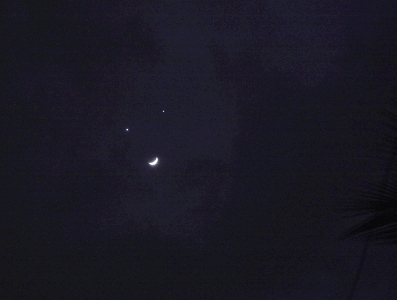
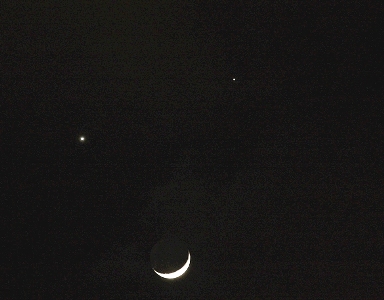
Vishwanath Bhagwat from Pune managed to click a couple of lovely pictures despite the cloud cover throughout the event. These pictures are very close to Arvind’s graphics. Here’s what Vishwanath has to say:

“These photos are not the best, but this is all that could be seen from Pune due to the depressing cloud cover. These photos were taken between 6:30 p.m. and 6:50 p.m. from the HDFC Colony in Chinchwad, Pune. One was taken with a 50 mm lens and other with a 200 mm lens.”
Venus_Jupiter_Moon_IMG_8496.jpg

Venus_Jupiter_Moon1_IMG_8512.jpg

Post-school science

The premier science academies of the country — Indian National Science Academy, the Indian Academy of Sciences and The National Academy of Science, India — had a brainstorming meeting earlier this month. Following extensive deliberations, the trio has prepared a position paper on the post-school science education in the country. The need for reforms in learning sciences at the post-school level has been duly emphasised in the paper.

The academies have mooted an integrative and broad-based training — the four-year B. S. degree — at select centres. The programme would enable graduates to directly enter the professional job market, or to pursue a doctoral degree (Ph. D.) research programme.

If everything goes well, the +2 qualified student could chose from the following options in science and technology next year on:

1. A 4-year B. S. followed by Ph. D. in basic sciences, with a provision for early exit with M.Sc degree or dual degrees after completion.

2. 4-year B. Tech. followed by Ph. D in basic sciences.

3. 4-year B. S. followed by M. tech/Ph.D. in professional (technology) field.

4. 3-year B. Sc. followed by 2-year M. Sc. and then Ph. D or 3-year B. Sc followed by integrated M.Sc.-Ph. D.

5. 3-year B. Sc. followed by 2-year B. Tech.

6. 5-year integrated M. Sc. followed by Ph. D.

7. Vocational courses.

Looks like science education in this country will finally get the long due overhauling it deserves.

Physics ahoy!

Here’s good news for Indian physical sciences.

The National Science Indicators of Thomson Reuters show that the number of papers indexed from India has grown from about 20,000 in 2003 to 27,000 in 2007. Of this, the main field indexed is the multi-disciplinary category (papers published in multidisciplinary journals Nature, Science, PNAS etc) – 5.47 per cent. Close behind is Materials Science — 5.45 per cent.

Materials Science has had the steepest growth from 432 papers in 1981 to 2,300 papers in 2007 with India-based authors. India’s share of world papers, in the latest five-year period, was also comparatively high in Agricultural Sciences (5.17% of the database), Chemistry (5.04%), and Physics (3.88%).

Overall, all but three of the top ten research fronts with the highest representation of India institutions were in high-energy or theoretical physics.

Kudos to the physical scientists of this country!