The Asian challenge

Research and Development is certainly emerging as a strongpoint for Asian countries with emerging economies — China and India — contributing majorly to global science in recent times.

The UNESCO Science Report 2010 has good news for the Asian region, inching its way up slowly and steadily in the field of scientific research as well as publications.

report.jpg

While Europe, Japan and the USA continue to dominate R&D, the impact of the global economic recession, has hit this triad harder than either Brazil, China or India. The R&D environment is ‘increasingly competitive, one in which the flow of information, knowledge, personnel and investment has become a two-way traffic.’

China and India, according to the report, are using their newfound economic might to invest in high-tech companies in Europe and elsewhere to acquire technological expertise overnight. China is “a hair’s breadth away from counting more researchers than either the USA or the European Union”. The country publishes more scientific articles than Japan.

The report also looks at the ‘leapfrog’ phenomenon where countries with lesser scientific capacity acquire, adopt and sometimes even transform existing technology over costly investments. The trend is fostering a “democratization of science worldwide.”
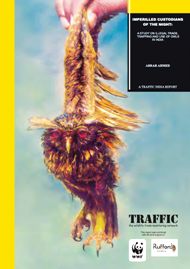
Black magic killing owls

A new report rings alarm bells for at least 15 species of Indian owls.

Apparently the night birds are being illegally traded for black magic and sorcery across eight states in India. An investigtion by WWF India into the illegal trade of owls reports that shaman or black magic practitioners prescribe the use of owls and their body parts — skull, feathers, ear tuffs, claws, heart, liver, kidney, blood, eyes, fat, beak, tears, eggshells, meat and bones — for ceremonial rituals. WWF says sacrifice of the birds is a common practice around Diwali, the Indian festival of lights, which went by last week.

owl.jpg

Hunting of and trade in all Indian owl species is banned under the Wildlife (Protection) Act 1972 of India.

Though the report does not have real numbers, the illegal trade is estimated to be in thousands. Larger species are most sought after, especially those with false “ear-tufts” (feather extensions on the head) thought to bestow greater magical properties on the birds. The illicit trade happens in Uttar Pradesh, Madhya Pradesh, West Bengal, Andhra Pradesh, Delhi, Gujarat, Rajasthan and Bihar.

The environment minister released the report before Diwali and one hopes the owls get a follow-up thought too, in terms of stricter implementation of the act.