Tyler Prize for Indian environment policy maker

Madhav Gadgil

Madhav Gadgil

Madhav Gadgil, Professor of Interdisciplinary Studies at Goa University and Chair of India’s expert panel on Western Ghats ecology, shares this year’s prestigious Tyler Prize for Environmental Achievement with Jane Lubchenco of Oregon State University, USA. The 2015 Tyler Prize, announced today, recognises their leadership and engagement in the development of conservation and sustainability policies in India, the United States and internationally.

Gadgil’s landmark report on the biodiversity of Western Ghats known as the “Gadgil Committee” report offered guidelines on the protection and development of India’s Western Ghats, a UNESCO World Heritage site and one of the eight most biological diverse areas on earth. His body of work has helped India draft the National Biological Diversity Act. Lubchenco, the former administrator of the federal agency National Oceanic and Atmospheric Administration (NOAA) has for long advocated the importance of the ocean and the need to protect it. The U.S. Department of State named her the first-ever science envoy for the Ocean, to promote this focus on ocean science, marine ecology, climate change and smart policy to a global audience.

“Drs. Lubchenco and Gadgil represent the very best in bringing high-quality science to policy making to protect our environment and ensure the sustainability of natural resources in their respective countries and around the world,” said Tyler Prize Executive Committee Chair Owen T. Lind, Professor of Biology at Baylor University announcing the prize winners. Lubchenco and Gadgil will share the $200,000 cash prize and each receive a gold medallion. The Prize, awarded by the international Tyler Prize Executive Committee with the administrative support of the University of Southern California, honours exceptional foresight and dedication in the environmental sciences and policy.

Gadgil’s career has been dedicated to marrying environmental science with policy making in India and promoting environmental science nationally. Through his public speaking and writing, Gadgil has advanced the field of environmental science and put it on the national radar. “From an early age, my father’s work inspired me to work with people and think about the impact of our collective activities,” Gadgil said in a release. “This first came about in my work in 1975 when traditional basket weavers who depended on bamboo in the Western Ghats approached the government and said the overexploitation of bamboo for paper mills was hurting their livelihood.”

Gadgil’s work began examining the tension between economic development, traditional use of resources among local communities and environmental conservation. This cross-sector approach drove the publication of his first book, This Fissured Land, which is used in environmental education across India, as well as a resource for policy makers.

According to Gadgil, the Western Ghats are central to India’s water supply, genetic diversity, economy and quality of life. “The Indian constitution is about empowering people and our resource management is too top down. Local communities do a better job of balancing economic development and conservation. We must have policies that empower local people to make these choices.”

Working with local forest communities in the central Indian forest belt, Gadgil has seen that that management in the hands of locals is most effective ensuring economic opportunity and sustainable use of natural resources while preserving sacred groves and local cultures. “We must engage local people who are most directly affected by policies if we want to develop policies that promote sustainability and balance the economics, culture and conservation,” Gadgil said in the release. “Empowering people is the key.”

Gadgil is a recipient of India’s highest civilian honours the Padma Shri in 1981 and the Padma Bhushan in 2006. He also received the Shanti Swarun Bhatnagar Award for biological sciences in 1986.
Away from home: One journey, three destinations

We are back with another interesting entry in our  ‘Away from home‘ blog series featuring promising young Indian postdocs working in foreign labs. The postdocs featured in the series recount their experience of working in foreign lands, the triumphs and challenges, the cultural differences and what they miss about India. They also offer useful tips for other Indian postdocs headed abroad. Join their online conversation using the #postdochat hashtag. 

Our ‘Away from home’ interactive map now features 41 bright Indian postdocs from around the world. Please feel free to suggest names of postdocs from countries and disciplines we haven’t covered yet.

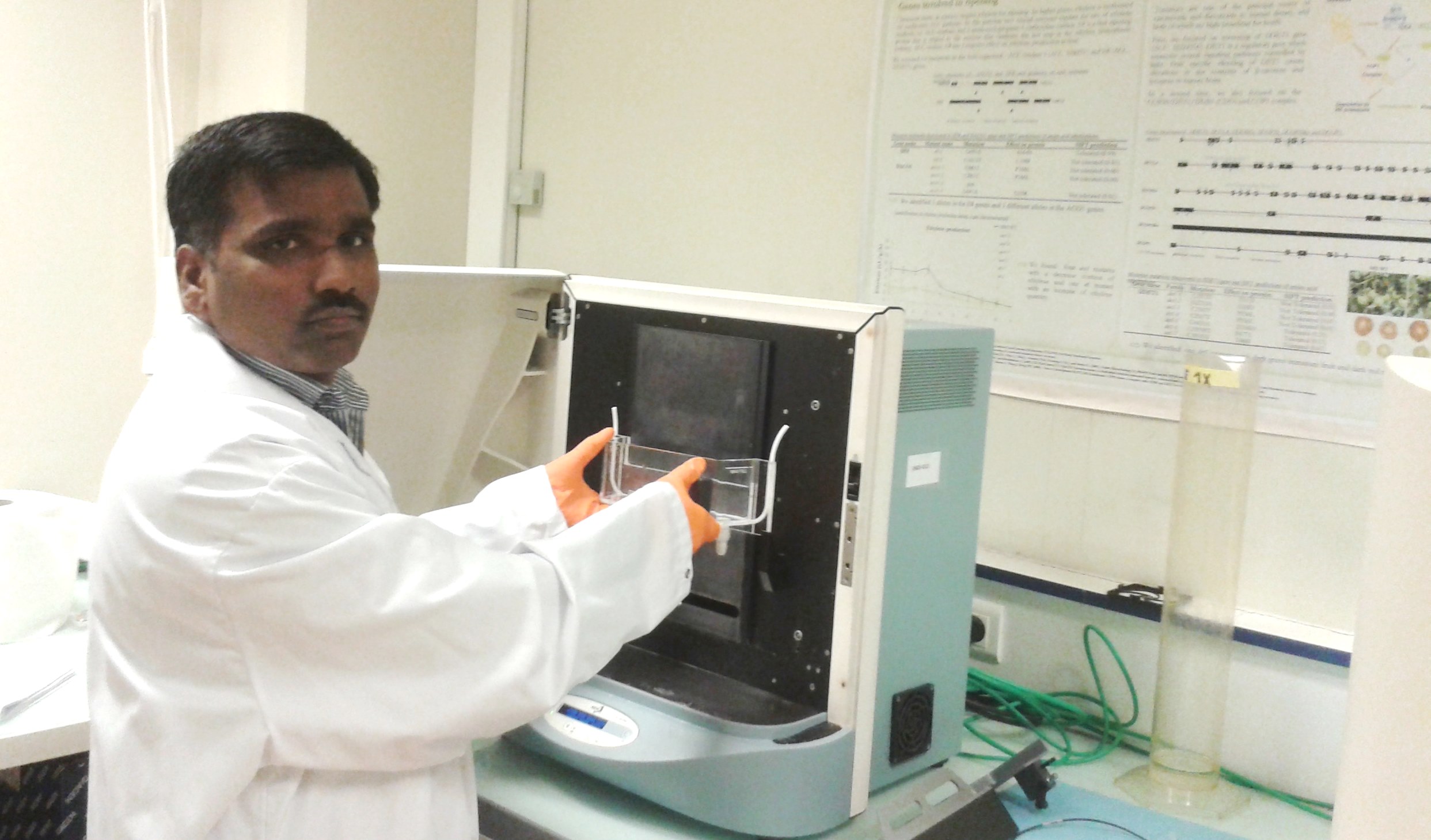
Today we have our very first entry from France — Siddanagouda S Biradar — who works as a postdoctoral scientist at Institut National de la Recherche Agronomique. A PhD. from the State Key Laboratory of Crop Stress Biology in Arid Areas, Yangling, China, Biradar narrates his research journey in plant genetics through his enriching experiences in India, China and France.

S S Biradar at INRA, FRance

S S Biradar at INRA, France

Of whys and hows

I entered the science field by chance and not by choice. I was born and brought up in a small village called Padekanur in Karnataka, India. Because of our poor economic background, my parents struggled very hard to give quality education to all of their three children.

Since childhood, I was curious about everything – ‘Why’ and ‘How’ were my favourite questions. I joined M. Sc (plant biotechnology) at Institute of Agri-Biotechnology (IABT) in Dharwad, Karnataka where I learnt most of the basic molecular biology techniques.

For my PhD (molecular biology) I chose the State Key Laboratory of Crop Stress Biology in Arid Areas, NWSUAF, Yangling, one of the top agriculture universities of China. I worked on genome-wide analysis of WRKY transcription factors in wheat and barley. I was also actively involved in some other projects at the lab such as miRNA identification and validation in barley and wheat, SSR marker development and characterization for wheat and Crofton weed, BAC library construction and physical mapping of wheat 7DL chromosome. Our lab was a part of the International Wheat Genome Sequencing Consortium (IWGSC).

Currently, I am working as a post-doctoral scientist (CEFIPRA funded project) at Institut National de la Recherche Agronomique (INRA), France which is one of the most reputed organizations for plants genetics and genomics research in Europe. It provides the basis for development of key molecular biology skills and to learn modern techniques with well-equipped labs, excellent guidance by senior researchers and complete freedom to explore new ideas. More importantly, we have a favourable research environment. My research focus is on improving shelf life in Cucurbits, making plants gynoecious which helps in hybrid seed production.

Namaste – Nĭ hăo – Bonjour

It was a smooth transition to France since I was in China for 4 years for PhD. Though weather was similar, there were a lot of cultural differences. France has large number of high profile international level universities/institutes and it is one of the best places for young researchers to start their career – the work culture is highly competitive. Unlike Indians and Chinese, the French enjoy their weekends to the fullest. Hard work, time management, discipline and work-life balance are things to be learnt from such an environment.

Don’t remain under-exposed

For Indian graduates looking for post-doc positions in France, my suggestion is try, try and try until you get a good opportunity. I know it is very hard to find a postdoc position abroad, especially for graduates from small universities in India like me, because of lack of exposure to modern techniques, lack of publications in high-profile journals and lack of guidance which makes us less competitive at international level.

Try to find a good lab which suits your research area, contact the professor, and tell him/her about your scientific skills. Don’t forget that past is always a stepping stone, not a milestone. So try and try again to get into a good lab. The postdoc experience definitely decides your future. No matter how many labs, scientists, research groups you try, get some postdoc experience. Always do your best. What you plant now, you will harvest later. In the end, it’s only the hard work, not chance or choice, that decide your destiny.

India calling

I miss many things about India. As I am herbivorous, food is a big problem. It’s hard to find pure vegetarian restaurants outside India. Of course, I miss my family and Indian friends.

Even though science has no boundaries, I want to come back and work in India soon. I want to utilize my experience, exposure and knowledge to improve the lives of the farming community in India. Unfortunately, there is not much value for young researchers like us in the Indian job market (specifically in plant biotechnology) because of which many graduates hesitate to come back and work in India. Let’s hope that India will create good working environment for plant biotechnology researchers in the near future.