Nature India Photo Story: The enigmatic sun

In our visual storytelling blog series titled the ‘Nature India Photo Story’, we feature photo stories that explore the realms of science, wildlife, environment, health or anything else that smells of science.

Here’s a photo story and a personal essay by B. Lakshmi Sowjanya on the mystical aura of the sun, arguably the most prominent among all celestial objects.

Sowjanya is a geneticist, a Bio-CARe Woman Scientist, and a postdoctoral researcher at the Indian Institute of Science, Bangalore. Her research interests are in the field of molecular oncology and lipidomics. She is keen on nature photography, and immensely enjoys capturing the Sun, drawing poetic parallels for life from its many hues.

Sun1

{credit}B. Lakshmi Sowjanya{/credit}

The Sun has not only attracted humans forever but also supports all life-sustaining activities on planet Earth. Several cultures around the world worship the Sun. Amazingly enough, the distance between Earth and the Sun is exactly right for life-conditions to flourish. Closer, we would burn; farther away, we would freeze.

In my photography journey, I try to capture glimpses of the Sun through clouds spread across the sky. As I set sight on the warm colours of the setting Sun, I am transported to an enchanted world. It has been an amazing journey so far, shooting the Sun in different colours, shades and moods.

Sun2

Sun6

{credit}B. Lakshmi Sowjanya{/credit}

These photographs were taken at the West Coast of India during winter (October to January) at dusk in Honavar taluk (14° 16′ 48″ N, 74° 26′ 38.04″ E), Uttara Kannada district, Karnataka state. They show the magical play of the clouds, humid weather conditions of the seashore, and the hues of sun rays.

In these photographs I tried to capture how differently we can visualize the Sun in the same season. The climate, atmospheric gases and clouds in the sky could greatly impact the way in which we see the Sun.

Sun4

{credit}B. Lakshmi Sowjanya{/credit}

Even as it signals an end, a sunset promises renewal. With the last rays peeping over the horizon comes the realisation that tomorrow holds endless possibilities. The descending Sun embodies the sheer power of an utterly romantic moment. Just like love at first sight, the sight of the Sun takes my breath away, leaving me speechless. I feel a rush of love and gratitude for Mother Nature.

Sun5

{credit}B. Lakshmi Sowjanya{/credit}

There is science behind these feelings, too. Watching sunsets promotes psychological effects believed to enhance satisfaction in life. Sunsets are a moment to pause in preparation for a new phase of life; a time of renewal, learning, and moving ahead with challenges. Sunsets can be real blessings.

I admire the steadfastness of the sun – an eternal and untiring effort to repeat the daily cycle, day after day, until all energy is spent, bidding us goodbye with a promise to return the next day in all its power and glory.

Sun3

{credit}B. Lakshmi Sowjanya{/credit}

This collection of radiating hues represents some of the most beautiful moments and most wonderful memories of my life. The ‘sweet light’ time, just before the sunset, is perhaps the best time for serial sunset photography. It is during those fleeting moments that the bright and pale shades of red tend to be even more dramatic, enhancing sunset photos and making the colours pop.

You can follow this blog series online with the hashtag #NatureIndphotostory. If you have a photo story to tell, email your high resolution entries with a short narration and a couple of lines about yourself to npgindia@nature.com with the subject line “Nature India Photo Story”. If it appeals to our editorial team, your photo story might get featured on this blog.

Suggested posts:

Nature India Photo Story: Cubanacan the Litigon

Nature India Photo Story: A midnight date

Nature India Photo Story: The kingfisher feeds

Nature India Photo Contest

Why I marched for science: Debunking myths, promoting rationality

Following the “March for Science” in 600 cities across the world on 22 April 2017, Indian scientists gave a call for “India March for Science” on the 9 August 2017. On that day, more than 15,000 scientists, science teachers, research scholars, students, and science-loving people came out on the streets of 43 cities and towns of India.

Scientists within India did not join the global protest. Did they miss the boat? Yes, say Vineeta Bal and Aurnab Ghose from the Indian Institute of Science Education and Research, Pune. Along with Satyajit Rath from the Agharkar Research Institute, Pune, they joined hundreds of scientists in the ‘India March for Science’ held, albeit belatedly, across the country. Here’s the trio’s guest post on the unique challenges facing India’s science that made the protests timely.

[The views expressed are personal].
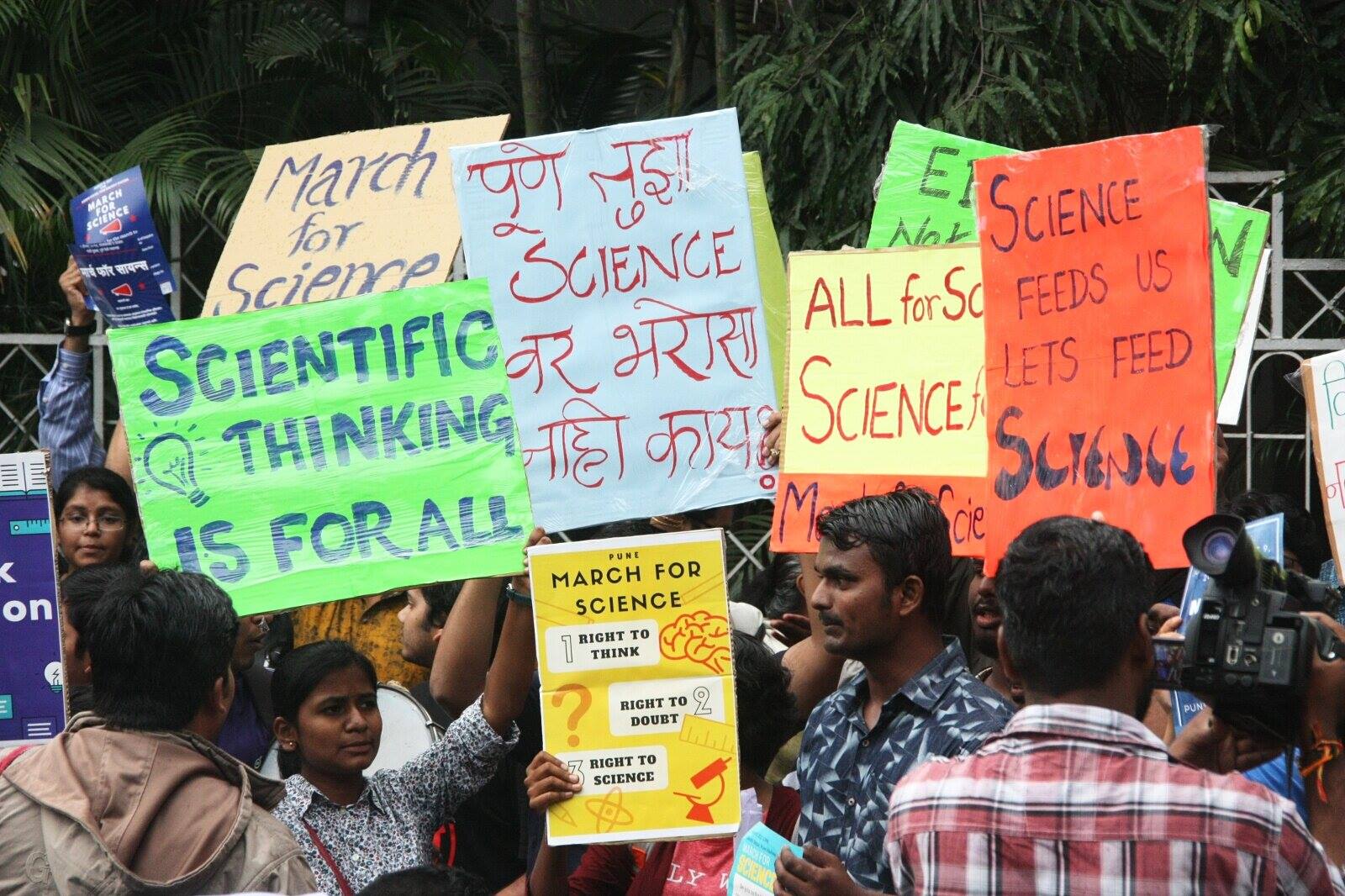
The protestors in Pune

The protestors in Pune{credit}Sourabh Dube{/credit}

There is a need to focus attention on the current trajectory of scientific pursuits in India – we need rationality and scientific temper in our society, and for that, we need the scientists of today and tomorrow.

The process of rational thinking needs to be inculcated early in life by encouraging young children to ask questions, by providing avenues for finding logical answers, by discouraging blind faith and acts associated with the perpetuation of blind faith. In many of these contexts, formal education can help. Hence there is a clear need to develop curricula which encourage curiosity and experiment-driven learning and discourage faith-driven irrational approaches and unquestioning attitude to learning.

One of the major demands during our ‘India March for Science’ was to increase the budget on education and spend it on developing young minds to think rationally and critically. While the exact proportion of GDP that should be spent on education can be debated, there is no doubt that in India there is a clear need to increase governmental spending on education at all levels.

Another demand during the event was that spending on research in science should be increased. For the last many decades, every successive government has promised to increase allocation for science research for various departments. Departments affiliated to defence research have seen substantial increases in certain years but civilian science research departments have not been as consistently fortunate.

While it is true that in recent years the funds allocated during the budget speech by the Finance Minister of the country appears higher than the previous year and hence can be used to counter the scientists’ arguments that there is no budgetary increase, the larger reality is far less promising. Funding is unpredictable, with even inflation not allowed for in some years, it is seldom available on time, and it is terribly patchily distributed. The Director General of CSIR (the largest network of laboratories in the country) has admitted near bankruptcy, stipends of research personnel are being withheld or delayed; there is thus little doubt that the funding for civilian scientific research in India is sub-optimal.
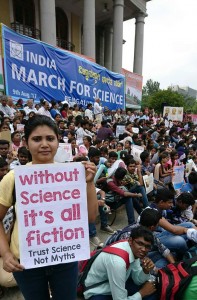
Bengaluru MarchScience research is a continuous, often long-term, process. It can’t start and stop arbitrarily. Hence there has to be an equivalence between the sustainability of efforts and sustainability of the associated funding. Also, just like in science education, rationality should be the mainstay of any science research. For this to be practised, development of reasonable models based on available data, refinement and testing of these models and evidence-based modification or rejection of the models should be the basis of scientific efforts and policy.

Funding for research where the outcome appears to be already defined is undesirable – a case in point is the Scientific Validation and Research on Panchgavya (SVAROP) project. The research aims to prove the usefulness of panchgavya, a concoction of five cow products (dung, urine, milk, curd and ghee) used in traditional Indian rituals. The Indian Science Congress, a major annual scientific meeting in the country, has also been used as a platform to promote pseudoscience. Such efforts undermine the basic tenets of science where research questions are asked with a hypothesis in mind and the knowledge gained is likely to support or refute the hypothesis. Instead, these regressive efforts foster superstition in society by pretending that pseudoscience is ‘science’.

The Indian march

At least 15000 people participated in the Indian march in several cities. About 700 people participated in the Pune march. Besides demonstrating solidarity with the global ‘March for Science’, the Indian students, teachers and researchers stressed on inculcating rational thinking in the society. The relevance of rationality in society was highlighted by the explicit and public reference to the work done over many decades in Maharashtra by the rationalist Narendra Dabholkar, an intellectual who was murdered for his stance against superstition.

India March for Science

{credit}Sourabh Dube{/credit}

August 9 was chosen for its historic significance as the day of the launch of the Quit India movement against erstwhile British rulers, with an implicit corollary of self-empowerment in making societal decisions. It is World Indigenous Peoples’ Day, underlining the most underprivileged sections of society in need of the empowering potential of science. It’s also Nagasaki Day, which reminds us that science disconnected with society can be used for horrific ends. Together, these reminders make the urgent point underlined by the march for science, that science must be recommitted and reconnected to society, and that society must rediscover the progressive potential of science and value it appropriately as an open-minded, fearless enquiry into causes.

We marched despite direct orders prohibiting some scientists from participating in the ‘March for Science’ and many refraining from joining due to perceived threats to their jobs and possible harassment. The practitioners of science who hit the streets were demanding freedom of speech to express their concerns, freedom for dissent and discussion, assurance of steady supply of funds for pursuing scientific research, provision of more funds for education for all.

In a democratic country such as India, these are basic demands to make. If a country’s scientific community need to take to the streets for such basics, there is serious need for introspection.

Physicist Soumitro Banerjee from the Indian Institute of Science Education & Research Kolkata, who joined the march in India’s capital Delhi, talks about the policy changes that scientists want to see in the wake of the march.

The march in Kolkata

The march in Kolkata

I marched for science in New Delhi because the funding support for scientific research in India is sorely inadequate, having remained stagnant in the range 0.8%-0.9% of India’s GDP for far too long. Other countries with similar aspirations have provided financial support for science exceeding 3% of GDP. It is not difficult to imagine the crisis facing most Indian scientific institutions because of paucity of funds.

The education system that supplies the scientific manpower is also in bad shape. The public school system, where a majority of Indian children get their education, is deplorable. Many schools are without proper buildings, toilets, and playgrounds, have overcrowded classrooms, face acute shortage of teachers and are without laboratory facilities. As a result, a vast majority of children are deprived of the opportunity of being a part of the scientific manpower of this country.

The college and university system is also reeling under acute shortage of infrastructure, teaching and non-teaching staff, and funds for research.

The situation is crying out for urgent redressal, and the march demanded allocation of 3% of GDP for R&D and 10% of GDP for education.

A bigger area of concern is that in recent times attempts to spread unscientific beliefs and superstition are on the rise. Sometimes, unscientific ideas lacking in evidence are being propagated as science, patronised by persons in high positions. Untested personal beliefs of educational administrators and textbook writers are infiltrating the education system, and mythology is being taught as history.

This is vitiating the cultural atmosphere of the country. There is an article in the Indian Constitution (Article 51A) that demands every Indian citizen to develop a scientific temper, humanism and spirit of inquiry, and the current cultural atmosphere runs counter to that. The march demanded that the government uphold this provision of the Constitution.


Suggested links:

Thousands across India march in support of science

What happened at March for Science events around the world

India’s ‘yoga ministry’ stirs doubts among scientists

Science writing across the world

Nature India intern Kate Telma from the Graduate Program in Science Writing at the Massachusetts Institute of Technology reflects on a summer of reporting science in India.

Kate Telma

Kate Telma{credit}Sonia Sharma{/credit}

As I made plans to join Nature India this summer, I was met with two questions from fellow students, professors, and friends: Will you be able to get my research into Nature?,  followed closely by, Why India?

Over the course of my science writing internship at Nature India, I haven’t been able to fast-track any of my PhD-pursuing friends’ research – I warned them about this before I left Cambridge. But my answer to the second question is still evolving, and only began to crystalise when I started asking others — mostly Indian scientists — why they had chosen India.

Many Indian researchers train abroad at some point in their careers (Indigenus has a whole series interviewing Indian postdocs abroad, ‘Away from home’), and need to make a big decision at the end of their stint away. I asked myself related questions about interning overseas: did I stay in the U.S. and perfect the science writing skills I had learned during my programme, or should I venture away to see how people in other countries communicate science? How far is too far?

One of the scientists I interviewed, Arun Shukla, said the main reason he chose to return and establish his lab in Kanpur was open space. He could be the first to accomplish challenging crystallography experiments in India, but from Europe or the US, he would be only one of a crowd. In many ways, this has also been true in my experience as a science writer in India. Instead of competing with news interns and writers at myriad online science and general publications to break the news of a well-publicised study, I am often the first person to contact scientists about their recent work, even when the embargo was lifted a week ago. Many researchers seem pleasantly surprised by the attention.

This unfamiliarity with the media has played out in amusing ways. While covering one new study, I sent a manuscript version of it to another scientist in the field, requesting his comment on it for my news article. When I called him the next day, he asked what sort of journal I was hoping to publish in, and offered some advice for improving the figures — thinking, perhaps, that I was a researcher hoping for some pre-submission peer review of my original research.

Many of even the largest universities in India don’t have a formal press or communications office, making news of scientific breakthroughs less available to the public. As a reporter, it often takes more effort to find a study by Indian scientists, or to identify a local expert willing to give outside comment. The methods I learned in graduate school — cultivate relationships with press officers, check embargo sites, interview a graduate student or a postdoc, who might have more time to sit down and really explain the research — frequently don’t suffice.

In my experience, the “open space” that Shukla seeks poses another challenge: there simply aren’t scientists in the field who were not also involved with the study, at least in India. For a story about a population genetics study, I wanted to get the perspective of a genetic counsellor who might have actually interacted with the type of patients in question. When I finally located one, he told me his training programme was still so new, there were an estimated 50 licensed genetic counsellors for a country of more than a billion. His time is in high demand, but he was happy to chat.

Enthusiasm for science writing and communication is growing faster than anything I’ve observed in the U.S. While covering an event at the Department of Biotechnology, or visiting the Translational Health Science and Technology Institute in Faridabad, I was invited to give talks to scientists and other writers about “how science writing should be done,” and “how scientists can best communicate.” Protests that I am just a student, and not an authority, go unheard.

KT

The summer has been an exciting time for science in India. In my first couple of weeks in Delhi, India became an associate member of the European Synchrotron Radiation Facility, a huge step forward for accessing cutting edge x-ray crystallography resources. In July, fifteen years of genomics data revealed that several large people groups in South Asia with populations of more than a million arose from just handfuls of ancestors, putting them at risk for population-specific genetic disorders. Clinicians and researchers are turning to both traditional turmeric and an Indian-made leprosy vaccine to fight tuberculosis infections. Resistance — both antibiotic resistance in poultry farms, and quests to track down drug resistant malaria strains — is never far from headlines. As the summer comes to a close, the community has been saddened by the deaths of several of the country’s leading scientists, in fields as far-ranging as molecular biology to space and science popularisation.

The milieu of passionate scientists waiting to share their discoveries presents a world of possibility for aspiring science writers. For me, it’s been more important than ever to write clearly for an audience who might not get news of the latest research anywhere else.

Nature India Photo Story: Cubanacan the Litigon

In our visual storytelling blog series titled the ‘Nature India Photo Story’, we feature photo stories that explore the realms of science, wildlife, environment, health or anything else that smells of science.

The third in this series is a photo story and commentary by Karl Shuker and Shubhobroto Ghosh, about the rediscovery of a litigon’s image amid the hybridisation debate, which Nature India has previously covered in-depth here.

On 22 May 2017, Karl Shuker, author and cryptozoologist in England, discovered this long lost photograph of an extraordinary hybrid cat. Cubanacan, the progeny of a lion and a tigon [tiger x lioness] was born at the Alipore Zoo in Kolkata, India, on 7 March 1979, and was the only surviving cub of his litter of three.

Cubanacan as portrayed in the 1985 Guinness Book of Records.

Cubanacan as portrayed in the 1985 Guinness Book of Records.{credit}Alipore Zoo, Kolkata{/credit}


Alipore Zoo had embarked on a fifteen-year endeavour to hybridise lions and tigers, an effort that created Cubanacan’s tigon mother, Rudrani, and her sister, Rangini, several years earlier. A pioneering scientific success for India, and even the rest of the world, Cubanacan was widely regarded as the first litigon born in the world.

A depiction of Cubanacan’s tigon mother, Rudrani, approaching his lion father, Devabrata. From 100 Years of Calcutta Zoo (1875-1975).

A depiction of Cubanacan’s tigon mother, Rudrani, approaching his lion father, Devabrata. From 100 Years of Calcutta Zoo (1875-1975).{credit} The Centenary Celebration Committee, Zoological Garden, Alipore, Calcutta (1975){/credit}


A captioned photograph of the litigon Cubanacan, published in The Statesman, Calcutta (now Kolkata) on 12 March 1980.

A captioned photograph of the litigon Cubanacan, published in The Statesman, Calcutta (now Kolkata) on 12 March 1980.

However, a record from 1943 indicates a successful mating between a fifteen-year-old lion-tiger and a lion at the Munich Hellabrunn Zoo to produce a female cub. Even so, Cubanacan’s remarkable genetic makeup sparked interest and enthusiasm in India and around the globe. The fascination with hybrid cats continued as Rudrani produced four more litigons in subsequent years.

There is now evidence that these experiments were led by a scientific quest to determine if hybrids could be fertile, a question that struck at the heart of the notion of biological species. At the time, the very definition of species hinged on reproductive isolation.  Though probing at a research question, concerns surfaced about artificially creating animals not found in the wild as freaks for public curiosity. There were also claims of animal cruelty during the process, an allegation that has come to the forefront in the current effort to ban cross breeding of big cats in the United States.

In the weeks following his birth, The Statesman ran articles about Cubanacan.

In the weeks following his birth, The Statesman ran articles about Cubanacan.

In the midst of this controversy, hybrids still command ample public attention. The 2017 Guinness World Records (formerly the Guinness Book of Records) ranked, Hercules, a liger [lion x tigress] at the Myrtle Beach Safari in South Carolina, the world’s largest big cat.

Cubanacan was also once the world’s largest big cat, who, according to Guinness in 1985, weighed 363 kg (800 pounds), stood 1.32 m (4.4 inches) at the shoulder and measured 3.5 m (11.6 inches) in length. Given the aversion to hybridisation and the subsequent 1985 ban on cross breeding big cats in India, it appears that Cubanacan’s memory was purposely forgotten.

Unspecified photographs of a tigon and a litigon, published in the Guidebook to Calcutta Zoo, A Dunlop Presentation, with legends whitened. Presumably, this was an effort to prevent proper identification of the taxa in the years after cross breeding became illegal. Exact publisher & publication date unknown, but circumstantially the photographs date to between 1992 and 1995.

Unspecified photographs of a tigon and a litigon, published in the Guidebook to Calcutta Zoo, A Dunlop Presentation, with legends whitened. Presumably, this was an effort to prevent proper identification of the taxa in the years after cross breeding became illegal. Exact publisher & publication date unknown, but circumstantially the photographs date to between 1992 and 1995.

The hybridisation debate in biology is important. So is the current proposal on banning big cat hybridisation in the US, and it is in the light of this controversy that Cubanacan’s photograph is being preserved for posterity as a valuable item in wildlife history, best viewed without value judgement.

Karl Shuker is a British zoologist, cryptozoologist and author. He currently lives in the Midlands, England, where he works as a zoological consultant and writer. He is a Scientific Fellow of the Zoological Society of London and a Fellow of the Royal Entomological Society. His books include Mystery Cats of the World (1989), The Lost Ark: New and Rediscovered Animals of the 20th Century (1993; expanded in 2002 as The New Zoo), and In Search of Prehistoric Survivors (1995), as well as two worldwide bestsellers – Dragons: A Natural History (1995; reissued in 2006), and The Unexplained (1996; reissued in 2002).

Shubhobroto Ghosh is Wildlife Project Manager of World Animal Protection in India and the author of the “Indian Zoo Inquiry,” a white paper review of conditions in Indian Zoos, and the book Dreaming in Calcutta and Channel Islands (2015).

[The authors are grateful to Dr Ashish Kumar Samanta and Ms Piyali Chattopadhyay Sinha, Director and Deputy Director of Alipore Zoo, for allowing the use of the Cubanacan photograph published in the Guinness Book of Records in 1985, in this photo story.]

You can follow this blog series online with the hashtag #NatureIndphotostory. If you have a photo story to tell, email your high resolution entries with a short narration and a couple of lines about yourself to npgindia@nature.com with the subject line “Nature India Photo Story”. If it appeals to our editorial team, your photo story might get featured on this blog.


Suggested posts

Nature India Photo Story: A midnight date

Nature India Photo Story: The kingfisher feeds

Nature India Photo Contest