Science without borders: The Bhabha legacy

As young physicists at the Tata Institute of Fundamental Research (TIFR), Mumbai circa 1981, Alak Ray and Prajval Shastri experienced an exciting era in the life of the institute, set up by visionary scientist Homi Jehangir Bhabha in 1945.

In this guest post, Ray, now a Raja Ramanna Fellow at the Homi Bhabha Centre for Science Education (TIFR) and Shastri, a Professor at the Indian Institute of Astrophysics, Bangalore peer into the institute’s history, armed with Indira Chowdhury’s book Growing the Tree of Science, Homi Bhabha and the Tata Institute of Fundamental Research.

The campus of Tata Institute of Fundamental Research around the time of inauguration of its new buildings in January 1962 in south Bombay (now Mumbai).{credit}TIFR archives{/credit}

After seventy years of the government of independent India nurturing scientific enterprise, even in the face of criticism of its investment in the fundamental sciences, it is a good moment to review the story of what many regard as the prized jewel of them all – the Tata Institute of Fundamental Research (TIFR), which was founded in 1945 by the physicist Homi Jehangir Bhabha with the help of the Dorabji Tata Trust.

Growing the Tree of Science (Oxford Univ Press, New Delhi 2016) by Indira Chowdhury treats us to a visit of this famous institute and its history. The reference to a growing tree in the title comes from an address by Bhabha in 1963 at the National Institute of Sciences of India: “A scientific institution… has to be grown with great care, like a tree.”

Chowdhury distills the history of the institute from years of effort she put in to set up the TIFR archives. She explores the early efforts of scientific institution building around the time of India’s independence in 1947, when science was envisaged as being serviceable to the nation and a tool of nation building, but the need to nurture institutional spaces without borders was also recognised.

Bhabha undertook this nurturing with enthusiasm, though juggling multiple responsibilities within a few years of founding the institute left him little time for research. He concentrated on creating the conditions for conducting good research, in enticing stellar scientists to visit, and to recruit established scientists to lead various programmes. A largely unknown initiative by Bhabha was his invitation in 1952 to Richard Feynman “to spend a couple of years or more here as a Professor of Theoretical Physics”, which Feynman declined.

A poignant story of Bhabha’s sense of science without borders concerns the Chinese mathematician S. S. Chern. During the intense civil war in China (1948), Bhabha wrote to Chern at the Mathematical Institute of the Academia Sinica at Nanking, which Chern himself had founded in 1946 after returning from Princeton. Bhabha wrote, “Although we know the patriotism which prompted you to prefer to work in your own country despite the many attractive offers from abroad, we realise that the present conditions must make work in your neighbourhood extremely difficult, if not impossible… I am therefore, writing to you to offer you the hospitality of this institute… to spend one year in the first instance as a Visiting Professor?” By this time Chern had already accepted J. R. Oppenheimer’s offer at the Institute of Advanced Study at Princeton, but was deeply grateful “for the concern of my foreign friends, which has never failed me”.

Bhabha smoothly and successfully recruited the mathematician K. Chandrasekhar in 1948 and the physicist M. G. K. Menon in 1955, though he failed with astrophysicist S. Chandrasekhar. In 1962, he offered George Sudarshan an Associate Professorship. Sudarshan had worked in TIFR’s emulsion group earlier (1952-1955) at the Old Yacht Club. Then, while on leave from TIFR at the University of Rochester, Sudarshan, with his thesis advisor Robert Marshak, worked out the universal V-A theory of weak interactions, for which they were nominated for the Nobel Prize multiple times. But the effort to repatriate Sudarshan failed because Bhabha tried putting Sudarshan on par with others who stayed on in the institute and did their research in India.

Indeed, Chowdhury writes about Bhabha’s notion of “self-reliance which had instilled in him an unswerving faith in the scientists who had trained at his institute”. She elaborates, “It was this group that had been responsible for growing the roots of the tree of science and Bhabha the master gardener was unwilling to carry out any process of grafting a foreign branch which could potentially disturb the stability of the tree itself.”

Chowdhury asks, “The institutional model itself had an unresolved paradox at its core – was it national or international?” She opines that the “ambiguity at the heart of Bhabha’s grand vision presented a troublesome dilemma – how to be international and national at the same time”.

The idea of using modern science for social transformation has been debated among the Indian elite since social reformer Raja Ram Mohan Roy’s time in the 1820s. The debate has touched on questions such as: What are the priorities for development? What types of scientific activities are most appropriate for a developing country like India? How can a scientific community be best established within a traditional society? How can scientists working in such a society keep their loyalty to the internationalism of science and at the same time deal with the more local and immediate needs of their own countries? [see “India’s Scientific Development”, William Blanpied, Pacific Affairs, vol 50, 91,1977)].

In the first two decades after India’s independence the international network that Bhabha built worked together with India’s nationalism and was happy to contribute to the development of institutions for a newly independent India. (The most notable scientist in this network was Nobel prize-winning experimentalist P. M. S. Blackett – see “Empire’s Setting Sun?”, Robert Anderson, Econ. Pol. Weekly, vol 36 (39), 3703, 2001). Chowdhury points out, “The sense of national self-realisation and an awareness of international cooperation went hand in hand.”

Bhabha also successfully drew a strong connection between fundamental science and technology development. Bhabha in his letter to the Sir Dorabji Tata Trust in 1944 wrote, “It is absolutely in the interest of India to have a vigorous school for research in fundamental physics, not only in the less advanced branches of physics, but also in the problems of immediate practical interest to industry. If much of the applied research done in India today is disappointing and of very inferior quality, it is due to the absence of sufficient numbers of outstanding pure research workers who could set the standards for good research.”

Growing the Tree of Science paints the picture of TIFR and its journey of undertaking science in a newly developing nation on a wide canvas. The story however is somewhat less richly textured for the period after Bhabha’s death. Chowdhury does discuss the beginnings of molecular biology, radio astronomy and other disciplines in TIFR with the recruitments of the geneticist Obaid Siddiqi in 1962 and the radio astronomer Govind Swarup in 1963. Her story is however mainly concentrated in the earlier phase of these groups. The hits and misses of the Bhabha era affected TIFR’s later development and the future it looks into. One wishes that a deeper appraisal of the era that followed could be put together in greater detail.

[This blog was originally posted on ‘On Your Wavelength’].
Why I marched for science: Debunking myths, promoting rationality

Following the “March for Science” in 600 cities across the world on 22 April 2017, Indian scientists gave a call for “India March for Science” on the 9 August 2017. On that day, more than 15,000 scientists, science teachers, research scholars, students, and science-loving people came out on the streets of 43 cities and towns of India.

Scientists within India did not join the global protest. Did they miss the boat? Yes, say Vineeta Bal and Aurnab Ghose from the Indian Institute of Science Education and Research, Pune. Along with Satyajit Rath from the Agharkar Research Institute, Pune, they joined hundreds of scientists in the ‘India March for Science’ held, albeit belatedly, across the country. Here’s the trio’s guest post on the unique challenges facing India’s science that made the protests timely.

[The views expressed are personal].

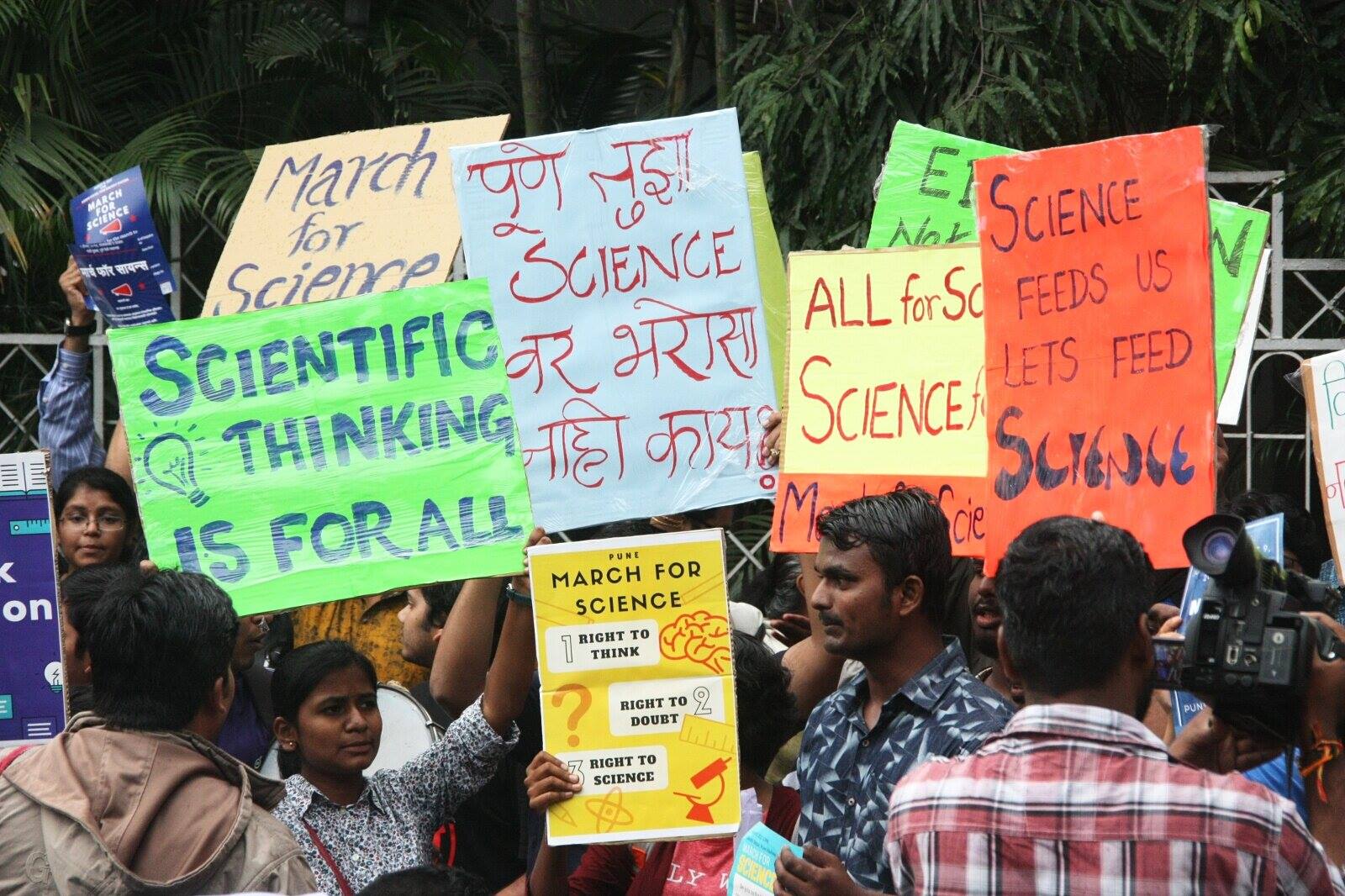
The protestors in Pune

The protestors in Pune{credit}Sourabh Dube{/credit}

There is a need to focus attention on the current trajectory of scientific pursuits in India – we need rationality and scientific temper in our society, and for that, we need the scientists of today and tomorrow.

The process of rational thinking needs to be inculcated early in life by encouraging young children to ask questions, by providing avenues for finding logical answers, by discouraging blind faith and acts associated with the perpetuation of blind faith. In many of these contexts, formal education can help. Hence there is a clear need to develop curricula which encourage curiosity and experiment-driven learning and discourage faith-driven irrational approaches and unquestioning attitude to learning.

One of the major demands during our ‘India March for Science’ was to increase the budget on education and spend it on developing young minds to think rationally and critically. While the exact proportion of GDP that should be spent on education can be debated, there is no doubt that in India there is a clear need to increase governmental spending on education at all levels.

Another demand during the event was that spending on research in science should be increased. For the last many decades, every successive government has promised to increase allocation for science research for various departments. Departments affiliated to defence research have seen substantial increases in certain years but civilian science research departments have not been as consistently fortunate.

While it is true that in recent years the funds allocated during the budget speech by the Finance Minister of the country appears higher than the previous year and hence can be used to counter the scientists’ arguments that there is no budgetary increase, the larger reality is far less promising. Funding is unpredictable, with even inflation not allowed for in some years, it is seldom available on time, and it is terribly patchily distributed. The Director General of CSIR (the largest network of laboratories in the country) has admitted near bankruptcy, stipends of research personnel are being withheld or delayed; there is thus little doubt that the funding for civilian scientific research in India is sub-optimal.

Bengaluru MarchScience research is a continuous, often long-term, process. It can’t start and stop arbitrarily. Hence there has to be an equivalence between the sustainability of efforts and sustainability of the associated funding. Also, just like in science education, rationality should be the mainstay of any science research. For this to be practised, development of reasonable models based on available data, refinement and testing of these models and evidence-based modification or rejection of the models should be the basis of scientific efforts and policy.

Funding for research where the outcome appears to be already defined is undesirable – a case in point is the Scientific Validation and Research on Panchgavya (SVAROP) project. The research aims to prove the usefulness of panchgavya, a concoction of five cow products (dung, urine, milk, curd and ghee) used in traditional Indian rituals. The Indian Science Congress, a major annual scientific meeting in the country, has also been used as a platform to promote pseudoscience. Such efforts undermine the basic tenets of science where research questions are asked with a hypothesis in mind and the knowledge gained is likely to support or refute the hypothesis. Instead, these regressive efforts foster superstition in society by pretending that pseudoscience is ‘science’.

The Indian march

At least 15000 people participated in the Indian march in several cities. About 700 people participated in the Pune march. Besides demonstrating solidarity with the global ‘March for Science’, the Indian students, teachers and researchers stressed on inculcating rational thinking in the society. The relevance of rationality in society was highlighted by the explicit and public reference to the work done over many decades in Maharashtra by the rationalist Narendra Dabholkar, an intellectual who was murdered for his stance against superstition.

India March for Science

{credit}Sourabh Dube{/credit}

August 9 was chosen for its historic significance as the day of the launch of the Quit India movement against erstwhile British rulers, with an implicit corollary of self-empowerment in making societal decisions. It is World Indigenous Peoples’ Day, underlining the most underprivileged sections of society in need of the empowering potential of science. It’s also Nagasaki Day, which reminds us that science disconnected with society can be used for horrific ends. Together, these reminders make the urgent point underlined by the march for science, that science must be recommitted and reconnected to society, and that society must rediscover the progressive potential of science and value it appropriately as an open-minded, fearless enquiry into causes.

We marched despite direct orders prohibiting some scientists from participating in the ‘March for Science’ and many refraining from joining due to perceived threats to their jobs and possible harassment. The practitioners of science who hit the streets were demanding freedom of speech to express their concerns, freedom for dissent and discussion, assurance of steady supply of funds for pursuing scientific research, provision of more funds for education for all.

In a democratic country such as India, these are basic demands to make. If a country’s scientific community need to take to the streets for such basics, there is serious need for introspection.

Physicist Soumitro Banerjee from the Indian Institute of Science Education & Research Kolkata, who joined the march in India’s capital Delhi, talks about the policy changes that scientists want to see in the wake of the march.

The march in Kolkata

The march in Kolkata

I marched for science in New Delhi because the funding support for scientific research in India is sorely inadequate, having remained stagnant in the range 0.8%-0.9% of India’s GDP for far too long. Other countries with similar aspirations have provided financial support for science exceeding 3% of GDP. It is not difficult to imagine the crisis facing most Indian scientific institutions because of paucity of funds.

The education system that supplies the scientific manpower is also in bad shape. The public school system, where a majority of Indian children get their education, is deplorable. Many schools are without proper buildings, toilets, and playgrounds, have overcrowded classrooms, face acute shortage of teachers and are without laboratory facilities. As a result, a vast majority of children are deprived of the opportunity of being a part of the scientific manpower of this country.

The college and university system is also reeling under acute shortage of infrastructure, teaching and non-teaching staff, and funds for research.

The situation is crying out for urgent redressal, and the march demanded allocation of 3% of GDP for R&D and 10% of GDP for education.

A bigger area of concern is that in recent times attempts to spread unscientific beliefs and superstition are on the rise. Sometimes, unscientific ideas lacking in evidence are being propagated as science, patronised by persons in high positions. Untested personal beliefs of educational administrators and textbook writers are infiltrating the education system, and mythology is being taught as history.

This is vitiating the cultural atmosphere of the country. There is an article in the Indian Constitution (Article 51A) that demands every Indian citizen to develop a scientific temper, humanism and spirit of inquiry, and the current cultural atmosphere runs counter to that. The march demanded that the government uphold this provision of the Constitution.


Suggested links:

Thousands across India march in support of science

What happened at March for Science events around the world

India’s ‘yoga ministry’ stirs doubts among scientists

Harvesting water from dry air

A team of researchers in the US made headlines some time back by developing a device that can extract potable water from ambient air¹ using only sunlight as the source of energy. K. S. Jayaraman got curious on how that could work for India. He spoke to Sameer Rao, an Indian postdoc involved in the project at the the Device Research Laboratory of Massachusetts Institute of Technology (MIT), and Omar Yaghi, who led the project at University of California, Berkeley.

Here’s Jayaraman’s guest post on the solar-powered water harvester and implications for India.

This is almost reminiscent of the famous magic trick — the “Water of India” — which India’s legendary magician P C Sorcar Jr. performed without fail in each of his stage shows. He would wave his hand in thin air, say the magic words in his characteristic style and, “by magic”, an empty jug kept on the table would constantly fill itself up. Again and again.

Now, a new research promises a potential new technology for harvesting drinking water from this hitherto neglected source – air.

Atmosphere actually contains an estimated 13,000 trillion litres of water – equivalent to nearly 10% of all fresh water present in lakes worldwide – that remains untapped. A solar-powered water harvester, which the MIT-UC Berkeley team has built, works even when relative humidity (RH) is as low as 20%, the level common in arid areas and deserts of the world.

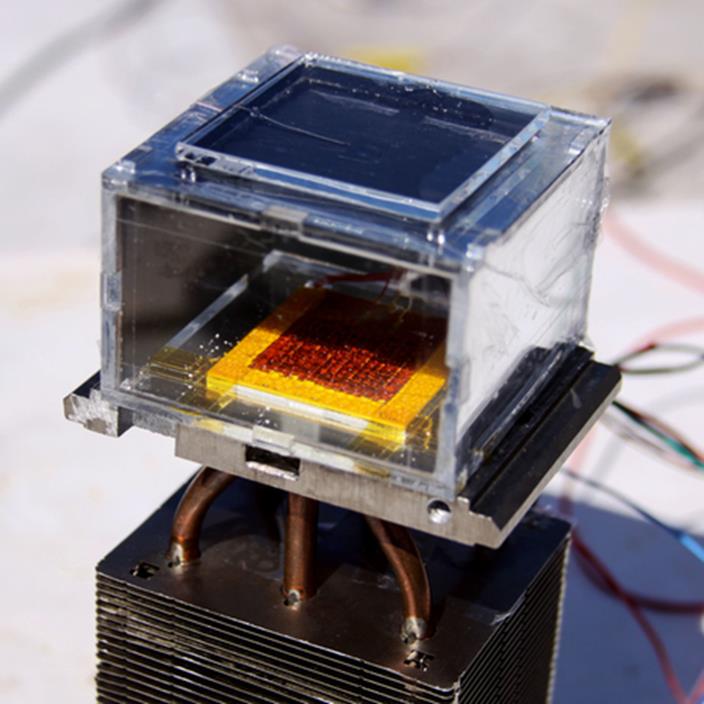
Sameer Rao tells me their device could work well in most parts of India. Large scale use of this device can change the landscape of water utilisation in India where sunlight is abundant, Rao, a post-doctoral associate in Evelyn Wang’s lab at MIT says. The heart of the new device is a metal-organic framework (MOF) that belongs to a class of unique materials exhibiting extremely high porosity that Yaghi’s team had pioneered in the 1990s at Berkeley.

Yaghi, a chemistry professor at UC Berkeley and one of the research leads, calls this a major breakthrough in the long-standing challenge of harvesting water from the air at low humidity. “We used only ambient sunlight, with no electricity – this is a major improvement over most other air-water harvesting devices which require energy input, and therefore are economically not viable.”

MOF crystals are embedded in the copper sheet sandwiched between the solar absorber and a condenser (in yellow).

MOF crystals are embedded in the copper sheet sandwiched between the solar
absorber and a condenser (in yellow).{credit}Evelyn Wang{/credit}

“They have high affinity to water molecules, to pull them out of ambient air, but do not hold on to them too tightly so that water can be concentrated and released with a slight temperature change (induced by sunlight),” Yaghi says. The adsorbed water thus released is then stored by the device in a condenser.

The adsorption-desorption experiments performed in a RH-controlled chamber in the laboratory found that the device was able to pull 2.8 liters of water from the air over a 12-hour period at RH levels as low as 20% using one kilogram of MOF. Roof top tests at MIT confirmed that the device works equally well outdoors. The scientists have found the experimental data to be in “good agreement” with a theoretical framework they had developed.

The quantity of harvested water can be scaled up by finding better MOF materials “with enhanced sorption capacity and high intra-crystalline diffusivity” that could absorb more water. The current MOF can absorb only 20 percent of its weight in water. Evelyn Wang, who led the MIT team says they “continue to improve the harvesting system to produce more water..”

“…If you are cut off somewhere in the desert, you could survive because of this device,”Wang says.

The developers hope their device, when commercialised, could help every household obtain drinking water it needs out of the air using only the power of the sun.

Rao particularly feels the social impact of this in India would be far-reaching. “It would enable greater success for government’s grass-root level programmes seeking to increase literacy and education of women and children in villages as they would get more time not having to travel long hours to fetch water from far off reservoirs for cooking and drinking.

How much would the solar water harvester cost? “We have made the significant first step by building the demonstration model combining chemistry and engineering to show how it works,” Yaghi says. “The economic aspects as well as the production of these materials and devices are the obvious next step.”

  1. Kim, H. et al. Water harvesting from air with metal-organic frameworks powered by natural sunlight. Science. doi: 10.1126/science.aam8743 (2017)

At 76, would you join a start-up? This scientist did

Remember the 2015 movie ‘The Intern’ where Robert De Niro plays a 70-year-old who discovers that ‘retirement isn’t all it’s cracked up to be’. In the movie, Niro joins an online fashion site as an intern, learning things he never did in his entire career.

Our guest blogger Tess Felder profiles an inspiring Indian scientist working in the US, who comes close – Yash Kamath, who has worked his way researching textiles and hair. Kamath, after retiring from active research, is now helping a start-up devise a hand held machine that straightens hair at the molecular level without heat or harsh chemicals.

Yash Kamath

Yash Kamath{credit}Mirakel Technologies{/credit}

It isn’t every day that you encounter a scientist in his mid-70s who works in a start-up but that is exactly where Yash Kamath finds himself these days. And while it is unusual to start in textile research and end up working around hair, with Kamath’s career it has somehow made sense.

A native of Karnataka in southern India, and now living in New Jersey, USA, Kamath was approached by technopreneur Suman Lal in July 2013 to do some work for his start-up called Mirakel Technologies, a company working on hair care technology using principles of dynamic electrochemistry.

Kamath’s innovative work in the field caught the company’s eye. The scientist had filed a couple of patents after retiring in 2006 from the Textile Research Institute in Princeton, New Jersey– in 2012, he got a patent aimed at detangling hair and in 2015 another on the chemical reshaping of hair.

“I was intrigued,” Kamath says about being approached by a start-up. During his career at the institute, his team had looked into electrochemical applications in hair treatment. “But Mirakel had a product development approach for commercial use,” as opposed to doing research alone. Kamath found the company’s initial results promising, and decided to come on board. He now spends his days conducting research for Mirakel at his lab in Monmouth Junction, New Jersey and coordinating with teams in Singapore and New York. He also spends time at the company’s salon space in Manhattan, where the product is tested on models with varying hair types.

Kamath is helping the company develop a hand-held device that straightens hair at the molecular level. The team includes chemical and mechanical engineers, in addition to hair stylists, but until Kamath joined, it had no one with a background in biochemistry and hair science.

Kamath has a master’s degree in plastic technology from the University of Bombay and a Ph.D. in physical chemistry from the University of Connecticut. He started his 34-year-long career at the Textile Research Institute as a postdoctoral fellow researching polymer science and textiles and eventually became the institute’s research director.

How did he get from fabric to hair? Interestingly, the institute turned away from textile research (as that industry shifted to Asia-Pacific) to hair care – a more logical step than it might seem, as wool and hair have similar chemical structures. And so Kamath and his team of researchers delved into the science behind everyday products like shampoos and conditioners, focusing on changes in the aesthetic appearance and durability of hair. Most of this work was done in collaboration with some of the world’s largest cosmetic and hair care companies. It also brought him significant recognition: in 2010, the Society of Cosmetic Chemists presented him with its top honour, the Maison G. de Navarre Medal Award, for technical contributions to cosmetic science.

After retirement, Kamath kept up his scientific pursuits setting up his own consulting firm, Kamath Consulting, Inc. “It is a different world from the 34 years of laboratory research,” Kamath says. “I am now getting an opportunity to be a part of a team which is developing a product for a real world application.” Starting up with a fresh mandate after decades of pure research has its challenges, such as frequent international travels, “But working in the lab trying to solve challenging problems is something I relish,” he says.

Nature India special volume on 30 years of DBT

DBT 30 years volumeOne of the key government departments of India credited with heralding the era of adventure and entrepreneurship in the country’s science – the Department of Biotechnology (DBT) – is entering its youthful years. Thirty, as they say, is the new twenty.

In these three eventful decades, DBT’s achievements have been many, in terms of the science it has enabled, the policies it has introduced, as well as the linkages it has established across disciplines and countries. DBT’s many forays into biological sciences education and its societal contributions have also bolstered its position as a formidable science-faring body in the country – as a confident young global icon who looks to the future, armed with a dynamic policy framework, the spirit of adventure and ample room for self-criticism.

Nature India is happy to be associated with DBT at this historic time of transition, a time when India’s science is making waves globally. This  special volume (freely downloadable from the Special Issues section of Nature India) marking DBT’s 30 years was released today. The volume features commentaries from leading names in biological sciences in India and across the world. The milestones of DBT have been highlighted in a commentary ‘The changing face of biological sciences in India’ and a short note ‘Three decades of biotech solutions’ by two of the many visionary past leaders of the department. DBT’s present chief outlines the vision for the future in an interview titled ‘As India’s economy grows, we will have more support for science’.

The articles compiled in this issue range from looking at the state of basic biotech research in the health sector (malaria, TB, allied microbes and stem cells) to green medicine and frugal medical innovations; from biosafety of India’s laboratories to the looming debate over genetically modified crops; and from biodiversity to big data.

The future of science and science-led entrepreneurship lies in an interdisciplinary, global approach; in frugal
innovations; in providing local solutions to the world’s problems. DBT, which has been playing the catalyst in all these areas successfully, now has an enviable 30-year benefit of hindsight to reflect upon and open newer doors to newer challenges.

As media partner, Nature India, a showcase of India’s science, is proud to collaborate with DBT in its newest mission of disseminating science better. It would be a mission well accomplished if the youth of this country gets back to thinking that ‘science is cool’.

Goodbye Kalam saab

Last night when news of APJ Abdul Kalam’s death spread thick and fast on social media – many heartbroken with the scientist/ex-President’s death and many wishing the news wasn’t true – one thing became clear. That this was not just the death of a scientist, a leading light of India’s space programme, or of the ‘People’s President’ – it was the demise of an adorable, all-round-good-natured, immensely accessible human being, rooted in his humble beginnings and untouched by the highs that fame brought.

Avul Pakir Jainulabdeen Abdul Kalam (1931-2015)

Avul Pakir Jainulabdeen Abdul Kalam (1931-2015){credit}PIB{/credit}

Why do I say that? In no time, my Facebook wall was a collage of pictures featuring Kalam alongside practically everyone I knew – the quintessential smiling face beamed in each of those pictures almost saying “Come here, do you want a picture with me?” Kalam would be missed most for this ease of approach, this humility that comes with knowledge. Small wonder that he often quoted from a Sanskrit slöka that roughly translated to “A fruit-laden tree always bends low.”

For Kalam, science was one of the many, many things he was passionate about – the number one on his passions list being teaching. “You ask me to teach 20 hours a day, I perhaps can,” he said to me once.

And he always came across as a teacher you could look up to for those wonderful motivational one-liners that stay with you for a long, long time and egg you on when you are not in the best of speeds. For instance, the Christopher Morley quote “Big shots are only little shots who keep shooting” featured quite regularly in his talks. “India needs such small shots in thousands,” he would say. No big surprise that his books – strewn with such pep quotes – flew off the shelves in no time.

With a gentle sway of the head and smiling eyes, he could heap on you tonnes of data peppered with intricate statistics, effortlessly – and then cross check if you retained all of it, typical Professor-style. “An aerobic space transportation vehicle can have a 15% payload fraction for a launch weight of 270 tonnes. This trans-atmospheric space transportation system has the potential to increase the payload fraction to 30% for higher take-off weight. So what per cent payload fraction can an aerobic space transportation vehicle have?” he would ask. And you had to say, “15%”, before the conversation went any further. He made sure the learning never stopped as long as you were with him. And then he left you with further food for thought – that was the magnet of his personality.

Kalam saab, as we fondly called him (though he might have secretly preferred Prof. Kalam), wrote several books, scientific papers, essays and his public talks are all freely accessible on the internet for anyone to benefit from. One piece he wrote for the launch of Nature India, however, will always remain precious to me. “What do you want me to write on?” he asked when I said we would love to have an inaugural article from him. “You are launching Nature India – I have to write something worthwhile. Let me give it a good thought”. Kalam, then a popular President with non-stop speaking assignments, entertained several rounds of emails before the article could be finalised. “Please feel free to edit as you like,” was his standard reply to all my queries. Here’s the piece that was finally published in Nature India.

I leave you with the endearing bits from that article – they give a peek into the man’s difficult early years that ended up shaping his invincible spirit, which India will continue to look up to for years to come:

“As I embark on my discussion on space safety and security, I am reminded of my joint family in Rameswaram, a small island in southern part of India, where a number of us brothers and a sister lived together. I was the last fellow. I keenly witnessed my mother keep all her children connected in spite of their varying needs and personalities. I used to ask myself, how does she keep us united despite such amazing diversity? It was only through the inherent pure love of the mother.

During the last five decades, I have seen how many successes and a few failures of space programmes helped connect countries around the globe. Whenever a major space event takes place – man landing on the moon, first series of communication satellites in the geo-synchronous orbit or remote sensing satellites in polar orbit, NASA astronauts, including Sunita Williams, descending on earth on a rainy day – it captures the attention of the entire planet. Events in space have in a way integrated the world, like the mother unifying the family. The question is: can we use space to transform earth into a homogenously prosperous place without poverty or fear of war?”

[“With Kalam’s demise, India’s scientists will miss their champion and star supporter in New Delhi,” says veteran science journalist K. S. Jayaraman in this obituary. “Being non-political, Kalam could cut across political parties while his image as father of India’s missile programme helped him promote science and technology. An approval from Kalam almost always resulted in budgetary support for such projects like the $250 million nanotechnology initiative, or the manned space mission.” Read more on India’s missile man’s contribution to India’s science vision here.]

Arrest irks scientists

The arrest of an Indian molecular biologist on flimsy grounds has irked the scientific community of the country. Partho Sarothi Ray is under arrest and subsequent detention since April 8, 2012, along with some others for peacefully protesting against the eviction of slum dwellers in the West Bengal state capital Kolkata. He has been charged under a number of sections under the Indian Penal Code, which his supporters say hold no ground.

The arrest of the scientist with an enviable record — his science is rated among the best in this country as evident from the list of publications  — has been criticised by eminent scientists, colleagues and friends. The community has written to the Prime Minister Manmohan Singh to intervene in the matter and get Ray released. An online petition by a pro-people group had already amassed close to 900 signatures (and counting) from across the world.  Mriganka Sur, an eminent professor of neuroscience at Massachusetts Institute of Technology, who was  a member of a review committee of the Wellcome Trust-India Alliance that awarded Ray the prestigious Wellcome Trust-India Alliance Intermediate Fellowship in 2010, has also expressed concern over the arrest of the young life scientist.

In my personal interaction with Ray after one of his papers got published in Nature, this assistant professor at the Indian Institute of Science Education and Research (IISER) Kolkata came across as a scientist with a purpose and sense of societal responsibility. That explains his being involved in the cause for the downtrodden. His interesting work on a molecular solution to the ‘dilemma’ that cells face was featured in Nature India. 

We hope the mounting pressure on the government makes it take a fresh look at Ray’s arrest.

Sari scare

The scare is that tying the petticoat under the traditional Indian women’s wear — the sari — too tightly and at the same place repeatedly might lead to skin cancer. The scare, obviously, is over rated. Any drawstring clothing — a pyajama, a salwar or a petticoat — could trigger this condition. The debate over whether this cancer should or shouldn’t be called ‘saree cancer’ refuses to die in the media[1], [2], [3], [4]. This, even four months after doctors reported  a couple of cases of cancer triggered by unhealthy petticoat tying in the Journal of Indian Medical Association (JIMA).

Sari

It boils down to how you tie the petticoat.

The researchers from Grant Medical College, Mumbai say it is ‘debatable’ whether the sari is an ideal clothing for the Indian climate. They also point out that “to make matters worse, they wear a skirt underneath fastened securely to the waist by a cord. These tight garments induce various dermatoses along the waist in female patients”. This is primarily because of sweating and skin irritation. They, however, cite an earlier study of 140 cases of waist line lesions associated with sari wearing but no malignancy.

In both the cases that the fresh study reports, the malignancy triggered by waist dermatoses was slow to spread.

Is the case study good enough to get worried over the humble sari or the salwar-kurta or pyajamas yet? Two cases do not seem to be good enough. Though caution — tying the drawstrings loosely and not at the same place always — looks like the way out of the scare. The researchers also suggest replacing the thin cord with broader  belts with hooks to reduce pressure on a particular site.

As long as it doesn’t cause physical irritation or lesions, the sari — unequivocally voted the most flattering Indian wear — has been given a green signal, for now!

Science Day

Happy Science Day to all!

A proud day in the annual calendar of India dedicated to celebrating science. The day marks the discovery of the Raman effect by Indian physicist Chadrasekhara Venkata Raman on 28 February 1928. He was awarded the Nobel Prize in physics for this path breaking discovery in 1930.

It was lovely to hear of celebrations in universities, institutions, colleges and schools from across the country (though many of them remained closed today in the national capital region on account of assembly polls).

The government’s science popularisation wing Vigya Prasar held public lectures at the National Science Centre in New Delhi with nuclear energy and environment experts talking about ‘Clean Energy Options and Nuclear Safety’ and ‘Scientific Attitude’. A workshop on low cost science teaching aids; quiz and essay writing competitions for youngsters were also part of the interactive programme. Along with the National Centre for Innovations in Distance Education (NCIDE), Vigyan Prasar also unveiled an innovative science popularisation programme through mobile phones, the first such in India.

In the western state of Gujarat, a five-day science carnival with the theme ‘Sparking Young Minds with Science’ was kicked off. Along with the usual competitions for students and lectures, it had some lively film shows, demonstration exhibitions and sky gazing fun.

Yesterday, we heard of protests on the eve of National Science Day at Pune’s Agharkar Research Institute. The protestors did not allow nuclear scientist Anil Kakodkar, a former chairman of India’s Atomic Energy Commision, to deliver a talk on the Jaitapur nuclear power plant. The plant, in Maharashtra, has been facing anti-nuclear protests since last year.

A national science day is a reminder of the country’s science legacy and a day for policy makers to spare a thought about the biggest malady affecting science — its education in schools and colleges. Hope there was some discussion in some corner of this country to address the issue.


Dating for techies?

Now, this one really amused me.

Sometime back while we were reinventing the Nature India website and inviting suggestions from our readers, someone said it would be a great idea to introduce a dating/matrimonial corner for scientists. Though we did not take up the suggestion on grounds that it might not gel with our core objectives, it looks like the idea has been bounced around. And some enterprising youngsters have actually created a social dating site for students of the country’s elite technology and management schools — the IITs and IIMs!

So when I saw DateIITians, I didn’t bury my curiosity. I browsed around to find that the site was still under construction in parts. In the age of social networking, it does not come as a surprise that someone has tailor-made a dating site for techies and management graduates. What I could not understand though was why a site meant for Indian students should have European-looking models! The objectives and privacy policy of the site are very well laid out. And apparently, there’s a waitlist running for enrollment!

Do you know of more such networking/dating sites for scientists, tech graduates? Write in. It would be interesting to track this new social trend.