Building blocks of life from space

Narendra Bhandari, a planetary scientist formerly with the Indian Space Research Organisation, recollects the time when he fortuitously became part of a meteorite detective team.

Narendra Bhandari with a meteorite fragment.

We spend crores of rupees trying to go to the Moon and other planets and bring back rocks. But nature is bountiful, even lugging space debris to our door step free of cost.

I regaled in one such gift a few summers back.

Just before sunrise at 5.15 a.m. on 6 June 2016, a rock of extraordinary type fell from the skies in the farm of Bishan Mehta of the Mukundpura village. The sound woke up the whole village, located in the outskirts of the pink city of Jaipur in Rajasthan.

I was driving down from Ahmedabad to Udaipur in Rajasthan when I heard about the meteorite fall on radio. I called Rajendra Prasad Tripathi, my friend who had recently retired from Jai NarainVyas University, Jodhpur and had settled in Jaipur. Tripathi immediately went to the site and surveyed the small foot-deep pit that the meteorite had created. To his dismay, the Geological Survey of India had swiftly collected all the pieces of the 2.5 kg meteorite. Not one to give up, Tripathi went home to fetch a kitchen sieve and filtered the sand from the bottom of the pit. He found two small pitch black chips, easily distinguishable as meteorite pieces owing to their colour.

Within a day, three of us – Tripathi, Ambesh Dixit of Indian Institute of Technology Jodhpur and I – measured the pieces using Mossbauer spectroscopy- to be sure the rocks were a rare type of carbon-containing meteorite, somewhat similar to the famous rock that fell at Murchison, in Australia, in 1969. About 2.5 per cent carbon content made this black, fragile, coal-like rock a scientific treasure.

A fragment of the Mukundpura rock , about 3 cm x 2 cm. The greyish surface on the left is due to heating in the Earth’s atmosphere. Dark black colour of the interior suggests presence of carbon, which contains organic molecules including amino acids, the building blocks of life. Mineral grains appear white.{credit}Anil Shukla{/credit}

When we analysed the minerals and chemical composition, it became clearer that this was going to be an important rock to study. Soon, we embarked on a detailed study with N.G. Rudraswami and colleagues at the National Institute of Oceanography, Goa, and found several amino acids in it. Amino acids, the chemical molecules from which biomolecules can be formed, are the building blocks of life.

We found evidence of water activity on various silicate minerals indicating the presence of abundant water on the asteroid where this rock had been lying for most of its life time, till it was kicked off by another space rock to come to Earth. Isotopes of carbon and nitrogen confirmed its extraterrestrial origin from the interstellar space.

M. S. Kalpana at the National Geophysical Research Institute, Hyderabad soon joined the effort, bringing a different set of expertise and technically sophisticated machines to complete the description of the extraterrestrial rocks. The team work paid off and using many techniques of mass spectrometry and gas chromatography, we were able to identify over 40 organic molecules of polyatomic aliphatic and aromatic hydrocarbons, including some fatty acids, and naphthalene.

These molecules are formed in the interstellar clouds from which our sun and planets were made 4.5 billion years ago. It is surprising that these organic molecules, easily destroyed at high temperature, survived the chaotic and complex processes in the severe environment that resulted in the formation of the Earth. Obviously the rock had not gone through much heating, may be it stayed below 100 degrees Celsius on the asteroid harbouring water, which saved the organic molecules, albeit with some alteration.

Hundreds of meteorites fall on the Earth every year, but what we received were among the rarest of rare rocks – only five such have fallen in India, the last one about 75 years ago. The Mukundpura rocks are now kept at Geological Survey of India museum in Kolkata.

These messengers from space packed with valuable information can tell us how life appeared on the earth. Together, we found over 15 heavenly rocks of different types in the past 30 years, many of which are described in my book Falling Stones and the Secrets of the Universe.

Strange rocks, like the ones that fell at Piplia Kalan and Lohawat in Rajasthan, tell different stories of their origin from different asteroids and their journeys to Earth. They increase our horizon of knowledge on space and fetch us extraordinary material for laboratory studies. These rocks tell us fascinating storiess of how it all began — the formation of the Sun, Earth, planets and life.

(Narendra Bhandari can be reached at nnbhandari@yahoo.com.)

Being rocket woman

Physicist Moumita Dutta from the Indian Space Research Organisation’s Space Applications Centre in Ahmedabad, Gujarat, was part of the team that put a probe into Mars orbit in 2014.  In an interview with Elizabeth Gibney, a senior reporter for Nature based in London, she talks about the lure of optics, the challenge of crafting super-light sensors, and the rise in Indian women entering space science.

Moumita Dutta and colleagues in her lab.

Tell me about your work with the Indian Space Research Organisation (ISRO).

The Polar Satellite Launch Vehicle of the Indian Space Research Organisation, which carried the Mars Orbiter Mission satellite Mangalyaan. The payload included instruments developed by Dutta and her team.{credit}ISRO{/credit}

In my childhood I dreamed about space, aliens, the Universe, the stars – particularly the aliens! But I didn’t think I would be involved in space science. I became interested in physics when I saw the magnificent colours coming out of a prism in an experiment at school.

I ended up doing a master’s in applied physics, specialising in optics. Then one morning in 2004 I read in the local newspaper that India was preparing for its first lunar mission, and I thought ‘What a phenomenal thing’. From that moment on I wanted to join the ISRO. A year and a half later, I did, ending up working on two sensors that would fly on the Chandrayaan-1 project [India’s first lunar mission, which launched in 2008 and found evidence of water before losing contact with Earth.]

My base is the Space Applications Centre in Ahmedabad, mainly working on optical sensors for studying Earth and for planetary missions. For India’s 2018 lunar mission, Chandrayaan-2, we will use advanced versions of the sensors flown in the last mission, carrying out a very detailed study of the lunar surface and mineralogical mapping. There will be an orbiter, a lander and a rover, with mounted instruments to carry out experiments on the surface.

Methane sensor for Mangalyaan.{credit}SPACE APPLICATION CENTRE, ISRO{/credit}

Mangalyaan launched just 18 months from its conception, costing a relatively low US$75 million.  What challenges did you face in building its sensors? 

All the sensors were designed in India: a colour camera, an infrared spectrometer generating a thermal map of the Martian surface and a methane sensor. We had 15 months or so to develop them. The main challenge was to make them very compact, lightweight and low-power, because the mission was to be launched with minimum fuel. We fought for every gram. The sensors were all first of a kind, and to develop them quickly we had to use off-the-shelf — rather than space-qualified — components, then test each under extreme conditions. The team of almost 500 engineers working  across the centres on the mission worked day and night.

I feel like people worked from their heart and no one cared about the clock. The mindset was that they were working for our country, and the mission had to be successful. When we received the first signal after the spacecraft was captured into Mars orbit, a wave of joy spread across the country. The project team members became the superstars of India, with people even holding their pictures on placards, like film stars. Eagerness about Indian space research has rocketed. Three years on, the orbiter still transmits data from all the sensors, which we are analysing today.

Colour camera for Mangalyaan. {credit}SPACE APPLICATION CENTRE, ISRO{/credit}

Is space science in India welcoming women?

In the past few years we have seen a significant increase in the number of women joining Indian space science: right now, they constitute 20% or 25% of ISRO. The organisation is always ready to welcome women. As a government body, we get a minimum of six months’ maternity leave, for example, and women are given equal responsibilities. I feel like it’s not about whether someone is a man or woman, it is all about how they can handle the challenges.

Now, whenever I give a talk and a small girl comes up to me and says, “I want to work for ISRO, I want to be an astronaut,” I feel wonderful. Women scientists of ISRO have also featured in the media, including Vogue India; and when our work is recognised, we represent the contributions of all the women involved.  That is the best part of it.

[This interview was edited for brevity and clarity. It first appeared in ‘A View from the Bridge‘, Nature’s books and arts blog.]

Goodbye Kalam saab

Last night when news of APJ Abdul Kalam’s death spread thick and fast on social media – many heartbroken with the scientist/ex-President’s death and many wishing the news wasn’t true – one thing became clear. That this was not just the death of a scientist, a leading light of India’s space programme, or of the ‘People’s President’ – it was the demise of an adorable, all-round-good-natured, immensely accessible human being, rooted in his humble beginnings and untouched by the highs that fame brought.

Avul Pakir Jainulabdeen Abdul Kalam (1931-2015)

Avul Pakir Jainulabdeen Abdul Kalam (1931-2015){credit}PIB{/credit}

Why do I say that? In no time, my Facebook wall was a collage of pictures featuring Kalam alongside practically everyone I knew – the quintessential smiling face beamed in each of those pictures almost saying “Come here, do you want a picture with me?” Kalam would be missed most for this ease of approach, this humility that comes with knowledge. Small wonder that he often quoted from a Sanskrit slöka that roughly translated to “A fruit-laden tree always bends low.”

For Kalam, science was one of the many, many things he was passionate about – the number one on his passions list being teaching. “You ask me to teach 20 hours a day, I perhaps can,” he said to me once.

And he always came across as a teacher you could look up to for those wonderful motivational one-liners that stay with you for a long, long time and egg you on when you are not in the best of speeds. For instance, the Christopher Morley quote “Big shots are only little shots who keep shooting” featured quite regularly in his talks. “India needs such small shots in thousands,” he would say. No big surprise that his books – strewn with such pep quotes – flew off the shelves in no time.

With a gentle sway of the head and smiling eyes, he could heap on you tonnes of data peppered with intricate statistics, effortlessly – and then cross check if you retained all of it, typical Professor-style. “An aerobic space transportation vehicle can have a 15% payload fraction for a launch weight of 270 tonnes. This trans-atmospheric space transportation system has the potential to increase the payload fraction to 30% for higher take-off weight. So what per cent payload fraction can an aerobic space transportation vehicle have?” he would ask. And you had to say, “15%”, before the conversation went any further. He made sure the learning never stopped as long as you were with him. And then he left you with further food for thought – that was the magnet of his personality.

Kalam saab, as we fondly called him (though he might have secretly preferred Prof. Kalam), wrote several books, scientific papers, essays and his public talks are all freely accessible on the internet for anyone to benefit from. One piece he wrote for the launch of Nature India, however, will always remain precious to me. “What do you want me to write on?” he asked when I said we would love to have an inaugural article from him. “You are launching Nature India – I have to write something worthwhile. Let me give it a good thought”. Kalam, then a popular President with non-stop speaking assignments, entertained several rounds of emails before the article could be finalised. “Please feel free to edit as you like,” was his standard reply to all my queries. Here’s the piece that was finally published in Nature India.

I leave you with the endearing bits from that article – they give a peek into the man’s difficult early years that ended up shaping his invincible spirit, which India will continue to look up to for years to come:

“As I embark on my discussion on space safety and security, I am reminded of my joint family in Rameswaram, a small island in southern part of India, where a number of us brothers and a sister lived together. I was the last fellow. I keenly witnessed my mother keep all her children connected in spite of their varying needs and personalities. I used to ask myself, how does she keep us united despite such amazing diversity? It was only through the inherent pure love of the mother.

During the last five decades, I have seen how many successes and a few failures of space programmes helped connect countries around the globe. Whenever a major space event takes place – man landing on the moon, first series of communication satellites in the geo-synchronous orbit or remote sensing satellites in polar orbit, NASA astronauts, including Sunita Williams, descending on earth on a rainy day – it captures the attention of the entire planet. Events in space have in a way integrated the world, like the mother unifying the family. The question is: can we use space to transform earth into a homogenously prosperous place without poverty or fear of war?”

[“With Kalam’s demise, India’s scientists will miss their champion and star supporter in New Delhi,” says veteran science journalist K. S. Jayaraman in this obituary. “Being non-political, Kalam could cut across political parties while his image as father of India’s missile programme helped him promote science and technology. An approval from Kalam almost always resulted in budgetary support for such projects like the $250 million nanotechnology initiative, or the manned space mission.” Read more on India’s missile man’s contribution to India’s science vision here.]

Aerospace engineers win global innovation challenge, virtually

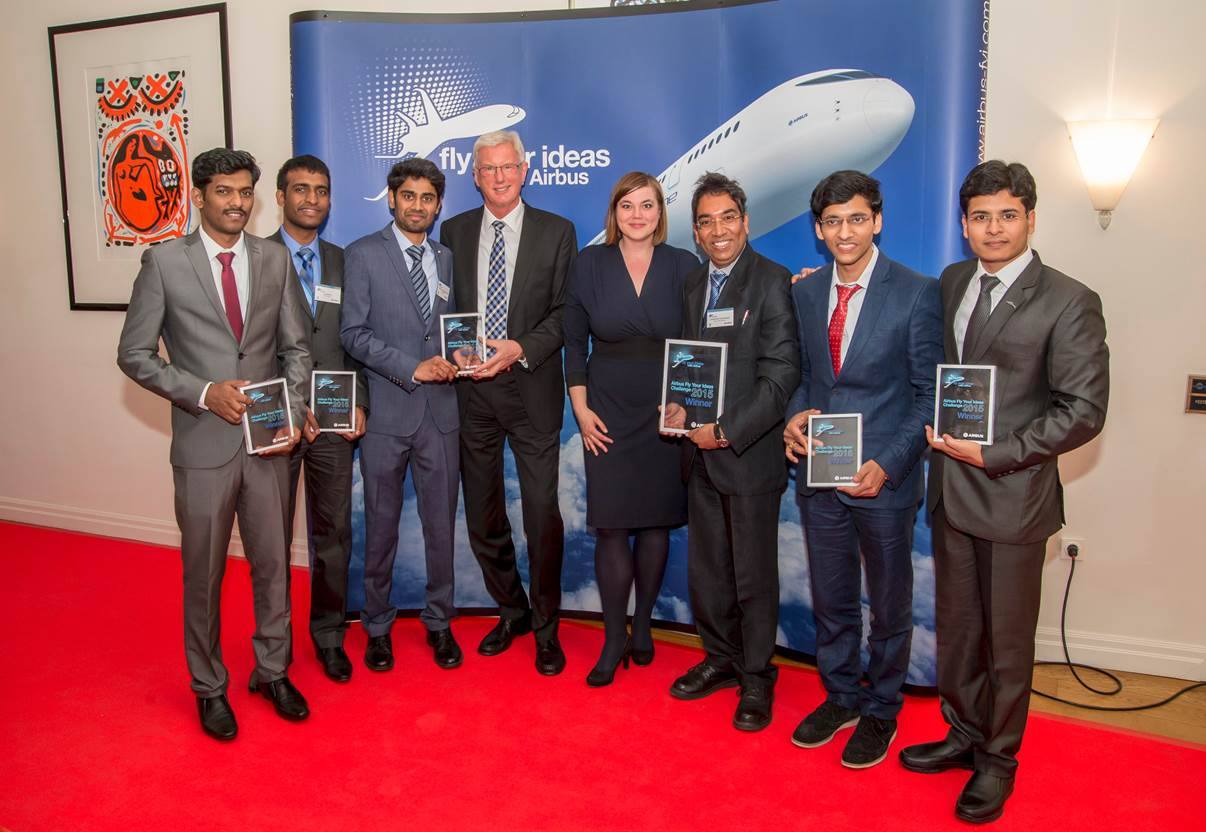
A virtually connected team of Indian aerospace engineers — based in India, USA, UK and The Netherlands — have emerged champions in a global biennial innovation challenge organised by UNESCO and the passenger aircraft manufacturing company Airbus.

Interestingly, members of the team, which aptly calls itself MultiFun, met in person for the first time only for the final round of the event last week (May, 2015). Their winning entry for the ‘Fly Your Ideas (FYI)’ competition held in Hamburg, Germany was a “hybrid battery-piezoelectric composite structure for next generation aircraft”. Simply put, they designed aircraft wings dressed in a “composite skin that harvests energy from natural vibrations” or flex in the wings.  MultiFun bagged €30,000 as prize money along with the coveted trophy.

The winning team

The winning team{credit}MultiFun{/credit}

“Piezoelectric fibres gather electrical charges from even the smallest movements during flight, storing the energy generated in battery panels integrated in the fuselage and using it to power auxiliary in-flight systems, such as lighting and entertainment systems. This reduces the energy footprint of aircraft during flight and could even replace the entire power source for ground operations,” the jury said calling MultiFun’s entry a ‘path breaking’ innovation.

The idea was sprouted in the Department of Aerospace Engineering, Indian Institute of Science (IISc), Bangalore. The chief mentor for the project was Dineshkumar Harursampath, lab head of the  Nonlinear Multifunctional Composites — Analysis & Design Laboratory at IISc. Harusampath got this globally-placed team of IISc alumni and current IISc students together through video-conferencing and virtual platforms. Team leader, Sathiskumar A. Ponnusami, a doctoral student in TU Delft, and Dhamotharan Veerasamy, a doctoral student in City University London, are IISc Masters alumni. Shashank Agrawal and Ajith Moses are current doctoral students at NMCAD Lab. And the youngest, Mohit Gupta, a Masters student at Georgia Tech, Atlanta, was an intern at NMCAD Lab a year ago.

The Indian team’s entry was shortlisted in the top five from among 518 teams representing 104 countries.  FYI is designed to identify and encourage the next generation of innovators and uncover futuristic and unconventional yet promising solutions for the evolution of flight.

Team leader Sathiskumar says the “long umbilical cords” of IISc inspired them to design and develop multifunctional materials for next generation aerospace applications. “The lab provides an environment conducive for out-of-the-box thinking and uninhibited multimedia communication without space-time limitations amongst team members,” he said in a release. “Only half the time was spent on technical issues. The rest was inspirational yet unplanned chatting leading to team bonding, true to the name MultiFun!”

The team was able to work 24 hours a day by interacting across physical boundaries from four different locations around the world and managed to present the most disruptive idea for the future of aviation at the competition. “… the winning idea is all about good vibrations,” the jury noted.

Indeed a brilliant example of virtual networking for science and innovation.

Century launch

It will be the 100th space mission for the Indian Space Research Organisation (ISRO) tomorrow (September 9, 2012) as it launches another vehicle from  its workhorse series — PSLV-C21. The 49-year-old organisation has come a long way with  62 satellites and 37 launches in its repertoire. ISRO’s first mission — the Aryabhatta satellite launched using a Russian rocket — dates back to1975.

PSLV C-21{credit}ISRO{/credit}

As countdown begins for PSLV-C21, preparations are also underway to host VIPs such as Prime Minister Manmohan Singh — in charge of space and atomic energy — at Sriharikota, the launch venue. However, considering that it’s ISRO’s 100th mission, the event has not received as much publicity as one would expect of a landmark occasion like this. The ISRO press release announcing the countdown for the launch had no mention of its historic significance. ISRO might be playing it down, making room for some cautious and deferred celebrations until after a successful launch. Rightly so.

Coming back to ISRO’s century launch, it will carry two satellites — the French SPOT-6 and Japanese PROITERES. PSLV C-21 will be lifted off Satish Dhawan Space Centre (SDSC) SHAR, Sriharikota as most of India turns on their television sets on Sunday — around 9:51 a.m. The two satellites are  expected to be propelled into an orbit of 655 km altitude at an inclination of 98.23 degrees. In the 13 years since PSLV has been undertaking business launches,  this one will also be its biggest ever commercial lift. The French satellite weighs 720 kg and the Japanese 15 kg.

Just how does ISRO count its missions considering that it launches foreign satellites and also its own satellites on foreign rockets?  An ISRO official solves the number crunching thus:  each ISRO rocket flight is considered one mission; an ISRO satellite launched by a foreign rocket is marked as one mission and; an Indian rocket (such as PSLV) launching a number of satellites built and owned by ISRO is marked as several missions — 2 if there are two satellites, 3 if there are 3 satellites.

So PSLV C-21 will be one mission — the one that strikes the ton for ISRO.


Post updated on September 9, 2012:

PSLV C-21 lifts off.{credit}ISRO{/credit}

ISRO’s 100th space mission PSLV C-21 was successfully launched from the Satish Dhawan Space Centre in Sriharikota in Andhra Pradesh at 9:53 a.m. Prime Minister Manmohan Singh, who witnessed the launch, described the mission as a ‘spectacular success’. Soon after launch, the vehicle put the two foreign satellites into orbit.

As is the norm, ISRO chief K Radhakrishnan had offered prayers at the Lord Venkateswara Temple in Tirupati yesterday for the success of the historic mission.


Year-closing eclipse

The year will close with another total lunar eclipse, though not as dark as the the mid-year eclipse of June 15, 2011. This one, to occur on the night of 10 December 2011, will have the advantage of a clear winter night.

Stargazers in India will have close to five hours to feast on the celestial event. And no, you don’t want to miss this one — the next total lunar eclipse is six years away in August 2017.

The Moon will be in the penumbral shadow of the Earth at about 5:00 p.m. Indian time, says Arvind Paranjpye of the Inter-University Centre for Astronomy and Astrophysics in Pune. For the next half hour or so, there wouldn’t be much action. Then we can see a gradual change in the brightness on the lunar disk. By 6:16 p.m. the Moon will be in the umbra of the Earth’s shadow. The dark shadow of the Earth will slowly cover the lunar disk. This phenomenon will be quite noticeable to the naked eyes, he says.

In the next 75 minutes, the Moon will be totally engulfed by the shadow of the Earth. The colour of the lunar disk will become many hues of red from crimson to brick red during this time.

The time of the maximum eclipse is 20:27:16 when the Moon will be very dark. The sky assume the likeness of a new moon night. One can see lots of faint stars. By 10:00 p.m. the shadow play will be over and a bright full moon will illuminate the Earth.

India has had six eclipses — four solar and two lunar — this year.

Lets say adieu to the year with this final cosmic event. Happy skygazing!

Oceansat 2 pictures

ISRO today released the first pictures of its Ocean satellite Oceansat-2 launched on September 23. Oceansat-2 is India’s second remote sensing satellite in the series that will study the ocean atmosphere. It replaces Oceansat-1 launched in 1999.

1.jpg

Global area coverage. © ISRO

2.jpg

Mosaic of Indian region. © ISRO

3.jpg

Northern and western India. © ISRO

ISRO said the three payloads on-board Oceansat-2 — ocean colour monitor (OCM), scatterometer and radio occultation sounder (ROS) for atmospheric studies — have been successfully turned on.

The OCM, a multi-spectral imaging radiometer, provides information on chlorophyll concentration and helps locate potential fisheries zones. The scatterometer, an active microwave sensor, facilitates retrieval of sea-surface wind speed and direction, and monitoring polar sea-ice. The ROS measures parameters pertaining to lower atmosphere and ionosphere.

The data provided by the different sensors on-board Oceansat -2, will also facilitate monitoring of turbidity and suspended sediments, sea-state and sea-surface winds, and meteorological/climatological studies. The satellite collects data over the entire globe once in two days.

Indian IAA prez

gmn.jpg

©ISRO

Close on the heels of Chandrayaan’s Moon water find, ISRO chairman G Madhavan Nair has taken over as the President of the International Academy of Astronautics (IAA) headquartered in Paris. He is the first Indian space expert to be elected to the post. Among all the 25 Indian space missions under his tenure, the most significant was the successful launch of India’s first Moon mission Chandrayaan-1.

Madhavan Nair was the Vice-President of scientific activities of the IAA for the last four years. He is the recipient of two of India’s biggest civilian honours Padma Vibhushan and Padma Bhushan.

His election as President of IAA recognises India’s growing presence and expertise in space sciences and exploration. It also raises the bar for future ISRO missions.

IAA is an independent organisation of 1200 distinguished members from 85 countries elected by their peers for their outstanding contributions to astronautics and the exploration of space. It is the only international academy of elected members in the broad area of astronautics and space. IAA membership consists of individuals who have distinguished themselves in one of the fields of astronautics or one of the branches of science of fundamental importance for the exploration of space. The Academy has a strong scientific program this year with about 16 stand-alone conferences around the world.

Chandrayaan tales

New revelations from Indian’s moon mission Chandrayaan-1, despite its short lived glory, seem to be in the offing.

Last week at the European Planetary Science Congress in Postdam, Germany, Manuel Grande, principal investigator of Chandrayaan-1’s X-Ray Spectrometer (C1XS) made announcements on some interesting data India’s lunar mission had gathered. During its 10 month long journey in outer space, Chandrayaan-1 gathered data for a total of 30 solar flares, giving the most accurate measurements to date of magnesium, aluminium, silicon, calcium and iron in the lunar surface.

chandrayaan.jpg

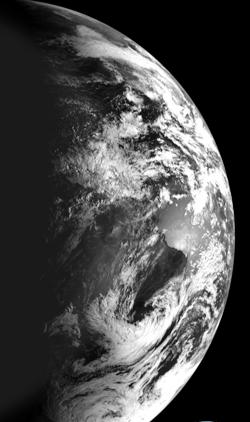
© ISRO. A lovely picture of earth taken by Chandrayaan-1’s terrain mapping camera way before it started gazing at the Moon.

Adding some vital pieces to the jigsaw of the mineralogy of the lunar surface, the C1XS instrument investigated the lunar surface using an effect whereby X-ray illumination from the Sun causes rocks to fluoresce, emitting light at a different wavelength. This re-emitted light contains spectral peaks that are characteristic of elements contained in the rock, revealing its composition. Solar flares acted like flash bulbs, giving added illumination and allowing C1XS to ‘see’ more elements.

Grande said the results will help us further our knowledge of the Moon and planetary formation. "We were able to separate clear peaks for each of the target elements, allowing us not only to identify where they are present but give an accurate estimate for how much is there. The technology developed for C1XS opens up some exciting opportunities for future missions,” he was quoted as saying in a release.

Here’s hoping we will hear more earth shaking stories — water or no water on the Moon — soon!

Quick update: Looks like the water stories are absolutely right, after all. More coverage on Nature India .