Science in comics

Very heartening to hear that a series of medical comic books for kids, launched in the UK last month, would soon make a debut in India.

The idea behind the project is brilliant — telling stories to explain swine flu, asthma, cardiac arrest and hundreds of such medical conditions in the language of a ten year old. UK-based Medikidz comics will come to India with their glossy tales of the adventures of five superheroes in a make-believe land. The books are written and reviewed by doctors and will help parents, teachers and children basics of difficult to understand medical concepts.

comics.jpg

I remember UNICEF’s girl child Meena, parrot in tow, in comic books and animated films taking on tough issues such as HIV/AIDS in the south Asian region. Meena was a greatly inspiring example of communicating health and education even at the village level. Some time back I was thoroughly impressed with the work of Jean Pierre Petit, who uses comics in France (and now the rest of the world) to tell science stories.

Also India’s Centre for Science and Environment’s commendable publication ‘Gobar Times’ (Gobar is cow dung in Hindi) dejargonising environment issues for children.

I’m sure there are hundreds of lesser known publications that we must know about. I would love to hear of such regional and national publications that are successfully doing this relatively difficult job of taking science to children. Writing simply and effectively is the most challenging way of communicating and my respect goes to such publications who do this tirelessly, sometimes as an act bordering on philanthropy.

E-book woes

Makes me sad that digital book reading technology would cost Indians far more than book lovers in the western world. A slew of new technology tools being launched in the west will be priced far more in India, a country whose tech-savvyness and love for books match any western nation. Add to that the higher cost of acquiring a book online.

But first the details, and then a little more crib.

e-book.jpg

Among many such devices, Google Inc. is hoping to launch a new online service that will let readers buy electronic versions of books and read them on gadgets — cell phones, laptops and possibly e-book devices. Google Editions will make millions of printed books available online, abiding by all copyright laws.

Google faces competition from Amazon.com Inc.‘s Kindle e-book reader and Sony Corp.’s new Reader Pocket Edition. Kindle weighs less than 300 grams and gets you a book to read within a minute. Sony’s eBook Store includes more than 100,000 books, as well as a million free public-domain books available from Google. The Kindle Store currently has more than 330,000 available titles, according to an Associated Press report.

Indian bibliophiles will have to wait a while to be able to afford these ‘lighter than the lightest paperback’ devices. Or hope that someone kindles a flame here to develop an indigenous e-book reader! The latter sounds more like it, what with a country abounding in world-class software experts. Or maybe, we have an indigenous version already that has escaped my keen eye.

Oceansat 2 pictures

ISRO today released the first pictures of its Ocean satellite Oceansat-2 launched on September 23. Oceansat-2 is India’s second remote sensing satellite in the series that will study the ocean atmosphere. It replaces Oceansat-1 launched in 1999.

1.jpg

Global area coverage. © ISRO

2.jpg

Mosaic of Indian region. © ISRO

3.jpg

Northern and western India. © ISRO

ISRO said the three payloads on-board Oceansat-2 — ocean colour monitor (OCM), scatterometer and radio occultation sounder (ROS) for atmospheric studies — have been successfully turned on.

The OCM, a multi-spectral imaging radiometer, provides information on chlorophyll concentration and helps locate potential fisheries zones. The scatterometer, an active microwave sensor, facilitates retrieval of sea-surface wind speed and direction, and monitoring polar sea-ice. The ROS measures parameters pertaining to lower atmosphere and ionosphere.

The data provided by the different sensors on-board Oceansat -2, will also facilitate monitoring of turbidity and suspended sediments, sea-state and sea-surface winds, and meteorological/climatological studies. The satellite collects data over the entire globe once in two days.

Indian IAA prez

gmn.jpg

©ISRO

Close on the heels of Chandrayaan’s Moon water find, ISRO chairman G Madhavan Nair has taken over as the President of the International Academy of Astronautics (IAA) headquartered in Paris. He is the first Indian space expert to be elected to the post. Among all the 25 Indian space missions under his tenure, the most significant was the successful launch of India’s first Moon mission Chandrayaan-1.

Madhavan Nair was the Vice-President of scientific activities of the IAA for the last four years. He is the recipient of two of India’s biggest civilian honours Padma Vibhushan and Padma Bhushan.

His election as President of IAA recognises India’s growing presence and expertise in space sciences and exploration. It also raises the bar for future ISRO missions.

IAA is an independent organisation of 1200 distinguished members from 85 countries elected by their peers for their outstanding contributions to astronautics and the exploration of space. It is the only international academy of elected members in the broad area of astronautics and space. IAA membership consists of individuals who have distinguished themselves in one of the fields of astronautics or one of the branches of science of fundamental importance for the exploration of space. The Academy has a strong scientific program this year with about 16 stand-alone conferences around the world.

National aquatic animal

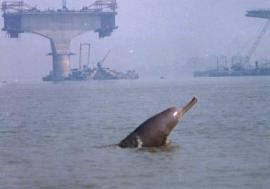
The Gangetic Dolphin is India’s new national aquatic animal. The idea is to increase the visibility of this endangered species on the conservation map. The 100 million year old species faces the danger of extinction in 10 more years.

dolphin.jpg

© VBREC

The Gangetic Dolphin (Platanista gangetica) is to Ganges what the salmon has been to Thames. Only the comeaback of this lovely creature in desirable numbers can convince environmentalists that the ‘Mission Clean Ganga’ project has been a success, according to environment and forests minister Jairam Ramesh. Dophins can’t be bred in captivity.

The fresh-water dolphin is found in rivers originating from the Himalayas.

I remember making a long journey to Bhagalpur in Bihar to have a look at them in the Ganges. Another time, I went looking for its cousin — the Irrawaddy Dolphin (Orcaella brevirostris) — in Orissa’s Chilika lake, and came back absolutely thrilled after the rare sighting. The adorable wild creatures have a will of their own unlike captive dolphins (e.g. the pink ones in Sentosa Island of Singapore), who are trained to dance, play and talk.

India currently has around 2,300 Gangetic dolphins. The World Wide Fund for Nature says its population is declining at a rate of 10 per cent annually. The environment ministry’s wish to replicate the ‘salmon-Thames’ success story with a Rs 15,000 crore project is laudable. It would be wonderful to see the dolphins back where they belong.