
After a gap, our ‘Away from home‘ blog series is buzzing again. Here we feature promising young Indian postdocs working in foreign labs. The postdocs featured in the series recount their experience of working in foreign lands, the triumphs and challenges, the cultural differences and what they miss about India. They also offer useful tips for other Indian postdocs headed abroad. You can join their online conversation using the #postdochat hashtag.
Our ‘Away from home’ interactive map now features 43 bright Indian postdocs from around the world. Please feel free to suggest names of postdocs from countries and disciplines we haven’t covered yet.
Today, we hear from Samrat Roy Choudhury, a postdoctoral fellow at the Myeloma Institute, University of Arkansas for Medical Sciences (UAMS), USA. Samrat, an alumnus of Indian Statistical Institute (ISI), Kolkata, tells us about his pathbreaking work in CRISPR-based gene editing, its implications in cancer therapeutics, his first snow experience in the US and his tough journey to reach there.
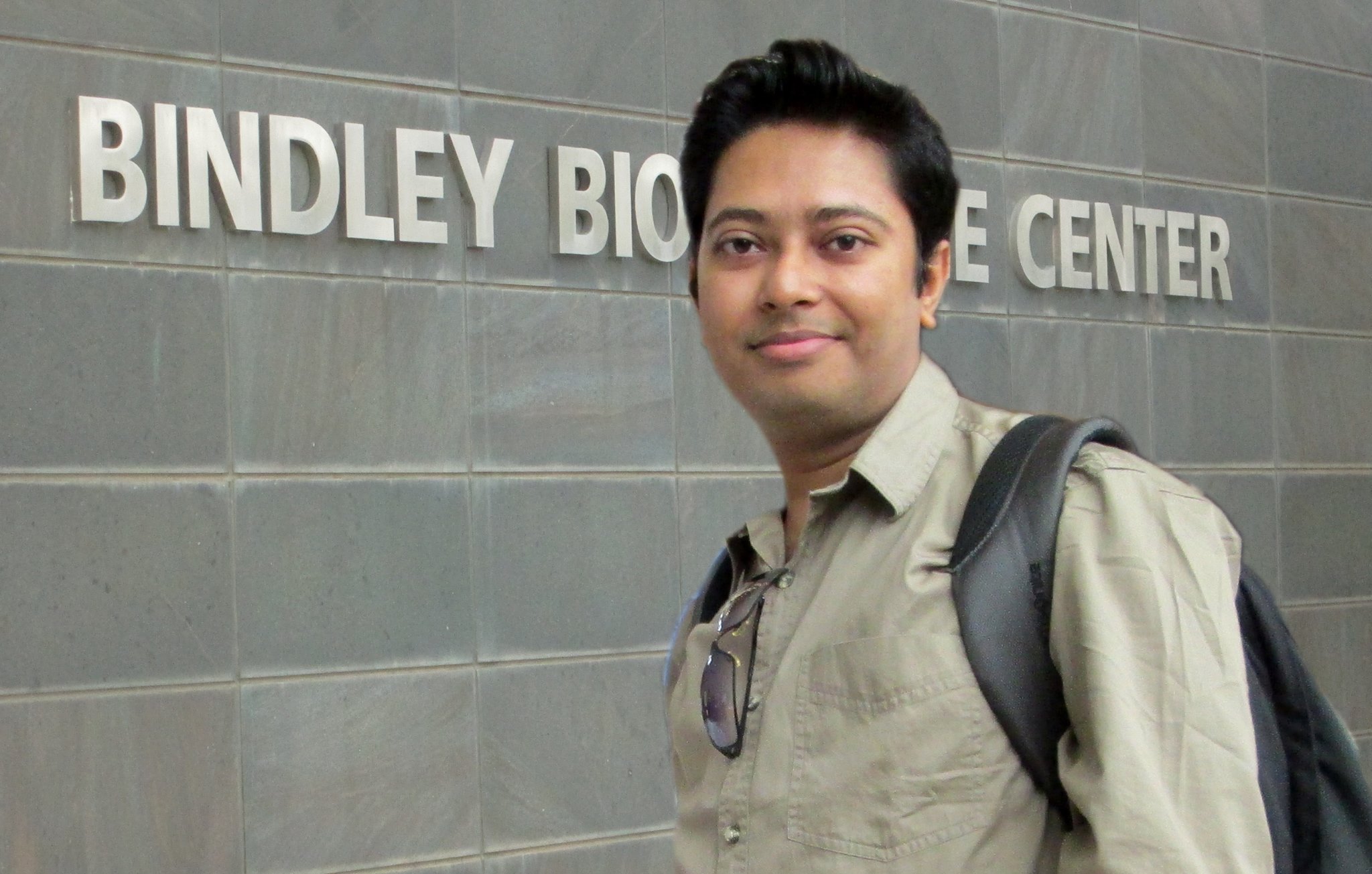
Samrat Roy Choudhury in front of the Bindley Bioscience Center, Purdue University, USA.
Always loved science
Science, particularly biology and chemistry, were my favourite subjects in middle and high school. I aspired to become a high-school teacher or a college lecturer. When most of my classmates opted for engineering or medicine as careers, I chose the longer path.
Late Prof. Swapan Das at Kolkata’s Asutosh College was my inspiration in biological sciences. After a Zoology masters from University of Calcutta, I got a chance to work at the lab-bench of the National Institute of Cholera and Enteric Diseases (NICED), Kolkata. The experience was fascinating and convinced me to pursue research as a career – I enjoyed designing experiments, executing them and using analytical skills to interpret data. It’s empowering to think that my research might make a small but powerful impact in the way we combat diseases.
During my PhD in nanobiotechnology at the Biological Sciences Division of the Indian Statistical Institute (ISI), Kolkata, I got the chance to design and develop several nanoparticles and nano-conjugates of antimicrobial implications. I was amazed to see how the same chemical elements behaved dramatically differently at nano-level compared to their micronized state. I was fortunate to meet and work with several eminent physicists and biologists, such as Prof. Dipankar Chakravorty (IACS) and Prof. Ratanlal Brahmachary (ISI) who re-kindled the passion for research and innovation in me. They taught me that science is not simply an act to be performed in a confines of a laboratory but the inner vision to explore our surroundings.
I wanted to continue exploring novel biophysical and biochemical tools, beyond the area of nanoparticle research. I was particularly interested in evaluating the potential of bioengineering tools in deciphering intriguing bio-molecular complexities. The prime search criteria for my postdoctoral training was, therefore, aimed at finding a group, which is dedicated in developing innovative and functional biomolecular tools. I chose to work with Prof. Joseph Irudayaraj at the department of Biological Engineering at Purdue University, USA.
CRISPR and cancer therapeutics
I spent three years (2013-2016) at Purdue as a postdoctoral research assistant, where I was exposed to a new arena of bio-engineering applications. During this period, I focused mainly on designing and targeting novel synthetic protein tools such as TAL (transcription activator like elements), or CRISPR-Cas9 (Clustered Regularly Interspaced Short Palindromic Repeats) to the cancer epigenome for site specific modifications with a purpose of therapeutic interventions.
Cancer, as the title of Siddhartha Mukherjee’s Pulitzer-winning book says, is indeed ‘The Emperor of All Maladies’. My team’s research efforts at Purdue resulted in CRISPR-based epigenomic editing at the promoter of a known tumor suppressor gene BRCA1. We utilized a deactivated version of the Cas9 (dCas9) enzyme, fused to a demethylating enzyme TET1, which specifically demethylated the BRCA1 promoter. By achieving these loci specific demethylation, we succeeded in increasing BRCA1 expression and obtaining a significant reduction in cancer cell proliferation. This illustrated the novelty of using CRISPR based bioengineering tools to promote targeted epigenetic corrections and broadening the scope of next generation cancer therapeutics.
Subsequently, I joined the Myeloma Institute at the University of Arkansas for Medical Sciences (UAMS). In addition to studying the targeted epigenetic regulations in high-risk multiple myeloma (HRMM), I’m also engaged in identifying the aberrant epigenetic signatures of HRMM.
Of the first snow fall
I belong to Kolkata, a city which nicely orchestrates the core cross-over values. Hence, the transition to USA was smooth for me with a few minor awkward incidents. In any case, a postdoc’s life mostly revolves around laboratories, so the scope of social events remained limited for me. I witnessed the first snowfall in my life in USA, which was wonderful. I remember, my wife and I made a miniature snow-man (she called it a snow-baby), which grew bigger and bigger with subsequent snowfall. I however, do not enjoy hopping like penguins over 6 inches of snow all through winter.
USA has historically served as a key destination for scholars. In larger cities and universities, life can be busy but also very entertaining. For instance, Purdue’s campus was very cross-cultural with a diverse array of restaurants, multilingual people and a reputation for academic excellence. Both at Purdue and UAMS, I met very talented, hard-working, professional and helpful people. Lab-meetings, seminars, and inter-research group discussions are common, meant to bring out the best in people. USA could also be a wonderful destination for travel and recreation. The country is picturesque, has everything from acres of green meadows, amazing fall colours and an array of skyscrapers and ultra-modern works of architecture.
Postdoctoral life in USA is extremely challenging. At times it can be frustrating and even depressing. I realized, like thousands of other postdocs, the meaning of the maxim ‘publish or perish’. Continuous pressure at work, in addition to thousands of miles of distance from parents and friends, can be excruciating at times.
Tips for postdocs
Please do not give up on your dreams. I grew up in a lower-middle class family with continuous pressure of stable employment. I used to take private tuitions beyond the lab hours and was so exhausted sometimes that I slept off in public transport missing the right stop. But I never thought of leaving research or academics. When your innovation and hard work pay off, the absolute joy of that moment alleviates all injury and bitterness.
India, first choice
I miss my parents and friends. My parents are old and have limited access to video-chatting. A part of the ‘worried’ me, hence always remains with them.
I’m very keen on starting my own laboratory in India. My primary research focus would be the study of physicochemical influences of nutrients, nanoparticles and chemical compounds/drugs with respect to their instigation of epigenetic modifications. Furthermore, I would be interested to correlate their influence in various disease models. With a suitable offer, India would be my first choice.

