Dance your Science: Where did Indians come from?

Nature India‘s most recent and most creative foray into science communication is through a format called dance-narration. At the beautiful confluence of science and arts, these dance-narration productions are a unique new way of science story telling using the rich medium of traditional Indian performing arts.

We recently did a couple of experiments with the format and found that it won hands-down in terms of audience engagement and in conveying complex science ideas through a simple science-led script, dance expressions and music.

Here’s a piece we executed at the 10th Anniversary celebrations of Nature India on 16 April 16 2018. This dance narration tries to trace the origin of human life in India through a review of recent population genetics studies in the country. The troupe consisted of a trained classical Odishi dancer, a trained keyboard player and a science journalist.

The medium of dance and music allow the science story to become more personal and thus immediately understandable. Not surprisingly, this dance narration video is one of the most viewed, shared and liked content on our social media channels.

The script for the narration is culled from scientific studies, just like any journalistic science story. Some popular elements of science writing – drawing analogies, describing the human side of science, or contextualizing data and numbers – are used to enliven the script. Voice modulation and music variations are used to highlight the important points of the story and to add drama and excitement to the narrative.

We look forward to your feedback on this new experiment. Nature India hopes to bring to you many more dance narrations from various scientific disciplines in the near future.

Nature India Special Issue on ‘Grand Challenges’

coverAs part of Nature India’s 10th anniversary celebrations, we produced a special issue on ‘Grand Challenges’. (Download your free copy here.)

India is headed towards an astonishing population surge. With 1.34 billion people recorded in early 2018, the country is estimated to add another 100 million by 2024 overtaking China, currently the most populous nation in the world. Therefore, her daunting demographics are integral to any discussion around the challenges faced by India.

The mammoth population coupled with limited resources, and growing urbanization and energy needs are important factors behind many socio-economic issues. Be it poverty, healthcare delivery, literacy, pollution or waste management — each of India’s problems can be directly linked to and are intensified by its teeming millions.

Some of the most pressing challenges raised by a large population are in the public healthcare, energy and sanitation sectors. Successive Indian governments have made tremendous efforts to meet public needs and expectations. However, health concerns such as tuberculosis, maternal and infant mortality, vector- and water borne-diseases, malnutrition, hygiene and sanitation remain major problems.

03The Nature India special issue on Grand Challenges takes a closer look at some of these hazards, which are experienced across the developing world. What are the grand challenges for the country’s 1.3 billion people? Can science help find solutions to some of the public health problems? Can innovation provide long-term answers?

Through in-depth commentaries by subject experts, this special issue looks at the state of affairs in malaria
management, maternal and child health, malnutrition and tuberculosis. It also looks at the science-led innovations and solutions already on offer. In a reprint section, we compile some recent articles from across Nature Research publications that highlight the grand challenges and research-based solutions that India and the rest of the developing world have adopted.

The volume also features a special photo section curated from top entries to the 2017 Nature India photo competition, themed ‘Grand Challenges’. These pictures are compelling visual narratives of some deeply moving and familiar circumstances.

With examples and case studies of evidence-based solutions, the Nature India special issue on Grand Challenges hopes to be an enlightening read for scientists, policy-makers, business leaders, and societies across the developing world.


Nature India Annual Volume 2017 is out

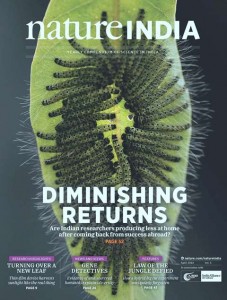
NI Annual Volume 2017Nature India stepped into its 10th year in 2018. To mark the occasion, we gave a face lift to our annual volume with a new international design, very similar to Nature. A global team of editors and art designers worked across time zones to produce this annual volume.

In February 2008, Nature Research (then called Nature Publishing Group) launched Nature India in an attempt to chronicle the region’s rapidly changing scientific scene and efforts to embrace globalization. In the decade since, Nature India has witnessed and reported the distinctly Indian essence of science. Thanks to India’s enviable scientific stock that gets an additional 100,000 science post-doctorates every year and to a culture of frugal innovation, the website has seen a plethora of interesting stories.

Nature India has reported this evolution — the moments of glory as well as the difficulties — through in-depth commentaries, news and feature articles and research highlights from the country’s many laboratories and research and development organizations. From rural, low-resource settings to state-of-the-art space facilities, from well-equipped labs in burgeoning cities to makeshift mobile labs in remote islands, this journey of covering science in the world’s largest democracy has been pioneering and meaningful.

Besides producing award-winning editorial content, Nature India has evolved as a useful resource for India’s science community with listings of relevant jobs and events, discipline-specific special issues and the Nature
India annual compendia. Responding to the need for effective communication of science by researchers, Nature India also devised a series of science communication and career workshops in partnership with the Wellcome Trust–DBT India Alliance.

A much-awaited event in our annual calendar is the Nature India photo contest, which has not only enriched our archives with stunning science pictures from around the world but also resulted in a roving exhibition that sparks thought-leading conversations around the visual narrative of science.

Through these years, Nature India has broken major investigative science news stories — from the visible impacts of climate change as the sea gobbles up entire islands in the Bay of Bengal (10.1038/nindia.2013.60) to the poor genetic diversity threatening to wipe out the few surviving population of the Kashmir red deer (10.1038/nindia.2015.35); from the intriguing story of a diabetes-free desert tribe of Madhya Pradesh (10.1038/nindia.2015.23) to the resurfacing of a forest virus that killed more than 100 people in the Western Ghats of India (10.1038/nindia.2016.139).

Among the many engaging investigations we undertook in 2017 was one that looked at why Indian scientists coming back from stints abroad turn out to be less productive once they reached home (10.1038/nindia.2017.82) and a retrospective look at a quietly performed hybridization experiment in 1964 that created a litigon, a cross between a lion and a tigon, in a Kolkata zoo (10.1038/nindia.2017.46).

Our annual volumes are put together by a group of editors and eminent scientists, who curate the contents from our coverage through the year. The affiliations and research interests of some people may have changed after publication of these articles. These annual volumes are handy reckoners for anyone who wants to keep abreast with the research highlights of the year, newsmakers, trends in research and development, careers and policy issues.

As Nature India enters another decade, it will continue to bring to you the best coverage on Indian science in exciting new formats, such as podcasts and possibly videos.

You will find more on our our archival annual issues here:20152014 and 2007-2013.  And some more on the content and subscription of these issues here.