COVID-19 fuels India’s biotech entrepreneurship

As the pandemic restricts imports of reagents and kits, India’s biotechnologists are making their own, writes Somdatta Karak* in this guest post.

The Addlagatta lab at CSIR-IICT in Hyderabad has been scaling up production of the key enzyme reverse transcriptase. {credit}S. Karak{/credit}

India’s Prime Minister Narendra Modi recently called for self-reliance in the country’s fight against the COVID-19 crisis. Being a biologist by training, the question that came to my mind immediately was: are India’s biologists and biotechnologists self-reliant in their laboratories across the country?

I walked down to one such example-setting lab earlier this month – the CSIR-Indian Institute of Chemical Technology in Hyderabad – where chemist Anthony Addlagatta and his lab members have been working to scale up the production of reverse transcriptase (RT), an enzyme at the heart of the diagnostic test that detects the novel coronavirus SARS-CoV-2.

RT was discovered in 1970 and it changed our understanding of how information flows in our living cells. Information does not flow in just one direction from DNA to RNA to proteins. RT makes the reverse possible – a conversion of RNA to DNA. Combined with the power of Polymerase Chain Reaction (PCR), invented in the 1980s, the duo ‘RT-PCR’ became an indispensable tool in biology labs across the globe. PCR helps amplify minute stretches of DNA in micro test-tubes.

Fast forward half a century as the world struggles with COVID-19 and urgently needs enough diagnostic kits that use the RT enzyme and Taq DNA polymerase, a bacterial enzyme used in PCR for its ability to amplify short DNA segments.

Though India has been using these enzymes for a few decades now, there is not a single ‘Made in India’ kit in the market. With India’s ability to import reagents and kits for its fairly limited use, the motivation to make a completely home-grown kit has been missing. Now, in times of a pandemic when imports are restricted, we are forced to think of developing these reagents ourselves.

Anthony Addlagatta with the fermentor that is brewing bacterial culture to produce reverse transcriptase.{credit}S. Karak{/credit}

In Addlagatta’s lab, a 10-litre fermentor has been brewing a bacterial culture cloned to produce the RT enzyme. The lab procured this fermentor for one of their industrial projects. Armed with the know-how of producing RT and Taq DNA polymerase, they wanted to develop their own resources and found the right industry partners in Genomix Biotech, who provided oligonucleotides for an RT-PCR kit. Oligonucleotides are short stretches of DNA or RNA molecules that initiate a reverse transcriptase or PCR reaction. Together they are validating these tests and hope to be in the market with test kits soon. A few kilometres down the road at the Atal Incubation Centre of the Centre for Cellular and Molecular Biology (CCMB), Nasar Khaja is also developing RT-PCT kits at his company BioArtis, which manufactures oligonucleotides.

Many other companies across India are developing these diagnostic kits using RT-PCR as well as other methods. Are such home-grown RT-PCR kits going to be in demand only as long as COVID-19 lasts? Can they sustain even after the pandemic?

The quality of these kits will drive their demand when import bans lift. Limited funding and bureaucratic hassles to procure reagents is a huge deterrent for scientists in India to try newer products of unestablished brands. Biotechnologists like Khaja feel that it is the scientific community’s responsibility to groom the home-grown brands. The newer kits might need a bit more enzyme or a few extra steps as opposed to established brands but will give the exact same results at cheaper prices, he says. In the bargain, the scientific community will have supported new start-ups, fostering a culture of product development.

The current Indian market size for many of these home-grown products is too small for start-ups to sustain. Biotech companies in India will have to compete with their global counterparts in quality and price.  Another way of dealing with this challenge could be to attract multinational companies to set up manufacturing units in India. The downside here is that global businesses may not share India-centric goals.

Adversities have often shaped cultures and national objectives. In the 90s, India proactively boosted the vaccine industry to fight Hepatitis-B in the country. This industry is now at the global forefront and also actively participating in the race for a vaccine against the novel coronavirus. Would the COVID-19 crisis be able to spawn entrepreneurship in other areas of biotechnology in India?

[*Somdatta Karak is the Science Communication and Public Outreach Officer at CSIR-Centre for Cellular and Molecular Biology in Hyderabad, India.]
Lockdown unlocking technology for India’s farmers

Rural communities grappling with livelihood issues and looking for support for farming activities are increasingly embracing technology for survival. Jayashree Balasubramanian, who heads communication at the M S Swaminathan Research Foundation (MSSRF) in Chennai, talks of her experience with farmers attending virtual ‘plant clinics’.

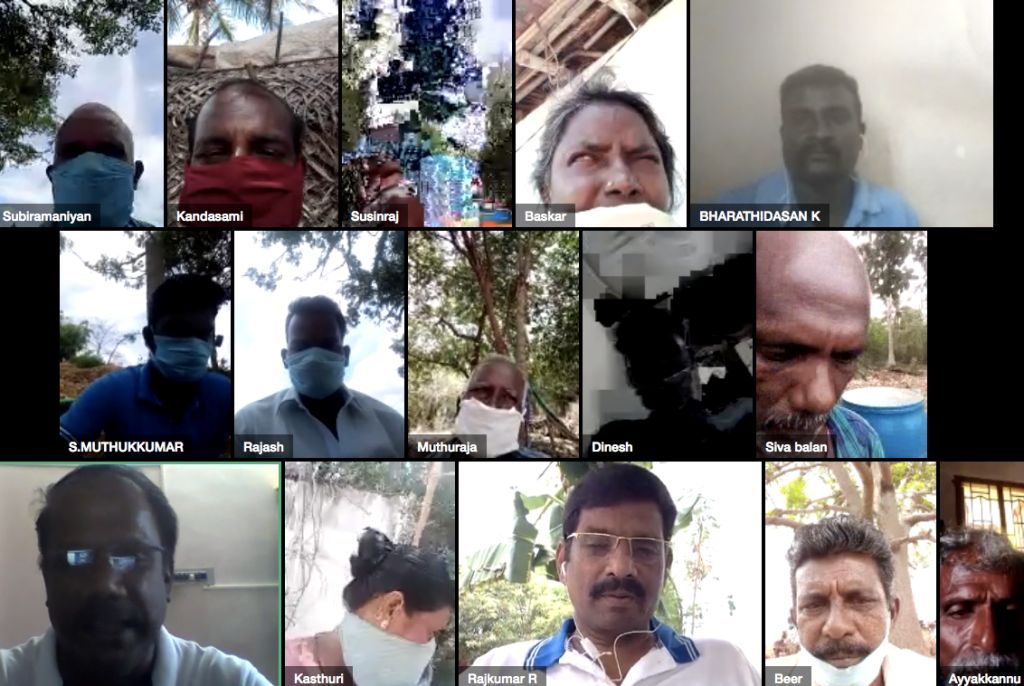
A virtual ‘plant clinic’ in progress.{credit}MSSRF{/credit}

It’s a Friday morning and Lakshmi, a farmer who grows paddy, maize and finger millet in central Tamil Nadu, is peering into her phone camera adjusting the webinar settings. From behind her, the top of her toddler’s head pops up on the screen as she navigates her way around the virtual ‘plant clinic’. “I can’t hear you sir, please unmute yourself,” Laxmi says several times in Tamil before the expert on the other side heeds.

‘Unmute’, ‘webinar’, ‘share video’, ‘chat message’ – the Tamil conversation is peppered with these English phrases. The e-plant clinic session is one of the ways in which farmers are getting technical advice and support amidst the world’s largest lockdown that India imposed in the last week of March 2020 to check the spread of the novel coronavirus.

Soon, 39 other farmers crowd up every inch of her phone’s screen. Many of these farmers are holding samples of pests or diseases that have affected their plants. Two ‘plant doctors’ are advising them online in this three-hour session. Some farmers are in their picturesque farms with mobile phones ready to zoom into on-site problems they need advice on.

During the ongoing lockdown, a survey found 227 million internet users in rural India, 10 per cent more than urban India. The increased use of internet at this time is opportune for the rural community grappling with livelihood issues and looking for technical support for farming activities.

Global farming communities have long advocated the use of Information and Communication Technology (ICT) to empower farmers suggesting it may improve farmers’ livelihoods by as much as 500 per cent. The usual bottlenecks – lack of technology access, good connectivity, devices or capacity – suddenly seem to have eased under the pressure of the novel coronavirus crisis. The crucial need to connect is transforming how rural communities and holders of farming knowledge are working around these challenges.

For instance, the plant clinic which Laxmi sometimes attends alongside approximately 25 farmers every week, is rigged up in a physical venue and advertised beforehand so that farmers come prepared with their pest-disease affected plants to consult plant doctors. It also arms them against using any unscientific applications that may cause long-term damage to the soil or plants. A study by MSSRF found that e-clinics cost less than half of what a physical plant clinic would.

A farmer holding up a sample for the plant doctors to see.{credit}MSSRF{/credit}

Even before the pandemic struck, farmers have been part of such efforts where support is provided on phone or social media. “During the lockdown, farmers started video-calling us, and we realised their need for visual connection and advice,” says Ramasamy Rajkumar, who coordinates efforts across 150 villages in India since 2012. The first webinar on 16 April 2020 saw 82 farmers joining in. “It meant that this was a format we should continue,” he says. While physical clinics build knowledge and capacity, the virtual clinics are building technology skill and mutual support.

Losses from pests or disease attacks can have a devastating effect on crops causing huge damage. The Food and Agriculture Organisation (FAO) estimates that pest attacks account for 40 per cent of all yield losses prompting the United Nations designate 2020 as the International Year of Plant Health.

Since the beginning of the lockdown, MSSRF has conducted five webinars in three states of India. They have not been without their fun moments. Farmer Kandasamy from Ramasamypuram, had multiple queries and also brought in a neighbouring farmer who had a volley of questions needing resolution. Subramanian, a farmer from Aayavayal helped himself merrily to a snack as he waited for his turn. Meanwhile, Muhammed Andakkulam altered his user name to ‘Beer’, to symbolically reflect reopening of liquor shops in his state of Tamil Nadu. The plant doctors patiently go through each query, sharing their recommendations in the chat box and promising support later on the phone.

Sometimes rural callers also glitch out but resurface miraculously and complete the call, to the envy of urban bandwith-squeezed callers. Most stay connected even after their query is answered, listening to other recommendations on a variety of crops from paddy to brinjal and black gram to coconut.

The farmers’ questions range from concerns over yellowing of groundnut leaves, discolouring of jasmine flowers, white-coloured pests on coconut tree leaves and withering of banana leaves. The common pests they report during the lockdown are whiteflies, thrips, aphids and green leafhoppers.

Purshothaman Senthilkumar, a plant doctor in the Pudukkottai district of Tamil Nadu, says the small farmers are facing issues in marketing their yields and report up to 40 per cent losses. “Those who did not have adequate labour to harvest have seen up to 20 per cent losses in the field,” he says. Seasonal pests and diseases have been compounded by shortage of labourers, maintenance, shop closures and non-availability of expert guidance.

E-plant clinics have not only been about technology and technical guidance, but also about moral support for the farming communities.

Honey bees starve in COVID-19 lockdown

Bee farmers are finding it hard to move their bee boxes from one place to another across India. This means their bees can not be fed as usual on seasonal flowers, neither will they pollinate this summer, writes Gopinathan Maheswaran of the Zoological Survey of India, in this guest post.

{credit}Pixabay{/credit}

Across the world, honey bees are the most commonly used pollinators.

In India, more than 9698 government-registered entities – individuals, societies, firms, companies and a few self-help groups – depend on beekeeping for their livelihood. A massive 15, 59, 771 registered bee colonies are spread across various states of India. However, the bee keeping business has its own challenges, especially in cases where farmers depend only on bees as the single source of pollination. Often the health of these colonies suffers from poor nutrition, pests and diseases.

The COVID-19 lockdown has presented a peculiar problem for the beekeepers and the bees. As countries go into extended lockdowns, movement of non-essential vehicles has come to a standstill. In India, the restrictions have made it difficult for the farmers to move the huge number of beehive boxes from one state to another or even within the states. As a result, the bees are starving to death.

During the summer months between February and July, farmers, especially in northern India, go from one state to the other with their bee boxes to feed the bees (Apis indica) on seasonal flowers of mango and litchi trees. Bees feed on the flower honey for nutrition and farmers sell the honey the insects store in their hives. The bees also help pollinate the mango and litchi trees, thereby increasing the production of these two cash fruit crops, and also a variety of other plants.

Farmers in Canada have reported struggling to get their shipment of beehives from aboard. Global food production, which depends a lot on bee pollination, is estimated to get affected due to COVID-19 lockdowns in various countries as without bees the yields of some fruit, seed and nut crops are known to decrease by more than 90 per cent.

This may impact poor and developing countries in the coming years as truncated food supply may result in hiking prices of many essential commodities beyond the reach of the poor in Asia and Africa. The lockdowns also hamper assessment of the damage by researchers, who can not reach the affected areas.

(Gopinathan Maheswaran is a Scientist in the Bird Section of Zoological Survey of India,  Kolkata. He can be reached at maheswaran@zsi.gov.in)

How coronavirus data from history is helping fight COVID-19

When a bunch of database experts peered through archival information on coronaviruses, they saw substantial data that could aid the world’s fight against the novel coronavirus pandemic.

Satyavati Kharde and Poulomi Thakurdesai describe how a Springer Nature Experiments team quickly turned this data into a valuable resource for life science and biomedical researchers working on COVID-19.

Many of us had heard the term ‘coronavirus’ for the first time at the office lunch table. Our team lunches are unusual, discussing topics that range from evolution, to bodily functions to Bollywood. The scientific experts in the team were trying to explain how the coronavirus works, its relation to respiration and the conspiracy theories associated with it.

When we read about the first outbreaks, our natural reaction was – not yet again!  Another epidemic! We thought it would not cross the China borders and so we continued planning our upcoming travels.

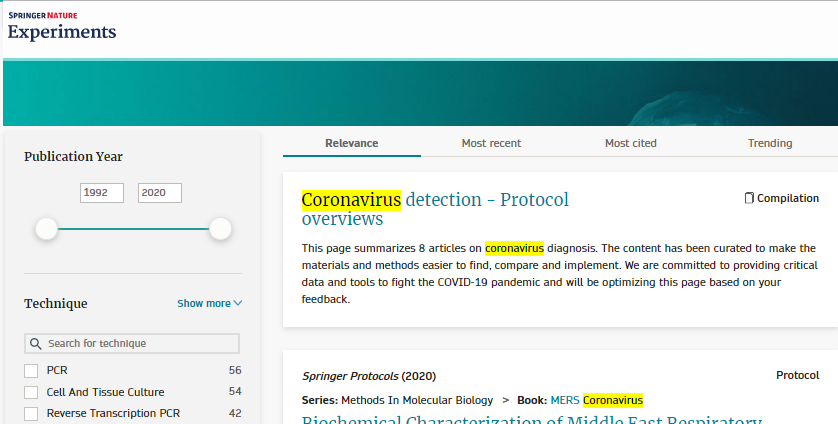
Out of curiosity, we checked the Springer Nature experiments database – the largest database for life science protocols and methods – to see what content we had around past coronaviruses. We were pleasantly surprised to find a huge number of experiments such as detection of the virus, drug design, drug delivery, vaccine design and biochemical characterisation of coronaviruses that caused earlier contagions – the Severe Acute Respiratory Syndrome (SARS) of 2002 and the Middle Eastern Respiratory Syndrome (MERS) of 2012.

Soon we realised that mankind was in the middle of a pandemic after centuries. In India, we entered the world’s largest ever lockdown in history, started working from home in this ‘new normal’ while continuing our virtual tea break conversations and getting a virology class where some of us non-scientists learnt for the first time that viruses are not exactly living beings!

At the same time, we began watching life science researchers and healthcare professionals, the traditional end users of our products, emerge as the heroes in the world’s fight against the novel coronavirus. These frontline COVID-19 researchers in India and across the globe were working tirelessly to develop new detection methods, new drugs and vaccines to prevent the spread of the pandemic. Lockdowns and a global emergency situation had added several challenges to the existing workflow for researchers in academia as well as in the industry.

Many of our friends were these scientists trying to look for solutions to halt the pandemic at various Indian and international institutes. In one of our casual discussions, some of these scientists talked about the tardy speed and the many challenges of research during the lockdown.

The inner scientist in some of our team members was itching to help ease out their problems. The question was, how? We started working on a workshop for life scientists (involving questions around the database, engineering, and user experience) to understand if there was anything we could do to decrease the challenges they were facing.

In no time, a large global team chimed in taking the challenge up on priority. In one frenzied week, we designed, tested, and pulled together a collection of more than 160 openly accessible protocols and methods on COVID-19 to help laboratory researchers in their work around the pandemic. The resource brought together content on the detection of coronavirus in various species, protocols on designing the vaccine, and understanding the biochemistry of viruses to design new drugs.

Working remotely – alongside sharing recipes and haircut tips – we create a digital interface to address the challenges around the scarcity of reagents and lack of information to develop detection tests for the novel coronavirus. In this interface, researchers can find detailed procedures on various detection techniques, such as RT-PCR, PCR, virus RNA purification, sequencing, and more. With the help of this information, researchers can compare the materials and methods before implementing them in the laboratory.

As we begin to feel a little fulfilled to have contributed our tiny bit in the global fight against COVID-19, this data explorers’ journey is far from over. We are constantly tweaking and scaling up this resource – for the researchers and by the researchers – as and when newer information emerges in the fast-evolving pandemic.

[Satyavati and Poulomi are part of the Springer Nature Experiments team in Pune, India.]

Return of the Ridleys

There is hope that technology may help the Olive Ridley turtles and their human protectors.

Special Mention, Nature India Essay Contest 2020

Shambavi Naik

An Olive Ridley hatchling.{credit}Deepak Sahu{/credit}

There was fear in Suhas’s eyes as we dug up the Olive Ridley hatchery. He had expected the hatchlings to burrow out four days before. But there was no sign of them yet, so we decided to check if all was okay. As his hands moved the sand, frantic but delicate, he uncovered an alarming sight. Thousands of eye-less, red-coloured fire ants swarming over the helpless, newly hatched Olive Ridleys.

The scene was gut-wrenching. Suhas had been brought up on this beach in the idyllic little village of Wayangani, off the Konkan coast. Wayagani is populated mainly by fisherfolk, the closest grocery store is 6 km away, there is no tap water and electrical supply is unreliable. My grandfather had moved out of this very village to pursue a better life; as a consequence, I have been raised in Mumbai. But that day as Suhas and I were looking down at the carnage together, neither his experience as a village fisherman, nor my education as a cancer biologist could help hold back our tears.

Over the past 15-20 years, a group of volunteers led by Suhas have made a spirited conservation effort to save the vanishing Olive Ridley turtle. UNDP has recognised this by calling him a biodiversity champion. Though the turtles chose the remote beach to nest, the eggs were routinely lost to predation and poaching. The villagers had formed teams that scoured the roughly 1.5 km beach through the night, searching for female turtles that had come to nest.

Suhas with Olive Ridley hatchlings

Once the female was spotted, the team would wait till she finished laying her eggs. As she waddled her way back to the Arabian sea, the team quickly dug up the eggs and moved them to a secure location. They also cleared up the turtle’s tracks, so that her visit to the beach remained unknown. Roughly three months later, the team would celebrate the birth of baby turtles and watched over them as they explored their way to the sea. Over a decade of sustained efforts, the villagers had been rewarded by an ever-increasing number of turtles choosing their beach to nest.

But then, from 2016, more incidents of fire ant predation started occurring. In the 2018-2019 season, about 60% of hatcheries had been lost. Promptly the villagers had tried traditional ways to block the ants. Relocation of eggs away from human settlements, applying turmeric around the eggs, placing fresh neem leaves around the nest; but nothing protected the hatchlings. As nest after nest was lost, the villagers were fatigued and despondent. After guarding the eggs for three months, to lose them in this manner is brutal.

Suhas observed that the fire ant predation had accompanied a change in the egg-laying season for turtles. The turtles would usually nest from October-December, but were now laying eggs until January-February. Consequently, eggs which used to hatch in January-February now hatch in March-April. The warmer sand temperatures in March-April are conducive to the fire ants and could be a reason for the increased attacks on the turtles.

In a fight of man versus man, the villagers had won against the poachers. They had stayed up all-night, meticulously watched over the hatcheries throughout the season, fought off poachers and predators; but they had won. But this is a fight of man-vs-man-made climate change and one that the unassisted two hands of a rural volunteer cannot win.

This was when Suhas had reached out to me for help, thinking that a scientist might offer some solution. Unfortunately, I had studied nothing of ant predation in my years of studying breast cancer. But since then I have been on the lookout for solutions that could help the villagers and the turtles. Olive Ridleys are classified as a vulnerable species worldwide and India is one of the hotspots for their nesting. A solution to my village’s problem could help save thousands of turtles across the country. The survival odds for an Olive Ridley turtle is as low as 2 in 1000, and they need any help they can get to able to thrive.

But there is hope that technology may help the turtles and their human protectors. Conservation biologist Helen Pheasey has used 3D printing to create fake eggs equipped with GPS technology. When placed in a nest with real eggs, these eggas can be used as tracker for any movement in the nest. This technology is great to identify if the eggs have been removed from the nest by a poacher and trace their movement. This may provide relief to the night shift volunteers who monitor the hatcheries, but will not protect against the fire ants.

An ecologically sustainable solution to the fire ants may come in the form of their natural enemies – a parasitic fungus, Kneallhazia solenopsae and a virus, Solenopsis invicta virus-3 (SINV-3). A combination of 3D printing and gene editing/synthetic biology could help engineer fake eggs coated with fungal spores or viral particles. These eggs when placed in the nest would not harm the turtles, but could keep the fire ants at bay. Alternatively, large scale systemic studies can enable us to identify molecular pathways that lead the fire ants to find and attack the eggs. The artificial eggs could be laced with appropriate synthetic smells that could mask these signals emanating from the real eggs.

Villages such as Wayangani intentionally stay away from using harmful pesticides that could interfere with ecological balance. This is true of many other villages and conservation groups across the country. Finding solutions depends on scientists working with the local people focused on conservation to protect these fledgling species. Technology & Science led sustainable conservation methods have the potential to re-energize India’s natural ecosystems with minimum interference.

Experts estimate that the rate at which we are currently losing species is 1000-10000 times higher than the background extinction rate. It may be too late to save some of these species, but for others new technologies could bring a ray of hope.

[Shambhavi Naik is a fellow at Bangalore based Takshashila Institution and Director of CloudKrate Solutions Pvt Ltd..]

Suggested reading:

Announcing winners of NI Essay Competition 2020

Memories of paati

A predictive lifeline

A grain of truth

Mapping the malady of cancer

A friend indeed

A friend indeed

Chatbots are becoming an extension of human capabilities of search and analysis, as they steadily grow better to perform a variety of tasks on our behalf.

Second runner-up, Nature India Essay Contest 2020

Arijit Goswami

Arijit Goswami

No stretch of time can fade my vivid memory of the fine afternoon when I first saw a computer before my eyes. Led in a queue by our class teacher into an air-conditioned room (the computers of those times were indeed spoiled brats under heat), I was no less enamored by the glow of the VDU, as I was enticed by the quirks of the friend I had inside the machine. Peeping from corners of application windows, the Microsoft Office Assistant interacted with me just like a real living-breathing friend. A friend that promised to not judge me, nor mock me, but be the personification of ‘a friend in need is friend indeed’.

Nineteen years later, I grieve the loss of that paperclip-shaped friend to oblivion, though I see it reincarnated everywhere across the world, living through smartphones, websites and a myriad of gadgets. Be it Google Assistant, Cortana, Siri or Amazon Alexa, chatbots have come a long way since then. These conversational interfaces are what infuse life into our gadgets, enabling them to interact with us just like any other human being. Leveraging AI and Natural Language Processing, these artificial machines accumulate, dissect, comprehend and respond to information from humans. Over the years, they have matured so well that one can not only resolve queries with these bots, but can also share some light moments with them and also get loads of work done seamlessly. So much so, that now chatbots are becoming an extension of human capabilities of search and analysis, as they steadily grow better to perform a variety of tasks on our behalf.

Today, I wake up to an alarm that I set the previous night, not through clicks on smartphone or by turning knobs behind a clock. I simply wish my Alexa ‘good night’ and tell her to set alarms for 7am and also at 8am, lest my slumber gets the better of me. I reach my office and log into my online bank account. Right at the bottom-right sits my friend eager to resolve any of my queries. I simply type in my query into the chat box, and regardless of whether I indulge in extreme politeness or utter rudeness, I am assured of a courteous response and quick resolution of my problems. The chatbot also does a wonderful job of recommending me products and services that are best suited to me. Guess what? I no longer need to get tossed around bank counters for getting my work done, no longer need to ask friends and relatives for best deals and no longer need to be distressed with irrelevant marketing calls as the bot knows what’s best suited for me as per my behavior.

By the end of my tiring day, I am too hungry. 10 years ago, I would have had to scavenge through the streets for restaurants. But no more! My smartphone glows up with a notification from Zomato recommending me deals. I confess to Zomato about my cheat day and make it my accomplice in food guilt. I simply need to type in a few keywords and my payment is automatically done, leading to an awesome conversational selling experience. While I wait for my order to be delivered, I interact with the chatbot. The conversational AI tracks my mood through text analytics and emotion analytics, and responds to me with emoticons and witty messages. And sometimes, out of the blue, I just wonder if it is really a bot or an actual human talking to me behind a veil of a software.

However, chatbots are going to transform this world and how we interact with devices in ways still unimagined. Can you imagine that we may soon have chatbots providing therapy to distressed people? Reports published by National Center for Biotechnology Information (NCBI) say that it is possible to automate the expertise of a therapist. Woebot is an automated conversational agent that uses a short user-friendly survey and adds a fine sense of humor to cheer up its users. Wysa is an AI penguin on smartphone that helps anxious people to improve focus, manage conflict and relax. And though they are still inept at handling nuanced concerns of humans, the day is not too distant that we will confide the emotions from our deepest recesses of mind and seek help of chatbots that will be the best ears to listen to us.

How would you react if someone told you that chatbots are helping refugees in rehabilitation? Syrian refugees in Lebanon are using a chatbot, Mona, to flag their cases to non-profits that help them connect to lawyers, doctors and authorities of host nations for resettlement. DoNotPay, a robot lawyer gives free legal aid to refugees seeking asylum in Canada, UK and US, through a seamlessly easy to use conversational interface. With Lucia, MarHub and even WhatsApp being leveraged by NGOs, non-profits, and even the United Nations, for refugee rehabilitation, the humanitarian future of chatbots looks bright.

Not to forget, that chatbots will soon become our virtual assistants in all matters of life, from handling our daily chores to keeping our fitness on track and being our omnipresent, omniscient and omnipotent secretary for life.

I can very well visualize the day when chatbots will grow quite mature in the way they handle not only our written text, but also our emotions, location and circumstances to proactively provide contextually-sensitive services. The day is not far when future generations of chatbots will be our closest friends, mentors and confidants. And maybe one day, I will wake up and stare at my tablet where the great grandchild of Office Assistant will peek from the corner of screen, wish me a pleasant morning, and provide me with updates of all household chores it has automatically completed on my behalf to make my life more blissful than ever.

[ Arijit Goswami is a manager at Capgemini India in Mumbai.]

Suggested reading:

Announcing winners of NI Essay Competition 2020

Memories of paati

A predictive lifeline

A grain of truth

Mapping the malady of cancer

Mapping the malady of cancer

The demonstrations we were so proud to have put together garnered forced applause and empty smiles. We had not addressed their main concern, the sense of finality associated with cancer.

Second runner-up, Nature India Essay Contest 2020

Aditi Ghose

Aditi Ghose explaning an exhibit on COVID-19 at the Birla Industrial and Technological Museum, Kolkata.

A group of cancer patients under palliative care, aged under 15, were scheduled for a guided visit to our Science Centre. As a science communicator I was desperate to make it special. Having lined up the choicest of our expositions, I was adamant on giving them an amazing experience. From decking the halls with cheerful banners, to ensuring that they could touch and see science-in-action – I believed that all would take part.

At the end of the day though, I realised I couldn’t have been more wrong. Moving along on wheelchairs through decorated alleys, the children wore desolate looks. The demonstrations we were so proud to have put together garnered forced applause and empty smiles. No amount of enthusiasm from our side could counter the children’s vibe of helplessness. The care-givers thanked us for our initiatives that day, but we knew we had failed. We had not addressed their main concern, the sense of finality associated with cancer.

With the World Health Organisation reporting that one in six deaths is caused by it, cancer is aptly called ‘the Emperor of All Maladies’.  The messages about cancer can be conflicting. ‘Cancer cannot be prevented.’ ‘It is a death sentence.’ ‘It’s contagious.’ ‘Everything causes cancer.’ ‘Over-the-counter remedies can cure cancer’. ‘Children don’t develop cancer.’  Trying to turn these children away from their fears and divert them to our regular demonstration routine had been a mistake. They could be best addressed only where they hurt most — we had to show them how cancer is being challenged today. We called in a few favours and asked the children to visit again. This time we wanted to tell them of the Pan-Cancer Analysis of Whole Genomes (PCAWG) Project.

Featuring a cast of more than 1300 scientists and clinicians with 744 affiliations between them, across four continents, analyzing 2658 whole genomes for 38 types of cancer, the PCAWG Project had revealed, in a suite of six research papers, the most complete picture (yet) of how DNA glitches drive tumour cell growth. It had identified the driver mutations — limited between four of five in 95% of the samples —  that powered the typical shattering and rearrangement of cells in tumor growths. This implied that patients diagnosed with those hallmark mutations will, in principle, be matched to a drug that targets the protein made by that driver gene. Another paper revealed that these mutations cropped up years or decades before the actual cancers were diagnosed. Detecting such anomalies suggested that many could be detected and treated earlier now.

Processes such as defective DNA-repair mechanisms or exposure to environmental mutagens produce characteristic patterns of DNA aberrations. Expanding our knowledge of genomic data sets of these mutations, the current study had identified 97 such signatures, crucial to the refinement and extension our understanding. It introduced the idea of ‘molecular time’ to classify mutations in tumour cells – helping identify and perhaps monitor common mutational trajectories. Papers matching data to functionally link DNA and RNA alterations illustrated the power of their integrated analysis for cancer studies.

The efforts warranted hundreds of terabytes of data, spread across multiple data centres, exacting millions of processing hours, making this level of international collaboration a reality. Pinpointing 705 recurring mutations in cancer genomes, acquiring samples protecting patient privacy while generating terabytes of data for use by the researchers, the project was a milestone in cancer genomics, along with a marvel of cloud genomics. It was only fair that the findings and implications of this gargantuan scientific endeavor be put forward to those who hope and pray for such miracles day in and day out. All that was left to do was figure out how.

Poring over the original papers, I realised the research findings were basically a heat-map, identifying the causal regions responsible for the genetic aberrations. A similar heat-map, for an entirely different purpose, was devised in 1914. It was the First World War and the number of bomber-planes that made it home was central to deciding the outcome of the war. To turn the odds in their favour, researchers from the Center for Naval Analyses had devised a simple card containing the outline of the bomber-plane, to be handed over to the returning pilots, to mark out the areas where the plane had taken a hit. Stacking up such cards would lead to a heat-map indicating where the planes were receiving the most damage.

It turned out that these regions included the centre along the tail gunner and edges along the wings. These were the most resilient parts of the plane – they had managed to return home, hole and all. The parts that were left unscathed in the cardboard outline – the cockpit and the fuselage – warranted a layer of protective-cladding.  Planes that had been hit in those areas were lost forever. Taking the missing planes into account was seminal to the contemporary discipline of operational research. Similarly, identifying the driver mutations in each cancer cell is going to be decisive in developing precision medicine, tailored to understand cancer better. We decided to tell the data-intensive story of the latter while demonstrating the bomber plane heat-map on paper gliders.

Skeptical at first, the children were gradually drawn in to the floating gliders. By the end of the session, the room was resonant with their laughter while the floor was carpeted with their paper planes. We even saw their care-givers eyes sparkle. A few strategically reinforced bomber planes had not won the war for the Allies – but they certainly helped. The six PCAWG papers and global consortium of researchers are only perhaps the beginning – their collaborations, knowledge exchanges and insights are going to provide the air beneath the wings of all fighters who battle cancer — either for themselves or for someone they care about.

[Aditi Ghose is an Education Assistant at the Birla Industrial & Technological Museum, Kolkata. She can be reached at aditincsm@gmail.com.]

Suggested reading:

Announcing winners of NI Essay Competition 2020

Memories of paati

A predictive lifeline

A grain of truth