Away from home: The two-body problem

As promised our Away from home‘ blogging series will feature sporadic entries under the ‘Away from home’ category of the Indigenus blog from time to time. The series was earlier a weekly featuring one Indian postdoc working in a foreign lab recounting his/her experience of working there, the triumphs and challenges, the cultural differences, what they miss about India, as well as some top tips for postdocs headed abroad. You can join in the online conversation using the #postdochat hashtag.

Here’s the account of a scientist couple, looking at opportunities to come back to India. Naresh Bal, a PhD from Jawarharlal Nehru University, New Delhi and a postdoc from the Ohio State University, USA is currently wanting to start an independent research group of his own. He is busy writing grants overtime given the “current grant situation in the USA”.  Naresh urges the Indian government and institutions to think of schemes to recruit scientist-couples to work as a team. Read on and leave your comments — have you had a similar experience, do you know someone who has or are your bracing up for this now?
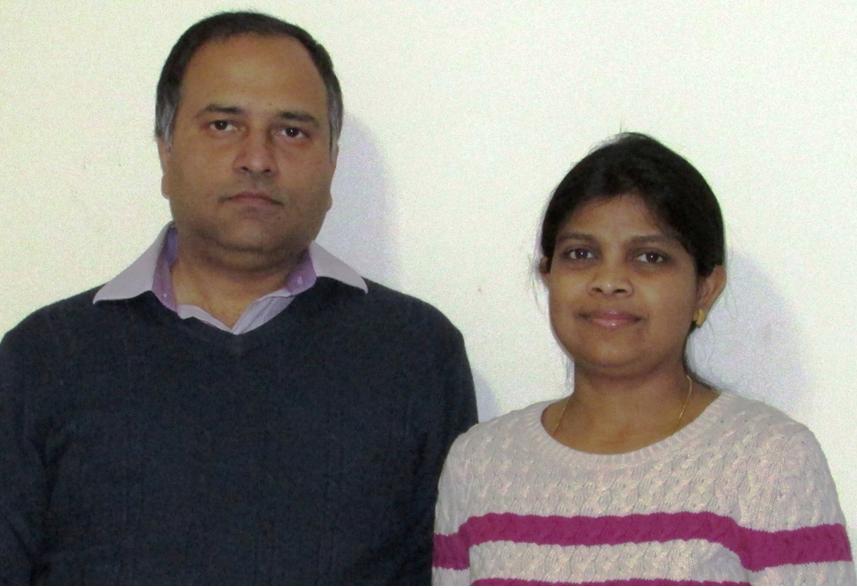
The scientist couple: Naresh Bal and Nivedita Jena

The scientist couple: Naresh Bal and Nivedita Jena

The enigma of protein structure

My interest in science originates from my curiosity about the incredible diversity in protein structure and the unique ways they perform their functions.

My doctoral research was from the Central Drug Research Institute (CDRI), Lucknow and a the PhD from Jawarharlal Nehru University, New Delhi. I evaluated three postdoctoral positions in three different places — Paris, Amsterdam and Vancouver. At the same time I got an offer from Dr. Periasamy  of the Ohio State University, Columbus, Ohio to work on a “calcium-binding protein” called calsequestrin. As I always wanted to work on structural aspects of proteins, this sounded like my type of research. So I chose to join Dr. Periasamy’s lab and came to USA.

Changing track

After joining Dr. Periasamy’s research group, I applied my doctoral experience of protein structure on calsequestrin. But a major twist in my scientific career was waiting for me. I came across two publications showing role of sarcolipin (a muscle protein) in heat production. Since a knockout mouse model was already available in our lab, I became interested in investigating this at the whole animal level. Not being a thermogenesis study lab, many challenges came in the way of my testing the idea. Finally, after two years I became successful and the study is now published in Nature Medicine.

Pursuing this project changed my career and I became a physiologist. Now, I am working as a research scientist and looking for an opportunity to establish my independent research group.

I like our current group, as each of us have our own independent view points about the mechanistic details of our project, but in the bigger picture we are united towards a single goal. I also like the efficient work culture in the scientific field and opportunity to work with people from diverse background here in the USA.

Small world

I was able to acclimatize quickly and my transition was smooth. On the very first day, when I was introduced to all the lab members, I found one among them was from Lucknow whom I had seen many times while working at CDRI. Although we did not know each other well, soon we glued to each other like old buddies: realizing world can be so small at times.

Hot tips

I think many things might have changed in the way a PhD student in India looks at doing a postdoc today. When I was at that stage in 2007, we used to apply randomly to hundreds of labs worldwide and based on the response, we decided. But now I think defining a long-term career goal and then applying to the labs that fits those goals is very important. The early years of postdoc are very important to become successful in academic career here in the USA.

Indian needs schemes to recruit couple-scientists

Being in the West, I miss near and dear ones. I am fortunate enough that my wife and son are here with me, which compensates for the loneliness here.  I would love to come back to India. I have been looking for opportunities all over India. Till now, I have had no success, even though skeletal muscle biology (my field of research) is a rapidly expanding and promising research area, it remains  almost invisible in India. My wife Nivedita is also working as a senior postdoc and looking for an independent faculty position. Her field of research is organic and medicinal chemistry. Her current research is related to cancer and infectious diseases. Nivedita is a PhD from IICT, Hyderabad and works in the Ohio State University.

Many postdocs and postdoc-aspirants have a two-body problem like us and getting employment for both is a very difficult issue. Therefore, it would be encouraging if the Indian government and/or institutions think of schemes to recruit scientist-couples to work as a team.

The Indian government has done a great job in creating many new central universities and institutions in last few years. However, the process of recruitment in most of the organization is not impartial. Moreover, Indian science has to shed its “me too” approach in science. In most places, I find that Indian scientific recruitment follows the scientific trend that was hot a couple of years back in the USA. But I urge the directors of Indian institutions to give opportunity to people with potential to create a whole new area of research.

Find Naresh Bal in our ‘Away from home’ interactive map featuring Indian postdocs from around the world. Please feel free to suggest names of postdocs from countries and disciplines we haven’t covered yet.

Nature India anniversary special issue — readers’ choice

We are happy to announce that on the sixth anniversary of Nature India in February 2014, Nature Publishing Group plans to bring to you the first ever ‘Nature India Anniversary Special’ print issue. The special issue will be a compendium of science coverage in India as seen through the eyes of Nature India over the last six years.

A must-have issue for anyone interested in India’s science, R&D scene and the latest career and industry trends, the compendium will have handpicked science news and features, research highlights, commentaries, policy features, career articles and interviews with some leading lights of Indian science. A team of NPG editors and eminent Indian scientists will dig into the rich archives of Nature India – the only stand-alone platform providing serious coverage of science in India – to bring you the special issue.

NI anniv spl readers' choice

Dig into our archives and choose your favourite articles.

In keeping with Nature India’s multi-disciplinary coverage, the anniversary special issue will cover most streams of science. The 100-page issue will chronicle the growth of Indian science. We plan to have successive annual issues making these compendia not just a showcase of the best in Indian science in the years gone by but also a historical account of science as it is happening in India, year on year. The anniversary special thus intends to be an annual feature in the country’s science calendar upholding Nature India’s mandate to provide its readers the best coverage of Indian science.

The first issue is scheduled for launch in March, 2014 and will be distributed widely across India to all the Nature subscribers and interested research institutes, libraries and R & D labs. Additional copies will be distributed at various science events, trade shows, academic institutions, national and international seminars. (Get your copy.)

We have always steered our coverage of Indian science based on our readers’ feedback. So here’s another chance for our readers to get involved in helping us chronicle the history of science in this country. Please feel free to rummage through our rich archives back to 2008 and choose what you think make the best articles in both the ‘research highlights‘ and  ‘news and features‘ section.

Tell us your choice in the comments below — you may make upto 12 choices, one from each section (research highlights/news & features) from articles published every year between 2008 to 2013. Based on your feedback, we will include a readers’ choice section in the Nature India anniversary special. Make your choice now! You may also mention your favourite articles on our Facebook page or Twitter with the hashtag #NIreaderspick .

If you haven’t registered yet to read our articles, register free now!

A young scientist’s tribute to Sachin Tendulkar

Last week I received an interesting email from India-born scientist Arnab De who lives in New York, USA.

Arnab has just defended a PhD at Columbia University in the Department of  Microbiology and Immunology. He developed new animal models to potentially study cancer. The 32-year-old also discovered a new biological pathway essential to defend against bacteria and viruses.

But that’s not why we are discussing his science here.

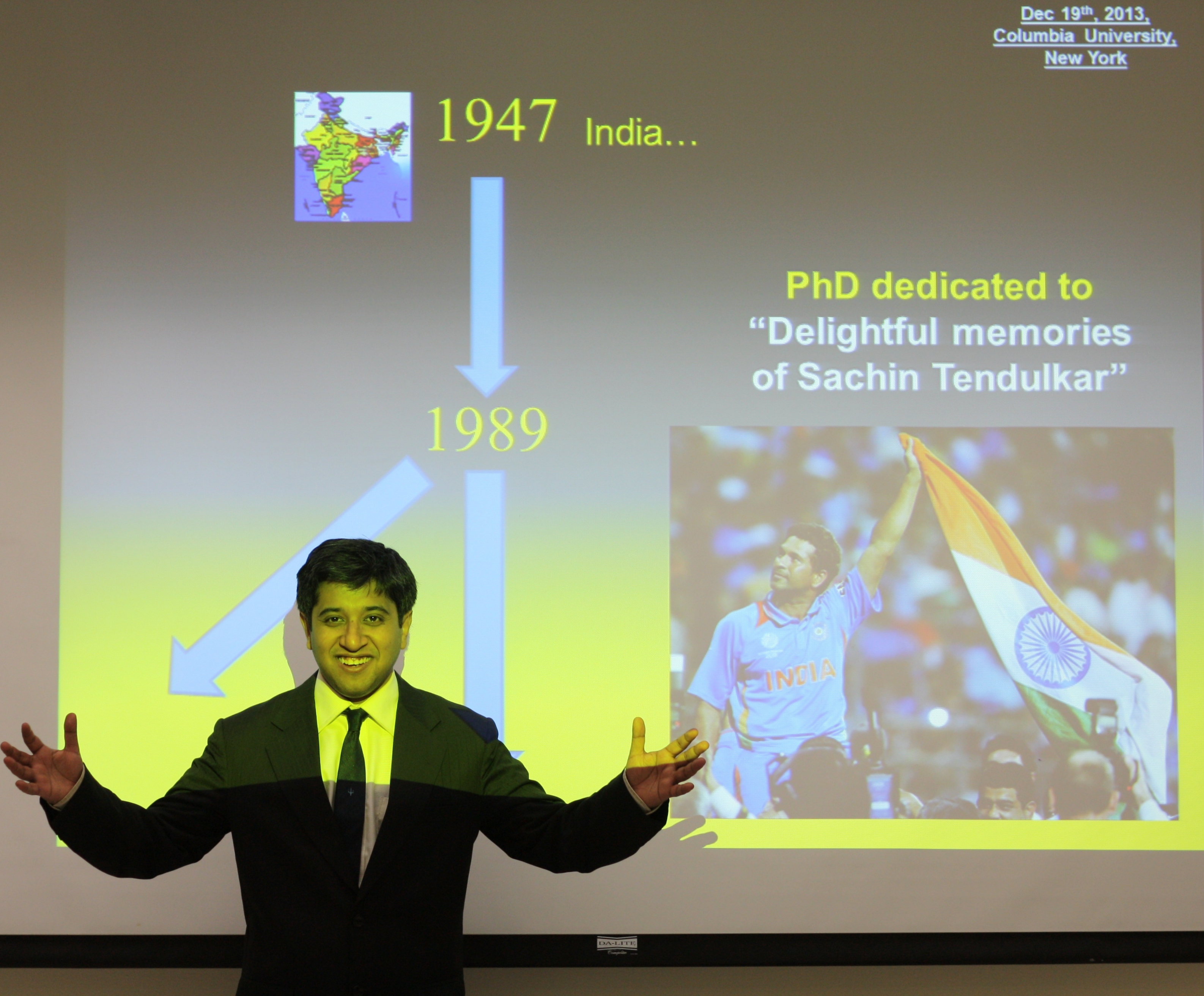
Arnab went ahead and dedicated his PhD to Sachin Tendulkar, perhaps a first in the world of science where a hard-core Ivy league thesis was dedicated to a sporting icon. And why, you will obviously ask, did he do something as inconceivable?  “Not for his cricketing achievements, but for the way Sachin has inspired history and impacted the social psychology (and confidence) of the Indian youth today”, Arnab explained in the e-mail.

Arnab De defending his PhD thesis at Columbia University

Arnab De defending his PhD thesis at Columbia University

On the face, it would look like another crazy fan pulling a quick publicity gimmick. But the young scientist defends his action. “There have been other dedications to Sachin in different fields. However, this is the first PhD to be dedicated to Sachin. I do believe that this article will be widely quoted internationally in different contexts in the future with the growing clout of India, especially as the legacy of Sachin Tendulkar is bitterly debated.”

This different stroke got Arnab some media publicity as well.

Well, you’ve got a point there, young man! Might appear a tad twisted to many, but that’s always the risk when you follow your heart, I guess.

Arnab considers Sachin Tendulkar the greatest batsman of the post World-War era “just as Bradman has been proposed to be the greatest pre-war”.

At the cost of drifting away from his science to sportingly accommodate his effervescent spirit, I quote him further from his email: “Cricket is evidently a British-Australian game and there is wide-spread reluctance to concede this. Hence the argument that Sachin is as good as a Ponting or Lara, probably a little better than them, but certainly not as good as Bradman. To counter such assertions, it might be good for our media to publish the peripheral influences of Sachin (such as this dedication). This is something that the western media has done in the past.”

I have no hesitation in admitting that Nature India considered publishing a scientific analysis of Sachin Tendulkar’s cricketing genius on the day of the legend’s retirement. We considered talking about any patterns in his cricketing career or of other legends such as Sir Don Bradman, any scientific papers that unravel the best techniques used by successful cricketers or why he has been a great cricketer and not such a great cricket captain.

But we stopped short of what would have been a story purely driven by popular demand rather than scientific insight after hearing from Bruce Elliott, Head of the School of Sport Science, Exercise and Health at the University of Western Australia. Elliott, an internationally-acclaimed expert in  the biomechanics aspects of performance enhancement and injury reduction, brought our editorial team down to terra firma with a single-line email in reply to our frenzied queries: “While I fully acknowledge Tendulkar’s greatness, I am not able to add anything to the story.”

Though I do not quite agree that media makes a man beyond what he stands for, or that dedicating a PhD to him would alter Sachin Tendulkar’s (or Arnab’s) fate dramatically, I am willing to take the enthusiastic scientist’s spirit positively. It is always a pleasure to see someone add that zest to science by thinking differently, in this case by trying to connect his varied passions — science and sports —  in a small way.

That’s precisely why this blog is even featuring Arnab De. He certainly has added a zing to biological pathways as we know them!