Away from home: March round-up

Our ‘Away from home’ blogging series features one Indian postdoc working in a foreign lab every Wednesday. The posts recount the experience of these postdocs — the triumphs and challenges of lab life, the cultural differences, what they miss about India — and, most importantly, offer some useful tips for postdocs headed abroad.

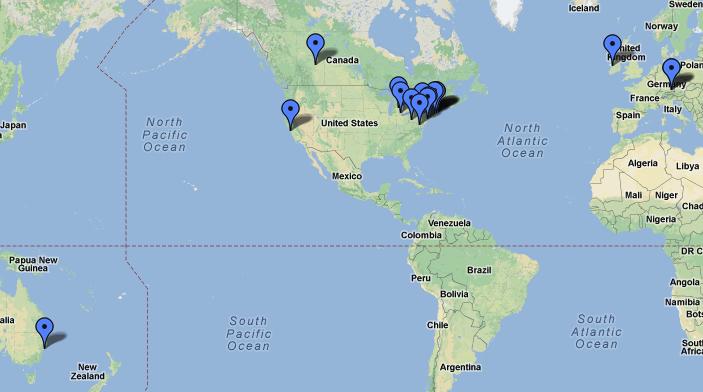
The series has had an excellent response from the scientific and research community worldwide. For our regular readers, and those who are just joining us now, we provide a summary of the month’s entries, including an interactive  map pinpointing the labs these postdocs are based. All these interesting entries and summaries can be found under the Away from home’ category of the Indigenus blog.

We will continue to update the map each Wednesday and hope that you will join in the online conversation using the #postdochat hashtag. 

Nanotech dream for rural India

The first post in March was from Archana Swami, a Ph.D from IGIB, New Delhi, India and currently a post-doctoral fellow at the Laboratory of Nanomedicine and Biomaterials of the Brigham and Women’s Hospital, Harvard Medical School, USA. Archana is also part of the Robert Langer group at The David Koch Institute at MIT, Boston, USA. The young researcher and mom talks about how family forms an integral support base for women scientists. She harbours a fond dream of transforming Indian villages armed with nanotechnology and says the scientific community in Boston is so enriched that it’s very easy to find good collaborations and learn new science with them.

Biomaterial and some ‘craic’

We heard from Akshay Srivastava, a doctorate from Indian Institute of Technology Kanpur, and currently a postdoc at the National University of Ireland, Galway. Akshay is living it up in Ireland bathed in good cheer and making targeted gene delivery vehicles for regeneration of the inter-vertibral disc. He says many institutes and universities in India are doing world class research and there’s good amount of funding in science now. His only cribs are India’s bureaucracy and the government’s not-so-professional attitude towards the health industry, of which he wants to become a part when he comes back home.

‘Research not Nobel-driven’

Our last blogger of March was Arghya Basu, who wears many hats — that of a membrane protein researcher, an amateur photographer and a weekend hiking enthusiast. A doctorate from Indian Institute of Chemical Biology, Kolkata, India, Arghya now lives his many passions working at the University of Alberta, Canada and says research might not always fetch you a Nobel but should be able to make life better for some. He gives out a harsh weather alert for postdocs headed towards Canada but says if you are the adventure loving sort and also enjoy the magic of science,  research and Canada are for you.

Our Away from home interactive map, pictured below and updated every Wednesday, is dotting up with interesting Indian postdoc experiences. Stay tuned as we add more from around the world. Please feel free to suggest names of postdocs from unusual countries and disciplines we haven’t covered yet.
AFH map update12

Away from home: ‘Research not Nobel-driven’

Every Wednesday, our ‘Away from home’ blog series features one Indian postdoc working in a foreign lab recounting his/her experience of working there, the triumphs and challenges, the cultural differences, what they miss about India, as well as some top tips for postdocs headed abroad. You can join in the online conversation using the #postdochat hashtag.

Today’s blog comes from Arghya Basu, who wears many hats — that of a membrane protein researcher, an amateur photographer and a weekend hiking enthusiast. A doctorate from Indian Institute of Chemical Biology, Kolkata, India, Arghya now lives his many passions working at the University of Alberta, Canada and says research might not always fetch you a Nobel but should be able to make life better for some.

AB

Arghya Basu

Dad, my first science teacher

My father was my first science teacher. A banker by profession, he had an extraordinary skill to explain the world and all conceivable worldly acts in terms of science. I remember, as a kid I used to look forward to those hours when my father would come back from office and open my science books, be it the physical sciences or life sciences. The next few hours used to be magical. I always wanted to touch that magic. So, it was a no-brainer for me to choose science and scientific research as my future career quite early in my life.

My lucky break

I completed my doctoral studies at the Indian Institute of Chemical Biology, Kolkata. When I was writing my thesis, I started applying for postdoctoral positions abroad to expand my knowledge. I e-mailed Prof. Joseph R. Casey of the University of Alberta after I got interested in his work from his webpage. He offered me a fully funded trip to visit his laboratory. During the three day trip to Canada I loved the lab environment and research projects. Prof. Casey was very well funded and there were a lot of opportunities to apply for personal funding also. I did not have to think twice when he offered me the postdoctoral position.

Research and the Rockies

I work as a Research Associate in the laboratory of Prof. Casey now in the Department of Biochemistry, University of Alberta. My interest revolves around the structure and mode of action of human anion exchanger protein, AE1. This membrane protein helps us in managing carbon dioxide level in our cells. It also regulates the acidity and basicity of cells. Disruption of the function of AE1 leads to many diseases like haemolytic anaemia and distal renal tubular acidosis.

Canada is probably the most beautiful country. I live in Edmonton, which is not far from the Canadian Rockies. We often take the weekend off from our urban life and go to the mountains. I love hiking in the Rockies. Being a serious amateur photographer this is almost heaven for me.

Getting used to Canada

It was a huge cultural jump for me to come to Canada from India. I will always be indebted to my supervisor, Prof. Casey, who helped me a lot to settle down in a totally unknown country. In the last few years I have changed a lot. My vision has broadened. My food habit has changed. Now I love my espresso, the most bitter coffee of all. But, I really enjoy it here, with friends, co-workers and friendly Canadians.

The worst part of being in Western Canada is the fact that it is too close to the Rockies! Canadian Rocky mountains are home of some of the most beautiful places in the whole world. Edmonton is only a three hour drive from these places. So, it is sometimes really difficult to concentrate on work during the weekdays. But, just one trip to the mountains can see you through some of the busiest weeks. We often go the mountains during weekends, be it winter or summer.

Harsh weather alert

Canada is a country of harsh weather. The winter can be really cruel here. You either love it, or hate it. If you are afraid of temperatures like -30 or -40 degree Celsius, you should not consider Canada, at least not Edmonton.

But, if you like winter sports and bright snowy sights, this is your destination. In terms of funding opportunities, Canada is doing better now as compared to the US. So, look for good quality research, good funding opportunities and some cool fun!

What don’t I miss about India?

If someone asked me what I miss about India, I’d say the list of “what I don’t miss about India” would be a lot shorter. I miss my beloved country. I miss my friends and family. I miss all the festivals. Though we have a very strong and happening Indian community here and we do celebrate all the major Indian festivals in Canada, I miss the Indian totality in them. Particularly during the time of Durga Puja, the greatest festival of Bengalis, I miss my city Kolkata.

Science knows no boundaries

For me working in India or abroad does not make much of a difference. It is more important to work in a place where I can give my 100% effort to add value to the society. We researchers often forget that we are not doing research to publish high impact articles. We are doing our job to add our little bit to improve the quality of life. If I think I can do that from a particular place in the world, then I will try to be there, be it India or abroad.

After spending more than ten years working in the field of science, I realized what one of my teachers once told me — “create your own measure of success”.  All research projects will not produce a Nobel laureate. Being a postdoc will not make one rich. But, there are far more satisfying things than awards and money — the satisfaction of doing something adventurous which will help mankind. So, if you are that adventure loving person who enjoys the magic of science,  research is definitely your path.

Arghya Basu is the first postdoc in this series from Canada. Find him in our interactive  Away from home map pictured below and updated every Wednesday. Please feel free to suggest names of postdocs from countries and disciplines we haven’t covered yet.
AFH map update12

Away from home: Biomaterial and some ‘craic’

Every Wednesday, our ‘Away from home’ blog series features one Indian postdoc working in a foreign lab recounting his/her experience of working there, the triumphs and challenges, the cultural differences, what they miss about India, as well as some top tips for postdocs headed abroad. You can join in the online conversation using the #postdochat hashtag.

This week it is Akshay Srivastava, a doctorate from Indian Institute of Technology Kanpur, and currently a postdoc at the National University of Ireland, Galway. Akshay is living it up in Ireland bathed in good cheer and making targeted gene delivery vehicles for regeneration of the inter-vertibral disc.

AS1

Akshay Srivastava

The biomaterial dream

I have been a student of science from school days. I got majorly interested in science/medicine while pursuing doctoral research. I started reading about medical devices and biomaterial. That propelled me into thinking in terms of developing some technology or device for the healthcare industry.

After completing a doctorate at  the Indian Institute of technology Kanpur, I was interested in working in the area of functional biomaterial with some basic biology work and I found this opportunity in Ireland after strenuous postdoc search. Currently, I am a postdoctoral researcher at the National University of Ireland, Galway. I am trying to design a targeted non-viral gene delivery platform for inter-vertibral disc regeneration.

I am in a collaborative project between Network of excellence for Functional Biomaterial (NFB) and department of microbiology. I work on cloning, expression and purification of short-chain fragment antibodies and other proteins. I then couple these antibodies on polymeric nanoparticles and use them for targeted gene delivery for regeneration of the inter-vertibral disc.

Discipline is key

This lab has brought discipline to my work and helped me learn work and science ethics. The professional attitude towards work fulfills me and gives me a sense of independence. Additionally, my institute encourages students and staff in entrepreneurship and industrial collaborations.  This exposure will definitely help me get a footing in the field of biomedical research.

Ireland, the ‘craic’ country

The best thing about Ireland is the ‘people’ —  friendly and nice to talk to. They have a life beyond work.  I am learning a lot from them and having some “craic” (fun) in life. As they say here, “Bí an saol agaibh” (Have a nice time). Settling in Ireland was exciting. To me, the place is very safe and easy going. And living alone made me learn some cooking too.

However, my lab is in its early stage of research and development and it is still a while to go before it comes at par with other big universities and labs in the US and other European countries. But I also see that the time is not so far to achieve this equality in terms of research.

It also rains/drizzles throughout the year and that’s not such a great thing about this country.

Postdoc tips

For postdocs, my only advice is to choose a good lab with high publishing rate and high impact of work.

The three Fs of India

I mostly miss the three ‘F’s of India:  Family, Friends and Food. I will be finishing my 2 years of postdoctoral work here soon and I have started looking for independent positions back in India to carry out research. I hope I will land in some good institute/university soon, to do what my young mind wants to do.

India is  developing very well in research and technology. I wish to become a part of this change and to contribute to the country as per my expertise. There are so many institutes/universities with potential for world class research in India. Also there is a lot of funding now. I do not see any problem in working as a researcher back in India with all these available resources. Except, of course, the bureaucracy and the government’s not-so-professional attitude towards the health industry.

Akshay Srivastava gets us the first flag post in Ireland as he joins our eminent league of Indian postdocs working in foreign labs. Find him in our interactive Away from home map pictured below and updated every Wednesday. Please feel free to suggest names of postdocs from unusual places and disciplines we haven’t covered yet.
AFH map update11

Away from home: Nanotech dream for rural India

Every Wednesday, our ‘Away from home’ blog series features one Indian postdoc working in a foreign lab recounting his/her experience of working there, the triumphs and challenges, the cultural differences, what they miss about India, as well as some top tips for postdocs headed abroad. You can join in the online conversation using the #postdochat hashtag.

Today’s addition to the series is Archana Swami, who completed her Ph.D thesis at IGIB, New Delhi, India and is currently a post-doctoral fellow at the Laboratory of Nanomedicine and Biomaterials of the Brigham and Women’s Hospital, Harvard Medical School, USA and part of the Robert Langer group at The David Koch Institute at MIT, Boston, USA.

AS2

Archana Swami with her son Soumil.

Science and I

The sense of ‘small’ was imbibed in me at age 6 while trying to dissect rose petals and seeing its tiniest part. This affair went on in school and college spending extra hours to see root sections or molds grown on food under microscope. During Ph.D,  I learnt to apply the knowledge of chemistry at sub-micron scale and to perform surface chemistry at nano-scale. This gave me a whole new perspective of creating something ‘functional’ that is a thousand fold smaller than human hair. I learned to package nucleic acids in nano-carriers to be used for manipulation of genetic machinery of cells.

This exposure at IGIB made me ready for taking on the next challenge. The next phase of my journey began with a postdoctoral fellowship at Brigham and Women’s Hospital (BWH), Harvard Medical School (HMS) under the supervision of Prof. Omid Farokhzad (BWH, HMS) and Prof. Robert Langer, at Massachusetts Institute of Technology (MIT).

Picking the right question

In this group, I learned to ‘pick the right question’ and think about how the answers will impact the next five years of medicine. Our group focuses on working in the field of potentially translational nanomedicine. As a postdoc, I am responsible to steer a project starting from experimental design to building collaboration and targeting potential funding sources for extension of the project to next level, a step closer to translation into clinic. With a pinch of luck in the recipe of smart work, a project can lead to the basis of a start-up company in places like these.

In the past several years I have worked with different biomaterials and have utilized these materials to package vulnerable macromolecules such as cytokines and siRNA, to create nanomedicines. These nanocarriers have potential to safely deliver toxic drugs for cancer treatment, in a site-specific manner. I have worked on developing nanoparticles to target metastatic tumors besides primary tumors, which is challenging especially in case of bone metastasis. It draw my interest toward exploring other potential applications of nanocarriers, for developing technologies for bone regeneration, quick healing of boney-fractures and for creating improved surgical implants. This gave me an insight to cell signaling pathways, and to choose relevant targets for combination therapy of cancer.

The best thing about my lab

The best thing about working in my group is that the scientific quest is not limited by the specific aims of the assigned project. A new great idea is always encouraged.

The scientific community in Boston is so enriched that it’s very easy to find good collaborations and learn new science with them. Boston is multicultural and has an awesome public transport system. You can do well without a car in Boston.

It is not easy to create your niche in such a competitive environment and keep up to the expectations when you are a working mother. To be able to stand up in such circumstances, the price has to be paid by your loved ones. My supportive husband Tathagata and son Soumil are the one who keeps me motivated each day.

A word for aspiring postdocs

Finding postdoc positions in Boston would mean contacting individual groups of your research interest. There is no easy way! A word for aspiring postdocs looking at the US and young parents: the US education system will imbibe logical thinking, creativity and imagination in your child.

I miss the sensory delight that India is

Whenever I see the cells in a fluorescent microscope lighting up with fluorescent nanoparticles, I am reminded of the lights of the Diwali festival. I miss masala chai and samosa with family and friends, gol gappa and khasta kachori of Kamla Nagar in New Delhi. I miss India for its earthly fragrance in the rains and miss listening to Vividh Bharati on radio every day.

My long term goal is to create cost effective diagnostic and treatment options for rural India with the help of nanotechnology. Hopefully I would be able to begin working on this soon!

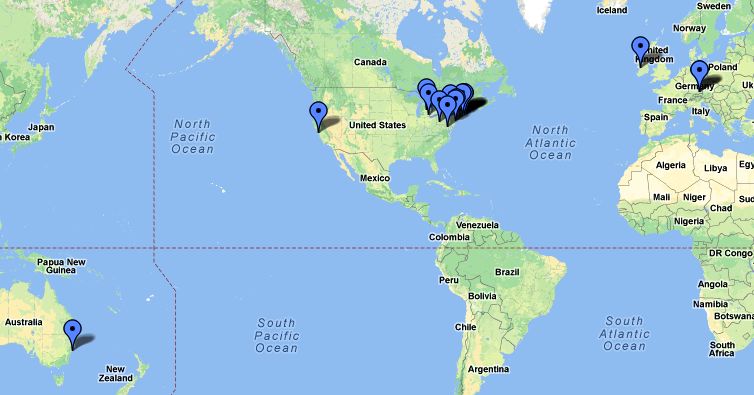
Archana Swami joins the thriving population of Indian postdocs in the West coast of the US. Stay tuned as we add more such promising postdocs every Wednesday to our interactive Away from home map pictured below. Please feel free to suggest names of postdocs from unusual places and disciplines we haven’t covered yet.

AFH map update10