Satellite faith

Indian Space Research Organisation has released some beautiful pictures taken from the Cartosat, its hi-tech mapping satellite.

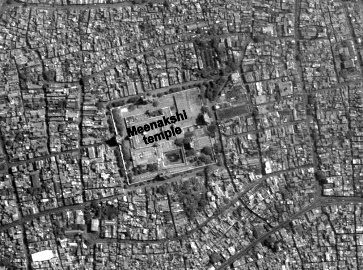
The CARTOSAT-2B satellite, launched by PSLV-C15 on July 12, 2010, sent in these high quality pictures, some of which are generating a lot of interest among the religious minded. One among them is a lovely picture of the Triveni Sangam, the confluence of the three rivers Ganga, Yamuna and the mythical Saraswati in Allahabad, which is a pilgrimage site for people from far and wide. Another picture shows the architectural wonder Meenakshi Temple in Maduari standing tall with a prominent shadow.

sangam.jpg

The Sangam in Allahabad.

meenakshi.jpg

Part of Madurai showing the Meenakshi temple.

We all have been witness to the religious side of our space scientists. We know there’s a tradition of the ISRO top brass visiting temples before a satellite launch to pray for its succeful take-off and landing. So it was nice to see them proudly exhibit their religious bent again. I have always found this an amusing mix, this blend of high end science and deep-rooted faith in god. Some time back, an interesting survey had pulled out some such deep secrets of the Indian scientists’ mind.

Some things are perhaps best left unexplained by high end science.

Spirit of inquiry

Reading an editorial by eminent Indian scientist Raghunath Anant Mashelkar in Science today, I wondered why asking questions of senior scientists in this country is seen as a mark of irreverence. In the recent past, I have come across some highly regarded scientists who thought it was inappropriate to question their findings. Contrary to the very spirit of science, they have chosen not to answer my queries or simply replied in monosyllables that amount to not answering. I know of colleagues who have had similar innocent questions bounced off such firewalls.

When science can not answer uncomfortable questions, it ceases to be science. Mashelkar talks of adventurism in Indian science, of the Kite Flying Fund that saw not many fundable ideas, of bringing back the spirit of inquiry that made Ramans, Boses and Sahas and of not loosing sleep over such irreverence.

I have seen hundred times more ideas merrily floating in labs which don’t care too much about such centralised flow charts for free thought. Many of them are brutally shot down for their sheer craziness but those that survive are brilliant pieces of start-ups. That, I guess, is far democratic and profitable over labs that need written approval even to ideate! A scientist friend I was talking to the other day made a particularly bold statement that made me partly happy and partly concerned over his youthful optimism . “Bureaucracy is not something I am bothered about, I can handle that. The sole aim of my lab is to get a Nobel for India soon. That’s what keeps me going.” Good luck!

This week, while talking to another young and brilliant energy researcher spearheading social outreach programmes from one of India’s many IITs, I was convinced all’s not doomed for the free spirit of science in this country. It was heartening to hear about the many young researchers under him choosing careers in remote villages to produce alternative energy over cushy MNC jobs. He was proud of these success stories that came out of simple and humane ideas that fought not just the bureaucratic, social and economic system but the political as well. Kudos!

The spirit is alive. In pockets.

Market-worthy ideas, anyone?

A new business plan competition for researchers from India and the UK hopes to identify the most promising scientific advances with equally brilliant commercial spin-offs. This is the kind of boost that young researchers in this country are looking for. It would be interesting to see what innovative ideas come in for the competition from India and, of course, which ones finally win.

The competition is led by The University of Nottingham, the Indian Institute of Technology Kanpur, and the Indian Institute of Management Bangalore. It will provide support to help the brightest and the best of scientists with “promising scientific advances underpinning a business idea to progress their concept towards commercial reality.”

The contest provides a new chance for winning entrants to gain funding to build healthcare or pharmaceutical businesses from their ideas.The idea is to create real businesses in the pharmaceutical and healthcare sector. The competition will hopefully see the launch of new companies and technologies in both countries by helping scientists with groundbreaking ideas work with the business and intellectual property experts required to translate ideas into products.

During the first round, teams are required to complete a short business plan executive summary. The deadline for submissions is May 14, 2010.

The best entry from India will get a package of benefits worth over Rs 15 lakhs to assist in starting up a new company, including Rs 5 lakhs cash award for early start-up costs, two years’ incubation facilities at SIDBI-Innovation & Innovation Centre (SIIC) at the Indian Institute of Technology Kanpur, providing room space, accommodation and support with IPR protection costs, lab testing and prototyping costs.

Pradip Bhatnagar, Senior Vice-President of Drug Discovery Research at Ranbaxy Laboratories Ltd in India says the competition will help unlock the vast potential of India’s pharmaceutical and healthcare research.

More information is here.

Virtual bioinformatics

This week I marveled at the organising skills of some young and enterprising bioinformatics researchers who had put together what they called India’s first virtual conference on bioinformatics in real time — Inbix ’10.

Going by the content of the conference — pre-recorded and live streaming talks, lively interactions as well as poster presentations — it did look like they made the most of the time-honored, cost-effective means of conferencing benefiting the Indian bioinformatics fraternity. This conference succeeded the African Bioinformatics conference (Afbix ’09) organised in collaboration with the African Virtual Bioinformatics Network in 2009.

Experts from India, Singapore, USA and Denmark spoke on a variety of subjects. There were talks on computational protein structure prediction methods, use of sequence diversity in emerging infectious agents for vaccine designing diagnostic tool development, open access tools in systems biology, mathematical models for simulation of multicellular virtual tissues, use of genomic expression data and metabolite pathway information to predict tumorigenic potential of chemicals, computational framework for the profiling and prioritisation of environmental chemicals, large-scale analysis of tissue-specific pathology and gene expression of human disease genes, open source drug discovery model for TB and analysing genetic data on human disease and the pathways associated with these genes.

The conference organised by the Indian bioinformatics network Bioclues and US-based Bioinformatics Organization opens up the possibility of creating such low-cost platforms for international conferencing in Indian labs.

DisCERNing India

Pardon me if I sound like an excited child in a toy shop but I am just back from CERN, the particle physics lab on the Franco-Swiss border that everyone knows of now, thanks to ‘Angels and Demons’. The best part of the trip, besides being able to see all the experiment hubs, was the Indian presence at CERN (and I am itching to write a bigger article on it soon).

It was lovely to be greeted by a Nataraj statue presented to CERN by India’s department of atomic energy.

DSC_0148.JPG

And then to be greeted by CERN physicist Archana Sharma, the woman from Jhansi whose infectious ‘science patriotism’ is something I identified with. There’s another story to be told on her efforts to put India on the CERN map and vice-versa. For the first time ever, a contingent of Indian students is visiting CERN to get an exposure of a lifetime, thanks to Sharma’s perseverance.

I can’t but mention Dilip Jana, a young scientist I found working late on a Sunday night in a CERN library, wife in tow. His fascinating personal journey from remote Nandigram (now famous as a political hotbed) in West Bengal to the US for higher studies and then a deputation at CERN is awe-inspiring. Something all young students aspiring to be scientists must be told about. More about him in the India article on CERN soon.

Being at CERN was an experience in itself — a glamorous particle physics lab, the Large Hadron Collider and loads of talk on matter, anti-matter and Higgs — in the middle of small villages on both sides of the border, vineyards and the Alps. Worth a longish travelogue, actually!

Pollution goes to school

We counted this already among the many menaces of living in polluted cities, but now there’s a study to prove it beyond doubt. Our children breathe heavily polluted air in schools.

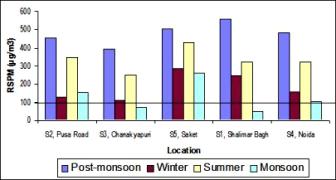
The respirable standard particulate matter (RSPM) in Delhi schools apparently exceeds all air quality standards in most seasons, according to pollution watchers at The Energy Research Institute (TERI) in New Delhi. They studied five schools in the national capital region and found that nitrogen dioxide levels were also over the top in some of these schools. They report ‘alarming’ levels of pollutants on Diwali day, the festival of lights, and for days preceding Diwali.

Here, the first two self-explanatory graphs talk of the RSPM and nitrogen dioxide levels (in that order). The third graph gives a feel of the Diwali bonanza!

rspm.jpg

no2.jpg

diwali.jpg

In the emission inventory of Delhi, the prime culprits stand out — vehicles and industries, primarily the power plants. The researchers have suggested a slew of mitigation measures to make school zones safer for children including improved parking, pick up and drop off zone for children, dense tree plantation, water sprinkling in play fields and special reinforcement messages prior to Diwali.

How doable is all this? Anything else that can be done to get our school authorities working?

Greenhorn blues

As I get to speak to more and more research scholars in this country, I sense the increasing frustration in them on account of the usual peeves — poor facilities and meagre resources. But something far more worrisome is the angst brewing up because of insensitive seniors. Sparks flew when a researcher scratched the surface of this controversial topic recently. I have been wondering if this is a majority situation. Are Indian labs really unfriendly towards young researchers?

Reading material

What do scientists want to read when not reading scientific papers? This is the question we asked our potential readers in a country-wide survey before planning the content for Nature India . Why don’t I just begin by asking what you, our valued readers, want from NPG’s India-specific science portal that goes live in a couple of weeks.

I have no hesitation in letting out this little secret: topmost on the wish-list of our survey subjects was job information! We know exactly where the buck stops, don’t we?

Here’s your chance to have a say. What do you want to see on the pages of this portal?