Careers for scientists away from the bench
Many postdocs end up leaving the lab – so what other opportunities are out there? The Nature Jobs Blog discusses a recent workshop at the University of Helsinki centred on careers away from the bench:
Which way now?
ISTOCKPHOTO/THINKSTOCKOne theme that emerged during the conference was the idea that the traditional career path has changed – these days, your career trajectory will likely be dotted with dips and plateaus as you build skills or change directions. Changing jobs – even when related to your current field – can be daunting, but there are plenty of steps you can take to initiate that process whilst in your current role

Continue to the post which includes a list of possible job roles.
Scitable Relaunches Their Blog Network
Nature Education’s Scitable relaunched their blog network this week, and to tie in with this we hosted a Q&A with Ilona Miko:

Of the ten new blogs launching this week, seven are group blogs that concentrate on specific fields of science (neuroscience, psychology, geology, oceanography, physics, evolution and environment) while three are individual blogs with a more personal focus (mentoring, philosophy of physics and astrobiology, and science news).
The group blogs aim to educate and entertain by tackling the fundamentals of their fields and answering relevant questions that you may have thought of… but never got answers to.
You can keep updated with the latest Scitable news on Twitter; their hashtag is #scitable. If you have a favorite blog, they also have RSS feeds available on each blog’s landing page.
India’s no to dolphinarium
Subhra Priyadarshini explains in the Indigenus Blog that last week India’s ministry of environment and forests banned creation of any dolphinarium across the country:
A fisherman with a Gangetic dolphin.
CAPGD 2010The ministry…observed that since the endangered Gangetic dolphin is India’s national aquatic animal and a highly intelligent and sensitive species, it is morally unacceptable to keep it captive for entertainment purpose. The ministry has advised state governments to reject any such proposal for dolphinarium by organizations or agencies.

The Gangetic dolphin was accorded the national aquatic animal status in 2009 when the 100 million year old species was found to face the danger of extinction within the next decade if not protected ferociously.
Further details can be found in Subhra’s post.
It’s great to be a woman scientist; it’s challenging to be a woman scientist
In her latest post, SciLogs blogger Stephanie Swift reviews an event run by the Canadian Science Policy Centre that looked at the status of women in science and technology:
Yet, as it turned out, it was actually a wonderfully empowering, evidence-based look at women working in STEM fields (or maybe I just thought so because I travelled to the meeting listening to the Spice Girls – the ultimate in female power).
Wendy Cukier and Dr. Maydianne Andrade first described that while overt gender discrimination no longer exists (for a recent convert to the ridiculously sexist show Mad Men, this is good news), subtly muted gender discrimination does. We have to acknowledge this reality, even if it doesn’t affect us personally.

California stem-cell agency discloses grant-review conflict

Leroy Hood
WIKIMEDIA COMMONS
Ewen Callaway reports in the News Blog that Leroy Hood, head of a prominent research institute in Seattle, Washington, violated conflict-of-interest rules when he reviewed a friend’s grant:
The 2 April letter was first reported by the California Stem Cell Report, an independent blog that covers the California Institute for Regenerative Medicine (CIRM), a US$3-billion agency established in 2004.
Hood, a DNA-sequencing pioneer who is president of the Institute for Systems Biology, reviewed a $24-million application to CIRM that included Irving Weissman, a stem-cell scientist at Stanford University in California. Hood and Weissman are good friends and own a ranch together in Montana — a fact that Hood did not disclose when he completed a conflict of interest disclosure.
Further information can be found in Ewen’s post.
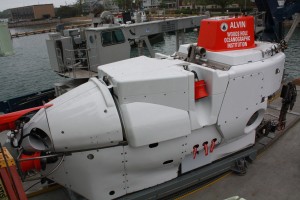
Refurbished Alvin submersible returns to sea
Brian Owens reveals in the News Blog, that after a two-year, US$41-million upgrade, the venerable Alvin submersible is about to return to sea:
Alvin will soon be back in business after a two-year hiatus.
BRIAN OWENSOn 25 May, the research ship Atlantis will leave the Woods Hole Oceanographic Institution (WHOI) in Massachusetts with Alvin on board, bound for Astoria, Oregon. After a series of US Navy certification cruises in September and a scientific-verification cruise in November, Alvin will return to full service in December studying the deep ocean off the US Pacific Northwest.
The main improvement in this first phase of the Alvin upgrade is the new titanium sphere where the sub’s three-person crew sits.
For more on this, see Nature’s feature story ‘Deep-sea research: Dive master‘.
Post America Depression
In the Trade Secrets Blog, Juliana Chan talks about meeting Nobel Laureate Dr. Shinya Yamanaka:
Leaving the bustling science scene in the United States can have its effects
As I am about to start a tenure-track faculty position in Singapore, I asked Dr. Yamanaka what was the biggest challenge he faced as a junior tenure-track professor. He told me that after leaving San Francisco, where he’d made his big iPS discovery, and arriving in Japan, he suffered from “so-called PAD – Post America Depression.”
This was around 1999, and the scientific environment in the States was much better than in Japan, he said. In his lab at the Nara Institute of Science and Technology, he found he “couldn’t get good funding; I couldn’t get good support from other scientists.” And for the first three years, he couldn’t publish any papers. This eventually had him considering going back to the clinic, away from academic research.

More advice from Dr. Yamanaka can be found in Juliana’s post.
Out West
Finally, if you want to learn more about canyon geology, check out Paige Brown’s latest post:

Secret Canyon, Page Arizona. (C) Paige’s Photography.