From an early visual representation of a hierarchically ordered universe in Robert Fludd’s ‘Great Chain of Being’ (1617), to a contemporary moving infographic of ocean currents from NASA, a free new exhibition in London shows how visualising data has changed the way we see, interpret and understand the world around us.
‘Beautiful Science’, which opens at the British Library today, is a fascinating journey from 17th century illustrated diagrams to interactive visualisations in science.
Exploring how advances in science alongside changes in technology have allowed us to visually interpret masses of information, the exhibition focuses on three areas; public health, weather and climate, and the tree of life.

Perpetual Ocean (c) NASA, Goddard Space Flight Center Scientific Visualization Studio, 2011. The striking animation by NASA visualises the flow of ocean surface currents from June 2005 to December 2007.
“The main idea behind the exhibition was to link the library’s historic science collections with what contemporary scientists are doing today, showing how by picturing scientific data, we can tell interesting new stories that reveal meaning and new discoveries”, says Dr Johanna Kieniewicz, lead curator of Beautiful Science. “The exhibition tells stories both of advances in science, as well as the advances and changes in the way in which we use information to understand our world.”
In an era when infographics are increasingly used as a popular tool to communicate complex data in science to a broader audience, the exhibition nicely delves into the visual legacy of scientific data and reasserts the idea that data from the past can still heavily influence and inform today’s cutting edge science.
There are some fascinating examples on show including Florence Nightingale’s seminal ‘rose diagram’ (1858), which showed that significantly more Crimean War deaths were caused by poor hospital conditions than battlefield wounds.
Much of the innovation in data visualisation started as far back as the Victoria era, as Dr Kieniewicz explains. “The Victorians witnessed an enormous proliferation of images where scientists, statisticians and doctors were using various sorts of visualisation techniques to actually convey the meaning that was within their data. I think this was partly due to the availability of data that suddenly took off in the Victorian era.
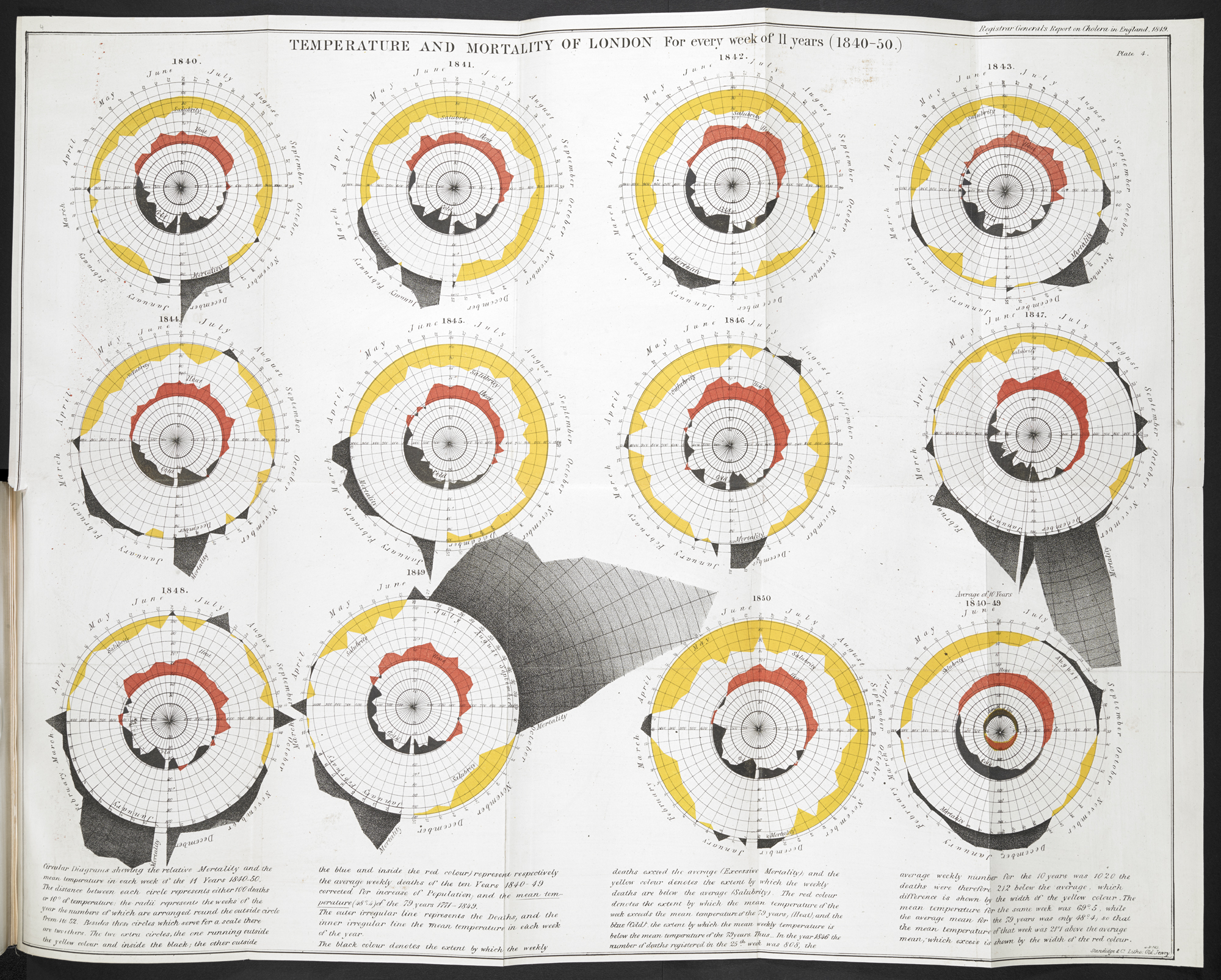
Temperature and Mortality of London. William Farr, Report on the Mortality of Cholera in England, 1848-1849. London, 1852. British Library.
“There are some interesting parallels with the Victorian times, as they certainly witnessed enormous innovations in terms of representing information graphically in the same way we do today. Scientists including William Farr and people like Florence Nightingale were actually really trying to wrestle the vast amounts of data into a meaningful form.”
Epidemiologist and statistician William Farr’s Report on the Mortality of Cholera (1848-1849) plotted cycles of temperature and cholera deaths, while David McCandless’s ‘Antibiotic Abacus’ shows the phenomenon of antibiotic resistance. The latter highlighting how bacteria have developed the ability over time to survive exposure to antibiotics. However most fascinatingly, for me, is the social media weather sentiment vs Royal Netherlands Meteorological Institute (KNMI) weather data chart. The chart compares actual weather data over 700,000 sentiment analysed social media messages about weather throughout 2011.

Weather Sentiment vs Reality, created by CLEVERFRANKE
“Now rather than simply working with static graphics you can actually explore how things change over time, over space, and interact with it, in a way that you couldn’t before, which is incredibly important in our ability to see so much more within the data,” adds Dr Kieniewicz.
Beautiful Science runs until 26 May 2014 and is accompanied by a range of events and talks.
To take a look behind the scenes of Nature and Scientific American’s infographics, read The Power of using infographics to Communicate Science and follow the weekly blog series Under the covers (Nature revealed)
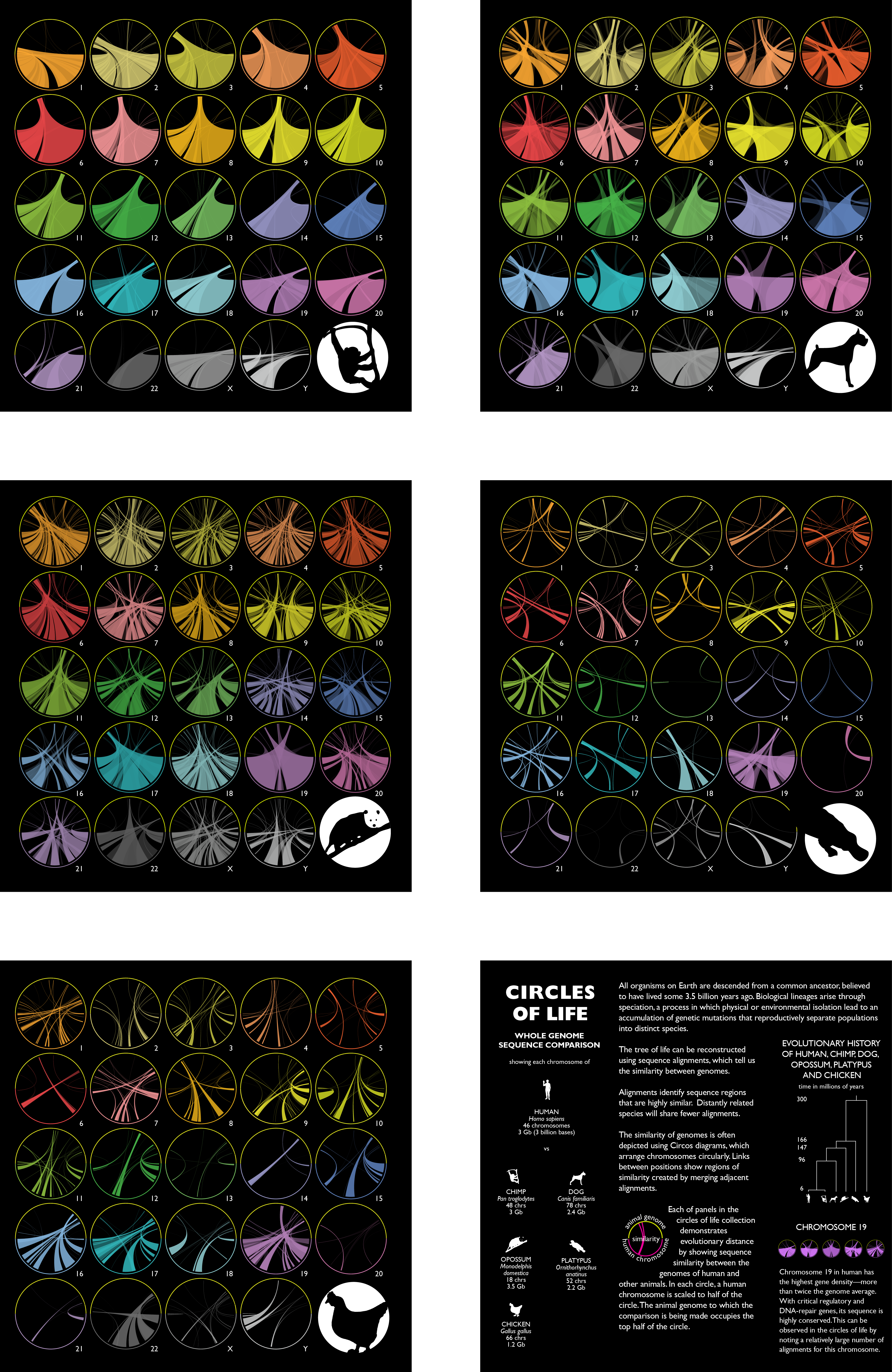
Circles of Life (c) Martin Krzywinski, Circles of Life, 2014. Specially commissioned for Beautiful Science, these striking ‘Circos’ diagrams picture the genetic similarities between humans and five other animals: chimpanzee, dog, opossum, platypus and chicken.