
The latest Soapbox Science mini-series focuses on the role of mentors in science. Tying in with this year’s Lindau Nobel Laureate meeting, where almost 600 young scientists have the opportunity to meet each other and 25 Nobel laureates, we’ll be looking at the importance of supportive relationships and role models. We’ll hear from a mix of mentors, mentees and projects set up to support scientists and we aim to explore not just the positive examples of good mentoring but what can happen when these key relationships are absent or break down. For more discussions around this year’s Lindau meeting, check out the Lindau Nobel Community site.
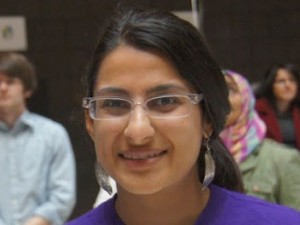
- Meghna Marjadi
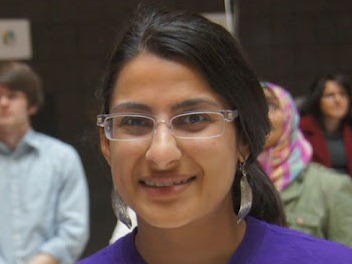
Meghna Marjadi is a Massachusetts Promise Fellow(Americorps) serving as the the High School Programs Coordinator for Science Club for Girls. The Cambridge, Mass. – based group sends volunteer mentor-scientists from local universities, research labs, and companies to area schools. Group members also train teens to serve as “Junior Mentors” to younger girls so they can “ picture themselves in STEM careers. Meghna also runs the herring monitoring program with the Mystic River Watershed Association.
While women comprise nearly half the work force, they fill only 25 per cent of STEM jobs, according to a 2011 report by the US Department of Commerce. The factors influencing underrepresentation of women in science include a dearth of role models, STEM careers that offer little family time and gender stereotyping. For example, earlier this year, the clothing store Forever 21 carried a t-shirt that read, “allergic to algebra.”
Science Club for Girls (SCFG) addresses the gender disparity in science by exposing young women to role models who help banish gender and racial stereotypes. Designed to increase K-12th grade girls’ (16-19 years old) confidence and literacy in STEM, the project provides free, out-of-school time programs that feature fun hands-on learning, teaching and leadership opportunities with adult scientists. Volunteer mentor-scientists from research labs and companies in the area serve as role models.
Weekly Science Clubs for K-6th grade girls (11–12 years old) nurture their curiosity for the world and familiarize them with the processes and tools of science, technology, and engineering. Participants engage in hands-on activities led by a teaching team of women, “Mentor Scientists”—often students from local universities. Through activities and field trips to local labs and other work places, girls find space to explore new ideas, discuss future goals, and solicit valuable feedback.
Eight-grader Zian Perez described her experience this way:
“During my time at Science Club for Girls I learned more science than I did in class. My Mentor Scientists would talk to me about my feelings toward science. They helped me enjoy science, but I thought that I couldn’t do well in it because of my lack of math skills. My Mentor Scientists said that if I really liked science, I could pursue it; I just had to focus on the subject. That experience helped me gain a new perspective on science and how it could be a possible career choice for me.” .
The program also trains 7th to 12th grade students like Zian to be Junior Mentors, or “JMs.” This past year, Zain worked with a group of 12 rowdy kindergartners. By making Jell-O, ublek, and other fun oddities, Zian and her Mentor Scientists helped the kindergarten girls discover properties of matter.
Walking into her kindergarten classroom, I was greeted by the following scenario: a group of five-year-old girls running around in circles with a large glass jar. They were extremely excited about exploring density by dropping pennies into the jar for “penny races.”
Junior Mentors enjoy a unique role; they work with their own Mentor Scientists and then become mentors to the younger girls. Through experience, participants develop leadership skills, self-identity and sisterhood. Over time, girls build strong relationships with their Mentor Scientists and develop assurance in their science abilities. Avianna Perez, a 10th grader (16 years old) and current Junior Mentor, began Science Club for Girls as a shy 3rd grader. With the encouragement of her Mentor Scientist Scientist, Gurtina Besla , or Tina, at the time a PhD student at Harvard, Avianna was able to become more outgoing. (Tina is now a postdoctoral fellow at Columbia Univeristy)
“…Tina was one of the main reasons that I continued being a part of the program. She knew how shy I was…and she slowly opened me up to participate more. She made me look forward to spending Friday afternoons with her and the other girls in my club.”
Through interactions with Tina, Avianna could picture herself as a forensic scientist.
“Tina was a student at Harvard University and was studying astrophysics. During clubs sometimes she would talk about what she did and she made me think that I could achieve the same goal as her but in a different career, such as forensics, which I look forward to studying in college.”
Similarly, Avianna identified the importance of allowing participants in clubs to become JMs.
“Starting science at a young age and keeping us involved as JMs as we grow older is great because we are showing the younger girls that we were once like them and that one day they can become like us…Later on, once we are in college, we can come back as Mentor Scientists.”
Daphne Politis said the program played a strong role in informing her two daughters’ education choices. Both have pursued science careers: one in neuroscience, the other in environmental sciences.
“Having it be a “science club for girls” also helped [the girls] incorporate science into their identity and sense of self,” she said. “I believe that their involvement in the Science Club for Girls was instrumental in helping to develop their confidence.”
Click here for more on Science Club for Girls. The group accepts donations. Here is a list of what gifts cover.
$25 = 3 brand new dissection kits for our Marine Biologists
$50 = Sponsors an overnight museum trip for one 5/6th grade girl
$75 = Sponsors one girl to attend a day of our Vacation Week program
$100 = Wires, light bulbs, buzzers etc for a group of our Electrical Engineers for one semester
$250 = Sponsors Career Exploration, Leadership and Life Skills (C.E.L.L.S.) workshops for one teen girl
$500 = Motors, parachutes, nose cones, igniters, altimeters etc and registration fee for one Rocket Team