Protocols Discussion Forum is Moving

As you may or may not know Nature Protocols has a Discussion Forum where anyone having problems with their experiments can ask questions and hopefully receive helpful advice from other researchers with some experience in whatever is causing the problems. For the last several years this has been hosted on Nature Network but as of, well right about now, we are shifting its platform to a Google Group.

We have always thought of Nature Protocols as more than a journal and we try to engage with our readers to help them in their research. We have done this through commenting on our manuscripts; this blog; our YouTube channel and the discussion forum. We are always on the look out for technologies that might be helpful.

That’s why we are now moving the Discussion Forum onto the Google Groups platform.  We hope that this will greatly improve the effectiveness of the discussions by making it even easier for anyone to become involved in the forum. It should be easier to access on mobile devices, and easier to post on as comments can be made and discussion topics started simply by sending an email to nature-protocols-discussion@googlegroups.com.There are other technical advantages for us as well, not least a better spam filtering system so hopefully far fewer topics or posts will be offering fake passports for sale!

There are two ways to access the new look discussion forum, either through the Discussion page on this blog or directly at Google Groups . We very much hope that this move will increase the usefulness of the Discussion Forum by making it easier for researchers to take part, easier for the topics to be found by people searching for answers using search engines, and easier for topics to be connected to from throughout the Web.

The Current Discussion Forum isn’t going away but will remain as an archive. However it will not be possible to post new topics or reply to existing threads. I have however copied across all discussions started this year into the new platform as well as some of the most active from 2012. If there are any threads that you would like to see continued please let me know and I will copy those across as well.

I hope that everyone will find the new forum at least as helpful as it’s predecessor.

So, what shall we talk about? As an eponymous fictional talk show psychiatrist didn’t quite say:

“We’re listening.”
 

Deadline Roulette

I didn’t mean to write about peer review again. Two things I never mean to write about are Peer Review and Impact Factors, but being an editor provides a privileged viewpoint on both so I seem to keep coming back to them. And here we go again:

This time the spur is a new paper in Scientific Reports that caught my eye called “How Important Tasks are Performed: Peer Review“. I wrote last month about the psychology of setting deadlines for referees

and so this line in the abstract made me sit up and take notice:  “the time a referee takes to write a report on a scientific manuscript depends on the final verdict”. The phrase “a Deadline-effect” also appears in the abstract. My interest was piqued. Did the authors have real data? Were they going to conclude that setting different length deadlines could change the decision on a manuscript?

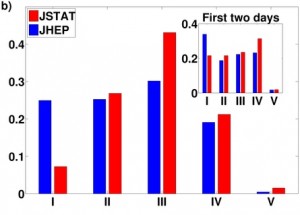
Fractions of various decision: classes accepted (I), accepted with minor revision (II), to be revised (III), rejected (IV), not appropriate (V) from all reports (as an inset the same for short-duration processes) . Adapted from Figure 2b of ref. 1

Fractions of various decision: classes accepted (I), accepted with minor revision (II), to be revised (III), rejected (IV), not appropriate (V) from all reports (as an inset the same for short-duration processes) . Adapted from Figure 2b of ref. 1

The authors have looked at data from two journals: Journal of High Energy Physics (JHEP) and the Journal of Statistical Mechanics: Theory and Experiment (JSTAT). The journals don’t really matter, what is important is that they have access to data from these journals of every interaction with referees giving times for responses to review requests, how long it took them to return reports and what the decision was (on the paper). From this they can do lots of plotting of decision times and see that things seem to be covered by Poisson statistics which means that they can do some mathematical modelling. They also see that for those reports that come back fast, that is within a day, there is a much higher proportion of clear cut decision: Accept as is, or Reject.

I don’t think that either of those observations will surprise many people but there is more. For a start the two journals have different reviewing deadlines. JSTAT asks for reviews in 3 weeks, JHEP in 4. Both slower than Nature Protocols but then this is physics, a foreign country where they do things differently. Their data don’t support my comments on deadlines though because the shape of the distribution of return times for reviews is the same for both journals just that JHEP’s is spread over a longer scale.

Now because the distributions they get are Poisson looking they can be modelled with a series of stochastic steps. Referees are seen as people who spend their days doing little bits of action (sub tasks) each one taking about 10 minutes, that add up to a whole task. Every 10 minutes (approximately) the referee chooses what subtask to do based on importance of the overall tasks.  If that were all though the distributions wouldn’t be as they are, there would be power-laws involved and a long tail of reports that take a very long time to be completed. What stops this happening is the ‘Deadline-effect’. Because there is a deadline set on the task the referees know they have to spend a set amount of time before the deadline on the report. The clear-cut reports come in more quickly not because they have fewer sub-tasks but rather because the referees assess from the outset that these are going to be ‘easier’ sub-tasks to complete and so are likely to perform them with higher probability. Always pick the low hanging fruit first!

I can’t quite decide what take home message I have from this paper. It certainly suggests that clear deadlines and ruthless chasing are needed to get reports from referees. Perhaps though there is also a lesson for authors: If you want to get your paper reviewed swiftly, make it as easy as possible to review. That it took almost 3 months for this paper to pass through review might suggest that is a conclusion the authors didn’t draw for themselves.

1. Hartonen, T. & Alava, M. J. How important tasks are performed: peer review. Scientific Reports 3, 1679 doi:10.1038/srep01679

Model Behaviour

Model organisms are much used in modern biology. Generally small and easy to keep in the lab, these creatures serve as the ‘typical example’ of a type of organism or biological process. Fruitflies, mice, yeast, zebra fish, Arabidopsis, etc. The list of organisms that can be regarded as models sometimes seems so long that the concept is itself undermined; how long before we see the platypus championed as a model? Nevertheless the use of ‘standard’ creatures does allow the results from different laboratories across the world to be directly compared, always assuming that these labs are treating their models in a standard way.

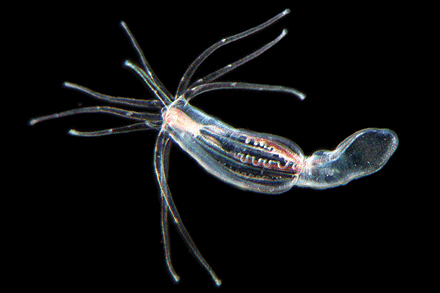
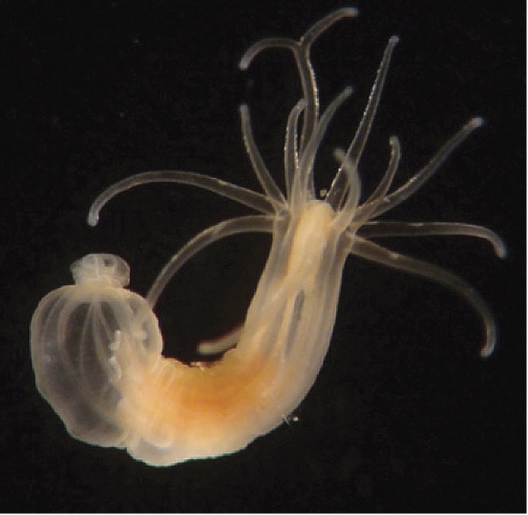
nematostellacoverFor the study of critical steps in animal development researchers are increasingly turning to the cnidarians, a phylum that includes jellyfish and corals, as they retain relatively simple body plans and yet are more clearly multi-cellular organisms than the somewhat colonial sponges. This week we have published four protocols concerning the cnidarian Nematostella vectensis, more commonly known as the starlet sea anemone, to act as a very basic ‘starter kit’ for anyone wishing to work with this organism.

Nematostella is a native of the east coast of the United States. It spends its time buried in mud feeding through its mouth, which is surrounded by two rings of tentacles. Slightly paradoxically they are classed as ‘vulnerable’ by the International Union for Conservation of Nature, but are also behaving as invasive aliens on the south coast of England and the west coast of the United States. But they grow fast and prolifically in the lab and have a sequenced genome1.nprot_2013_044-F5

The four protocols take us through some essential steps in working with Nematostella. John Finnerty and colleagues describe their approach to collection rearing, spawning and regeneration (doi:10.1038/nprot.2013.044)2, Isolation of DNA, RNA and proteins (doi:10.1038/nprot.2012.151)3, and characterization of RNA and protein expression (doi:10.1038/nprot.2013.014)4. To complete the quartet, Mark Martindale explains how his lab approaches overexpression and knockdown studies in this versatile beastie (doi:10.1038/nprot.2013.009)5.

We are hoping that this collection of protocols will provide a useful resource for aspiring cnidarian biologists. We would also be keen to see anyone with experience of working with Nematostella presenting their own protocols in the Protocol Exchange. The cluster also raises the following question:

Are there other emerging model organisms that are crying out for similar attention?

References:

1. Putnam NH, Srivastava M, Hellsten U, Dirks B, Chapman J et al. Sea anemone genome reveals ancestral eumetazoan gene repertoire and genomic organization”. Science 317, 86–94 (2007).

2. Stefanik, D. J., Lauren E Friedman, L. E. & Finnerty, J. R. Collecting, rearing, spawning and inducing regeneration of the starlet sea anemone, Nematostella vectensis. Nature Protocols 8, 916-923 (2013).

3. Stefanik, D. J., Wolenski, F. S., Friedman, L. E., Gilmore T. D. & Finnerty,  J. R. Isolation of DNA, RNA and protein from the starlet sea anemone Nematostella vectensis. Nature Protocols 8, 892–899 (2013).

4. Wolenski, F.S., Layden, M. J., Martindale, M. Q., Gilmore, T. D. & Finnerty, J. R. Characterizing the spatiotemporal expression of RNAs and proteins in the starlet sea anemone, Nematostella vectensis. Nature Protocols 8, 900-915 (2013).

5. Layden, M. J., Röttinger, E., Wolenski, F. S., Gilmore, T. D. & Martindale, M. Q. Microinjection of mRNA or morpholinos for reverse genetic analysis in the starlet sea anemone, Nematostella vectensis. Nature Protocols 8, 924-934 (2013).

Antibodypedia on Facebook

Those readers who are avid, or even obsessive, followers of Nature’s various blogs will know that NPG is collaborating with a website called Antibodypedia since December of 2011. Well, last week we passed a significant milestone with the listing of its half-millionth antibody. And this week we are launching a Facebook page.

Antibodypedia attempts to pull together information about the performance of publicly available antibodies so that researchers can make informed decisions about which will work best in their experiments before they buy them. The data we aggregate are things like links to research papers in which the antibodies have been used, technical data from the antibody suppliers, and the results of experiments performed by independent scientists.

Antibodypedia is a great resource as it is, but the aggregation and presentation of information already available, albeit in diverse places, is only half of the story. We want it to also be a place where researchers can share their experiences with specific antibodies and discuss the problems that arise with immuno-based cell biology techniques.

We already have a mechanism in place for researchers to submit experiments showing the performance of antibodies, and an advisory board to help us peer-review those experiments to ensure their usefulness; it is a form of micro-publication. Now we are taking a further step in engaging with the research community with our Facebook page.

Why Facebook?

Well, it would have been perfectly possible to incorporate a message board, discussion forums and the other functionalities of a community site into Antibodypedia but the plain fact is the vast majority of researchers are already members of a global social networking site, so why ask them to join another one? Instead we are making things easy and carving out a small corner of Facebook for all things antibody(pedia). We will of course be posting a lot ourselves on the page—news, highlighting of research papers, running polls etc.— but we also hope that antibody-using researchers will start their own discussions, share their experiences and try to solve each other’s problems.

The page launches today so please come, take a look and ‘like’ us. Then come back regularly over the next few weeks to follow our posts, take part in the polls and, of course, leave a comment or two.

The Season of the Impact Factor

It is that time of year again! A bit like Christmas, now is the time when journal editors wait expectantly to open their presents; or in this case present singular. I’m talking about the annual release of Impact Factors from ISI. I’m not going to go through all the reasons why Impact Factors may not be the best way to judge scientific research. Katharine made some comments about that last year and I haven’t changed my opinion much since I railed against their tyranny at another journal. But Impact Factors and the other citation metrics probably say something about a journal so I thought I’d give you the numbers for Nature Protocols and say what I’m taking from them.

A picture from the cover

My favourite cover image from 2011.

So the 2011 Impact Factor for Nature Protocols is 9.924 which I’m really happy about. It would be a presentable number for a journal publishing primary research, and we don’t publish primary research. I would expect protocols to be formally cited less often. Also it is up 1.562 points from the 2010 value so Nature Protocols is probably being cited more than 12 months ago and hopefully that is an indication that our articles are being used more than 12 months ago. If our articles are being used more than they were then that’s good news.

Impact Factors are quite good for making comparisons between similar journals, but sadly none of the other main publishers of protocols is indexed by ISI and so don’t get given Impact Factors. I analysed the citation of those journals a few months ago and I’ll let you draw your own conclusions about what thier IF might be if they were given one. What ISI does do is put Nature Protocols in a group of journals publishing “Biochemical Research Methods”. Our colleagues at Nature Methods top that list with an IF of 19.276. However it is a bit like comparing chalk and cheese as other journals in this group are things like Acta Crystallographica Section D: Biological Crystallography (IF 12.619), Current Opinion in Biotechnology (IF 7.711) and even PLoS Computational Biology (IF 5.215). Still in the group we rank third, up from fourth last year, so again pleasing.

The numbers that please me are those that suggest that Nature Protocols articles have some longevity. If you calculate IF over 5 years instead of 2 it rises to 10.201 suggesting that Protocols are relevant well beyond their initial publication. Many journals, possibly even most (I’m eyeballing rather than having done a proper analysis)  have a lower 5-year IF than their standard 2-year IF.

For a slightly more sophisticated measure there is the Eigen Factor score. This is calculated in a similar way to Google’s page rank algorithm in that not all links are of equal value and self citations aren’t counted at all.  For 2011 ours is 0.10716. I’m not completely clear how to interpret that but it is more than for 2010 so that must be good!

Last up the Article Influence Score. This is derived from the Eigen Factor and then normalised for the size of the journal so that the ‘average’ journal will have an Influence of 1.000. Ours for 2011 is 4.422 which is again more than it was last year and shows, to misquote the immortal Yogi, that we are “smarter than the average journal (Boo-Boo)”.

So it’s all good (for as much as Impact Factors and similar measures can tell you anything about a journal).  But at Nature Protocols we don’t really care about the value of our IF. In the next 12 months we will try to commission and publish even better protocols so that more scientists will be helped in their research. If someone can quantify that then I’d like to hear about it.

The first few months of Antibodypedia

This is a guest blog post from Victoria Newman, the Antibodypedia curator.

Late last December I wrote a blog post for Stepwise announcing the launch of the new NPG resource Antibodypedia | nature (www.antibodypedia.com), an open-access platform to search for antibody data and commentary. I’ll talk more about what we’re trying to do below; however, as a quick status update, since our launch we’ve been steadily adding antibodies and making improvements here and there and have had lots of positive feedback from users. Most impressively, since the New Year we’ve been accessed from 136 countries, with repeat visitors from 113 countries in the last four weeks. Yay for open-access! But we know there is always room for change and we value your comments. Send us your feedback or, if you’re planning on attending the FASEB Experimental Biology (ASBMB) meeting next week in San Diego, stop by the NPG booth and let me know what you think in person: I’ll be there from 12-3 on the afternoon of Monday the 23rd.

So what does Antibodypedia do? We think of it as a microjournal, publishing bite-sized bits of data rather than full-length manuscripts. The data are specific to assays involving antibodies, since we believe that there’s huge scope for improvement with regard to their annotation—the process of buying them can be intensely chaotic, sometimes with very little information available to suggest that one reagent works better than another in the experiment you’re trying to plan. Our aim is to provide data from the antibody user community (including published references citing reagents) and antibody vendors or distributors to give users as well-rounded as possible a grasp of how a product works for different techniques. Because we feel strongly that your data (the control experiments in your lab notebook that may make it into supplementary data or may never see the light of day again) are the best way to convince other users that reagents do or don’t work, we’ve arranged to assign a DOI to each data submission so they can be cited onward. They don’t have to look lovely, especially if you think they’re evidence that something isn’t working, but we feel that they should be made public to help you troubleshoot your blank western blot. So send us your data—help users to answer the eternal question ‘Did I forget to induce my cultures again?’.

Advanced Search on Antibodypedia

Advanced Search

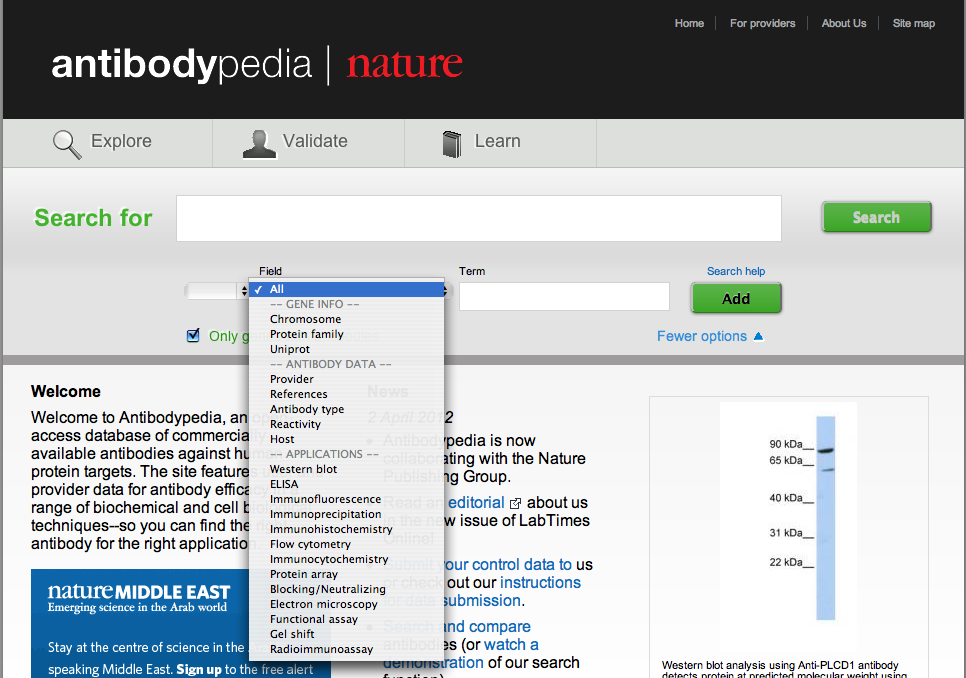
Because we want to provide researchers with the capacity to identify antibodies proven to work in specific techniques, Antibodypedia is structured slightly differently from many of the antibody search engines you might find out there: its organization is gene-centric, so each antibody directed against a single protein target can be retrieved by a search for that antigen. ‘Advanced search’ lets you find antibodies that are recommended or validated for one or more types of experiment, sold by a particular provider, and linked to reference citations, among other things. The ‘Advanced search’ menu is always undergoing development, so please let us know if it’s missing something you’d find useful.


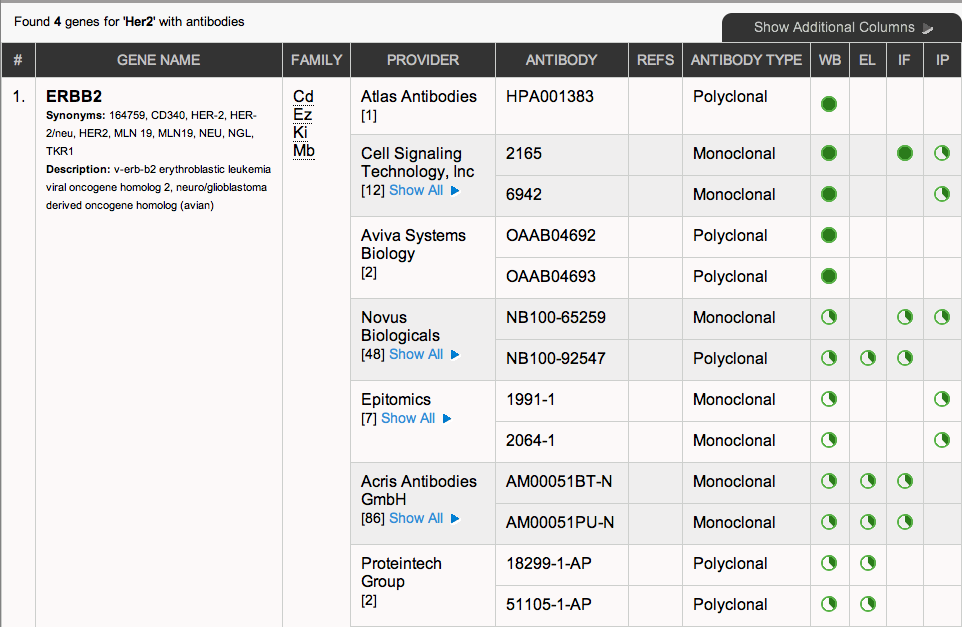
After you’ve defined and run your search, your results will be displayed as a table, with each row representing a single antibody.

Search Results

Search Results

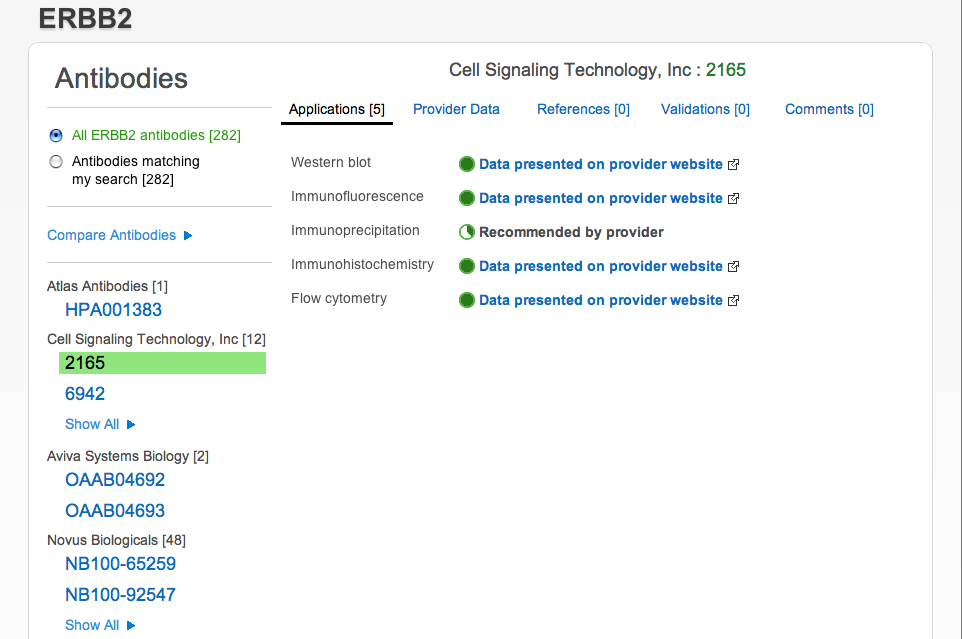
Clicking on a reagent will take you to antibody pages, which host or link to both user- and provider-sourced data as well as protocols and published references using those reagents.

Antibody Details

Antibody Details

You can also choose some of the antibodies retrieved by your search for side-by-side comparison to decide more easily which one(s) you’d like to test. Our antibody pages link directly out to vendor pages as well so you can find pricing and ordering information.

We think Antibodypedia will simplify selecting an antibody for a particular experiment by making quality control data both accessible to bench scientists and easy to interpret. But in order to maximize our utility, we need your help. Tell us which antibody providers you’d like to see listed in Antibodypedia so we can contact them and which techniques you use that aren’t currently searchable so we can start gathering data for them. And most importantly: submit to us so that we can populate antibody entries with your results! Remember that we’re not asking for publication-quality images, just something that can be interpreted as positive or negative proof that something’s working along with some notes on how you set up your experiment. Help us create an efficient means to search for good antibodies so you and your colleagues can plan your assays with less waste of time and money.

Blowing our own trumpet

As the sharp eyed among you might have noticed, Nature Protocols is running an ad campaign at the moment. If you haven’t here is one of our banners:

With this campaign we are offering anyone the opportunity of a month’s access to Nature Protocols. There are no catches other than that we want to know who you are, that we will send you an email after your month is up (which you can cheerfully ignore if you wish) to ask what you thought of the journal and prompting you to recommend us to your institution’s library, and that you will need to create an account for yourself on nature.com (which is also free). For that you can spend a month happily exploring the entire archive of Nature Protocols content.

Anyway, in the ads we are making a very specific claim: that nature Protocols is the most referenced source for protocols. A bold claim which I think I should justify here.

Normally when journals want to talk about their citations they turn to the Impact Factors calculated by ISI. That’s fine in the main, if you treat that number with some caution and only use it to compare very similar journals covering similar topics. Nature Protocols had an IF of 8.4 for 2010 (the most recent number) which we are very happy with although we hope that the number for 2011 (released in June 2012) will be a little higher.

However, laboratory protocols are useful long past the two year window from the year of publication that IFs consider. We could look at a 5-year impact factor (also 8.4 although higher if you believe in accuracy to more decimal places, which I don’t) which would be better, but the fact is that ISI don’t index or calculate IFs for the other publishers of research protocols: Current Protocols, Cold Spring Harbor Protocols, or Springer’s Methods In … series; and those are the people we would like to compare ourselves against.

So I had to do the calculating myself using the Scopus database of citations maintained by Elsevier. Using that I looked at all the papers published by Nature Protocols and our big three rivals from 2006, when Nature Protocols launched, to the present (well January this year when I did the number crunching anyway). I looked at every citation to any paper classified as ‘Article’ or ‘Review’. I also restricted the “Methods In …” series to research in the biological and biomedical subject areas. These are the data I got:


Published since 2006 Nature Protocols Current Protocols Cold Spring Harbor Methods in …
Total Number  1,474  1,859  1,090  1,0791
Total Cited  1,351  793  742  5,672
Total Citations  34,586  2,687  2,154  23,246
Average Citation Per Article  23.46  1.45  1.98  2.15
Average Citation per Cited Article  25.60  3.39  2.90  4.10
Highest citation  1,311  71  14  309
No in top 100 cited  91  1  0  8

As you can imagine that is very pleasing. Even if you mistrust simple means for a distribution that is far from Normal, Nature Protocols as a whole has been cited more than any of our competitors, and that despite publishing a much lesser number of Protocols than “Methods in…”. (I would say we are more selective but I feel I’m already crowing too much). And this isn’t due to one or two exceptionally highly cited protocols. It is true that one protocol* has been cited over 1300 times—1,533 times as of today—but of the 100 best cited protocols in this period from these sources 91 of them were published in Nature Protocols.

So there is the justification. Nature Protocols protocols are cited more often, and so presumably used more often, than any others.

* Da Wei Huang, Brad T Sherman & Richard A LempickiSystematic and integrative analysis of large gene lists using DAVID bioinformatics resources. Nature Protocols 4, 44-57 (2009) doi:10.1038/nprot.2008.211


Antibodypedia is up and running!

This is a guest post from Victoria Newman

Hello, I’m Victoria.

I’m the curator of Antibodypedia, an open-access database of antibody validation data and user commentary initially founded as part of the Human Antibody Initiative/Human Protein Atlas. In addition to running Nature Protocols, Chris is in charge of the collaboration that has started between Nature Publishing Group and Antibodypedia which is my excuse for posting on this blog. I was hired as curator last June and am psyched to say that we finally launched the new Antibodypedia site on December 4 at the ASCB’s annual meeting.

The problem facing anyone who uses antibodies in their research is that for any given target there are a lot of antibodies available so how can you tell which one will work for you. What is needed is somewhere researchers can go which has a comprehensive list of antibodies available with information about how they perform in the various applications for which antibodies are employed. That is exactly what Antibodypedia is attempting to create.

There are quite a few antibody comparison forums out there if you search the web, so what makes Antibodypedia special?

First, we’re gene-centric: search for any antigen (human now, but expanding into other model systems in 2012) and you’ll pull up a whole list of antibodies directed against that target. You can sort and refine the results in a number of ways: by the antibody’s host, the types of experiments in which it’ll work, or whether or not it’s been used in research publications, among other things.

Secondly, you can submit your own data to us (with experimental protocols, please). We are of course making available the data that the providers of antibodies have but I’m sure you will agree that the most valuable information is that from researchers doing the same kind of experiments as yourselves. We hope this will do a number of things: showing whether and how to use a particular antibody for a specific experiment; helping decide the working concentration or dilution that are appropriate for an assay; identifying whether the antibody works as described by the vendor or in more (or fewer) assays.

This is all valuable information and yet all too often the data about the performance of antibodies languishes in researchers notebooks. The control experiments that had to be done before the ‘real’ experiments, those that will see publication in a research paper, could be started. Rather than forcing scientists in different labs to pointlessly duplicate these experiments we would like to see them made available to everyone, and see the researchers getting some credit for their experimentation. We are looking at these data as a ‘micro-publication’ and will be giving them DOIs to make them easily citable.

We want to encourage best practice for different experimental categories, so we’ve put together submission guidelines  with suggested controls that will make your blank western blot immediately interpretable by everyone.

One more thing—you can also find additional resources, including links to useful sites and online tools, at Antibodypedia, and we’ve assembled a list of hundreds of Nature Protocols and Protocol Exchange protocols using antibody based techniques.

Stop by www.antibodypedia.com to browse, search or submit data. And tell us what you think either by commenting here or emailing contact@antibodypedia.com.

Episode IV – A New Hope

Let’s start with a welcome: Welcome to Stepwise.

I know that Nature Protocols has had a blog for quite a while now but over the last few months we have let things slide a bit, chiefly because we knew the change in our blogging platform would give us an opportunity to do more things. Also we had the chance to give it a proper name; “Nature Protocols Blog” being no-one’s favourite.

The no-one’s in question-in other words the authors of this blog-are: Chris Surridge (that’s me), Katharine Barnes, Dot Clyde, Hannah Clarke and Bronwen Dekker. Collectively the editors of Nature Protocols and the guardians of the Protocol Exchange. We tend to blog about different things and hopefully you will pick up on our various interests with time. The thing to bear in mind is that Katharine, Dot, Hannah and Bronwen know stuff, while I just pontificate.

Why Stepwise?

The very first blog post for the Nature Protocols blog was in May 2010, and asked the very important question: “What should we call our blog?”. While we all agreed that out blog should have an outstanding name, we were not able to get terribly much further than “Nature Protocols Blog” until Dot looked up from her computer in a commissioning meeting and said:  Stepwise! Well protocols are made up from procedural steps and we try very hard to be wise about them. I hope that isn’t too much of a cryptic crossword clue justification.

What we will do here is continue to share news, helpful hints on how to use our nature Protocols and Protocol Exchange, comments about our protocols, or give updates from conferences.
These are handily organised into the following categories:

We might blog about things that just catch our eyes as well.If you are new in these parts here are some example posts that highlight what we are all about:

We try to maintain an active twitter account for news about published protocols, and other things we happen to find interesting.
Follow us at: @NatureProtocolsIf you would like to contact us you can also email: protocols@nature.comOr just comment ion this blog. We’ll do our best to answer your questions. What do you want to know?