Synthetic reactions inside detergent micelles: Bruce Lipshutz at the #ACSSanFran

On Sunday afternoon, I went to a symposium in honour of Bruce Lipshutz, who won the Herbert C. Brown Award for Creative Research in Synthetic Methods. The line-up of dynamic chemists and one chemical engineer!) was impressive and his work stood out as being truly ground-breaking.

He started by asking the question: Why do we do synthesis “the way we do”, when Nature does her reaction in an aqueous medium, at around 37 C, and using only trace amounts of metals for catalysis?

Organic solvents are the main polluters from synthetic chemistry and the number of years until many metals are extracted to exhaustion is sobering. While chemists don’t use these reagents lightly – it is not like its possible to magically make a lipophilic compound water soluble! And metals like palladium enabled reactions that were previous impossible – there is a move now towards developing new synthetic methods that address these issues.

For example, the green chemistry challenge from the US Environment Protection Agency who had a stand in the Exhibitor’s hall.

green

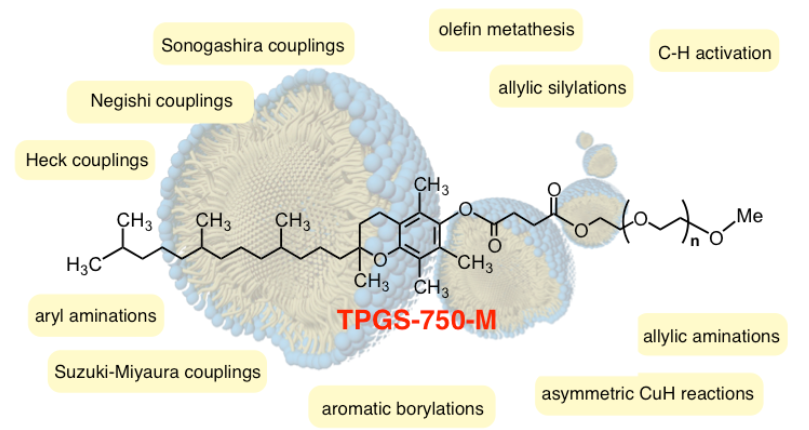
To address the solubility issue, Prof. Lipshutz’s team have developed a nanomicellar technology where organic reactions occur inside micelles formed from designer surfactants. Here water is not a solvent, but a medium – the reagents are not in solution, they are in a more dynamic state and are highly concentrated in the micelles. From the image below (taken from the Lipshutz Team website), the list of reactions that they have worked on is staggering.

nanomicelle small

They have been working on using iron nanoparticles doped with Pd, Ni or Cu to perform catalytic reactions such as Suzuki-Miyaura cross couplings, Sonagashira coupling, and reduction of nitro-containing aromatics.

What is notable, is that they are getting really good yields with lower catalyst loadings than those used in traditional organic synthesis; and that they are able to do may of the reactions – in some cases quite unexpectedly – under ambient conditions.

Top 100 papers of all time

I recently gave a talk in Singapore about publishing in Nature Protocols. When I give these talks, one of the things I explain is why Nature Publishing Group is interested in publishing methodological information. For that specific talk I had great new supporting document – an article in the previous weeks Nature about the “top 100 papers”. Of course, my top 100 papers is going to be very different from yours, but the top 100 for the purposes of this article was defined as the most cited papers of all time in the Science Citation Index, owned by Thomson Reuters.

cover_nature

When I saw the cover of Nature that week, and learnt of the news story, I knew what the most cited articles were going to be – methods papers. I knew about the high cites because when we first launched Nature Protocols we looked to see which methods papers were most cited, indicative, we believed, of people having reproduced the method and being in need of a protocol. We found such papers had amazingly high cites. An example of one of the highly cited papers serving as the inspiration for a protocol was the paper by Piotr Chomczynski and Nicoletta Sacchi on isolating RNA. We felt it was important that users of the assay understood how and why it worked, and published a protocol on the assay by the original inventors.

It will be fascinating to look in ten years’ time to see the methods being invented now that have taken off and revolutionised the way we do research. I very much hope our protocols will have helped facilitate their adoption in new labs around the world.

Top Exchange Protocols – By number of views

The three most viewed Exchange Protocols appear on the Protocol Exchange homepage; they don’t seem to change much, mostly because they are always highlighted!

This blogpost will list the top 13 Exchange Protocols (it is after all the 13th of July!) to give a better picture of which protocols people find most interesting, and to show our appreciation for some the researchers who upload excellent protocols to our site.

Of course, that they are the most downloaded does not necessarily mean that they are the ones that will be most useful to you. To find protocols relevant to your research, try using the browse function on our site.

The list below was obtained using Webtrends, and reflects the order of protocols in terms of the number of views over the last 91 days.


1.  A protocol for in vivo detection of reactive oxygen species

2. Neural Stem Cell Culture: Neurosphere generation, microscopical analysis and cryopreservation

3.  Production of neuron-preferential lentiviral vectors


4.  Western blot analysis of sub-cellular fractionated samples using the Odyssey Infrared Imaging System

Yukiko Misawa, Ying Li, David Rekosh & Marie-Louise Hammarskjold

5.  Fluorescence in situ hybridization (FISH) for DNA replication origins

Patrizia Gasparini & Omar Malazzi

6.  COBRA Toolbox 2.0

Daniel Hyduke et al. from Bernhard Palsson’s lab

7.  Trans-well migration assay

Ofer Mandelboim

8. Measuring fatty acid oxidation in tissue homogenates

Matthew D Hirschey & Eric Verdin

9.  Chromatin immunoprecipitation (ChIP) assay

Zhongfu Ni, Danny W.-K. Ng, Jianxin Liu & Z.Jeffrey Chen

10.  Combination of chemical cross-linking and pull-down assay to study transient protein-protein interactions

Feng Gong, Deirdre Fahy & Michael J. Smerdon

11.  Immunohistochemistry and in situ hybridization protocols

Joshua Hunsberger & Samuel Newton

12.  Simultaneous detection of murine antigen-specific intracellular cytokines and CD107a/CD107b by flow cytometry

Joyce J. Ruitenberg, Smita A. Ghanekar, Dirk G. Brockstedt  & Holden T. Maecker

13. A simple and rapid method for RNA isolation from plant tissues with high phenolic compounds and polysaccharides

Kam-Lock Chan, Chai-Ling Ho, Parameswari Namasivayam & Suhaimi Napis


All The Old Showstoppers

Now is the time of the month when I have to look at “the numbers” to see how things are going on Nature Protocols and Protocol Exchange. Since I was doing that anyway I thought I’d share some with you. The thing that most intrigues me is what brings people to the sites; what questions are they trying to answer? Well here are the top 20 search terms that resulted in people coming to Nature Protocols and Protocol Exchange in the last month (linked to the Protocols I imagine they found helpful).

Nature Protocols

  1. nature protocols
  2. nature protocol
  3. multiplex pcr
  4. “clonogenic assay “:https://www.nature.com/nprot/journal/v1/n5/abs/nprot.2006.339.html
  5. overlap extension pcr
  6. blue native page
  7. inverse pcr
  8. rolling circle amplification
  9. pyrosequencing
  10. pulsed field gel electrophoresis
  11. site directed mutagenesis
  12. scratch assay
  13. circular dichroism
  14. srb assay
  15. overlap pcr
  16. touchdown pcr
  17. trail making test
  18. cell culture
  19. chromatin immunoprecipitation
  20. qpcr

Not so informative really apart from showing that a lot of people need help with their PCR. I’m also surprised that there is so much interest in circular dichroism. But those looking for information are very persistent as the page I assume they are coming to (Using Circular Dichroism Spectra to Estimate Protein Secondary Structure) was on the third page of Google’s search results.

How about the Protocol Exchange:

  1. itraq
  2. transwell migration assay
  3. barnes maze
  4. kaiser test
  5. nature protocols
  6. neurosphere
  7. neurosphere assay
  8. slic cloning
  9. fluorescent in situ hybridization protocol
  10. dpph assay protocol
  11. immunofluorescence protocol
  12. chip assay
  13. nature protocol exchange
  14. transient transfection
  15. transwell assay
  16. in utero electroporation
  17. neurospheres
  18. protocol exchange
  19. purify protein complex
  20. fluorescence in situ hybridization protocol

That’s a much more diverse list of searches. But there certainly is a desire to know about iTRAQ (which stands for isobaric peptide Tags for Relative and Absolute Quantification if you were in any doubt), and the Protocol Quantitative analysis of protein expression using iTRAQ and mass spectrometry by Ry Y Tweedie-Cullen & Magdalena Livingstone-Zatchej will hopefully have satisfied them.

An Open Letter

Dear Researcher

I hope that earlier this year you received an email from me. However I know that spam filters are sometimes overzealous, email accounts become dormant and atrophy, passwords are forgotten, or a hundred other reasons why emails don’t get read by their intended recipient.

I am writing to you because you have previously uploaded a protocol to the Protocols Network part of the Nature Protocols website. I wanted to let you know of some major changes to the site which have greatly increased its usefulness. I hope that you will find exciting.

The most important change is the name, which has now been changed to Protocol Exchange which we feel better reflects what the site actually achieves. We hope that the site can now become the attractive place for scientists to share their experimental knowledge that we always intended it to be. The most significant features are:

  • The Protocols are laid out in a cleaner and more modular fashion more in line with the presentation of peer reviewed content in Nature research journals.
  • Protocols are linked to the research papers that relate to them
  • All the Protocols are now presented under a Creative Commons non-commercial licence which means that copyright remains with you as the authors but that anyone is free to read and use the protocols provided that they do not copy or reuse them for commercial purposes.

We have moved your Protocol into this new site and although we are fairly confident that no errors have been added during this transfer it would we very useful if you would look at your protocol and let us know if there any problems with it.

There is also a further feature which I want to tell you about. We have strengthened the concept of Lab Groups with respect to Protocols. In order to upload a Protocol to Protocol Exchange and author must be a member of a Lab Group. Anyone can set up a lab group and then either invite other people to join the group or adjust the settings of the group so other researchers can apply to join the group. Lab groups have a dedicated page on which are collected all the Protocols associated with that lab group. The owner of the group can also choose the upload a picture as a logo for the group and display the groups address and website address if they wish. There is also an RSS feed from each Lab Group page which will allow users to easily display the Protocol they have on the Protocol Exchange on their personal or departmental web pages. Finally all members of a lab group can read Protocols that are being drafted by members of the group

As you have a Protocol already uploaded to the Protocol Exchange we have also created a Lab Group for which you are the owner. You do not need to do anything with this lab group but we very much hope that you will log into Protocol Exchange and take control of your group. To do this please ‘log on’ at the Protocol Exchange site and, once you have done this, email me so that I can assign the Lab Group to you.

We hope that you will want to supply information about your lab including a photograph to act as the group logo and a URL to connect to your personal or departmental home pages. We also suggest that you invite the other members of your laboratory to join your Lab Group (which can be done by entering your colleagues’ email addresses). If you wish you can also change the preferences of the group to allow any users of the Protocol Exchange to request to join your group.

I really hope that you will come to Protocol Exchange and agree with us that this is an exceptionally effective way to share the experimental know-how of yourself and your colleagues. The resource is free to use both for authors and readers, and all Protocols receive a DOI allowing them to be cited in your research papers. All Protocols are also fully discoverable either by the Nature.com search engine or by a custom browse facility that covers the Protocols both in Protocol Exchange and in the peer reviewed journal Nature Protocols.

I hope that you will be as excited by Protocol Exchange as we are.

Thank you for your help in making Protocol Exchange a revolutionary resource to help speed scientific discovery.

Yours

Chris Surridge


Christopher Surridge, PhD

Chief Editor and Associate Publisher, Nature Protocols

The Macmillan Building, 4 Crinan Street,

London, N1 9XW, UK

c.surridge [at] nature.com

***************************************************

Come out from under that bushel

I, and many other people, have spent a lot of time over the last decade trying to figure out how to get scientists participate in online activity. Commenting on research papers would be nice for a start. Nature Protocols has had commenting on all its content from the start but the number of actual comments supplied is woefully low. Protocol Exchange also has commenting enabled and there this would act as a form of post publication peer-review as those Protocols are not reviewed before posting. Without this sort of activity whatever you find on the web needs to have a big ‘Caveat Emptor’ sign hanging over it.

I’m not going to thread my way through the various arguments about why researchers don’t comment online on research articles, or bemoan the fact that there can be tons of erudite discussion about a blog post about a piece of research, but not commenting on the research itself. I haven’t the strength (or caffeine levels) for that this morning. But there are two basic camps in all the discussions and brainstorms I’ve been involved with. First there is the cadre of glass-half-emptyites who look at past experiences and the arguments about why experts don’t comment and say that this is inevitable. We’ve tried and it hasn’t worked so there is no point expending more effort quixotically. The other group are the glass-half-fullers who think that if we could just understand exactly why the experts of the world don’t join in then we could provide systems and incentives to tempt them.

I’m definitely a glass-half-fuller and so is Daniel Mietchen. When he isn’t busy measuring brains at the University of Jena he’s involved in a whole lot of projects loosely under the umbrella of Open Science. At the moment one of these is a survey of people to understand why they do or don’t contribute to Wikipedia. Why is this great collaborative encyclopedia put together by interested amateurs while the experts whose contributions would be most valuable cheer (or sneer) from the sidelines? Is that characterization even correct?

This survey, Expert Barriers to Wikipedia, is being performed not by Daniel alone but by the Wikimedia Foundation Research Committee and I for one am going to be very interested in the results.

But before that please go and do what I did: take part.

Competition time!

I’m really pleased with the way that the Browse function that we have implemented for Protocols is working. I keep finding different ways to use it. As anyone who has been following our Twitter feed, and you really should be, will have seen we have used the browse to assemble lists of Protocols relating to quite specific subject areas. We have done: Stable isotope labelling for mass spectrometry, X-ray crystallography and Synthetic Chemistry.

There are plenty more possibilities for such lists and even more when we introduce user tagging of Protocols later in the year.

journal browse.jpgAnother facet of the browse is identifying Protocols based on the Journals in which related research papers have been published. We have called this the Associated Publications facet (a name which took much sweat and revision to settle on if you can believe it). You can access this feature, like all the other facets of the browse, through the left hand column but you can also create direct links. So if you want to see protocols associated with Nature papers you can see them all here. You will find 96 protocols there, which got me thinking about how the other Nature journals were doing. Here is the list.

Close behind Nature are:

Nature Medicine (48 protocols)

Nature Immunology (45 protocols)

And

Nature Methods (35 protocols)

In the 20s:

Nature Structural & Molecular Biology (https://bit.ly/i2mUfP)

Nature Neuroscience (https://bit.ly/gJfbrz)

Nature Genetics (20 protocols)

Then:

Nature Cell Biology (17 protocols)

Nature Biotechnology (12 protocols)

Nature Communications (5 protocols)

Nature Chemical Biology (1 protocol)

Nature Physics (1 protocol)

So that is where we stand.

But then I thought it might be good to use this as an incentive to my fellow editors to tell their authors about the awesome power of Nature Protocols and Protocol Exchange. So I’m going to give a bottle of champagne to whichever journal increases their number of associated Protocols by the most over the next 6 months (so that is numbers on the 15th August); probably as a percentage of the number of research papers they publish to make things a little fairer. So if you want to support your favourite Nature journal to the bubbly come to Protocol Exchange, set up a Lab Group and upload your Protocols.

Now you might legitimately complain that I’ve only mentioned Nature journals. Well this feature works equally well for non-Nature titles. The best of those at the moment is Nucleic Acids Research with 3 associated Protocols. There might well be champagne available to any other journals that substantially increases its number of associated Protocols. I’m not promising that as I can’t think what the appropriate rules of such a competition might be but we could always see how things go.

So let the games commence!

p.s. You are quite right, that Nature Physics hit was a bug which I’ve now rectified. But it made you check didn’t it! And it made Nature Physics editor Alison Wright start calculating her odds for winning the champagne. I reckon on about 10:1 but would love to be proved wrong.

Dangerous Curves

I’m a sucker for beauty in science even if the immediate application is a little unclear, and to my mathematically leaning brain the paper1 that has just come out in Nature Nanotechnology is a real beauty.

DNA isn’t just the parchment upon which our genetic information is scribbled but has become over the last decade or so the molecule of choice for those nonotechologists who are interested in creating self assembling molecular systems. It’s just great for it. The complementarity of one strand with another means that you can build double strands of DNA with sticky ends that will assemble themselves into all kinds of shapes. Cubes2, interlocking rings3, even tiles that can be used for computing answers to problems that are ‘difficult’ to do digitally4. There is a serious point behind thee studies but I have to say they are great fun too.

The new Nature Nanotechnology paper from Dongran Han, Suchetan Pal, Yan Liu & Hao Yan of Arizona State University has got DNA assembled into one of the favourite shapes of mathematicians, the Möbius strip. Möbius strips have the exotic property having only one edge and one side and you can make one right now by taking a long thin strip of paper, forming it into a loop but twisting one strand a half turn relative to the other before taping them together.

And that is what the Arizona team has done with a strip made out of 11 double strands of DNA looking for all the World like the data cables that used to be so common but are now being replaced by USBs. And they have the atomic force microscopy pictures to prove it.

Fig 2.jpg

Adapted from Fig. 2 of Han, Pal, Liu & Yan1

That though isn’t enough for these researchers. Because of the way that the DNA strands are constructed they are able to add to the Möbius DNA shorter pieces of DNA which disrupt the lateral interactions of the strand; the equivalent of taking scissors and cutting along the length of a paper strip.

Here things get weird as, just like the paper strip, slicing down the middle of the DNA ribbon result in a DNA loop twice as long as the original Möbius loop but with a double twist instead of the original single. Better yet, disrupting the ribbon a third in from the edge produces two loops, one Möbius and one not, separate but interlinked.

Fig 3.jpg

Adapted from Fig. 3 of Han, Pal, Liu & Yan1

It’s beautiful and delicate science for which I hope some practical application can soon be found so that the protocols of the Arizona group can be taken up more widely.

1 Han, D., Pal, S., Liu, Y. & Yan, H. Folding and cutting DNA into reconfigurable topological nanostructures. Nature Nanotechnology (2010) doi:10.1038/nnano.2010.193

2 Chen, J. & Seeman, N. C. The synthesis from DNA of a molecule with the connectivity of a cube. Nature 350, 631-633 (1991).

3 Mao, C., Sun, W. & Seeman, N. C. "Construction of Borromean rings from DNA. ":https://www.nature.com/nature/journal/v386/n6621/pdf/386137b0.pdf Nature 386, 137-138(1997).

4 Mao, C., LaBean, T. H., Reif, J. H. & Seeman, N.C. Logical computation using algorithmic self-assembly of DNA triple-crossover molecules. Nature 407, 493-496 (2000).

Experiments that Blow

I often come across methodologies that are just so cool that I need to tell someone about them. More than that I wanted to be doing the experiments themselves. One of these has just been published in PLoS ONE

Céline Frère and colleagues from the University of Queensland, Australia and Georgetown University, USA have worked out a way to collect and sequence the genomic and mitochondrial DNA from dolphins and, hopefully, other cetaceans1. They trained six bottlenose dolphins at the National Aquarium in Baltimore, Maryland to blow on demand into a sample tube.

But I’m not talking about exhaling through their mouths. Nope, they blew through their blow holes, the characteristic structure on the top of the heads of dolphins, whales and porpoises through which they so dramatically vent when at the water’s surface. The researchers looked for both nuclear and mitochondrial DNA in this cetacean snot and showed that the sequences produced were identical to the sequences obtained from blood samples from each individual dolphin. With this successful proof of principle under their belts the researchers are now trying to apply this to a population of wild dolphins in Shark Bay, Western Australia.

Being able to collect DNA samples in a non-invasive way is hugely preferable to the current standard procedure, dart biopsy.

“Dart biopsying is considered inappropriate for very young animals and the technique requires considerable skill to avoid injuring the animals,” says Janet Mann, one of the authors and a professor of biology and psychology at Georgetown. “Thus identifying alternative genetic collection techniques for cetaceans remains a priority, especially for internationally protected species.”

The technique isn’t yet perfect.

Both biopsy and blow-sampling require close proximity of the boat, but blow-sampling can be achieved when dolphins voluntarily bow-ride and involves no harmful contact. While we recognise the important role played by dart-biopsying, we provide evidence that blow-sampling is a viable alternative and less invasive mode of DNA collection.

Perhaps they should team up with Katarina Acevedo-Whitehouse and colleagues, who last year showed how to sample blow from free-swimming, wild whales using a remote controlled toy helicopter2.

Now there’s an experiment I’d love to try myself.


1 Frère, C.H., et al. Thar She Blows! A Novel Method for DNA Collection from Cetacean Blow. PLoS ONE 5, e12299 (2010). doi: 10.1371/journal.pone.0012299

2 Acevedo-Whitehouse, K., Rocha-Gosselin, A. & Gendron, D. A novel noninvasive tool for disease surveillance of free-ranging whales and its relevance to conservation programs. Anim. Cons. 13, 217-225 (2009). doi: 10.1111/j.1469-1795.2009.00326.x

Recipes for Research

A fairly senior scientists once gave me the advice that “you should never employ a lab technician who can’t cook”. A quantity of wine might have been consumed prior to this revelation but all the same I’m going to use it as an excuse to use lots of cooking analogies in this post. I hope it will help as I try to explain why protocols aren’t methods.

For the sake of this argument I’m going to classify research papers into three types. There are the vast array of Research articles which report the results of an experiment or experiments; there are Methods papers which present a new approach to collecting data and in which the reported results’ only importance is in showing that the approach actually works; and there are Protocols. Each contains a description of how experiments are performed but in very different levels of detail and for very different purposes.

Reading a research paper is like going to a restaurant. What you are really interested in is the results of someone else’s cookery: the food on your plate. You are interested to know how it has been produced to a degree – whether your meat is roasted or pan fried, are those potatoes dauphinoise or scallion mash, etc., – but you would have to already be an expert to use the information on the menu to recreate the meal. This is actually a real problem with research papers. Everything has to be taken on trust as the methods described are so scanty that there is no way that the results can be independently validated by replicating the experiments.

Taking things on trust is not science, but that is a rant for another day.

Reading a Methods papers is more like reading a glossy cookery book. I have loads of them on my bookshelves at home, many of them by celebrity chefs. They are great. They have lots of pictures of food and descriptions of where the chef discovered the recipes. Purple prose and travelogue into which I can sink for comfort while eating the beans on toast which was all I had the energy to cook for myself. One of the features of these cookbooks of mine is that they have no food stains on them. I don’t cook from them. When I have tried I’ve found that they have ingredients too exotic to be found in my kitchen or use pieces of equipment that I don’t posses. Like Methods papers they tell you about new and exotic approaches. Inspirational and aspirational, but if you try to emulate them you are going to need to work out a way to adapt them to the resources you have available in your lab/kitchen.

At the end of my shelf of cookery books there are three nondescript volumes whose covers are somewhat torn and whose pages are stained. These are the books I actually use when I want to cook something. Two are ancient volumes one of which has a twin printed in similarly garish colours, sitting in my mother’s kitchen, where it has been used constantly since the nineteen fifties, while the second has no pictures and I have no idea who the author is, if indeed their name is printed anywhere on it. The third, and most precious, isn’t a published text at all but is a scrap book assembled over the years from magazine clippings , give-away leaflets, supermarket promotions, and a host of jotted down recipes acquired from friends and family. These are the equivalents of Protocols. The recipes that are actually used every day in a researchers kitchen, sorry, laboratory.

At Nature Protocols we are trying to identify the experimental procedures that researchers will want to cut out and stick in their scrap books, metaphorically . We aren’t in the business of publishing the proofs of principle for shiny new experimental procedures. That is the remit of our colleagues on Nature Methods. No, at Nature Protocols we are looking for the techniques that experimentalist want to apply to their own investigations. These may be classic procedures tried and tested over many years, or approaches that were first reported a year or less ago. The most important thing is that they are procedures that will be used again and again.

We aim to supply the eager experimentalist with everything that he or she needs to perform identical experiments to those of our eminent authors. The Protocols are peer reviewed and edited to achieve a consistency of presentation which we hope make our protocols easy to apply in the lab. Also there is a substantial introduction to put the procedure in context, an anticipated results section to show how things are supposed to turn out and a troubleshooting table to help when things don’t go the way that one planned. Add to that a comprehensive list of reagents and equipment, and we think that our content is an invaluable resource for working scientists.

The commonest confusion is the difference between a method and a protocol. The simplest way to distinguish the two at least in my mind is this. If this is the first time that this procedure has seen the light of the scientific literature then you are not dealing with a Protocol, but with a Method. If you can point to one or more published papers in which the procedure under discussion has been used, then you are in the presence of a bona fide Protocol (and – which is more – you’ll be a Man my Son).