
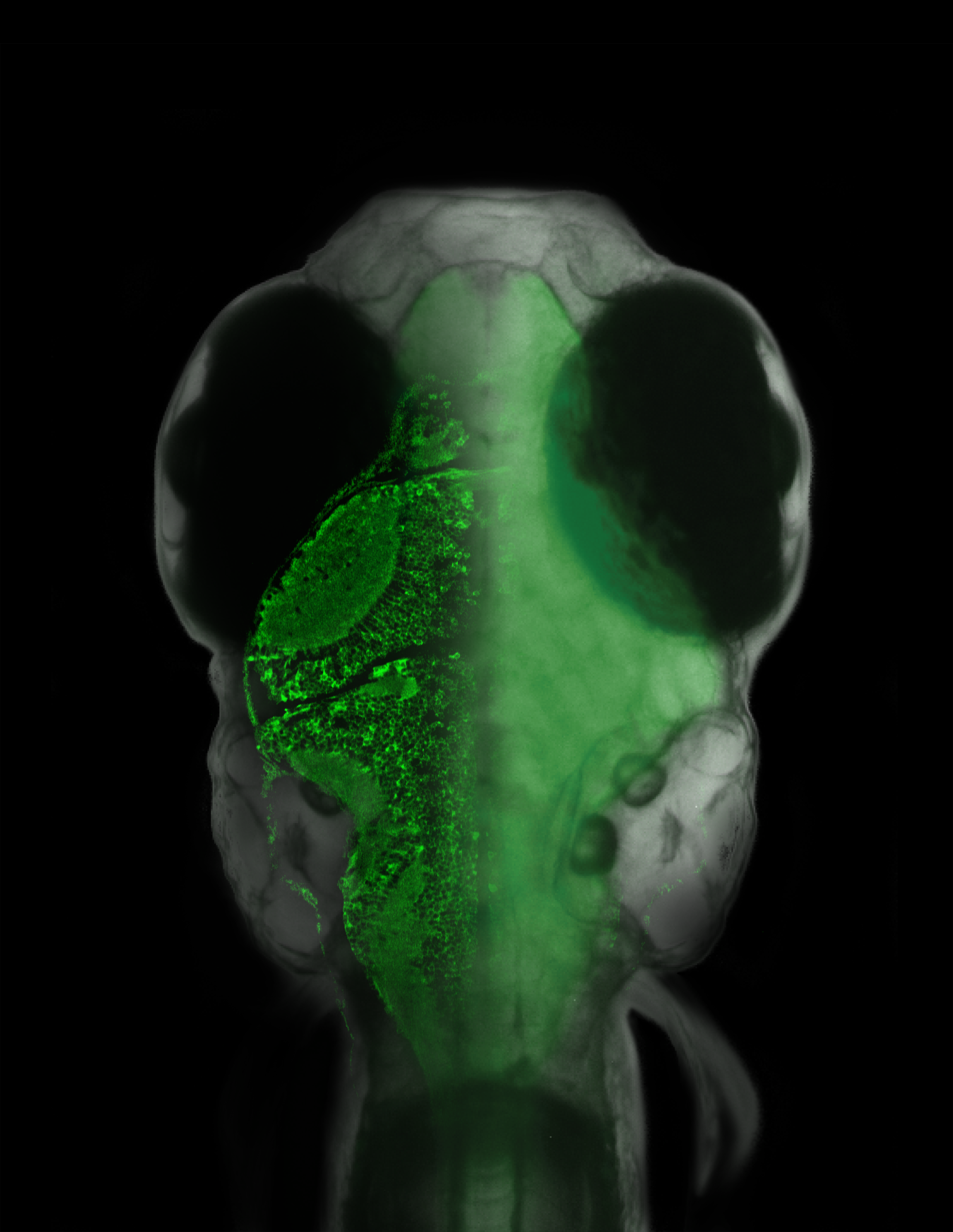
Overlaid on the micrograph of the fish is a slice of its brain measured with a laser scanning microscope, in which single neurons are visible.{credit}(courtesy of Ahrens et al.){/credit}
Sometimes an experiment will just reach off the page and slap you in the face, demanding attention. This happens to me every so often and I must admit, our latest paper from the lab of Florien Engert induced such an experience. There have been several cool, technical tours-de-force (is that proper grammar??) over the last few years involving different creatures navigating in a virtual environment while neuronal activity was monitored. These include a mouse running on a spherical treadmill, as well as a fly marching along a similar treadmill-style ball. But in these examples, having the subject head-fixed (for the stability of recordings in the brain, either with electrodes or through imaging) was moderately non-intrusive since walking motions were independent of the head. The same can’t be said for the subject in this latest example of a virtual reality navigator: a wriggling, swimming fish. Therefore, a more creative solution had to be sought and in a paper published online yesterday, Ahrens, Engert and colleagues decided that paralysis was the way to go in order to follow the neural activity of this navigating fish.
Zebrafish have long been used as a model system for a variety of experiments, but motor control long been at the forefront of topics. They offer many distinct advantages over mammalian-based systems, including the genetic tractability of Drosophila and the ease with which microscopy methods can be utilized; larval zebrafish are transparent, so no surgery is required in order to open up a “window” for fluorescence imaging. And more recently, several labs have begun to develop rich behavioral methods to further explore the limits of probing functional circuitry in these beasts. So what was interesting and cool about this latest fish-based technology? From the authors, here is the system set-up:
To examine neural dynamics across brain areas that drive sensorimotor recalibration, we developed a system to study neural activity at cellular resolution17, 18, using two-photon microscopy19, anywhere in the brain20 during closed-loop optomotor behaviour in larval zebrafish. These animals have a small and transparent brain that is readily accessible for optogenetic recording and stimulation21, 22, electrophysiology23 and single-cell ablation24. To remove motion artefacts25, 26, we developed a swim simulator for completely paralysed larvae (Fig. 1a). Motor commands, or ‘fictive swims’, are recorded at the motor neuron level8, 27, 28 (Fig. 1c, d) and translated, in real time, into visual feedback that resembles the optic flow of freely swimming fish (Methods). This constitutes a fictively driven virtual-reality setup. Simultaneously, a two-photon microscope scanning over a transgenic fish expressing GCaMP2 (ref. 29) in almost all neurons20, 30 allows activity to be monitored throughout the brain at single-neuron resolution. As the experimenter is in complete control of the visual feedback, this allowed us to study neural dynamics during visually guided motor adaptation throughout the brain at the cellular level.
Allow me to translate: “WE CREATED “THE MATRIX” FOR FISH.
Using this system, the authors were able to break down neural response properties during behavioral adaptation to perturbations in the virtual environment into four different categories, and the excellent spatial resolution of this technique allowed them to accurately map the anatomical substrate for each response. Some of these responses were observed while the fish was progressing through behavioral adjustments to the stimulus provided in the virtual world, strongly suggesting that focus on these elements could potentially yield functional insights into adaptive motor learning. Indeed, laser-based lesioning of one identified site, the inferior olive, did negatively affect visually-induced motor adaptation learning. Therefore, the authors had identified a powerful model for the study of brain-wide activity during adaptive locomotion.
The reviews for this paper were quite positive with regards to the innovative technology and each easily recognized the potential for this system, but the original version of the manuscript failed to provide a “proof-of-principle” for its utility; i.e., demonstrating novel insights into motor adaptation programs. Two referees even had concerns that there was a novelty issue when comparing this system to other virtual reality set-ups, including those mentioned earlier. At Nature, we aren’t shy about publishing manuscripts that are wholly-focused on technology and innovation, but in this particular case, although I was dazzled by the technique, we needed to go a little deeper into the biology in order to differentiate this system from the others and demonstrate its power. One could potentially make the argument that working in zebrafish is not as common as working in mammals or even insects, so if this paper was to be significant for a very broad audience, we had to throw some biology at the reader, in addition to the cool kit.
The authors graciously agreed to explore the circuitry further, adding new experiments to test the role and functionality of some of the neural response properties they observed. It took some time to get everything right, but in the end, both editors and (most) reviewers were satisfied that this paper had reached a point where it was not only showcasing the methodology, but also providing some novel biological insights. I say “most” because as is the case often times, not all reviewers were on board with the changes. In a rare occurrence, one reviewer was strongly supportive of publication in the initial round, with this existing more as a methods paper, but soured as the paper became more complex. The “biological insight” observations and extra modeling were not as graciously received, with this reviewer feeling these parts detracted from the rest of the paper. It’s not that this referee undervalues biological insight, rather the main concern was that the new insights require greater development and more sophisticated manipulation beyond lesion-based experiments to provide real value (one can imagine the power of working optogenetics into this set-up.) Fair enough, but in the end we felt the manuscript benefited from this brief, natural extension, to best-demonstrate the power of an exciting new system. Feel free to disagree with this editorial decision in the comments.
I’ll be brief: Super cool research!
Very informative post! Thank you for posting and sharing. I shall keep on returning to check more of this.
https://www.immobilie-seite.de