
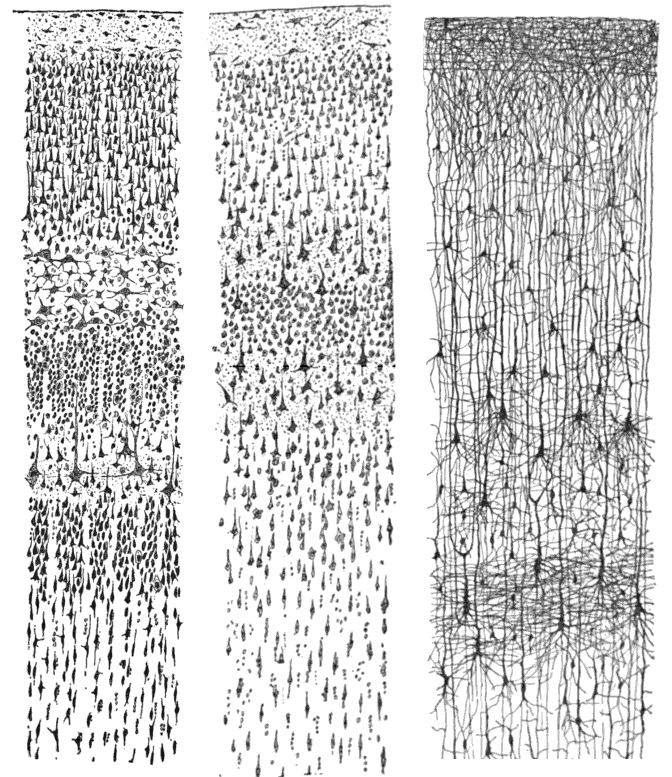
Layers of human cortex drawn by Ramon y Cajal. Image from Wikimedia Commons
We’ve known for over a century that sensory cortex is arranged in distinct layers, each containing a different make up of neuronal types and projection patterns, but we don’t actually know that much about the actual computations performed in each layer. Today a paper from Massimo Scanziani’s lab takes a big step towards cracking the function of the bottom layer (layer 6) in mice. Layer 6 neurons project both to upper cortical layers and to the lateral geniculate nucleus in the thalamus, which itself is the primary input to cortex, and so are primed to play a large modulatory role. Using a monumental combination of optogenetics, intracellular recording, and behavioral testing, the paper convincingly makes the case that layer 6 controls the gain of visual responses of upper layer neurons (i.e. changes the size of their responses without altering their selectivity). Gain control is a fundamental computation in cortex, and has been invoked as a mechanism for attention, perception, spatial processing, and more. The cellular mechanism here is worked out in primary visual cortex, but it could potentially operate throughout layered cortex.
This study joins a wave of technically amazing rodent studies that are transforming systems neuroscience. Just 10, perhaps even only 5 years ago, cell-specific manipulation, intracellular recording during behavior, large scale imaging at single cell resolution in awake animals were technological pipe dreams, but now they are steadily being adopted by more and more labs. And they are creating an inexorable shift towards rodent work even in that traditional bastion of primate research, the visual system.
Primate research has taken a lot of hits in recent years. Until recently single cell recording in monkeys was the predominant game in town for cracking the relationship between single neurons and perception, movement, and cognition. Now rats and mice can be trained to perform tasks once the purview of primate experiments, and new techniques available for rodents offer significant advantages for answering questions about the role of individual cell populations and circuitry. Add in hostile anti animal research environments that preferentially target primate researchers and you have a drop in the number of people willing to put in the big investment required for primate work.
But does this mean primate research is finished? Hell no, at least not in our pages. Without taking anything away from studies such as the one today, when it comes to questions about perception and cognition, a lot of basic facts still have to be established in rodents while primate research is ready to ask more mature questions. And one thing won’t ever change – primates are anatomically, genetically and behaviorally much more similar to us than rodents so when answers diverge across species guess who’s going to have the leg up for relevance. Has our bar gone up for technical and conceptual advance in primate papers? Yes, our criteria for what we’d publish 5 years ago are different today. But there is plenty of uniquely relevant perspective that primate research has to offer, as long as scientists are ready to step up to the challenge of really taking advantage of the system.
PS Starting tomorrow I’ll be at the Cosyne meeting & workshops in Salt Lake City. There’s going to be a session on perception and decision making in rodents, and also a presentation on optogenetics in monkey. Should be interesting.
Recent advances in techniques like optogenetics and imaging have made rodents an appealing model system for neuroscience. Although I doubt that rodent research will displace primate research, it does have the potential to augment it considerably. However, in order for rodent research to be successful in connecting behavior to its underlying mechanisms, the field must generate solid behavioral paradigms. In primates, the success of awake electrophysiology experiments in extrastriate, parietal, and frontal cortex relied on carefully developed psychophysical paradigms. Indeed, many paradigms were developed in tandem with human volunteers and monkeys to ensure that the behavior was similar in the two species and was robust to many different manipulations. If the tradition of collecting well-controlled behavior at psychophysical threshold can be extended to rodents, and I think it can, that field will be in a strong position to drive forward our understanding of perception, decision-making, and attention.