
US officials investigate E. coli outbreak

Public-health officials have yet to pinpoint the source of an outbreak of infections from a rare strain of Escherichia coli that resulted in the death a 21-month-old girl in New Orleans, Louisiana, and has infected thirteen others. Details of an ongoing investigation by federal and state health officials were released in a 10 June statement from the US Centers for Disease Control and Prevention (CDC) in Atlanta, Georgia. The organism behind the outbreak has been identified as part of the serogroup O145, which can produce a dangerous Shiga toxin.

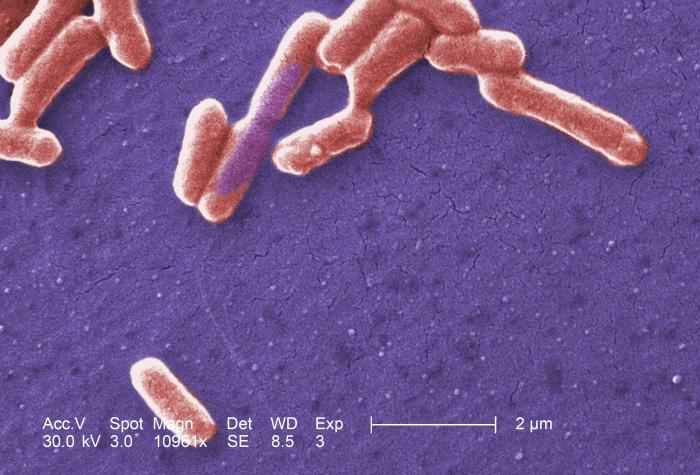
One serotype, called O157:H7 (pictured),  takes the blame for most Shiga-toxin-producing E. coli (STEC) cases. O145, which requires more testing to identify, is one of ‘the Big Six’ — a group of half a dozen serogroups responsible for most of the STEC infections that don’t come from O157:H7. O145 infections can be treated successfully if antibiotics are administered in time.

According to the CDC, the investigation is looking at both food and non-food exposures, and state public-health officials are interviewing patients about what they ate or might have been exposed to before getting ill. Interviews with ten patients have produced no clear pattern, and it’s possible that the source may never be known. Dates of illness onset range from 15 April to 12 May. At this point, it’s impossible to be sure if the outbreak is over or poses further threat.

Beginning 4 June, the US Department of Agriculture expanded its raw-beef-product testing protocol to include the Big Six. From December 2011 to March 2012, another Big Six strain, O26, contaminated raw clover sprouts at a popular sandwich chain and infected 29 people.

Photo: CDC

Dissolved iron may have been key to RNA-based life

Iron now locked in ancient rock formations may have once enabled an 'RNA world'.

More than three billion years ago, in the primordial soup that was the cradle of life on Earth, RNA took on many of the roles that its sister molecule DNA fills today — or so some scientists have speculated. A paper published 31 May in PLoS ONE posits one way that such an ‘RNA world’ could have worked: by making use of iron, a common element in the watery environs of ancient Earth.

In an RNA-dominated world, “RNA would have been the genetic material, and would have been the primary enzyme in metabolism,” says Loren Dean Williams, a chemist at the Georgia Institute of Technology in Atlanta and a co-author on the paper.

Today, RNA is best known as the messenger of genetic information, but large RNA molecules can fold into more complex structures, called ribozymes, with the ability to cut or glue other RNAs together. Magnesium ions (Mg2+) frequently stabilize charged phosphate ions in these globular RNA structures and allow it to fold and function as an enzyme — although not a very good one.

Williams, who studies ribosomes and ribozymes, became interested in how RNA might have operated in the very different chemical environment present in Earth’s early oceans.  With oxygen almost entirely absent at that time, he notes, iron (Fe2+) and other metals could have been far more abundant in seawater than they are today.  That all changed about 2.7 billion years ago, when primitive cyanobacteria started producing oxygen through photosynthesis, and iron gradually precipitated out of the ocean to form layer upon layer of a rusty, metallic rock known as ‘banded iron’ (pictured).

Continue reading

Comparative-effectiveness institute announces grant opportunities

The Patient-Centered Outcomes Research Institute (PCORI) — an organization established by the US government to enable research on the comparative effectiveness of clinical therapies — has announced its first batch of primary-research grant programmes at a meeting of its governing board in Denver, Colorado.

“Today marks a major milestone in our work as we build a portfolio of patient-centered research that will provide patients and those who care for them better information about health care decisions they face,” said Joe Selby, PCORI executive director, in a statement. “Our funding announcements reflect PCORI’s commitment to a patient-centered research agenda, emphasizing the inclusion of patients and caregivers at all stages of the research.”

In practical terms, the announcement means that PCORI, which was established in 2010 as part of US President Barack Obama’s sweeping health-care reform law, will distribute some US$96 million for research projects across four categories: decisions patients must make on prevention, diagnosis, and treatment options; improvement of health-care systems; communication and dissemination; and efforts to address health disparities. An additional $24-million grant programme that will focus on accelerating patient-centred and methodological research is slated for release this summer.

“We believe there’s a pent up demand for this kind of research, and we’re very excited to see what kind of response we get,” Selby told Nature.

The goal of comparing prevention and treatment options for patients (or groups of patients) is to help them to make more informed health-care decisions, resulting in better outcomes and greater efficiencies. “The question for the patient is often not whether the twelfth drug down the line is better than the placebo,” says Michael Steinman, director of comparative effectiveness research at the Clinical and Translational Science Institute at the University of California, San Francisco. Instead, says Steinman, it is about figuring out which treatment option is best and which is best for the patient. “Traditional research often doesn’t address those questions,” he adds.

The grants also come with the unique stipulation that patients be part of the project team, along with researchers and other stakeholders. This category could include family caregivers, parents, or health-care system administrators, depending on the scope. “We think that will help ensure that we’re getting the questions right and that we’re picking the right outcomes to study — the ones that patients care about,” says Selby. These outcomes could range from survival to quality of life and the ability to function or continue to work amid illness. As Selby puts it, the institute wants to look beyond the simple result of a blood test.

“Rather than specify very discrete questions, we created a framework around the kind of questions that we wanted answered to see what teams around the country will come up with in terms of projects that will have the best impact for patients,” says Harlan Krumholz, a member of PCORI board of governors and a cardiologist at the Yale University School of Medicine in New Haven, Connecticut.

“It’s a great idea. No one knows exactly how to do this yet,” says Steinman. “A lot of the work that PCORI will do is in figuring out how to do it — how best do you engage stakeholders in the research process, in addition to the narrow scientific questions.” Steinman notes that there will be hiccups along the way, but PCORI is “carving out its niche”.

Because PCORI is funded by the 2010 Patient Protection and Affordable Care Act, its fate is now hanging in the balance as the US Supreme Court ponders challenges to the larger law. The court is expected to issue its decision some time next month. But until then, both Krumholz and Selby say that all PCORI can do is press on. “It’s our responsibility to keep going until someone tells us otherwise,” says Krumholz.

Council questions award by Texas cancer institute

On the heels of Nobel laureate Al Gilman’s announcement that he plans to resign as the chief scientific officer of the US$3-billion Cancer Research Institute of Texas (CPRIT) and the leaking of his resignation letter, which raised concerns about the institute’s peer-review process, similar concerns and supporting details are now trickling out from the independent group of scientists who evaluate the Austin-based institute’s research grant applications.

In a letter dated 14 May, the organization’s scientific review council, chaired by Phillip Sharp of the Massachusetts Institute of Technology in Cambridge, criticizes actions taken by the CPRIT management and oversight committee — actions that they say are “inconsistent” with statements by CPRIT’s executive director William Gimson defending the integrity of the institute’s peer-review system.  The letter also reiterates the council’s faith in Gilman. In his 8 May resignation letter, Gilman had expressed concerns about CPRIT maintaining a “functional peer review system”.

Gilman told Nature in an e-mail that he believes that both letters address “the same basic issues”.

Among the most damning of the council’s concerns is their assertion that they were not consulted about a $20-million ‘incubator’ award  — the largest ever made by CPRIT — that went to Rice University and the University of Texas MD Anderson Cancer Center, both in Houston. Although the MD Anderson Cancer Center is slated to receive $18 million from the award, the council found their proposal too short (only 6.5 pages), too last-minute (it was approved three weeks after submission) and too skimpy on scientific detail.

“We will be viewed to have approved this award, and the failure to include us in the process calls into question our roles and the integrity of the review program in general. More importantly, this by-pass is inherently unfair to every scientist in Texas who participates in the CPRIT program,” the review council writes.

Incubator grants — to fund programmes and services aimed at commercializing new products for cancer diagnosis, treatment and prevention — are not defined by CPRIT as requiring scientific peer review. But the council argues that the activities laid out in MD Anderson’s proposal sound like research. Additionally, “no product candidates were mentioned,” said the letter, “nor is a company involved”. This marked the first time CPRIT has issued an award in this grant category.

“It is clear that the rules surrounding submission, evaluation, and funding of incubators must be clarified,” Gimson said in a statement. “It is my intent to address the concerns that have arisen about the commercialization review process by soliciting input from CPRIT’s stakeholders.”

The review council also criticizes CPRIT’s oversight committee for putting on hold seven multi-investigator research applications that the review council recommended for funding. The letter alleges that this was done because of opposition from certain committee members to a significant amount of the funding going to the University of Texas Southwestern Medical School in Dallas, where Gilman once served as dean. The review council writes that this amounts to an unfounded accusation of bias on the part of both the council and Gilman, which they “vigorously deny”.

Gimson said that the decision was related to timing and budget issues and confirmed that all seven projects are up for consideration at a meeting of the oversight committee scheduled for 26 July. In his resignation letter, Gilman suggests that he wants to remain in his role through the summer, in part to prevent ”negative decisions” about funding from being made at the same meeting.

US materials initiative gains momentum

A gathering of industrial and academic leaders has unveiled a flurry of new projects under the umbrella of the Materials Genome Initiative (MGI), a US government effort to boost progress in advanced materials research.

Of the 15 projects announced today, some provide funding for materials research, including US$17.3 million towards basic materials research from the Department of Defense and a new grant programme from the National Science Foundation (NSF) called Designing Materials to Revolutionize and Engineer Our Future. The NSF plans to announce awards later this summer. Other projects involve commitments by individual companies and universities to collaborate and share data and broader projects drawing on a number of national labs and agencies. They include:

  • a joint effort by Harvard University in Cambridge, Massachusetts, and the Champaign, Illinois-based software company Wolfram Research to simulate structures made from some 7 million organic molecules, with open public access to the results;
  • a consortium led by Bethesda, Maryland-based Lockheed Martin that will accelerate the development of carbon nanostructures;
  • the establishment of a Joint Materials Genome Institute sponsored by the Argonne, Lawrence Berkeley and Oak Ridge US national laboratories; and
  • a programme to predict the properties of nanomaterials under another multi-agency programme, the National Nanotechnology Initiative.

Cyrus Wadia, assistant director for clean energy and materials research and development at the US Office of Science and Technology Policy, which organized the workshop, says that the projects reflect an encouraging convergence of interests around the MGI. “Behind the scenes, there is a robust inter-agency process,” Wadia told Nature in an e-mail. “This work is creating a strong foundation for both current programs as well as future programs and commitments.”

A handful of other institutions have already shown support for the MGI. Earlier this year, the Department of Energy committed $12 million for materials research and $14.2 million towards improving fuel efficiency through methods such as “lightweighting” or developing new materials to make cars physically lighter.

The Obama administration has proposed a roughly $90-million budget for MGI-related activity in 2013, but Wadia stresses that this does not express the full leverage across existing science-agency budgets.

Entomologist takes charge of US agricultural research institute

The National Institute of Food and Agriculture (NIFA), a key component of the US  Department of Agriculture’s research effort, has a new director.  Sonny Ramaswamy (pictured at right), an entomologist by training and former dean of the school of agricultural science at Oregon State University and director of its Oregon Agricultural Experiment Station, was officially sworn in this week the USDA announced on 9 May.

NIFA funds research, education and extension programs across the country through the Land-Grant University System and partner organizations.  In a statement, Catherine Woteki, the USDA’s Chief Scientist and Under Secretary for Research, Education and Economics said of Ramaswamy: “He has proven his commitment to students, to the research community and to furthering scientific knowledge over his long career, and I’m confident he will carry that commitment with him every day at USDA.”

The institute has been without permanent leadership for nearly a year, since former director Roger Beachy left in May 2011 after less than two years in office. An advocate for genetically modified crops amid growing enthusiasm for organics, Beachy controversially reorganized the Agriculture and Food Research Initiative (AFRI), NIFA’s flagship competitive grants program, to include a wide variety of interdisciplinary projects from studies on obesity to large scale plant genomics.

Like other science agencies, NIFA may face budget cuts later this year. However, on 26 April the US Senate Appropriations Committee supported NIFA’s request for $1.239 billion for fiscal year 2013, a $36 million increase over 2012 numbers. NIFA’s budget is not expected to be finalized until later this year — probably after the dust has settled on a highly charged 2012 presidential election campaign.

US President Obama announced his intention to appoint Ramaswamy on 9 March. Ramaswamy replaces acting director Chavonda Jacobs-Young.

US releases new fracking rules on government lands

The US Department of the Interior’s Bureau of Land Management (BLM) has released a draft of new rules requiring oil- and gas-development companies to disclose the chemicals they use in hydraulic fracturing, or ‘fracking’.

“We’ve adopted a flexible approach to disclosure reporting, aimed at improving public awareness and oversight without introducing complicated new procedures or delays in developing oil and gas resources on public and tribal lands,” said BLM director Bob Abbey in a teleconference with the press on 4 May.

Since the original rules were revised in 1988, natural-gas development has seen a boom in production. But regulations have struggled to keep up with both production and growing concern about the potential environmental and public-health impact. Fracking entails drilling into the Earth to reach a layer called shale rock that’s rich in natural gas or oil, and then drilling horizontally through the shale. Companies then pump thousands of gallons of fluid — containing a mixture of ingredients — into the Earth at high pressure to break the shale rock and release natural gas into a pipeline. Under the BLM’s updated rules, companies must disclose the chemicals they use in fracking fluid, provide evidence that their underground well casings won’t leak chemicals into water-bearing geological sources, and present plans to dispose of waste water — a mix of fracking fluid and ground water containing radioactive elements — safely. The rules will affect only wells on federal and tribal lands.

The BLM also plans to make the chemical contents of fracking fluid available on a public website. Chemical ingredients used in fracking range from harmless coffee grounds to benzene, a carcinogen. Thus far, the list remains incomplete — although companies have voluntarily disclosed many on the website fracfocus.org, some remain proprietary “trade secrets.” Several states — including Wyoming, Texas, Pennsylvania, Colorado and Arkansas — have already adopted disclosure requirements. Nevertheless, disclosure remains a point of controversy.

Continue reading

California BSE prion comes with a different twist

Reports of ‘mad cow’ disease in the United States erupted in the news this week after the US Department of Agriculture (USDA) confirmed that the remains of a California dairy cow had tested positive for bovine spongiform encephalopathy (BSE).  This marks the fourth case of BSE identified in the US, and the first case in six years.

In spongiform encephalopathy diseases, abnormally folded prion proteins accumulate in the brain, causing other proteins to deform  as well. BSE has proved to be unusually adept at jumping between species; humans exposed to BSE can develop its human counterpart: Creutzfeldt-Jakob disease (CJD).

In a statement released on 24 April, Karen Ross, Secretary of the California Department of Food and Agriculture said, “The detection of BSE shows that the surveillance program in place in California and around the country is working.”  Food safety advocates such as Yonkers, New York, -based Consumers Union say it’s a warning sign that surveillance is inadequate and needs to be stepped up.

Ross’s statement also makes a point of noting a key feature of this particular case: The infected cow carried what is known as ‘L-type’ BSE, a version of the disease that has not been detected before in the US and has so far not been associated with transmission through animal feed. As the policy debate over testing rumbles on, here is a short guide to what is known and not known about this rare strain and its unexpected appearance.

How do they know that it’s ‘L’?

After brain tissue samples turned up inconclusive results in California, scientists at the USDA’s Veterinary Research Laboratories in Ames, Iowa ran two additional biochemical tests and got positive results for BSE. The second technique, western blotting, separates proteins based on their molecular weight to create a pattern on a gel. L-type prions have low weights, and another atypical strain, H-type prions have high weights compared to classic (C) strains. This sample produced a clear L-type pattern, said Mark Hall, head of the pathology, parasitology, and entomology section at Ames.

Continue reading

Chimpanzee bill receives first hearing

A US Senate bill that would phase out ongoing federally funded invasive research on chimpanzees and prohibit future projects received its first hearing on 24 April.

The Great Ape Protection and Cost Savings Act includes a three year phase out of invasive research on chimpanzees and other great apes funded on federal dime, guarantees retirement to sanctuary habitats for the roughly 500 chimps currently owned by the government, and prohibits breeding and transport for invasive research purposes. Non-invasive studies would remain fair game. Supporters hope it will put an end to chimp mistreatment in labs that fail to meet their social and psychological needs.

The proposed legislation would “allow us to focus on new alternative research methodologies, end a cycle of wasteful and unnecessary research, save money, and protect chimpanzees who have already given so much of their lives to research in the past,” said Martin Wasserman (pictured), a Maryland-based physician and former vaccine researcher at GlaxoSmithKline Pharmaceuticals, who testified in support of the bill. Because chimps cost between $67 and $35 per day to care for, Wasserman estimated that the legislation would save taxpayers $300 million over the next decade.

A parallel bill in the US House of Representatives was introduced last year and has been referred to subcommittee. The Senate and House bills now have 15 and 164 sponsors respectively. That ‘s already more than the 5 Senate and 165 House sponsors that earlier versions of the bills received during the previous Congressional term, in 2009-2010. In 2008, a lone House bill was only sponsored by 29 representatives. Although observers acknowledge that the bill has a steep hill to climb to become law, particularly during an election year when little in the way of passed legislation is expected from Congress, the growing numbers of sponsors suggest the bill is gaining momentum with each fresh attempt. Some of that momentum may stem from a December 2011 report by the Institute of Medicine (IOM), which concluded that chimpanzees were not essential to the majority of scientific research.

Continue reading

Hot spring yields hybrid genome

In the hostile environment of a bubbling volcanic hot spring, a team of researchers at Portland State University in Oregon has discovered a new viral genome that seems to be the product of recombination between a DNA virus and an RNA virus — a natural chimaera not seen before. Their findings appeared on 19 April in the journal Biology Direct.

“It’s a mythological beast of a virus, but it actually exists,” says virologist Ken Stedman, a co-author of the study.

In the bacterial communities that populate the acidic waters of Boiling Springs Lake in northern California’s Lassen Volcanic National Park, “viruses are the only predators”, Stedman says. To get a better handle on what types of viruses are present there, he and his colleagues performed a metagenomic analysis of hundreds of thousands of viral sequences from a lake sample. The results included something unexpected: a piece of DNA coding for a protein that until now has only been seen in the capsid or ‘head’ of RNA viruses. By comparing the sequence with those of other genetic fragments, they were able to arrive at a complete viral genome. In the genome, the RNA-like sequence sat adjacent to another sequence for a replication protein that is unique to DNA viruses.

The resultant single-stranded circular genome, dubbed BSL RDHV (short for Boiling Springs Lake RNA–DNA hybrid virus), seems to be the result of a recombination event between two completely unrelated virus groups. The RNA gene did not come from a virus that could produce reverse transcriptase, the enzyme required to change RNA into DNA, so it’s unclear how the RNA gene ended up in the DNA genome. “We have no idea how it happened, but we know it happened,” says Stedman.

Continue reading