Begin With the End in Mind

Last year I was asked to make a presentation on how I would approach strategy in my next start up. I’ve founded several life science start-ups in various countries over the years, and I also consult to companies needing assistance with their business development and strategic partnering, but the request gave me pause because there would be many in the room with a lot more experience (and grey hair) than me.  I felt surely everything I have to say is common sense.  But the conference organizer reassured me and we both agreed that strategy is often handled badly in start-ups, proving that there is room for more common sense.

I’d recently completed ten years of research on corporate strategy, mainly in biotech start-ups, and knew that many companies don’t realise their early decisions shape the options that they have for plugging into the value chain further down the track.  In earlier posts I’ve talked about the typical value chain for drug development and the typical business models companies adopt. Corporate strategy is about how we interact with this value chain – ‘what’, ‘where’, ‘how’ we plug in to get a return for our shareholders.

So, if I was starting afresh, how would I approach strategy in my new start-up?  I’d begin with the end in mind.

Consider all options upfront

What, when and how are we going to plug into the value chain?  I’d consider all the options, implications and trade-offs upfront.  The decisions made about ‘what’ our end product will look like has far-reaching implications for when and how we can plug into the value chain.  The decisions we make about ‘when’ we want to take money off the table have implications for ‘how’ we can do it.   (You can read more here and here.)

Continue reading

Key strategic choices – ‘when’ to plug into the value chain

Companies must make many strategic decisions in developing a business model. My last post looked at key strategic choices about ‘what’ a company could develop, and it considered trade-offs and implications of decisions that greatly impact the risks, costs and rewards of drug development. This post looks at another important element of the business model – ‘when’ a company should plan to plug into the value chain and earn a return for its investors.

Typical mechanisms for plugging in include licensing, sale of the product, sale of the company, or sale of part of the company via an initial public offering (IPO), whereby investors receive a return. In theory, this can happen anywhere along the product development value chain, from idea/discovery to marketing a physical product to consumers – as long as a willing partner or buyer can be found. But actually, there are certain factors around a drug development opportunity that can enable or constrain the feasibility of investors receiving a return at various stages in the drug development process.

Take a look at Figure 1. The central column lists certain attributes (factors) of a drug development opportunity that, if enabling, will leave open a wide range of commercially viable options for when a company can plug into the value chain and take value off the table for investors. However, certain factors, if they are constraining, will point a firm to plug into the value chain at a specific point in the drug’s development path. Some constraining factors – such as high cost, high risk, and lack of internal skills or assets – will drive a company to plug in earlier on the development path.

Fig. 1

When_constraining_enabling3


A RIPCO (royalty income pharmaceutical company) business model would then be typical. But other constraining factors, such as weak intellectual property protection, a high degree of in-house knowledge not easily transferred to a partner, or the need for specialised manufacturing assets, may drive a company toward plugging in at the other end of the value chain (selling a physical product). A FIPCO (fully integrated pharmaceutical company) business model might then be appropriate. In an earlier post I provided a diagram showing the parts of the value chain covered by commonly employed business models in the drug development industry.

Access to capital has to be one of the most common constraints in the sector. Without a doubt, capital constraint will drive a company toward plugging in earlier. However, I purposely left finance out of Figure 1, as I did not want firms to perceive this constraint as large enough to keep them from thinking about what their ideal business model would be if they did have adequate access to capital.

Firms may have more options than they think they have. As you progress down the development path, building value and reducing uncertainty, financing opportunities may emerge that were not available to you before. I’m a big fan of keeping options open, but in order to do that, you need to recognise those options exist in the first place. Real Options Reasoning (ROR) is an approach to strategy that involves identifying and nurturing options, and it fits very well with the biotech sector since the development of a drug occurs in a series of reasonably discreet steps that favour option-like investments. I might talk about ROR in a future post, but over the next couple of months we’ve still got ‘how’, ‘where’, ‘who and ’for whom’ to discuss…. a biotech start-up has a lot of strategic decisions to face!

Janette Dixon

Key strategic choices – ‘what’ to develop

As I discussed in my last post, the key strategic issues facing biotech start-ups are capital constraint, regulatory burden and the need for complementary assets and credibility. Together, with project specific factors such as market opportunity and competition, they shape decisions about what, when, and how a firm plugs into the value chain. These decisions are captured in the firm’s business model. Over my next few posts I am going to explore the implications and trade-offs that surround each of these strategic decisions, beginning with what.

What describes the final product offering that a company expects to be marketed. In the pharmaceutical sector this vision for the product is described in the “target product profile,” which includes the desired therapeutic indications, dosage form, strength and route of administration. When embarking on a new product development project there may be many decisions that have to be made about exactly what form the innovation is going to take when it comes to market. For example, in the case of a product for relieving pain, what will need to differentiate between acute pain and chronic pain, the type of underlying disease to be targeted (e.g. cancer pain or lower back pain), the degree of pain (mild, moderate, severe) and the presentation of the product (e.g. tablet, transdermal patch or injection).

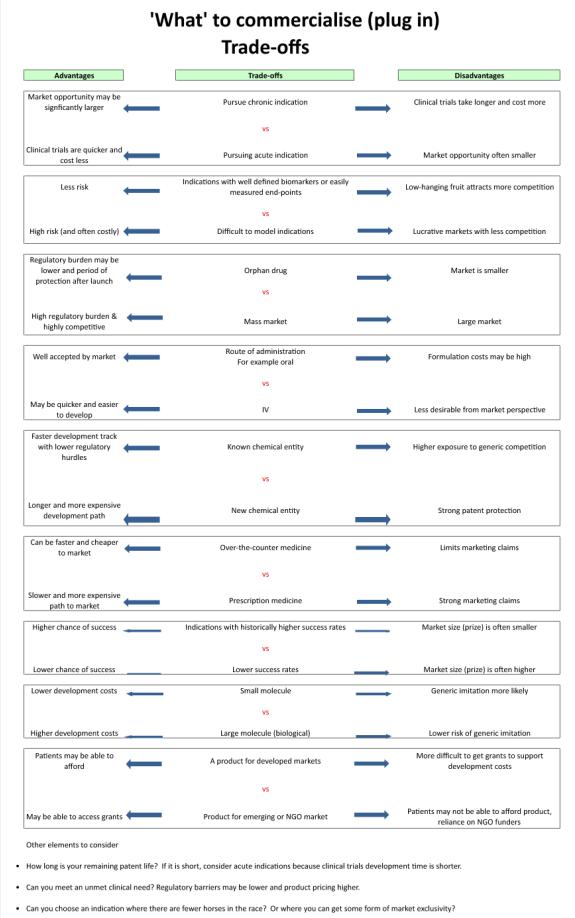
It is difficult to provide pre-emptive advice about what to bring to market, due to the vast range of unique development projects. However, in evaluating alternatives, there are often trade-offs to consider. The following table outlines typical trade-offs that drug development companies may have to face.

trade 2-thumb-650x1037-3650

Some of the factors to consider when deciding amongst this long list of trade-offs are the size of the market, the level of competition, regulatory barriers, pricing and reimbursement, and remaining patent life.

Time is an important driver of what choices from several perspectives. Firstly, what is the length of the firm’s intellectual property protection? (Patent protection usually expires 20 years after an initial patent filing.) The typical development time for a new drug is around 12 years, so it’s not hard to see that the shorter the remaining patent protection, the stronger the bias toward drugs that can be brought to market quickly. Factors such as the length of clinical trials for different indications or the availability of regulatory exclusivity become critical. Another consideration is how quickly you can get to market with a niche indication, allowing you to generate revenues for basic survival and for funding more potentially lucrative indications.

The choice of therapeutic area also brings different chances of success and is also typically associated with certain levels of costs and duration of clinical development. Figure 1 shows that anti-infective drugs are significantly more likely to pass phase I, II and III trials than cardiovascular, anti-cancer or nervous system drugs. However once drugs from these categories have been submitted for approval, they all have about 75-80% chance of making it to market.

Figure 1 Cumulative success rates to market by therapeutic area

Source: CMR International Institute for Regulatory ScienceCumulative Success Rates.jpg

Figure 2 shows that drugs for infectious diseases tend to be cheaper and faster to develop while central nervous system (CNS) drug development projects tend to be expensive and lengthy in duration.

Figure 2 Mean clinical study time vs cost for selected therapeutic groups

Source: DataEdge, Tufts Center for the Study of Drug Development

Mean Clinical Study Time.jpg

Clearly, a firm may have many options over what to develop and decisions made early in the life of the company will have major implications down the track.

But wait, there’s more ….. strategic decisions about ‘when’ and ‘how’ a firm will interact with its value chain are also key components of the business model. Coming up in my next post!

Janette Dixon

Strategic Issues Facing Biotech Start-ups

My last post talked about broad classes of technological innovation – novel research methods and tools, novel mechanisms of action or targets, novel compound types and novel treatment modalities – and the common business models associated with them. The type of technology a company has influences the choice of business model, since the technology bears on the need for specialised assets, such as manufacturing and distribution that may or may not be readily available, and on the ease of transferring knowledge about the technology to collaborators, licensees or acquirers. Some technologies are readily written down in standard operating procedures or lab reports, whilst others may be more art than science and their implementation may require extensive personal expertise. However, technology type is not the only factor driving a firm’s choices.

The hard reality is that drug development is an expensive process and access to capital is a massive constraint. The high costs are largely driven by the high quality standards inherent in clinical trials and manufacturing in order to pass stringent regulatory hurdles that stand between our innovations and commercialising a product. And for the most part, we need access to assets that are outside of our companies – such as clinical and regulatory capabilities, manufacturing, sales and marketing infrastructure and the like. Financial constraint often impairs our ability to build these assets internally, some of which may be needed to deal with regulatory burden.

The environment is tough. How do biotechs choose the best strategy? Which business models work best? There are no easy answers or good data to help make these decisions. The knowledge and data are simply not available because the biotechnology sector is too early in its life cycle to provide stable patterns of performance. Even the early successful biotechs have significant differences in strategies – Amgen commercialised a few blockbuster drugs, Genentech focused on smaller markets (e.g. specific cancer therapeutics) and Genzyme focused on very rare diseases.

However, I have made several observations (during my doctoral research) about strategies for biotech start-ups. Firstly, companies often endeavour to progress as far along the value chain as possible – capital and capabilities permitting. Certainly this is the trend that has emerged in the wake of the platform company era. There is a strong tendency for start-ups to plug in to the value chain at the point where they either run out of capital or they require complementary assets (such as sales and distribution) that they cannot easily access.

That is to say, biotech start-ups often enter into a partnering transaction when they can no longer raise enough capital to continue along the value chain independently or when they reach some kind of obstacle that they do not have the skills or resources internally to overcome.

Secondly, it is not uncommon for companies to pursue therapeutic indications where there are lower regulatory barriers, such as orphan diseases or acute uses for a drug rather than chronic, thus lowering cost and risk. Many companies focus on reformulations of existing drugs to minimise cost and risk.

Thirdly, in the absence of sufficient capital to bring their innovations to market, biotech companies pursue a number of supporting strategies:

  • Leveraging strategies
  • Survival strategies
  • Alliances
  • Strategies for building credibility

Leveraging strategies

All companies that I studied faced significant cash constraints. This caused companies to add value to, or to de-risk, more than one asset, and also to use assets in more than one way. For example, preclinical and phase 1 safety data may be applicable to more than one product based on a single molecule or technology. Similarly, proof-of-concept in a first indication may strongly suggest that proof of concept will be likely in other indications. Companies typically have a pipeline of projects that they intend to develop, and leveraging strategies are used to ensure that money spent enhances the value of several projects. (See also Taylor and Ramsey’s post for more ideas on leveraging strategies.)

Survival strategies

Survival strategies are often tangential. Examples include the provision of contract research or contract manufacturing services to third parties in order to generate surplus cash flow. Survival strategies are aimed at ensuring that the company lives until it earns a return on its core business. Sacrificing the first-born project through an early stage deal provides cash flow that will improve the firm’s chances of survival. Sometimes survival strategies are incorporated up-front as part of a business plan, whilst other times they are developed in response to financial pressure.

Alliances

Alliances are key for pursuing development and commercialisation in the face of capital constraint. Alliances can provide cash-strapped start-ups with access to complementary assets that they cannot afford to develop in house. Furthermore, alliances often provide the third-party validation and credibility, which may support further raising of capital.

Strategies for building credibility

Credibility for biotech start-ups may come from several sources – the reputation of the team, the science, or key investors and alliance partners. Biotechs can pursue credibility by ensuring that their scientists participate in conferences and by publishing in peer reviewed journals. Firms can also win credibility through cornerstone investors such as large pharmaceutical or biotech companies and respected venture capital firms.

The key strategic issues (capital constraint, regulatory burden and the need for complementary assets and credibility) faced by biotech firms are inter-related. Combine those with project-specific factors, such as market opportunity and competition, and the decisions about ‘what’, ‘when’, and ‘how’ to plug into the value chain are shaped. Over my next few posts I am going to explore the implications and trade-offs that surround each of these strategic decisions, beginning with ‘what.’

Janette Dixon

Business models and technological innovation

In an earlier post I discussed how biotech companies can earn a return on a technology either in the product market or the market for ideas. Although this appears to be a dyadic decision, it is more helpful to think of a continuum of choices, between plugging into the value chain early and full vertical integration, with many different ways in which a firm can interact with its value chain. The best strategy will depend on how well the market for ideas works. Important factors include the degree of information asymmetry between the seller and the buyer, the need for investments in specialized assets, how easily knowledge can be transferred between parties, and how strong the intellectual property protection is.

Looking at pharmaceutical development, there is a broad range of technologies and projects that span these factors, suggesting that different business models may be appropriate for various technological innovations. In Science Business, by Gary Pisano (published in 2006) the author provides a useful examination of four broad classes of technological innovation and the common business models associated with them:

• novel research methods and tools (such as high-throughput screening, combinatorial chemistry, bioinformatics)

• identification of novel mechanisms of action or targets (angiogenesis, RNAi)

• creation of novel compound types (rDNA, MAbs)

• identification of novel treatment modalities and therapeutic markets (gene therapy, xenotransplants, or drugs for rare genetic diseases).

There is broad variation within the technology categories described by Pisano, so we have to be cautious in generalization. The technology does not necessarily determine a firm’s business model, but rather influences it. Other factors, such as a firm’s ability to access capital, also influence the choice (and success) of a business model. Common business models across the four technology classes are discussed below, as is their popularity. This discussion draws heavily from Science Business.

Novel research methods and tools

Several business models are available to these companies, including simply licensing the use of the technique or tool to other drug companies that would then use them in their own discovery process. A second model would be to sell drug discovery services, while a third strategy would be to vertically integrate forward into drug R&D and develop proprietary molecules.

The market for ideas usually does not work efficiently in the first strategy, because the difficulty in fully sharing background information may make it difficult to convince potential licensees of the value of the technology or tool. Furthermore, the licensee would probably have to invest in specialized equipment (complementary assets), raising their risk. Difficulty may occur in transferring knowledge that is not easily codified, impeding the adoption of the new technology by licensees. If the intellectual property protection is not air-tight, the innovator could expose itself to imitation. Under the second business model all of these risks and issues are removed.

In the late 1990s this service model was followed by many platform technology companies. However, many of them, such as Millennium, Celera and Human Genome Services, abandoned this strategy to vertically integrate into the development of proprietary. Vertical integration (FIPCO/FIBCO) based on a platform technology is likely to be overkill and may even be suboptimal if the firm lacks downstream capabilities such as manufacturing, marketing and distribution. However, being a service or tool company offers a very different risk-reward profile than drug development. The problem that platform companies faced in the late 1990s was not their business models, but the environment created by the genomic bubble in which unrealistic valuations could not be sustained with a service or tool model.

Novel targets or mechanisms

Innovation here is concerned with the identification of new disease targets or mechanisms of action implicated in diseases. The market for ideas is not fully efficient is this situation. It is unlikely that intellectual property can be completely secured on a mechanism or class of targets. Often a lot of prior art exists and the intellectual property is based heavily on the kind of knowledge that cannot easily be transferred from one company to another, so it is unlikely that a firm in this innovation category can simply license its innovation. It is therefore more likely to pursue a drug discovery and development strategy. But how far down the drug development value chain should it integrate? This depends on the characteristics of the drug and the market. If it is a small-molecule drug candidate targeting a well established therapeutic market (hypertension, for example, or diabetes or depression) the rationale for full vertical integration is weak, assuming the innovator is able to secure IP protection on the molecule. A licensee would likely have the necessary complementary assets and capabilities required to take the drug candidate down the development pathway to market. Tacit knowledge (the knowledge that is difficult to write down and pass on) may be an issue in designing or interpreting clinical trials in some instances but can be overcome through close collaboration with the licensee. A long-term commitment would have to be made, and would probably be a more efficient solution than full vertical integration.

Novel compound types/novel treatment modality and novel markets

Biotechnology is bringing us new types of therapeutic molecules, such as rDNA, stems cells, monoclonal antibodies and new treatment modalities. Novel market opportunities are also being developed such as those for orphan disease for personalised medicine.

These types of innovations can be difficult to license due to lack of knowledge and capability on the part of would-be partners. Also, importantly, they typically require significant investments in downstream assets (development, manufacturing, distribution). Full vertical integration may be the logical strategy for these types of innovation. Collaborations have been seen with these opportunities, but the risks are high, disputes common and collaboration may be a second-best strategy. While vertical integration reduces the risks of operating in an inefficient market for ideas, it raises other risks. The level of capital required is huge, and may preclude R&D portfolio diversification. Younger firms pursing a FIPCO strategy may have everything resting on the success of a single (first) therapeutic candidate.

Pharmacogenomics is the branch of pharmacology behind ‘personalised medicine,’ in which drugs and combination therapies are optimised to an individual’s genetic makeup. Pharmacogenomics looks at the influence of genetic variation on drug response in patients by correlating gene expression or mutation with a drug’s efficacy or toxicity.

Whilst personalised medicine has been slow in making its mark on healthcare, it will probably be an important pillar in the future of drug therapy. The model for personalised medicine is evolving. It is likely to be more than one unique model, varying with the underlying technology, involving discovery companies, pharmaceutical company collaborators and clinical laboratories and may involve participation by healthcare providers.

It is clear from the preceding discussion that technology type has an important influence on business model by the bearing it has on the need for specialized assets and the difficulty in transferring underlying knowledge. Other factors influencing the choice of business model include how well the intellectual property can be protected and the firm’s ability to access capital.

In my next post I’ll talk about the strategic issues facing biotech start-ups and the kinds of strategies firms employ in response.

Janette Dixon

RIPCO, FIPCO, NRDO, FIPNET, VIPCO

Common_business_models_in_biotech_sector2

Click to enlarge

The above image summarizes some of the common business models in the biotech sector – showing which parts of the value chain the firms participate in and discussing very briefly the usual types of transaction mechanisms they use. Using the lingo of my previous posts (here, here and here), we are looking at the “when” and “how” of interacting with the value chain in these typical business models.

With limited financial resources, the vast majority of biotech firms start out life as RIPCOs – research intensive (or royalty income) pharmaceutical companies. They focus on the earlier stages in the value chain, such as discovery and preclinical development. The RIPCO model covers platform and tool-based companies seeking to commercialise drug targets, services and technologies that can be sold or licensed to other companies. At some point in the product development process, a RIPCO will plug into the value chain by contracting with one or more alliance partners who have the resources and/or capabilities to move the product development project further along the value chain. A RIPCO may not necessarily earn revenues the moment they plug into the value chain, as revenues may be contingent on achievements being made by the alliance partner as work progresses.

In the FIDDO (Fully Integrated Drug Discovery and Development Organization) model, platform companies extend their existing capabilities in order to take an innovation further along the product development process. The expectation is to enter an alliance or licensing agreement on more favourable terms than can be achievable under the RIPCO model.

We also have NRDO (No Research, Development Only) model, whereby a company in-licenses product from others that is already in preclinical or clinical testing. An example is The Medicines Company; that firm does not engage in drug discovery.

With the FIPCO/FIBCO (Fully Integrated Pharmaceutical/Biopharmaceutical Company) model, the strategy is to build and fully integrate most parts of the drug discovery and development chain. Given the large amount of capital required, few biotech firms attain this model, although many dream of it.

More recent concepts are the FIPNET (Fully Integrated Pharmaceutical Network) or VIPCO (Virtually Integrated Pharmaceutical Company Organisation) business model, whereby companies may outsource/contract extensively for services at any point(s) in the value chain, providing access to complementary assets outside the firm. This allows a company to maintain control of the product development process and defer the point at which they plug into the value chain.

Hybrid business models are sometimes used, particularly by platform or tool-based companies that enjoy stable revenues from licensing or sales, which allows for attracting investors or using their own income stream to develop products.

The ultimate goal for many biotech companies is still to pursue a traditional FIPCO structure controlling the value chain for their product offering. This may be a strategy driven by the promise of long-term return to investors and possibly naïve to the cumulative risks along the way. In any case, this seems to have become very difficult to do for biotech firms, due to the significant costs involved in bringing a product through the entire drug development and marketing chain. Therefore, the basic options seem to be to either find a niche in the value chain or control a relatively narrow slice of the market.

My next post will look at how and why the above business models tend to align with different classes of technology.

Janette Dixon

The market for ideas vs. the market for products

bulb2.jpg

Financial returns on an innovation may be earned through the “product market” or the “market for ideas.” The product market we are all familiar with – it describes the way in which we buy and sell physical products (medicines or diagnostic kits, for example) or services (laboratory tests or surgery).

The market for ideas, on the other hand, is a notional market in which innovations are sold or licensed before they are a final product (or service). In essence the innovation is still an idea, or intellectual property – it is a collection of intangibles. Choosing between these two options is a key element in commercialisation strategy. The innovator can try and take a product to market themselves (including manufacturing, marketing and distribution) or they can sell the idea to another firm – one with the appropriate infrastructure to launch the innovation.

In the first instance, the innovator will use or pioneer its own value chain, meaning the firm integrates internally or contracts for the value-added activities. (For more on value chains, read my last post.) In the second, the innovator will use an already-existent value chain. The majority of biotech firms commercialise their innovations in the market for ideas – after all, manufacturing, marketing and distribution all bring additional costs – but there are times when this may not be the best strategy.

How do we know which is best, and what are the drivers for this decision?

Intellectual property protection and access to complementary assets (regulatory knowledge, manufacturing ability, sales and distribution teams) both play a part. Strong intellectual property protection and a lack of in-house complementary assets usually means a company commercialises in the market for ideas – selling or licensing to a party with the skills and infrastructure to bring it to market. This is typical for small biotech firms.

However, when a firm does not have strong intellectual property protection, then it’s at risk of having a larger partner appropriate (steal) its ideas, or take a much greater share of the value than the smaller firm thinks is fair. In this case, that firm might be better off keeping its intellectual property protected as a trade secret, which means it takes the innovation to market itself. If resource constraints means self-commercialization is not possible, then a small firm will need to rely on the reputation of the larger company to not be taken advantage of. If this occurs, it’s best to use a trusted intermediary (such as a prominent venture capitalist or licensing lawyer) to act as a go between in negotiations that will not include full disclosure of the trade secrets until after deal completion.

A second situation is when there is no existing full value chain for a product, and the biotech start-up is forced to pioneer the development of new complementary assets. An example would be the xenotransplantation of alginate encapsulated neonatal porcine islet cells to produce insulin in the host. That’s what "Living Cell Technologies ":https://www.lctglobal.com/ (LCT), a New Zealand based biotech firm, is doing, and it has had to develop its own specialised manufacturing facilities. To bring the firm’s products to market it may eventually pioneer the development of specialised clinics that can handle the transplants in large numbers. LCT has no choice but to commercialise its technology in the product market.

Sometimes an evaluation of the risks and rewards of using an existing value chain vs. building one will show the latter to be more rewarding, though building one requires access to sufficient capital. Products targeted at high-paying and/or highly centralised or niche market opportunities may lead to the development of downstream infrastructure for manufacturing, sales and marketing and distribution, even though existing channels could be used (e.g. orphan drugs, products sold to specialists or hospitals).

Once a startup has made the decision to commercialise in the market for ideas, the next questions are “when” and “how” to plug into the value chain. Cooperation might occur via research partnerships, arms-length licensing agreements or cozy joint ventures among other alternatives. Further, a company might find help at many points along the value chain, from discovery to preclinical testing or clinical testing to marketing. Still, a bioentrepreneur might not know how to make these types of decisions, and I’ll explore that in future posts. First, though, we’ll look at typical business models in the biotech sector (that’s coming up next).

Janette Dixon

The basics: defining investment strategy, business model and value chain

chain2.jpg

My last post provided an introduction and something of a road map for my upcoming posts. The objective of this post is to make sure we all have a common understanding of the terms “investment strategy”, “business model” and “value chain”, and how these terms are related. This will help us in future discussions about how biotech firms typically approach investment strategy and in discussing how it could be done better.

A firm’s investment strategy outlines “what”, “when” and “how” it will interact with its value chain to create value for shareholders. These decisions are embodied in its business model.

What is a “value chain”?

Michael Porter introduced the concept of the value chain in his book Competitive Advantage (published in 1985 and now a pivotal reference in the academic literature on strategy), using the term to describe all the activities a firm performs and how those activities interact. He said a firm’s value chain is embedded in a larger stream of activities, called the value system. This figure shows a typical value chain for the development of a drug.

View image

Often, in the process of biotech drug development, firms will take up one or a number of the activities required to take a product from discovery to market.

Although Porter originally coined the phrase value system to describe this entire process, most people typically refer to it as the value chain. So I am going to use that term to cover activities carried out upstream, downstream and in parallel to the activities undertaken with a given firm.

The value chain is composed of a matrix of supply chain relationships along the drug discovery process. Only a small handful of biotech companies are engaged in the full value chain, from research and development through to marketing. The vast majority of biotech firms exploit a small or specialised niche.

The pharmaceutical value chain is characterized by two quite different focuses. The first is the business of scientific innovation – discovering a lead drug candidate then taking it through various stages of screening and preclinical testing, and eventually phase I and II human trials. A phase II trial is usually aimed at achieving a clinical proof of concept. The second focus is on commercialisation, which involves gathering information required by regulators and customers and communicating it to them. These activities occur during phase III clinical trials, the regulatory approval processes, marketing and selling, and any phase IV post-marketing studies.

Whilst the value chain outlines the major stages involved in getting a drug from concept to market, it does not indicate how multiple parties may interact with the value chain around any one (or multiple) stage. The vast majority of biotech firms either contract or collaborate for access to a wide variety of skills and complementary assets (such as manufacturing, sales and marketing infrastructure and distribution) that are vital to the development and commercialisation of their own innovation, or they provide know-how and services that other firms are reliant on.

The commercialisation strategy of a biotech involves the decisions it makes about “what”, “when” and “how” it will interact with its value chain. (Investment strategy also includes decisions around other parameters that can be particularly important in some biotech companies e.g. “where” to situate a company, “who” strategic partners are, “whom” strategic shareholders are, etc. But we’ll consider that at a later point.)

“What” describes the final product or service that the firm offers. For a pharmaceutical company this includes the formulation, presentation and therapeutic indications for a drug. “When” describes the point in the value chain that a firm decides to earn a return on its innovation. For example a firm may decide to sell or license a drug candidate soon after its discovery, or after preclinical testing or after phase I, II or III clinical trials. “How” refers to the revenue model through which value flows back to the company. Examples of revenue transaction mechanisms include direct physical product sales, licensing of technology for royalty payments, sale of technology and outright sale of the entire firm. All these strategic choices are summarised in a firm’s business model.

Arguably each firm should aim to insert

their product, service or intellectual property into the value chain at the point that will maximize value creation for its shareholders. Full integration is not an option for most biotech firms due to a limitation in financial and human resources. So a commercialisation strategy needs to evaluate the costs, rewards and risks of participating further down the value chain, or enabling the firm to control more of the product development, manufacturing and marketing activities. To do this it is helpful to have a good understanding of what factors drive a company to commercialise (earn a return) in the “market for ideas” vs. the “market for products”. That is coming up in my next post!

Janette Dixon

The Strategy of Biotech

blindelephant

How do small biotech firms “do” strategy, and how can they “do it better”?

In a nutshell this was essentially the topic of my doctoral thesis. I am a scientist-turned-bioentrepreneur and am passionately interested in the process of turning science projects into successful products and businesses. Why? Because I find the science of biotechnology fascinating, and I am excited about the promise it holds for improving the lives of individuals and populations if it can be turned from an idea into a product. And I also believe that those who take the risk and invest in these promises should be rewarded.

The biotech sector has struggled to provide attractive returns, with high rates of company failure and tens of billions of dollars of accumulated losses. The reasons for this are not clear. It may be that biotech science is not financially viable – high regulatory costs and long timelines of getting biotech products to market often overwhelm the financial returns. It may be that the timelines and risk appetite of investors are at odds with the needs of biotech firms. Or it could be that biotech firms need better business strategies to overcome these challenges.

The last suggestion is the perspective I take. When I embarked on my doctoral research, I wanted to find answers to how we can improve the process of taking an innovation, adding knowledge, reducing risk and turning it into a form that can earn a return for the owners of the innovation. Discussions about strategy in the academic literature

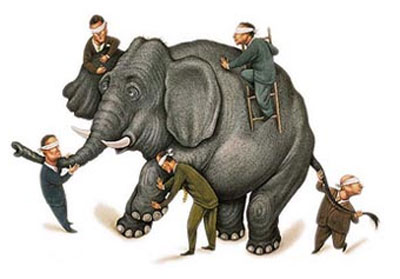
reminded me of the famous Indian legend and poem about the nine blind men and

the elephant.  Similarly many practitioners in the biotech sector seemed

to have a partial understanding of strategy based on their individual

experiences.

Earning a return on investment in biotech need not involve taking an innovation all the way through the development process to a physical product or delivered service. Often financial returns can be earned at earlier points in the value chain – for example a patent (an idea with intellectual property protection) may be licensed, or a drug that is still in clinical development may be licensed or sold, thereby earning a financial return for its owners.

Over a series of blog posts I am going to talk about how biotech firms “do” strategy – how the strategic issues that firms face shape their choice of business model, the strategic decisions and trade-offs that firms make and the implications of those choices.

Then over a further few posts I am going to suggest ways in which biotech firms can “do it better.” I’ll talk about organisational practices that support better investment strategy – the strategy that underpins getting a return to investors. I hope you’ll add your thoughts and comments as we go along, because the one thing that became obvious in my research was that no single biotech entrepreneur has all the answers. The answers are held across the community of entrepreneurs, and they have often been learned the hard way.

Upcoming posts will cover:

• The basics – defining investment strategy, business model and value chain

• The market for ideas vs product markets

• Common business models in the biotech sector (e.g. RIPCO, FIPCO, NRDO, FIPNET, VIPCO)

• How and why common business models are associated with certain types of technological innovation

• Strategic issues facing biotech start-ups and how biotech firms tend to do commercialisation strategy in this context

• Key strategic choices – what, when and how to commercialise

• What to commercialise – trade-offs and implications

• When to commercialise – trade-offs and implications

• How to commercialise – transaction mechanisms

• Organisational processes for improving investment strategy

• Amplifying value and reducing risk

Then we’ll see where we get to from there!

Janette Dixon