California stem-cell institute reacts to expert recommendations

California’s US$3-billion stem-cell agency plans to make a few changes in response to an assessment last month by the Institute of Medicine, an outside panel of scientific experts.

The governing board of the California Institute for Regenerative Medicine (CIRM) voted overwhelmingly to endorse a set of recommendations made by the chair of the board, Jonathan Thomas.

The Institute of Medicine (IOM)  report praised CIRM for supporting innovative science, but also cited problems with conflicts of interest and governance structure. In particular, it raised concerns that 13 members of its 29-member board come from research institutions that receive CIRM funds. Under the proposed changes, these board members would abstain from votes to approve grants, although they would still be able to participate in discussions about them.

Other changes concerned the role of patient advocates. The IOM had recommended that patient advocates on grant review committees should not be board members, as is currently the case. Instead, Thomas recommended that ‘programmatic review’, which considers non-scientific aspects of grants, be moved to the full board, and that patient advocates could participate in discussions but not vote on individual proposals.

The IOM also recommended eliminating certain instances in which unsuccessful grant applicants could appeal decisions. Thomas proposed that CIRM staff evaluate appeals to see if they merit further consideration.

Other IOM recommendations were only indirectly addressed by Thomas’s plan. The IOM report had stated that the board should restrict itself to an “oversight” role rather than an “operational” role. Thomas’s recommendations instead described ways to avoid overlapping duties. His own role as chair is to handle “external affairs” whereas CIRM’s president will be to handle scientific and internal affairs.

One long-term critic responded favourably to the proposals. Consumer Watchdog’s John Simpson wrote a blog post titled “Does the stem cell board finally get it?” which called Thomas’s recommendations “substantial”. Simpson also noted that CIRM will run out of money in four years and will need to maintain credibility if it hopes to go back to voters for more funds.

Further details of how the recommendations are to be implemented will be worked out in March. Blow-by-blow coverage of the meeting can be found at the California Stem Cell Report.

Update: CIRM has posted a press release summarizing the proposed changes, including a laudatory endorsement from the head of the IOM report.
Texas cancer institute gets no funds for new grants in proposed budget

The Texas legislature has left grant money for the state’s conflict-hobbled cancer institute out of the state’s preliminary budget plans.

A joint legislative committee recommended that the Cancer Prevention and Research Institute of Texas (CPRIT), based in Austin, should receive only US$5 million a year, down from nearly $300 million a year, according to the Houston Chronicle.

Early budgets often differ substantially from final budgets. Nonetheless, the cancer agency’s allotment is a clear sign of the lawmakers’ displeasure. CPRIT was voted into existence by a large majority of Texas voters in 2007, charged with funding research and education to stop cancer.

But 2012 was a bumpy year. The chief scientific officer, along with many of the agency’s high-profile grant reviewers, resigned in protest, saying that independent peer review had been disrespected. Chief among these concerns was an $18-million grant awarded to the University of Texas MD Anderson Cancer Center without scientific peer review. Subsequently, CPRIT announced that another $11-million grant had been awarded to a biotechnology company without peer review, and the district attorney began a criminal investigation, in part because of ties between a political campaign contributor and recipients of poorly reviewed grants.

Since then, both CPRIT’s chief commercial officer and executive director have resigned. A prominent cancer biologist, Margaret Kripke, left retirement to become the agency’s new chief scientific officer.

CPRIT’s new executive director, Wayne Roberts, told the Chronicle that CPRIT would work over the next few months to assure the legislature that CPRIT could allocate money appropriately.

California budget boosts funds for higher education

A balanced California budget announced Thursday is good news for the state’s institutes of higher education. The University of California (UC) and California State University (CSU) systems will each receive an additional US$250 million in the 2013–14 budget, partially restoring drastic cuts made during the fiscal crisis. The plan also includes an additional $2.7 billion for community colleges and primary and secondary schools, according to the Sacramento Bee.

When California Governor Jerry Brown was elected in 2010, he faced a $26-billion shortfall. The newly announced budget includes a modest surplus in addition to increased spending for education. Key to the boost is a $6-billion voter-approved tax increase tied to support for state-funded education. Democrats and Republicans expressed overall support for the proposed budget, which the legislature will need to approve before it goes into effect this July.

In 2009, cuts to the UC system exceeded $800 million, and CSU’s budget was nearly $600 million less than expected. The shortages prompted infighting between campuses (see ‘University cuts bite in California‘).

Budget cuts and tuition hikes at California schools have spurred waves of protest at meetings of the UC governing board. In one case, students dressed as zombies had to be escorted from public meetings. UC leaders had urged students to campaign instead for a ballot measure raising taxes and promised to stall tuition increases if the measure passed.

Sands keep shifting at Texas cancer agency: grants stalled, new execs

Days after declaring a voluntary moratorium on grants, the US$3-billion Cancer Prevention and Research Institute of Texas (CPRIT) has announced the appointment of two interim leaders with expertise in state finance. Wayne Roberts is a former associate vice-president for public policy at the University of Texas Health Science Center at Houston. Former Texas Deputy Comptroller Billy Hamilton will serve as an adviser. Earlier in December, the Austin-based CPRIT announced that it had hired a new chief scientific officer.

On Wednesday, CPRIT leadership agreed to a request from Texas governor Rick Perry, lieutenant governor David Dewhurst and House speaker Joe Straus. The politicians said that the confidence of Texas taxpayers should be restored before new funds are dispersed (now-funded grants should not be affected). Shenanigans at CPRIT have given the citizens of Texas much reason to doubt the state-financed funding agency (see ‘Banish cronyism’).

Meanwhile, CPRIT is under a criminal investigation because grantees that were funded despite low review scores had ties to a major campaign contributor backing the Texas governor and lieutenant governor.

In October, the chief scientific officer and many peer-reviewers resigned because of concerns about the integrity of peer review, in particular an $18-million grant awarded without scientific review.

In November, the chief commercial officer left amid revelations that an $11-million grant had been awarded without review. The executive director left in December, two days after a new chief scientific officer, Margaret Kripke, was hired. She will certainly have a lot on her plate for 2013.

Breast cancer behaviour: more than mutations

Many a cancer study seeks to tally dangerous mutations, but factors besides genes may yield insights that are just as important. Two laboratories at the annual meeting of the American Society for Cell Biology in San Francisco, California, this week presented work on cancer-relevant findings that are independent of particular mutations. One group has found that a few minutes’ compression reverts malignant cells to normal; another found that changes in breasts’ cellular composition may remove barriers for malignant growth.

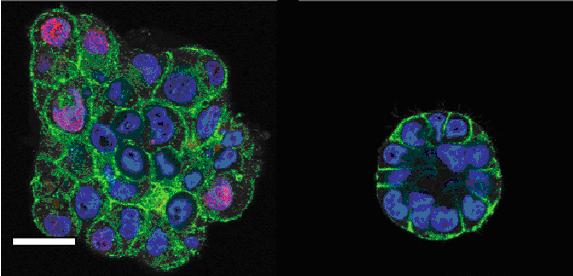
Malignant breast epithelial cells usually grow in disorganized masses (left), but if subjected to a few minutes of compression, they form normal-looking structures (right).{credit}ASCB; Fletcher lab, UC Berkeley{/credit}

Mark LaBarge, of the Lawrence Berkeley National Laboratory in California, and his colleagues examined how healthy breast tissue varied as women age, and found marked changes in its composition. They sorted out cells in tissue that had been removed for reasons besides cancer, such as breast reduction or augmentation. Tissue from younger women consisted of about 2–3% of duct-lining cells called luminal cells, and 70–90% myoepithelial cells, which help to squeeze milk into ducts during lactation. In older women, the two cell types occurred in nearly equal proportions. What’s more, cellular composition and other changes correlated almost perfectly with subjects’ ages.

Before these studies, most in-depth studies had looked at tissue from women in their teens and twenties, says LaBarge. “When we looked at our older people we were shocked. We were pretty startled to find out that the epithelium completely changes its character.”

Myoepithelial cells are believed to function as tumour suppressors, and numbers of luminal cells are thought to correlate with those of multipotent progenitors, which gives rise to several cell types. These cells are also thought to contribute to most breast cancers.

LaBarge believes that this makes for a situation where mutations that occur in younger women may not lead to cancer until they grow older. “Ageing takes away enough gatekeepers”, until the cells with dangerous mutations start to behave abnormally.

Figuring out exactly how this happens will be a collaborative effort. A culture technique for growing cells from healthy tissue seems to preserve cell characteristics and proportions remarkably well. This will allow LaBarge to share materials and conduct more experiments. “We can actually model the aged microenvironment one layer at a time.”

Not far from LaBarge’s laboratory, Gautham Venugopalan has been exploring how a short burst of pressure can prevent breast-cancer cells from forming tumours. His group suspends cells in a gel to which a brief compression pulse is applied. Afterwards, instead of growing into tumours, the cells form organized, star-shaped structures, typical of normal cells. The results are surprising, says Venugopalan, who received his PhD earlier this month from Daniel Fletcher’s laboratory at the University of California, Berkeley.

The pressure does not change the cells genetically. “If you sequenced them, you’d think that they would still be malignant,” he says. “By applying pressure, we are encouraging these cells to communicate with each other in a more normal way.”

The cell-surface molecule E-cadherin seems to be involved: blocking it causes malignant cells to go on to form unstructured tumours whether or not they had been subjected to a compressive force. Microvideos showed that, to form the non-tumorous organized structures, breast epithelial cells stick together and rotate around each other. “They do a little dance,” says Venugopalan. “Malignant cells don’t dance together,”

Now Venugopalan’s lab is trying to figure out how bursts of pressure act within a cell to encourage such graceful behaviour. The next steps in learning this dance could be the first steps towards a drug.

Connecting two culprits in Alzheimer’s disease

Plaques and tangles pockmark the brains of people with Alzheimer’s disease. The extracellular protein amyloid-β makes plaques, and the intracellular protein tau makes tangles, but how exactly these might kill neurons is unclear. Work presented at the annual meeting of the American Society for Cell Biology in San Francisco, California, this week starts to connect some of these dots.

George Bloom, of the University of Virginia in Charlottesville, and his colleagues began by following up on work that neurons exposed to amyloid-β die not from direct poisoning, but because amyloid-β prompts inappropriate cell behaviour. They re-enter the cell cycle but never divide, and die instead.

“The framework of the process has now been defined,” he says. “We think we’ve stumbled upon one of the seminal events in the transition of healthy neurons into Alzheimer neurons.”

The work identifies several potential very early biomarkers of Alzheimer’s disease and suggests new ideas to treat it. Continue reading

Is the scientific literature self-correcting?

A session on scientific reproducibility today quickly became a discussion about perverse incentives. Robust research takes more time and complicates otherwise compelling stories. This turns scientists who cut corners into rising stars and discourages the diligent. It also produces highly cited scientific publications that cannot be reproduced.

The problem of translating academic discovery into drug discovery was discussed in a panel called Sense and Reproducibility at the annual meeting of the American Society for Cell Biology in San Francisco, California.

Glenn Begley, former head of research at Amgen in Thousand Oaks, California, made headlines back in March when he revealed that scientists at his company had been unable to validate the conclusions of 47 out of 53 ‘landmark’ papers — papers exciting enough to inspire the possibilities of drug-discovery programmes. In one study, which has been cited over 1,900 times, not even the original researchers could reproduce the results in their own laboratory.

A big problem is confirmation bias, says Begley. Many quantitative results are built from a series of subjective assessments. “If you’re a postdoc counting the cells, you know you’ll find a difference,” he said. “People will find the answer that the reviewer wants to guarantee publication.” Continue reading

Complete Genomics CEO rebuts warnings of national security risks

In a letter to employees, sequencing company Complete Genomics chief executive Cliff Reid predicts that the acquisition of his company by Chinese sequencing giant BGI will win approval by national security regulators and be completed by the end of March in 2013.

Back in September, the companies announced a US$118-million agreement under which Complete Genomics, which has a proprietary technology for sequencing human genomes, would become a subsidiary of BGI, with staff and facilities to remain in Mountain View, California. In a spurned counter-offer, Illumina, based in San Diego, California, presented itself as a better suitor to Complete Genomics, predicting that a deal with BGI would be blocked by the part of the US Treasury Department that oversees foreign investment in the United States (see ‘Illumina, BGI spar over Complete Genomics‘).

Reid countered that Illumina’s proposal to acquire Complete Genomics was unlikely to get past antitrust regulators because Illumina dominates the sequencing market.

Continue reading

Scientific panel recommends changes to California’s stem cell institute

The California Institute of Regenerative Medicine (CIRM) today received a mixture of praise and hard-to-enact recommendations from an august scientific body.

Last summer, CIRM asked the Institute of Medicine (IOM) to gather a group of experts to assess the performance of the stem-cell institute, which has distributed more than US$1.3 billion to California researchers at dozens of institutions. CIRM paid $700,000 for the assessment.

The IOM study panel has now released 176 pages detailing its findings. They call for a reconstituted board with less oversight of day-to-day operations and fewer conflicts of interest, the creation of a scientific advisory board, funding for training programmes in ethics and stem cells and establishing policies friendlier to industry.

It’s unclear what effect the report will have. Many of these recommendations run counter to requirements enshrined in the legislation that created CIRM, and the board of CIRM has heard similar recommendations before and failed to act on them. “The IOM’s critical report echoes what every independent evaluator has said in the past,” said John M. Simpson, Consumer Watchdog’s stem-cell project director, in a statement. Continue reading

Expert tours his own exome, and finds mainly false alarms

When 23andMe offered a few select clients the opportunity to have the protein-encoding portion of their genome sequenced, Gabe Rudy jumped at the chance. On Wednesday, he walked strangers through the results. His conclusion: most detected genetic “variants of interest” are either not variants or not interesting. “Clinics beware,” he writes in a blog post detailing the analysis.

The standard service offered by 23andMe (based in Mountain View, California) does not sequence people’s DNA but instead probes for common variants, then lists these variants with an analysis of health, ancestry and other information, such as whether you carry a variant more often found in people who find that cilantro tastes soapy.

The exome sequence contained no such information, says Rudy; it was simply a list of ‘variant calls’ or differences that had been found between the sequenced individual and the reference genome.  There are several research software pipelines available to call variants. 23andMe used what is probably the most popular one, which is available from the Broad Institute in Cambridge, Massachusetts.

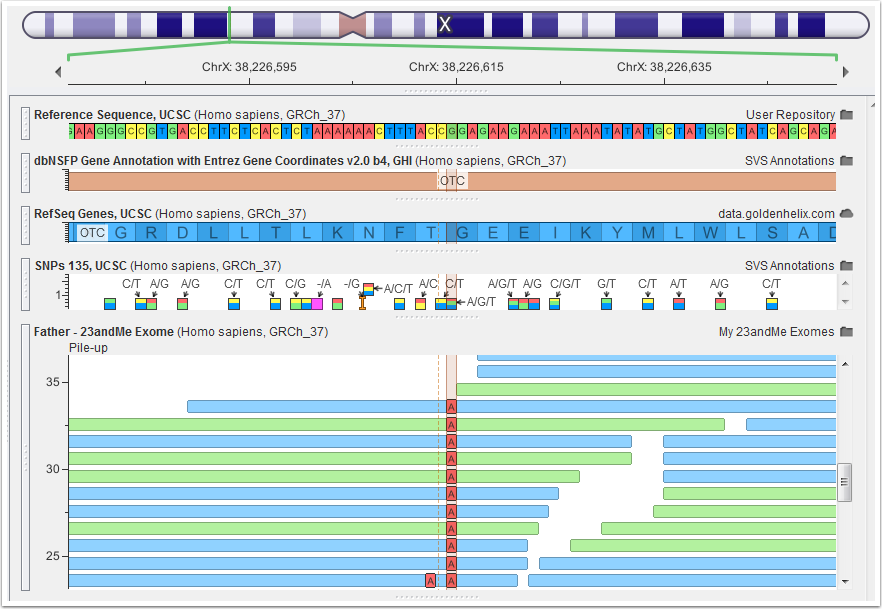
Analysis of pathogenic variant{credit}Gabe Rudy, Golden Helix{/credit}

An executive at DNA analysis company Golden Helix, Rudy was much better prepared than most to tackle this list.

He took the files he received for himself (as well as for his wife and son) and poured them into his own company’s software: the SNP and Variation Suite (SVS) and a freely available visualization and inspection tool called GenomeBrowse. Next, he began to assess the evidence behind his 151,000 variant calls and put them in their biological context.

Whereas whole-genome sequences cover all the DNA on all the chromosomes, exomes focus on the 2% or so of the genome that contains genes.  Exome sequencing aims to provide data for all protein-encoding genes, but only about three-quarters of genetic regions are profiled with enough accuracy for variants to be called confidently in a “research grade” (30×) exome. Even with “clinical grade” exomes, in which each DNA fragment is sampled 80 times or more, 5–15% of variants will still not be called variants. And those ‘low-coverage’ regions vary with each exome. As a result, Rudy had variants that had been called in his genome that he couldn’t compare with those in his wife and son.

Continue reading