Promising sequencing contender Oxford Nanopore and market leader Illumina sever financial ties

Two closely watched genetic sequencing technology firms who had been unhappily affiliated have now divorced. UK-based Oxford Nanopore announced on 15 November that it has raised £56.4 million — mostly by selling the 13.5% of its shares that had been owned by San Diego-based Illumina since 2009.

Illumina had purchased the shares for $18 million in pursuit of an alliance that would give it a foothold in nanopore sequencing technology, in which different genetic bases are identified by changes in electric conductance caused when they are fed through a nanoscale pore. The technology is seen as highly promising because it offers the potential for very rapid sequencing at low cost. But after Oxford announced in 2012 that it was commercializing a version of its technology that is slightly different from the one in which Illumina invested, the two companies severed commercial ties and Illumina licensed a competing nanopore technology.

Oxford also said that it will begin allowing scientists to register to test its MinION portable genetic sequencer on 25th November in a “substantial but initially controlled programme designed to give life science researchers access to nanopore sequencing technology at no risk and for a refundable deposit of $1,000.”

The impetus for Oxford’s divestiture of Illumina shares isn’t yet clear. As computational biologist Mick Watson of the University of Edinburgh writes on his blog, Illumina may have figured that it would never make much money from the investment, as Oxford is now staking out a competitive position. “The simple answer may be that Illumina had nowhere to go with this,” Watson writes. “Therefore this is probably the logical conclusion — sell the shares and compete, try and beat [Oxford Nanopore] at their own game.”

So far, financial analysts give Illumina the edge in this game: “We continue to believe that [Illumina] has the dominant platform for the foreseeable future,” wrote Goldman Sachs analyst Isaac Ro in a research note on 15 November.

Scientists who have tested MinION so far have agreed, though they been impressed with the technology. Geneticist Yaniv Erlich of the Cambridge, Mass. Whitehead Institute for Biomedical Research wrote earlier this month that “MinION (and presumably its GridION scale-up) is far from being a threat to Illumina.”

Follow Erika on Twitter @Erika_Check.

Expert tours his own exome, and finds mainly false alarms

When 23andMe offered a few select clients the opportunity to have the protein-encoding portion of their genome sequenced, Gabe Rudy jumped at the chance. On Wednesday, he walked strangers through the results. His conclusion: most detected genetic “variants of interest” are either not variants or not interesting. “Clinics beware,” he writes in a blog post detailing the analysis.

The standard service offered by 23andMe (based in Mountain View, California) does not sequence people’s DNA but instead probes for common variants, then lists these variants with an analysis of health, ancestry and other information, such as whether you carry a variant more often found in people who find that cilantro tastes soapy.

The exome sequence contained no such information, says Rudy; it was simply a list of ‘variant calls’ or differences that had been found between the sequenced individual and the reference genome.  There are several research software pipelines available to call variants. 23andMe used what is probably the most popular one, which is available from the Broad Institute in Cambridge, Massachusetts.

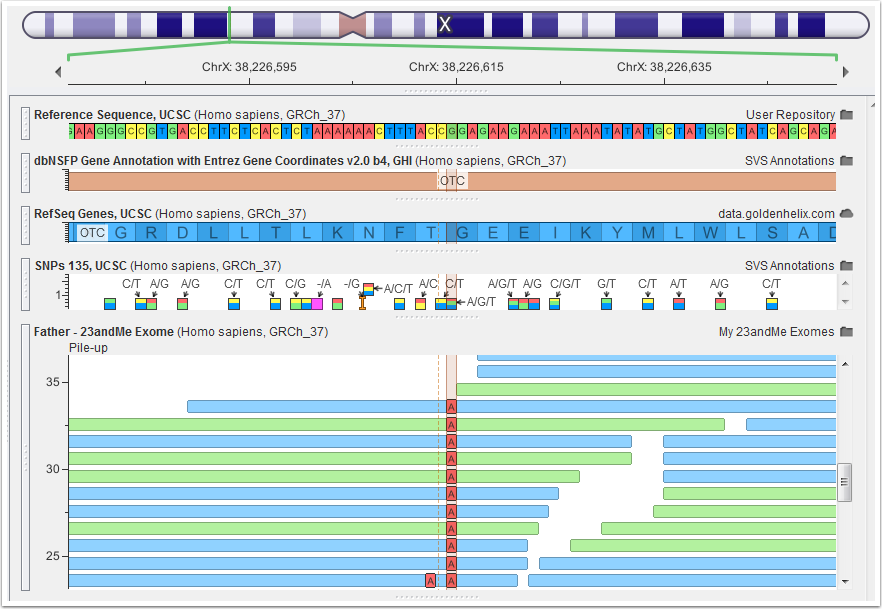
Analysis of pathogenic variant{credit}Gabe Rudy, Golden Helix{/credit}

An executive at DNA analysis company Golden Helix, Rudy was much better prepared than most to tackle this list.

He took the files he received for himself (as well as for his wife and son) and poured them into his own company’s software: the SNP and Variation Suite (SVS) and a freely available visualization and inspection tool called GenomeBrowse. Next, he began to assess the evidence behind his 151,000 variant calls and put them in their biological context.

Whereas whole-genome sequences cover all the DNA on all the chromosomes, exomes focus on the 2% or so of the genome that contains genes.  Exome sequencing aims to provide data for all protein-encoding genes, but only about three-quarters of genetic regions are profiled with enough accuracy for variants to be called confidently in a “research grade” (30×) exome. Even with “clinical grade” exomes, in which each DNA fragment is sampled 80 times or more, 5–15% of variants will still not be called variants. And those ‘low-coverage’ regions vary with each exome. As a result, Rudy had variants that had been called in his genome that he couldn’t compare with those in his wife and son.

Continue reading

Roche calls off Illumina takeover effort

Roche has backed off of its hostile takeover bid for Illumina. The move came after Illumina shareholders rebuffed Roche’s efforts to install board members favorable to a merger at the San Diego-based gene sequencing technology company’s 18 April annual meeting.

In a statement, Severin Schwan, CEO of Swiss-based Roche said, “We continue to hold Illumina and its management in very high regard but, with access only to public information about Illumina’s business and prospects, we do not believe that a price above Roche’s offer for Illumina of $51.00 per share would be in the interest of Roche’s shareholders.”

Roche had initially offered shareholders $44.50 in January, then raised its offer price to $51 in March. It was also trying to expand Illumina’s board and install favorable directors.

Illumina shareholders’ rejection of the measures was not surprising, as Illumina has fought the merger, and shareholder advisory firms had recommended against Roche’s advances.

“We are pleased that Roche has decided not to extend its inadequate offer to acquire Illumina and that we can now return our full focus to growing our business, making the most of the expanding opportunities in our space, and delivering superior results for our customers and stockholders,” Illumina CEO Jay Flatley said in a statement.

But Roche’s decision today that its offer for Illumina will expire on 20 April did surprise some analysts; most had predicted that Roche would be willing to extend or increase its offer even further to see the merger through, as the company did when it acquired Genentech and Ventana Medical Systems.

“I anticipated an extension of the offer at unchanged terms,” wrote analyst Martin Vögtli of Kepler Capital Markets in an email. “Initially, I thought that Roche is playing a tactical game,” perhaps hoping that Illumina would be more receptive to an offer later this year if it falters amid heavy competitive pressure and tightening government funding. “But after talking to Roche representatives I firmly believe now that this was the end of the bid.”

The move now raises pressure on Illumina to continue to dominate the sequencing market by both holding off its larger competitor, Life Technologies of Carlsbad, Calif., whose Ion Torrent technology debuted last year, and fending off companies with newer, potentially disruptive technologies such as UK-based Oxford Nanopore, which has said it will release its first commercial systems this year.

“Illumina will need to figure out longer term how to fight against Life’s much bigger sales channel,” wrote analyst David Ferreiro of New York-based Oppenheimer in an email. He notes that Illumina is under increasing pressure to cut the cost of both its machines and of their output: “Pricing will continue to be an issue, especially if Life’s Ion Proton delivers the $1000 genome,” as it has promised to do by the end of the year.

Vögtli says that Oxford’s potentially powerful platform may be one of the factors that dissuaded Roche from continuing to pursue the merger, along with Illumina’s resistance to a deal and with pressure from Roche shareholders not to pay too much for the acquisition.

“I think the move sends out a strong signal that cost discipline is high on the agenda and that Roche is no longer willing to overpay, especially for risky technologies,” Vögtli wrote.

Roche signaled that it may be interested in pursuing other sequencing companies, saying in its statement that it “will continue to consider options and opportunities to develop further its portfolio of businesses in order to expand its diagnostics leadership position.” But it is unclear who Roche could target; Life is a large company, while others are too new and have too little market share to be attractive targets for a firm whose main focus is bringing sequencing to the clinic.

The unraveling of the Roche bid heightens the competition in the race for the $1000 genome. Sequencing industry veterans had predicted that Illumina would become a much less innovative company under Roche’s management. But Illumina hasn’t clearly spelled out what technology will replace its current one under increasing pressure from other competitors that are just entering the market or on the immediate horizon. Illumina has a partnership with Oxford Nanopore, but it is for a separate technique than the one that Oxford itself is commercializing.

Analysts will be watching closely as Illumina announces its first quarter 2012 results on 23 April to see how well positioned the company is to profit from its continuing independence.

Follow Erika on Twitter at @Erika_Check.

DNA has limits, but so does study questioning its value, geneticists say

Scientists are irked over a paper claiming, as The New York Times reported on Monday, that “DNA’s power to predict illness is limited.”  “Yes,” geneticists have replied. “What else is new?”

Geneticists don’t dispute the idea that genes aren’t the only factor that determines whether we get sick; many  of them agree with that point. The problem, geneticists say, is not that the study, published on 2 April in Science Translational Medicine, arrived at a false conclusion, but that it arrived at an old, familiar one via questionable methods and is now being portrayed by the media as a new discovery that undermines the value of genetics. Here are the main criticisms of the new study and the resulting press coverage:

1. This study critiques the power of genomic medicine but does not contain any genome data. The paper is titled, “The predictive power of personal genome sequencing,” but it doesn’t include any sequence data. Instead, the authors analysed data on how often twins developed the same diseases. Because twins have very similar genomes but don’t always develop similar ailments, the authors, led by Bert Vogelstein and Victor E. Velculescu of the Johns Hopkins Kimmel Cancer Center in Baltimore, Maryland, assumed that the frequency with which the twins got the same illnesses reflects the power of their underlying genome sequences to determine their health. This assumption is not true (see point 4), and isn’t a good basis on which to dismiss the value of genome sequencing in the absence of data from large genome-sequencing studies, which are just now getting underway.

“Let’s fast-forward a year or two, when we’ve sequenced a million or two million people in whole-genome sequencing studies,” says Eric Topol, a cardiologist at Scripps Health in La Jolla, California, and author of The Creative Destruction of Medicine: How The Digital Revolution Will Create Better Health Care. “Then let’s see whether or not the predictive capacity is limited, or limited for certain conditions but not others.”

2. This study is beating a dead horse. Many other studies have already found that genes alone don’t predict a person’s risk for developing most diseases very well. They’ve also specifically questioned the value of commercial genetic tests that promise to reveal users’ risk for various illnesses. The new study doesn’t acknowledge any of the previous studies that have already arrived at the same answer and have done a better job of it, geneticists say (see point 3).

3. The mathematical model used in the study is unrealistic. Geneticists have developed a slew of mathematical models that try to predict how likely a person is to develop various diseases. Scientists debate how well these models work, but the models are largely based on how diseases actually behave in the real world. The Vogelstein–Velculescu model is not, say statisticians.

Vogelstein, Velculescu and their colleagues first developed a model that poses a theoretical idea of how diseases might behave. They then tested their model against data from twin studies. The model divides the universe of human genomes into 20 groups, or “genometypes.” Each of the genometypes encodes a certain disease risk and occurs with a certain frequency, but the authors don’t know how often different genometypes carrying various disease risks occur. To figure this out, they ask which combinations of disease risk and genometype frequency are realistic by comparing them to what they actually see in twin studies.

The problem with this approach, statistical geneticists say, is that it uses flawed data to test unrealistic assumptions. Geneticists know how often certain genetic risk variants for various diseases occur in the general population, and how much risk each of these variants confers. The new model ignores this information, and instead allows diseases to behave in ways that differ from how they behave in real life. “The particular parameters in the model don’t really correspond to anything in terms of real world behaviour of genetic risk variants,” explains Luke Jostins, a statistical geneticist at Cambridge University, UK. “This divorces the model from population-genetic plausibility, making the results potentially meaningless.”

By ignoring information about how diseases act in the real world, the new model also allows the authors to sidestep some controversial unanswered questions, such as whether standard models overestimate the genetic contribution to disease in twin studies. That could be a nice feature of the model, geneticists say. But because of the limitations of twin data, combined with the authors’ flawed analysis of these data (see point 4), there’s nothing in the paper to ground the new model in reality. If this were the first-ever paper to try to define the limits of genetic-disease prediction, it wouldn’t be convincing, says Jostins, who also blogs at Genomes Unzipped. “It’s very hard to interpret this model,” he says.

4. The study doesn’t correct for errors that can affect twin studies. The study assumes that genetics is the sole factor that determines whether two twins develop the same disease. But twins also grow up in a common environment, and the study doesn’t account for this, as the authors admit.

It’s also rare for both members of a twin pair to develop the same disease. So even a study such as this, which combines data from many different twin studies, suffers from a relatively small overall sample size of affected twins. That lowers the statistical reliability of its findings and introduces unpredictable errors into the study, Jostins says. Again, there are ways to account for for these errors, but this study doesn’t try to do that.

5. The media coverage of the study could weaken support for genetic research. Geneticists have lobbed some pretty heavy artillery at the Science Translational Medicine study, even though it claims to affirm what they already know. That’s because the new study has received more press coverage than your run-of-the-mill statistical genetics paper, and geneticists are concerned that the coverage has overblown the study’s conclusions in ways that could harm public support for science. “I don’t see the harm in telling the public yet again that there is no such thing as genetic determinism,” says Leonid Kruglyak a geneticist at Princeton University in New Jersey. “But I worry about the message being distorted to mean that genes have no value, or that genetic research is not worthwhile.”

Follow Erika on Twitter at @Erika_Check.

Geneticists debate what to tell patients about clinical genome sequences

Should patients undergoing genome sequencing be screened for a minimum set of disease-causing mutations, and should adults and children receive different types of genetic results?

Last night, geneticists debated these issues at the annual meeting of the American College of Medical Genetics (ACMG) in Charlotte, North Carolina. In an open forum at the meeting, the ACMG released a new policy statement on whole-genome sequencing and presented a report from a work group that is drawing up guidelines about what information should be given to patients about ‘secondary findings’ that turn up during the course of sequencing tests. Secondary findings are genetic mutations that predispose a patient to a disease but are unrelated to the initial reason for the patient’s decision to undergo sequencing.

The draft recommendations, which will not be finalized until this summer, are part of a larger debate over what geneticists should do about the ‘return-of-results’ issue, which focuses on how much information patients and research subjects should learn about their genomes. A project funded by the US National Institutes of Health recommended on 21 March that researchers who find disease-causing mutations in archived data should consider notifying research participants of the mutations. But the ACMG’s recommendations will focus specifically on patients being sequenced for clinical, rather than research, purposes.

Robert Green of Brigham and Women’s Hospital in Boston, who co-chairs the ACMG work group on secondary findings, says that the field must develop standards for informing patients about them.

“We don’t think it’s going to be a sustainable strategy for the evolving practice of genomic medicine to ignore secondary findings of medical importance,” he says.

These findings could arise in several ways. A child undergoing sequencing to diagnose the cause of a developmental delay might find out that he also has a genetic predisposition to certain cancers, or a cancer patient undergoing sequencing to guide personalized therapy might find out that she has a mutation linked to a treatable syndrome, called familiar hypercholesterolaemia, marked by high cholesterol.

The ACMG is considering recommending that clinical laboratories test patients’ genomes for a minimum set of mutations such as these that meet a checklist of criteria and are not detected by newborn screening programmes (see slides from the work group’s presentation here). High-penetrance mutations — those very likely to lead to disease — that cause treatable conditions would be high on the work group’s list, whereas genetic variants that only sometimes cause disease or are linked to untreatable conditions wouldn’t make the cut.

For instance, familial hypercholesterolaemia variants would be reported to patients. But variants of the gene that encodes apolipoprotein E, which is linked to an increased risk of developing Alzheimer’s disease, wouldn’t be reported, because these variants don’t actually predict that a patient will develop the disease, and because no early intervention has been shown to prevent Alzheimer’s disease.

Green said that some geneticists at last night’s forum were concerned that testing a standard set of genes would violate patients’ rights not to know about their genetic predispositions to disease.

And, although the current working group guidelines don’t distinguish between information given to children or adults, some geneticists argued at the meeting that it is inappropriate to tell children about predispositions to disease that will not affect them until they grow up.

Green says, however, that a patient’s right not to know about certain mutations could be protected, for instance, if a patient tells her doctor that she doesn’t want to know about them. And Green points out that a child’s genetic information will also be relevant to his or her parents. For instance, a child carrying a mutation that predisposes him or her to a certain cancer inherited it from at least one parent, who may not know that he or she is also likely to develop that cancer.

“That information sitting in our hands could save a parent’s life,” Green says.

The work group, co-chaired by Leslie Biesecker of the US National Human Genome Research Institute, is also proposing that clinical labs disclose their policies on reporting secondary findings to patients and doctors. The AMCG is still soliciting input on the draft guidelines and aims to deliver the finished recommendations in June.

Follow Erika on Twitter at @Erika_Check.
Illumina board rejects Roche offer

The board of directors of San Diego-based Illumina today rejected a takeover bid launched by Roche, based in Basel, Switzerland. The move by Illumina, which estimates that its machines produce 90% of the world’s genetic-sequencing output, was not surprising, given the company’s earlier moves to deter the offer.

Illumina’s board “unanimously determined that the $44.50 per share cash offer is grossly inadequate in multiple respects, dramatically undervalues Illumina and is contrary to the best interests of Illumina’s stockholders,” the company said in a press release.

Illumina said that the timing of Roche’s bid was opportunistic, coming weeks after Illumina announced weak third-quarter earnings and said that it would lay off 8% of its workforce, sending its stock price for a dive. The company’s stock had traded as high as US$79.40 in July 2011.

Illumina’s fourth-quarter 2011 earnings, announced today, were 6.3% higher than its earnings in the last quarter of 2010, although when one-time charges were accounted for, the company’s earnings fell 70%.

Illumina said that it was best positioned to capture growth in the sequencing industry in areas such as “molecular diagnostics, reproductive health, cancer management and industrial-end markets such as agricultural biotechnology, veterinary medicine and forensics.” It also said that the company has “a robust line of new products and services, which the Board believes will create powerful new tools in the armaments of researchers and healthcare providers.”

Illumina’s press release says that two new platforms, the HiSeq 2500 and MiSeq, will diversify the company’s customer base beyond genome research centres, but does not mention what platforms may eventually replace these, which employ Illumina’s current technology. Illumina faces serious competition in the race to deliver the $1000 genome from Life Technologies of Carlsbad, California, and its Ion Torrent platform.

Illumina has a commercialization agreement with the UK-based company Oxford Nanopore Technologies, which is developing a new genetic-sequencing platform. However, Oxford Nanopore said earlier this month that it will commercialize its own DNA sequencing system this year, and that this system will employ a separate analysis technique from the one licensed to Illumina. Oxford will present the first data readout using its technology on 17 February at the Advances in Genome Biology and Technology conference in Marco Island, Florida.

Other documents released by Illumina today give more details of the Roche offer and of a lawsuit filed on 30 January against the Illumina board by shareholders who favour the offer.

Roche did not immediately respond to the rejection of its offer. Roche succeeded in previous hostile takeover bids for the companies Ventana Medical Systems and Genentech by considerably raising its offer price.

Follow Erika on Twitter at @Erika_Check.

The $1,000 genome: are we there yet?

The race to the US$1,000 genome heated up today as Life Technologies, based in Carlsbad, California, announced that it will debut a new sequencing machine this year that will eventually be capable of decoding entire human genomes in a day for less than $1,000. The machine, called the Ion Proton, will be the successor to the Personal Genome Machine made by the company Ion Torrent, a subsidiary of Life Technologies.

Not to be outdone, Illumina, the present market leader based in San Diego, California, said that it will release its own genome-in-a-day contender, the HiSeq 2500, in the second half of this year. Unlike Life Technologies, which is asking customers to buy an entirely new machine, Illumina says that it will be able to upgrade existing customers’ HiSeq 2000 machines for a relatively low price.

So how will this battle of the sequencers shake out?

Ion Torrent is positioning its new machine as a lower-cost alternative to Illumina’s $690,000 HiSeq.  Scientists seem willing to believe that the Ion Proton will reach its speed goals, largely because Ion Torrent’s present model, the Personal Genome Machine, is performing well for its customers. That sets Ion Torrent apart from other companies with novel technologies that couldn’t deliver on their first-generation models, such as Pacific Biosciences of Menlo Park, California, which switched CEOs last week amid financial and legal hiccups, and the Cambridge, Massachusetts-based Helicos, which continues to struggle with lackluster demand for its machines.

Continue reading