
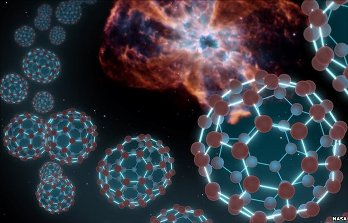
Astronomers have serendipitously found soccer-ball shaped carbon molecules in the nebula around a distant, white-dwarf star. The molecules are the largest ones ever found in space, and are part of a third type of carbon—the other two being graphite and diamond.
“We did not plan for this discovery,” said Jan Cami from the University of Western Ontario, London, Canada, who led the team making the discovery using NASA’s orbiting Spitzer infrared telescope. “But when we saw these whopping spectral signatures, we knew immediately that we were looking at one of the most sought-after molecules.” (NASA) The team published their findings in Science.
The molecules resemble the so-called ‘geodesic domes’ built by architect Buckminster Fuller, and are therefore called ‘buckyballs’ .
The buckyball molecule, C60, is about a nanometre across and consists of 60 carbon atoms arranged in a spherical, 3-D structure resembling a soccer ball. The molecule is exceptionally strong, and has chemical properties that scientists have long thought could make it useful in technological applications ranging from medicine to superconductivity and armor development.
The researchers also found the molecule C70, which is made up of 70 carbon atoms and is shaped like a stretched-out sphere. The two types of carbon together are estimated to make up about 3 percent of the carbon around the star, which is located in the planetary nebula Tc-1 in the constellation Ara, about 6,500 light-years away. (Space.com)
The data from the Spitzer infrared spectrometer matches laboratory spectral fingerprints of C60 perfectly.
The carbon buckyball was first discovered in the laboratory in 1985, also by accident, when researchers tried to simulate an ageing, carbon-rich star—in order to understand how carbon chains form in space. One of the scientists, Sir Harry Kroto, was awarded the Nobel prize in 1996 for the discovery.
“The experiments were set up to make those long carbon chains, and then something unexpected came out – these soccer ball type molecules, which just looked weird,” Cami told the BBC. “And now it turns out that those conditions that were deliberately created in a laboratory actually occur in space too – we just had to look in the right place.”
Image: NASA/JPL-Caltech/T. Pyle (SSC). Hubble image copyright NASA,
ESA and K. Noll (STScI)